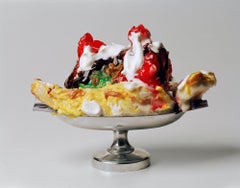
Banana Split
By Sharon Core
Located in New York, NY
From Sharon Core's series Oldenburgs, which playfully explores the sculptural work of Claes Oldenburg.
Category
2010s Color Photography
Materials
Archival Pigment
1974
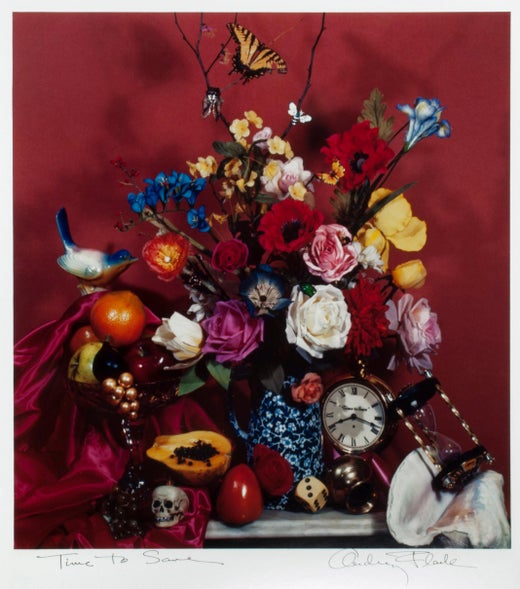
Audrey Flack became known for her Photorealist paintings and was one of the first artists to use photographs as the basis for painting. The genre, taking its cues from Pop art, incorporates depictions of the real and the regular, from advertisements to cars to cosmetics.
Flack's photography, prints and paintings bring in everyday household items like tubes of lipstick, perfume bottles, Hispanic Madonnas, and fruit. These inanimate objects often disturb or crowd the pictorial space, which is often composed as table-top still lives. Flack often brought in actual accounts of history into her Photorealist paintings, such as World War II (“Vanitas”) and Kennedy Motorcade. Women were frequently the subject of her Photorealist paintings.
In her neoclassical public sculpture of gilded bronze angels, muses, and goddesses, Flack mines Greek mythology, presenting the female in an array of archetypal guises. Though some critics have condemned her focus on the classical white female, Flack was an avowed feminist, and many of her sculptures seek to reinvent their subjects and source material.
Flack's early work in the 1950s was Abstract Expressionist; one such painting paid tribute to Franz Kline. Most influential among her early supporters was the Bauhaus artist Josef Albers. It was he who persuaded Flack to take up a scholarship at Yale with the mission of shaking up the institution's stuffy academic reputation.
The ironic kitsch themes in Flack's early work influenced Jeff Koons. But gradually, Flack became a New Realist and then evolved into Photorealism during the 1960s. Her move to the Photorealist style was in part because she wanted her art to communicate to the viewer. Flack was the first Photorealist painter to be added to the collection of the Museum of Modern Art in 1966. Between 1976 and 1978 she painted her “Vanitas” series, including the piece Marilyn.
In the early 1980s, Flack's artistic medium shifted from painting to sculpture. She described this shift as a desire for "something solid, real, tangible. Something to hold and to hold on to."
Flack discussed the fact that she was self-taught in sculpture. She incorporated religion and mythology into her sculpture rather than the historical or everyday subjects of her paintings. Her sculptures often demonstrate a connection to the female form, including a series of diverse, heroic women and goddess figures. These depictions of women differ from those of traditional femininity, but rather are athletic, older, and strong. As Flack described them: "They are real yet idealized... the 'goddesses in everywoman.'"
Flack had claimed to have found the Photorealist movement too restricting and later gained much of her inspiration from Baroque art. She was represented by the Louis K. Meisel Gallery and Hollis Taggart Galleries. Her work is held in the collections of museums around the world, including the Metropolitan Museum of Art, the Museum of Modern Art, the Solomon R. Guggenheim Museum, the Whitney Museum of American Art, the Allen Memorial Art Museum, and the National Gallery of Australia in Canberra, Australia.
Flack was awarded the St. Gaudens Medal from Cooper Union and the honorary Albert Dome professorship from Bridgeport University. She was an honorary professor at George Washington University, a visiting professor at the University of Pennsylvania, and taught and lectured extensively both nationally and internationally.
Find original Audrey Flack art for sale on 1stDibs.
(Biography provided by Lions Gallery)
Banana Split
By Sharon Core
Located in New York, NY
From Sharon Core's series Oldenburgs, which playfully explores the sculptural work of Claes Oldenburg.
Archival Pigment
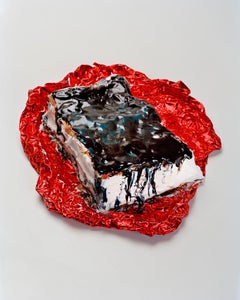
Ice Cream Sandwich
By Sharon Core
Located in New York, NY
From Sharon Core's series Oldenburgs, which playfully explores the sculptural work of Claes Oldenburg.
Archival Pigment
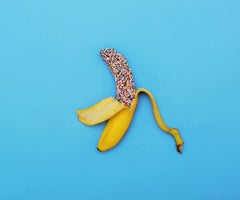
Sugar High
By Kimberly Genevieve
Located in New York, NY
ABOUT THIS PIECE: Sugar High is from Kimberly's "personal moments of happiness" series. LA based photographer Kimberly Genevieve is known for her use of col...
Photographic Paper
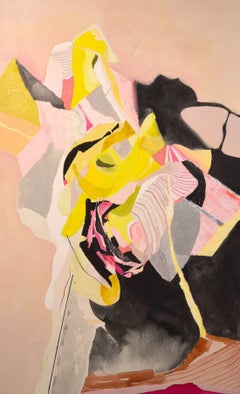
Sugar Rupture
By Jenny Day
Located in New Orleans, LA
Jenny Day is a painter who divides her time between Santa Fe, New Mexico and Tucson, Arizona. She paints a fragmented space, examining human demand and the effects of environmental d...
Enamel

Sugar, Sugar
By Pam Ingalls
Located in Denver, CO
Sugar, Sugar, 2020
Oil, Board
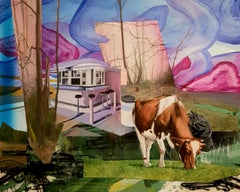
Fastfood
Located in Santa Monica, CA
A delightful new work by the artist
Paint
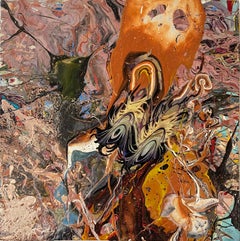
Layers of Exaggeration
Located in Saint Louis, MO
Robert Treece Layers of Exaggeration, 2012 Oil and collage 20 1/4 x 20 1/4 inches (51.4 x 51.4 cm)
Oil

Marbled Ice Cream
By Julia Stotz
Located in New York, NY
ABOUT THIS PIECE: Julia Stotz is a food and still life photographer that strives to capture the simple everyday moment with a sense of sincerity and wonder. Her food still-life’s sho...
Photographic Paper
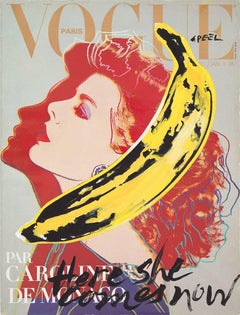
The Banana Issue
By Andrea Mary Marshall
Located in New York, NY
ABOUT THIS PIECE- Unframed Print FRAMING OPTIONS ALSO AVAILABLE: 23.5x17.9, edition of 25-This piece is available FRAMED with or without a mat in a white, black, natural, walnut, ...
Photographic Paper
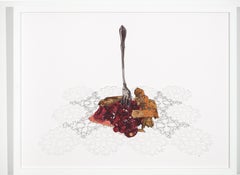
P.O.P. (Piece of Pie)
By Laura Tanner Graham
Located in New Orleans, LA
artwork dimensions (unframed): 15h x 20w inches LAURA TANNER GRAHAM’s drawings and installations are often discussed as part of the Southern Gothic literary tradition, sharing similar themes with authors such as Flannery O’Connor and Eudora Welty. As a Georgia native, Graham’s work seeks to understand the ways in which pattern and printed textiles are informed by social and political movements. Her narratives are tightly bound to antebellum traditions while balancing the changing ideals of the new generation of southern society. Graham received her MFA from the University of Illinois at Urbana-Champaign and a BFA from Florida State University. She has exhibited nationally in both group and solo exhibitions including the Weatherspoon Art Museum, the Ogden Museum of Southern Art, and the Athens Institute of Contemporary Art. She has also been a visiting artist at Tulane University and Valdosta State University. In 2016, Graham was awarded a fellowship and residency at the Ucross Foundation and the Vermont Studio Center. Graham is currently living and making work in Tucson, AZ. STATEMENT Firmly grounded in America’s expansive colonial history, my work interrogates how Southern culture has been idealized as “quintessential America” and the bedrock of traditional American values. Using my familiarity and position within Southern culture, I have created a new visual literacy to demonstrate how America’s nostalgia for tradition has been manipulated in an effort to isolate and disenfranchise. My drawings act as a visual archive of research that examines the consequences of American colonialism and addresses the sense of white fragility that continues to pervade Western culture. In the midst of widespread anxiety over the collective American identity, there has been a revival of many of the country’s unresolved historical battles, including contentious race relations, sexism, nativism, and an ever-growing wage gap. I employ the Americana aesthetic of the old South to parallel historical and contemporary acts of resistance to racial, economic, and gender diversity. Borrowing directly from the decorative arts, the meticulously hand-cut mylar and equally intricate drawing capitalizes on America’s propensity for nostalgia to lure the viewer into confronting injustices through the detached lens of that which has already happened. Through a combination of appropriated and invented imagery, my work contextually constructs contemporary accounts of systemic marginalization, executed under the guise of leisure, embellishment and luxury. The dense visual language invites investigation into the textured surfaces and leads the viewer to reflect on the social textures of contemporary culture while questioning their own complicity in current social constructs. Sourcing from period- specific textiles, turn-of-the-century advertisements, campaign posters, and found family photographs, the collaged images create a singular narrative composition that document the cyclical and systemic nature of marginalization in America. The methodology with which the drawings are constructed echoes historical layers of rules, regulations and hierarchies that are stitched into dominant white American myths. The resulting drawings are indexical in nature, recording the parallels between topics of current debate and 18th century Western expansionism. The disconnect between the delicate nature of the work and the unresolved cultural tensions that it reveals provides a visual record of the inconsistencies of American idealism. My current project explores the South as the embodiment of America’s pastoral traditions and values that are at the center of the “Make America Great Again” movement, a movement which has both exploited and is at odds with a social ideal that simultaneously proclaims itself to be “post- racial” and “post- gender” while identifying with a “pull-yourself-up-by-the-boot-straps” mentality. As one of the earliest colonized areas, the South is often portrayed as a region of racial and gender stability in the face of impending change. I am currently working with research institutions in the South to further understand how the architectural structure of the Southern plantation...
Mylar, Ink