Bar Harbor
By Judith Rothschild
Located in New York, NY
Edition: 5 or less. One of possibly 3 variants
Category
20th Century American Modern Abstract Prints
Materials
Monotype
1916
Bar Harbor
By Judith Rothschild
Located in New York, NY
Edition: 5 or less. One of possibly 3 variants
Monotype
American Landscape: Houses, Gardens and Trees
By Ralph Rosenborg
Located in New York, NY
Signed (at lower right): Ralph M. Rosenborg 1939; ll: 3/15 Woodcut
Woodcut
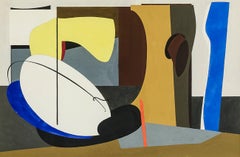
Untitled
By Charles Houghton Howard
Located in New York, NY
Charles Houghton Howard was born in Montclair, New Jersey, the third of five children in a cultured and educated family with roots going back to the Massachusetts Bay colony. His father, John Galen Howard, was an architect who had trained at M.I.T. and the École des Beaux-Arts in Paris and apprenticed in Boston with Henry Hobson Richardson. In New York, the elder Howard worked for McKim, Mead and White before establishing a successful private practice. Mary Robertson Bradbury Howard, Charles’s mother, had studied art before her marriage. John Galen Howard moved his household to California in 1902 to assume the position of supervising architect of the new University of California campus at Berkeley and to serve as Professor of Architecture and the first Dean of the School of Architecture (established in 1903). The four Howard boys grew up to be artists and all married artists, leaving a combined family legacy of art making in the San Francisco Bay area that endures to this day, most notably in design, murals, and reliefs at the Coit Tower and in buildings on the Berkeley campus. Charles Howard graduated from the University of California at Berkeley in 1921 as a journalism major and pursued graduate studies in English at Harvard and Columbia Universities before embarking on a two-year trip to Europe. Howard went to Europe as a would-be writer. But a near-religious experience, seeing a picture by Giorgione in a remote town outside of Venice, proved a life-altering epiphany. In his own words, “I cut the tour at once and hurried immediately back to Paris, to begin painting. I have been painting whenever I could ever since” (Charles Howard, “What Concerns Me,” Magazine of Art 39 [February 1946], p. 63). Giorgione’s achievement, in utilizing a structured and rational visual language of art to convey high emotion on canvas, instantly convinced Howard that painting, and not literature, offered the best vehicle to express what he wanted to say. Howard returned to the United States in 1925, confirmed in his intent to become an artist. Howard settled in New York and supported himself as a painter in the decorating workshop of Louis Bouché and Rudolph Guertler, where he specialized in mural painting. Devoting spare time to his own work, he lived in Greenwich Village and immersed himself in the downtown avant-garde cultural milieu. The late 1920s and early 1930s were the years of Howard’s art apprenticeship. He never pursued formal art instruction, but his keen eye, depth of feeling, and intense commitment to the process of art making, allowed him to assimilate elements of painting intuitively from the wide variety of art that interested him. He found inspiration in the modernist movements of the day, both for their adherence to abstract formal qualities and for the cosmopolitan, international nature of the movements themselves. Influenced deeply by Surrealism, Howard was part of a group of American and European Surrealists clustered around Julien Levy. Levy opened his eponymously-named gallery in 1931, and rose to fame in January 1932, when he organized and hosted Surrealisme, the first ever exhibition of Surrealism in America, which included one work by Howard. Levy remained the preeminent force in advocating for Surrealism in America until he closed his gallery in 1949. Howard’s association with Levy in the early 1930s confirms the artist’s place among the avant-garde community in New York at that time. In 1933, Howard left New York for London. It is likely that among the factors that led to the move were Howard’s desire to be a part of an international art community, as well as his marriage to English artist, Madge Knight...
Paper, Gouache, Graphite
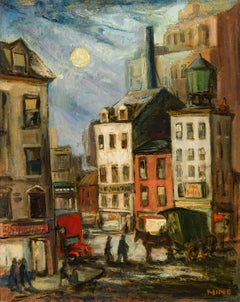
Below South Ferry
By Franz Kline
Located in New York, NY
Signed (at lower right): KLINE EXHIBITED: Pratt Institute, Brooklyn, New York, November 1–30, 1960, The November Show, as “Moonlight in Lower Manhattan” // Pratt Institute, Brooklyn...
Oil, Board
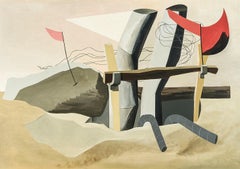
Excavation
By Charles Houghton Howard
Located in New York, NY
Charles Houghton Howard was born in Montclair, New Jersey, the third of five children in a cultured and educated family with roots going back to the Massachusetts Bay colony. His father, John Galen Howard, was an architect who had trained at M.I.T. and the École des Beaux Arts in Paris, and apprenticed in Boston with H. H. Richardson. In New York, the elder Howard worked for McKim, Mead and White before establishing a successful private practice. Mary Robertson Bradbury, Charles’s mother, had studied art before her marriage. John Galen Howard moved his household to California in 1902 to assume the position of supervising architect of the new University of California campus at Berkeley and to serve as Professor of Architecture and the first Dean of the School of Architecture (established in 1903). The four Howard boys grew up to be artists and all married artists, leaving a combined family legacy of art making in the San Francisco Bay area that endures to this day, most notably in design, murals and reliefs at the Coit Tower and in buildings on the Berkeley campus. Charles Howard graduated from the University of California at Berkeley in 1921 as a journalism major, and pursued graduate studies in English at Harvard and Columbia Universities before embarking on a two-year trip to Europe. Howard went to Europe as a would-be writer. But a near-religious experience, seeing a picture by Giorgione in a remote town outside of Venice, proved a life-altering epiphany. In his own words, “I cut the tour at once and hurried immediately back to Paris, to begin painting. I have been painting whenever I could ever since” (Charles Howard, “What Concerns Me,” Magazine of Art 39, no. 2 [February 1946], p. 63). Giorgione’s achievement, in utilizing a structured and rational visual language of art to convey high emotion on canvas, instantly convinced Howard that painting, and not literature, offered the best vehicle to express what he wanted to say. Howard returned to the United States in 1925, confirmed in his intent to become an artist. Howard settled in New York and supported himself as a painter in the decorating workshop of Louis Bouché and Rudolph Guertler, where he specialized in mural painting. Devoting spare time to his own work, he lived in Greenwich Village and immersed himself in the downtown avant-garde cultural milieu. The late 1920s and early 1930s were the years of Howard’s art apprenticeship. He never pursued formal art instruction, but his keen eye, depth of feeling, and intense commitment to the process of art making, allowed him to assimilate elements of painting intuitively from the wide variety of art that interested him. He found inspiration in the modernist movements of the day, both for their adherence to abstract formal qualities and for the cosmopolitan, international nature of the movements themselves. Influenced deeply by Surrealism, Howard was part of a group of American and European Surrealists clustered around Julien Levy. Levy opened his eponymously-named gallery in 1931, and rose to fame in January 1932, when he organized and hosted Surrealisme, the first ever exhibition of Surrealism in America, which included one work by Howard. Levy remained the preeminent force in advocating for Surrealism in America until he closed his gallery in 1949. Howard’s association with Levy in the early 1930s confirms the artist’s place among the avant-garde community in New York at that time. In 1933, Howard left New York for London. It is likely that among the factors that led to the move were Howard’s desire to be a part of an international art community, as well as his marriage to English artist, Madge Knight...
Canvas, Oil
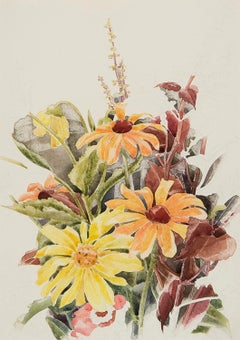
Garden Flowers
By Charles Demuth
Located in New York, NY
Charles Demuth was one of the most complex, talented, and deeply sensitive artists of the American modern period. Whether he was painting floral still lifes, industrial landscapes, or Turkish bathhouses, art was, for Demuth, fraught with personal meaning. A fixture of the vanguard art scene in New York, Demuth navigated the currents of Modernism, producing some of the most exquisite watercolors and original oil paintings in twentieth-century American art. Demuth was born in Lancaster, Pennsylvania, the only child of a well-to-do family. He had an awkward and introverted childhood shaped by a childhood illness, Perthes, a disease of the hip that not only left him permanently lame, but, as part of the “cure,” bedridden for two years in the care of his mother. This long period of incapacitation had a deep impact on Demuth, who came to see himself as an invalid, an outsider who was different from everyone else. It was perhaps during this period of indoor confinement that his keen interest in art developed. Several relatives on his father’s side had been amateur artists, and, following his convalescence, his mother encouraged his artistic pursuits by sending him to a local painter for instruction. The majority of his early pictures are of flowers, a subject for which Demuth maintained a lifelong passion. Following high school, Demuth enrolled at the Drexel Institute of Art in Philadelphia, a school renowned for its commercial arts program. He advanced through the program rapidly, and, in 1905, at the encouragement of his instructors, he began taking courses at the Pennsylvania Academy of the Fine Arts. The two leading teachers then at the Academy were William Merritt Chase and Thomas Anshutz. Anshutz, himself a former student of Thomas Eakins, was well liked by his students, and is best known as the teacher of Robert Henri, John Sloan, and several of the other artists of the Ashcan School. Demuth, too, adopted a similar idiom, working in a controlled, realistic manner while at the Academy, where he remained until 1910. In 1907, Demuth made his first trip to Europe, staying in Paris. He spent time on the periphery of the art scene composed of the numerous American artists there, including John Marin and Edward Steichen. He returned to Philadelphia five months later, and immediately resumed courses at the Academy. Despite his introduction to advanced modern styles in Europe, Demuth’s work of this period retains the academic style he practiced before the trip. It wasn’t until he had summered at New Hope, Pennsylvania, in 1908 and 1911, that his style began to evolve. New Hope was a prominent American Impressionist art colony whose members were largely affiliated with the Pennsylvania Academy. Demuth dropped the conservative tone of his style and adopted a freer and more colorful palette. Although he remained based in Philadelphia, Demuth frequently went to New York during this period. Many of the same American artists of the Parisian art scene Demuth had encountered on his earlier European trip now formed the nucleus of New York’s avant-garde, which centered around Alfred Stieglitz’s 291 gallery. It wasn’t long before Demuth began to apply modernist-inspired strategies to his work. He was particularly influenced by the watercolor work of John Marin, also a former student of Anshutz, whose bold use of color in the medium Demuth freely adapted into looser washes of color. In 1912, Demuth again left for Paris, this time studying in the Académie Moderne, Académie Colorossi, and Académie Julian. In Paris Demuth met the American modernist Marsden Hartley. Hartley, a principal figure in the expatriate art circle, acted as a mentor to Demuth, and introduced him to the wide array of modern styles currently practiced in Europe. Hartley also introduced Demuth to many of the members of the Parisian avant-garde, including Gertrude Stein. Demuth was an aspiring writer, and he spent many hours in conversation with Stein. He wrote extensively during this period, and published two works shortly after his return to America. He also developed an interest in illustrating scenes from literary texts. From 1914 to 1919, Demuth produced a series of watercolors of scenes from books such as Emile Zola’s Nana and Henry James’s The Turn of the Screw. Upon his return to America, Demuth settled in New York. In 1914, Demuth had his first one-man show at Charles Daniel’s gallery, which promoted emerging modern American artists, including Man Ray, Rockwell Kent, Yasuo Kuniyoshi, Stuart Davis, and Max Weber. Demuth drew closer to the artistic vanguard in New York, becoming friends with many in the Stieglitz and Daniel circles, including Georgia O’Keeffe, Marcel Duchamp, Carl Van Vechten, and Edward Fiske. New York’s cosmopolitan atmosphere and active nightlife appealed greatly to Demuth. In a sketchy style well suited to watercolor, he painted many vaudeville and circus themes, as well as nightclub, café, and bathhouse scenes. Often with Duchamp, Demuth took part in an urban subculture replete with nightclubs, bars, drugs, and sexual permissiveness, which, for a homosexual artist like himself, allowed room for previously unattainable personal expression. Demuth’s pictures of sailors, bathhouses, and circus performers embody a sensual and sexual undercurrent, expressing the artist’s sense of comfort and belonging in the bohemian subculture of New York. Simultaneously, Demuth deepened his interest in floral pictures, painting these almost exclusively in watercolor. His style evolved from the broad color washes of his earlier pictures to more spare, flattened, and sinuous compositions, inspired by the drawings of Aubrey Beardsley and other artists of the Aesthetic Movement. Demuth’s flower watercolors are moody and atmospheric, sensuous and elegant, introspective and yet full of expressive power. Moreover they are beautiful, and are unequivocally among the finest still lifes in American art. Despite numerous subsequent artistic undertakings that led him in a variety of directions, Demuth never stopped painting flower pictures, ultimately adding fruits and other still-life objects to his repertoire. In 1916, Demuth began to develop a style later known as Precisionism, a form of landscape painting infused with Cubism, in which space is divided into precisely drawn geometric regions of color. Demuth first began to paint the landscape in an appropriated Cubist mode while on a trip with Hartley to Bermuda. In these early landscapes, in which the curvilinear forms of trees intersect the geometrically articulated architectural forms, Demuth explored ideas that shaped the future development of modernism in America. The full realization of Demuth’s explorations came after his return to America in 1917, when he turned his attention to industrial subjects. These works derive from a “machine aesthetic,” espoused by New York artists such as Francis Picabia, Joseph Stella, Albert Gleizes, and Duchamp, by which artists viewed machines as embodying mystical, almost religious significance as symbols of the modern world. Rather than painting the skyscrapers and bridges of New York as did most of his like-minded contemporaries, Demuth returned to his home town of Lancaster, where he painted factories and warehouses in a Precisionist idiom. The titles for these pictures are often contain literary references, which serve as clues for the viewer to aid in the decoding of the artist’s meaning. In 1923, Demuth planned a series of abstract “poster portraits” of his friends and contemporaries in the New York art and literary scene. In these “portraits,” Demuth combined text and symbolic elements to evoke the essential nature of his sitters’ distinguishing characteristics. In this fashion, he painted portraits of such artists as Georgia O’Keeffe, John Marin, and Arthur Dove. His most famous poster portrait, I Saw the Figure 5 in Gold...
Paper, Watercolor
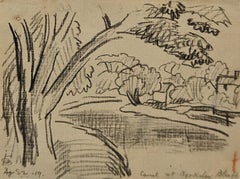
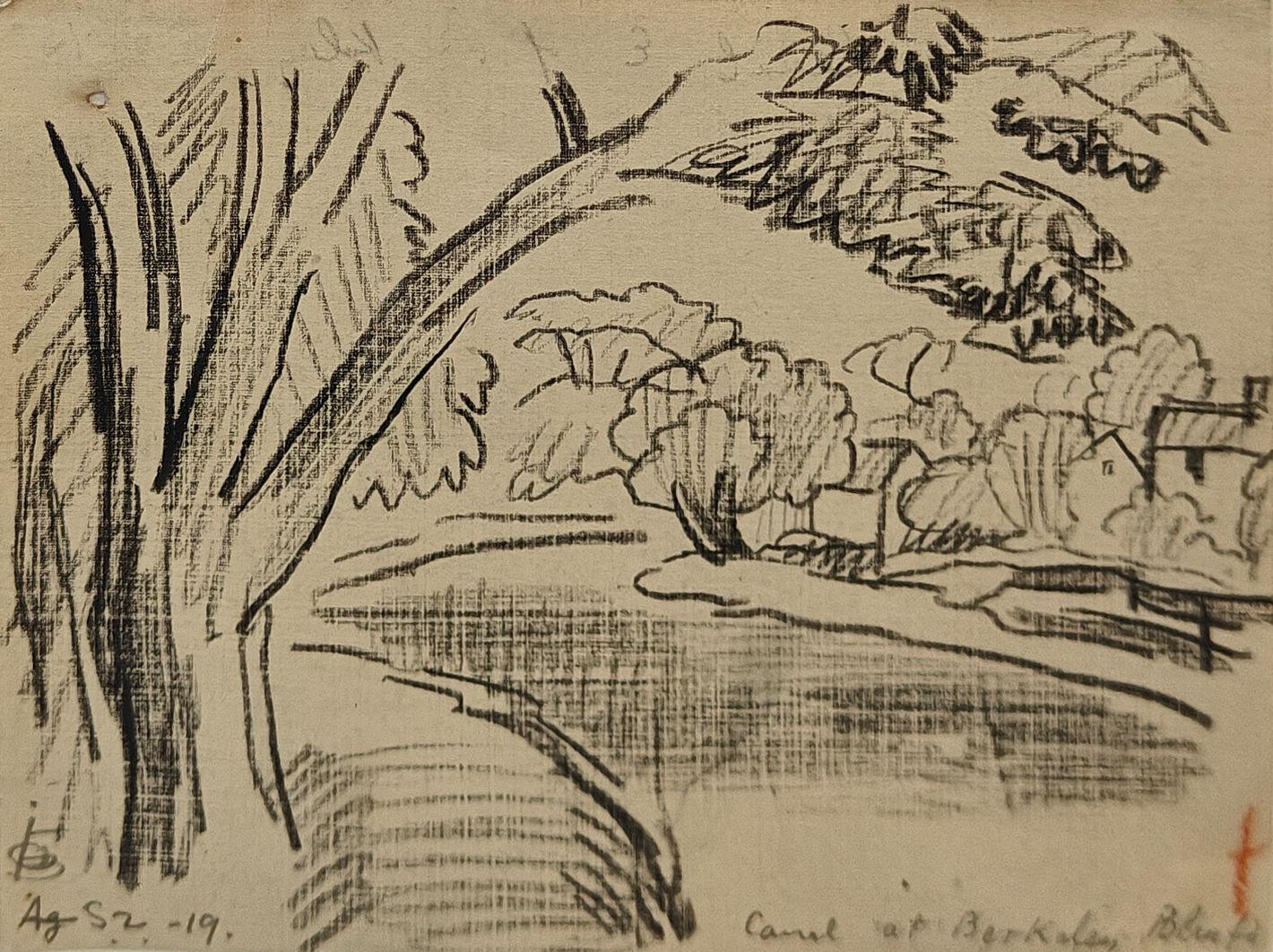
"Morris Canal E of Berkley Bridge 2-19 (Bloomfield NJ)" Oscar Bluemner
By Oscar Bluemner
Located in New York, NY
Oscar Bluemner Morris Canal E of Berkley Bridge 2-19 (Bloomfield NJ), 1919 Signed, Titled, Dated, and Monogrammed Graphite on Paper 4 1/4 x 5 1/2 inches The son and grandson of arc...
Paper, Graphite
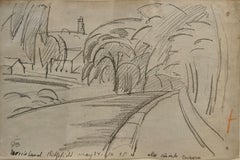
"Morris Canal, Ridgefield, NJ MAY 24-14" Oscar Bluemner, Modernist Urban Scene
By Oscar Bluemner
Located in New York, NY
Oscar Bluemner Morris Canal, Ridgefield, NJ MAY 24-14, 1914 Signed, Titled, Dated, and Monogrammed Graphite on Paper 5 1/8 x 7 7/8 inches Provenance The artist Estate of the artist ...
Paper, Graphite
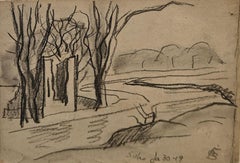
"SoHo Canal, From Hill, January 30, 1919" Oscar Bluemner, Early Modernism
By Oscar Bluemner
Located in New York, NY
Oscar Bluemner SoHo Canal, From Hill, January 30, 1919, 1919 Signed, Titled, Dated, and Monogrammed lower left Graphite on Paper 4 1/4 x 6 inches Provenance The artist Estate of the...
Paper, Graphite
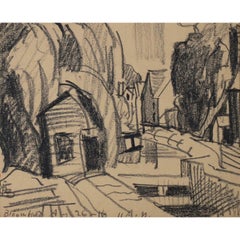
American modernist drawing of Bloomfield, NJ by Oscar Bluemner, dated 1916
By Oscar Bluemner
Located in Colfax, CA
Architectural study by pioneering American modernist Oscar Bluemner dated 1916. Titled : Bloomfield - Aug 26-16 Dated 1916. Monogrammed lower left. Charcoal on paper. Measures 4.5 x ...
Paper, Charcoal
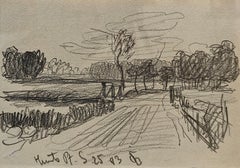
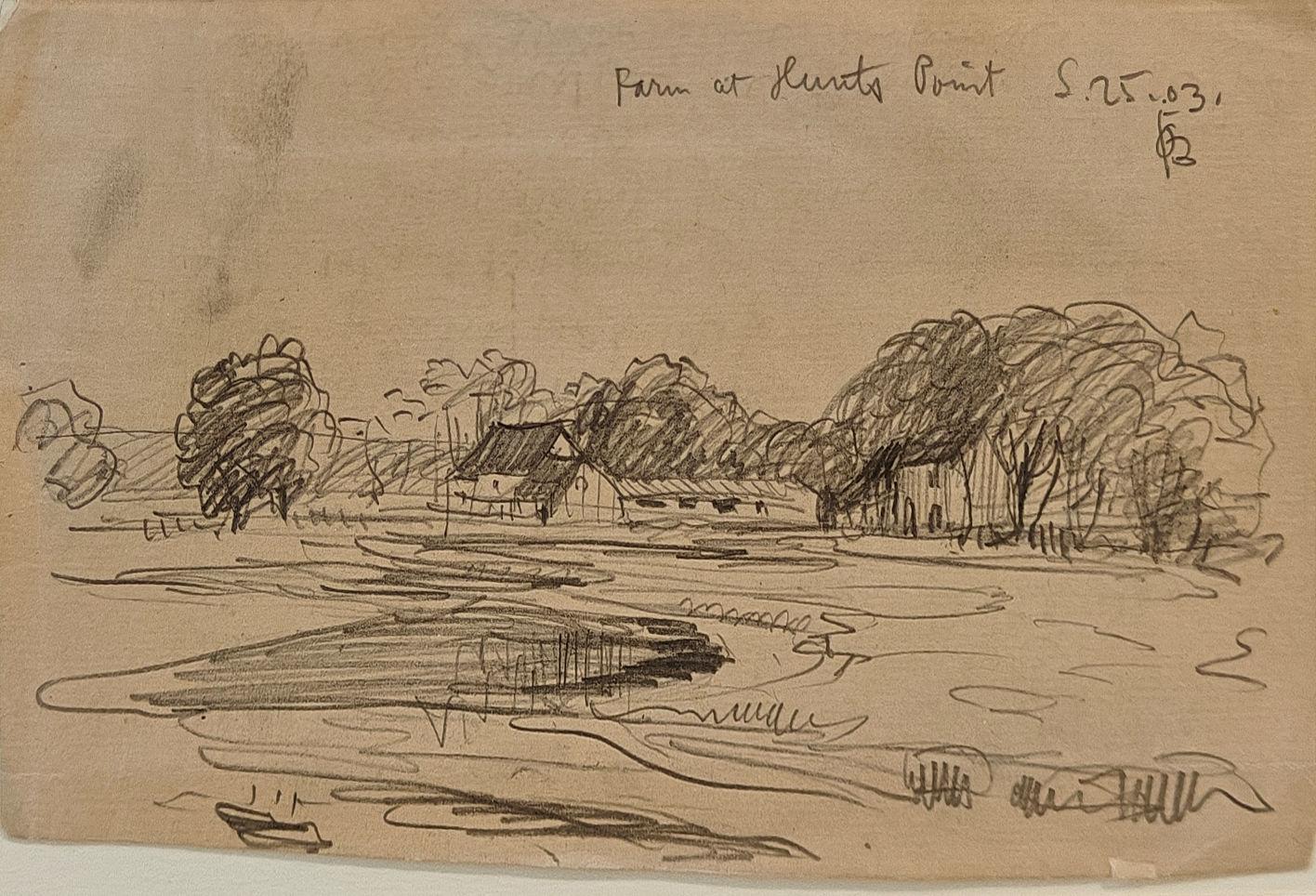
"View At Hunts Point, Long Island Hunt Pt. S25.03" Oscar Bluemner, Modernism
By Oscar Bluemner
Located in New York, NY
Oscar Bluemner View At Hunts Point, Long Island Hunt Pt. S25.03, 1903 Signed, Titled, Dated, and Monogrammed lower left Graphite on Paper 4 3/8 x 7 inches The son and grandson of a...
Paper, Graphite
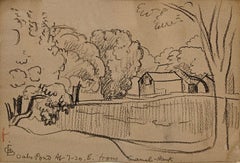
"Oaks Pond, E. from Canal Bank, Aug 7-20" Oscar Bluemner, Modernism, Barn
By Oscar Bluemner
Located in New York, NY
Oscar Bluemner Oaks Pond, E. from Canal Bank, Aug 7-20, 1920 Signed, Titled, Dated, and Monogrammed lower left Graphite on Paper 5 x 7 inches Provenance The artist Estate of the art...
Paper, Graphite