Want more images or videos?
Request additional images or videos from the seller
1 of 9

Carl Haag
Mashallah! by Carl Haag

1870

$44,500
£33,634.22
€39,341.74
CA$63,186.33
A$64,282.36
CHF 36,937.56
MX$773,000.46
NOK 431,239.72
SEK 433,821.32
DKK 294,099.97

About the Item

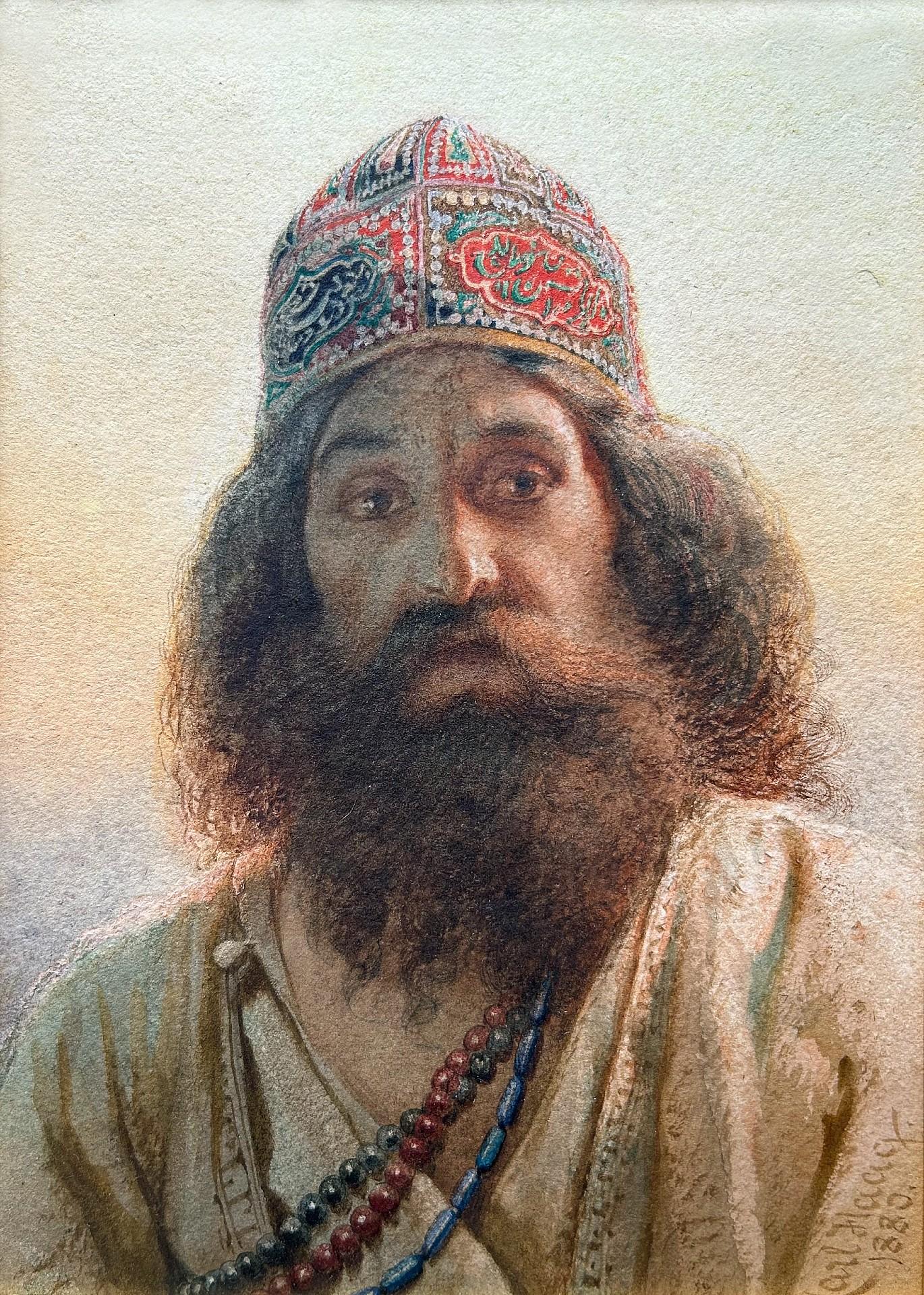
Carl Haag 1820–1915 German Mashallah! Signed and dated “Carl Haag / 1870” (lower right) Titled and signed “Mash: Allah! / by Carl Haag” (en verso) Watercolor heightened with white A commanding and highly evocative work, Mashallah! stands as an exceptional example of Carl Haag’s Orientalist production. Executed in 1870, shortly after the artist’s extensive travels through the Middle East, this large-scale watercolor reflects Haag’s firsthand engagement with the region and his remarkable ability to translate lived experience into images of enduring visual power. Rich in atmosphere and cultural resonance, the work captures the contemplative dignity that defines Haag’s finest portraits. The composition centers on a male figure dressed in traditional Middle Eastern attire, rendered with striking presence. His calm expression and distant gaze convey introspection, while the soft modeling of the face demonstrates Haag’s refined understanding of anatomy and character. A vivid green hookah held delicately in his hand introduces a moment of chromatic contrast against the muted earth tones of the palette. Heightened with white and subtly scratched to create texture, the surface shimmers with delicate detail. Carl Haag was among the most accomplished Orientalist painters of the 19th century and remains celebrated for his meticulous draftsmanship and mastery of watercolor technique. Bavarian-born and later naturalized as a British subject, Haag trained in Nuremberg and Munich before settling in England in 1847. His election to the Royal Society of Painters in Water Colours—first as an Associate in 1850 and then as a full member in 1853—confirmed his standing among Britain’s artistic elite, a reputation reinforced by his patronage from Queen Victoria. Between 1858 and 1860, Haag undertook extended journeys through Egypt, Jerusalem, Lebanon and Syria, often working directly from life. These travels fundamentally shaped his oeuvre, grounding his Orientalist imagery in direct observation rather than romantic invention. The title Mashallah!—an Arabic expression meaning “God has willed it,” is commonly used to express admiration, reverence or gratitude. Works of this scale and quality are among Haag’s most sought-after compositions, prized for their authenticity, technical finesse and poetic restraint. Painted 1870 Paper: 19 5/8" high x 13 5/8" wide (49.85 x 34.61 cm) Frame: 35 1/2" high x 27 1/2" wide x 2 1/2" deep (90.17 x 69.85 x 6.35 cm) Provenance: Private Collection, London M.S. Rau, New Orleans
  • Creator:
    Carl Haag (1820 - 1891, German)
  • Creation Year:
    1870
  • Dimensions:
    Height: 35.5 in (90.17 cm)Width: 27.5 in (69.85 cm)Depth: 2.5 in (6.35 cm)
  • Medium:
  • Movement & Style:
  • Period:
  • Condition:
  • Gallery Location:
    New Orleans, LA
  • Reference Number:
    Seller: 32-20601stDibs: LU18617593342

More From This Seller

View All
The Musician

The Musician

Located in New Orleans, LA

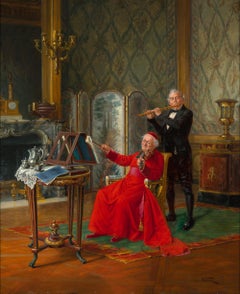
Alfred Weber 1859-1922 I Swiss The Musician Signed “Alfred Weber” (lower left) Oil on panel This work by Swiss ecclesiastical genre painter Alfred Weber, best known for his humorous and meticulously detailed paintings, features a cardinal enjoying his leisure time. Weber's talent for rendering opulent interiors and his keen sense of comic narrative are evident in this painting. The cardinal, looking blissfully content, sits in his lavish living space playing the violin, accompanied by a flutist. Alfred Charles Weber...

Category

Late 19th Century Academic Figurative Paintings

Materials

Oil, Panel

An Amusing Thought by Georges Croegaert

An Amusing Thought by Georges Croegaert

By Georges Croegaert

Located in New Orleans, LA

Georges Croegaert 1848-1923 Belgian An Amusing Thought Signed "Georges Croegaert Paris" (lower left) Oil on panel This oil on panel by Belgian artist Georges Croegaert is a rich ...

Category

19th Century Academic Figurative Paintings

Materials

Oil, Panel

The Connoisseur By Georges Croegaert

The Connoisseur By Georges Croegaert

By Georges Croegaert

Located in New Orleans, LA

Georges Croegaert 1848-1923 Belgian The Connoisseur Signed "Georges Croegaert Paris" (lower right) Oil on panel A Cardinal peers through a magnifying glass at gilded treasures in...

Category

19th Century Academic Figurative Paintings

Materials

Oil, Panel

Une charmeuse by Emile Cambiaggio

Une charmeuse by Emile Cambiaggio

Located in New Orleans, LA

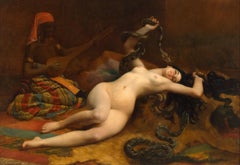
Emile Cambiaggio 1857-1930 Italian Une charmeuse (A charmer) Singed "E. Cambiaggio" (lower right) Oil on canvas This magnificent painting by Émile Cambiaggio stands as the artist...

Category

19th Century Academic Nude Paintings

Materials

Canvas, Oil

Portrait of Napoléon II

Portrait of Napoléon II

Located in New Orleans, LA

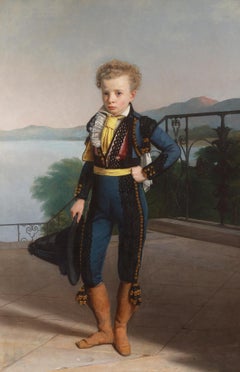
The son of the legendary Napoléon Bonaparte, Napoléon François Charles Joseph, takes a spirited stance in this remarkable oil painting attributed to the Austrian portraitist Johann Peter Krafft. Believed to have been exhibited at the Exposition Universelle of 1900 in Paris, this work stands as a testament to both Austrian artistry and the legacy of one of the most powerful men in history. After Napoléon's exile to the island of Elba in 1814, his son was seen by many of his supporters as the last hope of France. The child was named the ruler of half of Europe, holding the titles of Napoléon II...

Category

Early 19th Century Academic Portrait Paintings

Materials

Canvas, Oil

Henry Bowles Howard, 12th Earl Of Suffolk And 5th Earl Of Berkshire

Henry Bowles Howard, 12th Earl Of Suffolk And 5th Earl Of Berkshire

Located in New Orleans, LA

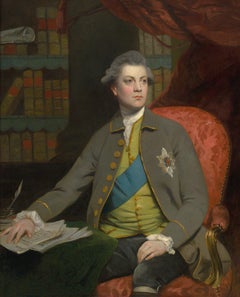
Sir Joshua Reynolds 1723-1792 British Sir Henry Bowles Howard, 12th Earl of Suffolk and 5th Earl of Berkshire Oil on canvas Sir Joshua Reynolds is unequivocally considered the most important English portraitist of the 18th century who was instrumental in adapting the Grand Manner style in the portrait genre. In fact, when the Royal Academy was founded in 1768, Reynolds was elected its first President, setting the precedent of quality for which all other portraitists would strive. Reynolds's portrait of Henry Bowles Howard, 12th Earl of Suffolk, showcases his genius in the genre and mastery over the medium. Reynolds’s portrait of the Earl expertly invokes classical values with strong lighting, rich colors and expert attention to detail to help underscore the prominence and revered echelon of the sitter. Howard was an esteemed British politician and Knight of the Garter. He served as Secretary of State for the Northern Department from 1771 to 1779, and he played a key role in utilizing mercenaries during the American Revolution and safeguarding Sweden's independence. The portrait employs Reynolds's signature style to render Howard rightfully as a gentleman of distinction. Captured seated in a stately library, the Earl appears learned and austere as he places one hand upon a stack of important documents and looks wistfully into the distance. Reynolds makes these compositional choices decisively, as the seated position gives Howard a weighty appearance of importance and the semi-profile turn captures his countenance at an attractive angle that highlights his strong, masculine features. The work draws on the classical conventions of Greek and Roman art and the Italian Renaissance masters, anchoring the nobleman in a history of refinement. Everything from his strong yet welcoming expression to his pale face enlivened by a rush of blood to the cheeks presents the picture of a strong, vital and powerful leader. As the first president of the Royal Academy in London, Reynolds’s commissions raised the status of an artist in Britain during the Romantic period and also established the portrait as an esteemed high art genre that garnered equal import to the history paintings that reigned supreme in decades prior. Today, Reynolds’s works grace the walls of the most important museums in the world, including the Louvre, the Metropolitan Museum of Art, and the National Gallery in London, among others. Circa 1770 Canvas: 50 1/2" high x 40 1/4" wide Framed: 61" high x 52 1/2" wide x 3 1/2" deep Provenance: Sir Henry Howard, 12th Earl of Suffolk and 5th Earl of Berkshire, 1739-1779 His mother, Lady Mary Howard, née Finch, Lady Andover, d. 1803 Acquired by descent to her daughter, Frances, and her husband Richard Bagot (later Howard) Acquired by descent to their daughter, Mary (1784-1877), and her husband Col. Fulke Greville Upton (later Howard), d. 1846 Acquired by descent to Lieutenant Colonel H.R.G. Howard Sale, Christie's, London, March 24, 1961, no. 29 Julius Weitzner, London and New York Sale, Paris, Musée Galliéra, December 7, 1965, no. 165 Newhouse Galleries, New York, NY Mr. and Mrs. F. Howard Walsh, Fort Worth, Texas, 1966 Walsh Family Art Trust Private collection, Oregon M.S. Rau, New Orleans Exhibited: British Institution, London, 1844, no. 130, loaned by the Hon. Fulke Greville Howard. South Kensington, "Second special exhibition of National Portraits," 1867, no. 478, lent by the Hon. Mrs. Greville. Agnew's, London, 1903, no. 17. Literature: Algernon Graves and W. V. Cronin, A History of the Works of Sir Joshua Reynolds, P.R.A., vol. 3 (London, 1899), p. 945. David Mannings...

Category

18th Century Other Art Style Portrait Paintings
Materials

Canvas, Oil

You May Also Like

A pair of Orientalist portraits

A pair of Orientalist portraits

Located in Stoke, Hampshire

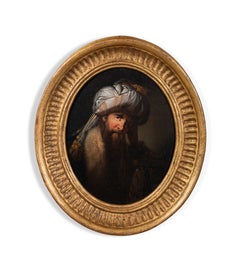
Edward Alcock (1745-1788) A pair of portraits of Orientalist subjects Both signed 'E. Alcock' Oil on copper Framed size 9 x 8 in Edward Alcock (active 1846–1905) is best known for h...

Category

18th Century Old Masters Portrait Paintings

Materials

Oil

Characters

Characters

Located in Genève, GE

Work on paper Dimensions of the passepartout: 38.3 x 48.3cm

Category

Early 20th Century Figurative Drawings and Watercolors

Materials

Crayon

Half-length portrait of a Pharisee - In the shadow of betrayal -

Half-length portrait of a Pharisee - In the shadow of betrayal -

Located in Berlin, DE

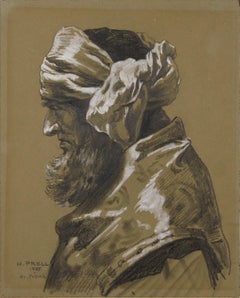
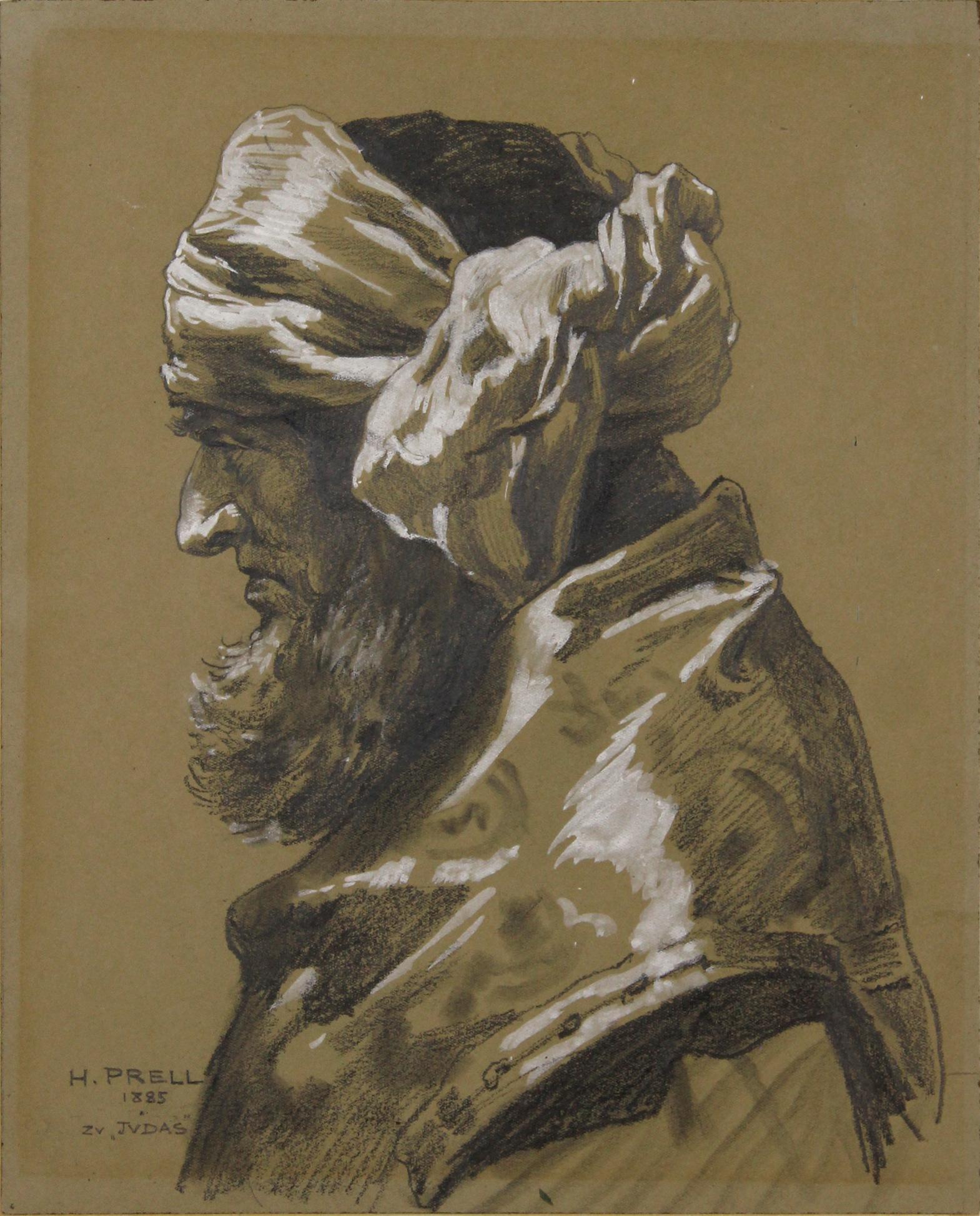
Hermann Prell (1854 Leipzig - 1922 Dresden-Loschwitz). Half-length portrait of a Pharisee, 1885. Sketch for the right-hand figure in the painting Judas Iscariot, 1886. Pencil drawing heightened with opaque white and black chalk on beige-grey wove paper (papier vélin), 34 x 27.8 cm (visible size), 52 x 45 cm (mount), signed, dated and inscribed "H. PRELL 1885 zu 'Judas'". Minor browning, collection stamp on the reverse. - In the shadow of betrayal - About the artwork This painting is the sketch for the head of the Pharisee offering the coins to Judas in one of Herrmann Prell's major works, the painting Betrayal of Judas, completed in 1886. The painting belongs to the Staatliche Kunstsammlungen Dresden and is illustrated in Adolf Rosenberg: Prell, Bielefeld and Leipzig 1901, p. 21 (Fig. 19). It is especially highlighted in Thieme-Becker (vol. 27, p. 376). Hermann Prell, Betrayal of Judas, 1886 The monumental head, which fills the picture and is distinguished by its ornamented robe, is almost a lost profile, which in the executed painting is justified by the Pharisee's turning towards Judas. Despite the fact that the sitter withdraws from the viewer by turning away, it was necessary to artistically elaborate the motivation for the purchase of one of Christ's disciples, which is why the drawing focuses on the expression of the face, while the 'accessories' are treated in a more summary manner. In characterising the face, Hermann Prell performs a balancing act: since the Pharisee, despite his destructive actions, is an actor in the history of salvation, the head must show a dignity appropriate to the event, but at the same time the physiognomy must also bear witness to the scheming attitude that led to the betrayal. To solve this dilemma, Prell draws on the traditional depictions of the heads of the apostles, shading the face to indicate the obdurate darkness of the spirit and moving the base of the nose slightly upwards while the mouth falls away, thus giving a physiognomic expression to the motivation of the action. The fatal drama of the betrayal is expressed in the monumentalisation of the head and in the thunderous white highlights that contrast with the darkness of the chalk. As a study, considered by the artist to be a work in itself, this drawing reveals the pictorial problems and brainstorming of monumental painting. About the artist In 1872 Prell, who was one of the most important exponents of monumental painting of his time, began studying painting with Theodor Grosse at the Dresden Academy of Art and continued with Carl Gussow at the Berlin Academy in 1876. Hans von Marées taught him in Rome in 1878. More influential on his work, however, were Arnold Böcklin and Max Klinger, with whom Prell had been friends since his student days and with whom he worked together on several occasions. Prell's first major work, which established his reputation as a monumental painter, were the frescoes in the banqueting hall of the Architektenhaus in Berlin in 1881/82, commissioned by the state and depicting the different periods of architecture. Prell then went to Italy for two years to study fresco painting. Other major commissions followed. These included monumental frescoes in the town halls of Worms (1884), Hildesheim (1882-92), Gdansk (1895) and Dresden, the staircase of the Silesian Museum of Fine Arts in Breslau (1893/94), the throne room of the German Embassy in Rome (1896-99) and the staircase of the Albertinum in Dresden (1900-1904). From 1886 Prell taught at the academy of arts in Berlin and in 1892 he was appointed professor at the academy of arts in Dresden. His students included Osmar Schindler and Hans Unger...

Category

1880s Realist Figurative Drawings and Watercolors

Materials

Chalk

Clemente Pujol de Gustavino   An orientalist  Arab Guardsman

Clemente Pujol de Gustavino An orientalist Arab Guardsman

Located in New York, NY

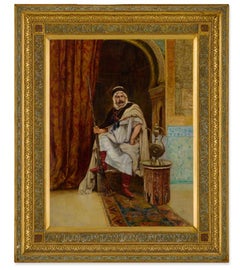
Artist: Clemente Pujol de Guastavino (1850-1905) Origin: Spanish Signature: signed C. Pujol (lower right) Medium: oil on canvas Dimension: 25 1/2 in x 19 3/4 in. Framed 34 by 2...

Category

19th Century Portrait Drawings and Watercolors

Materials

Canvas, Oil

Oriental Motives 1

Oriental Motives 1

Located in Zofingen, AG

In this piece, I explored the depth of tradition and mystery through expressive brushstrokes and layered textures. The mix of acrylic, watercolor, oil pastel, and ink brings a rich v...

Category

2010s Impressionist Interior Paintings

Materials

Oil Pastel, Acrylic, Archival Paper