Want more images or videos?
Request additional images or videos from the seller
1 of 10

Jean-Honoré Fragonard
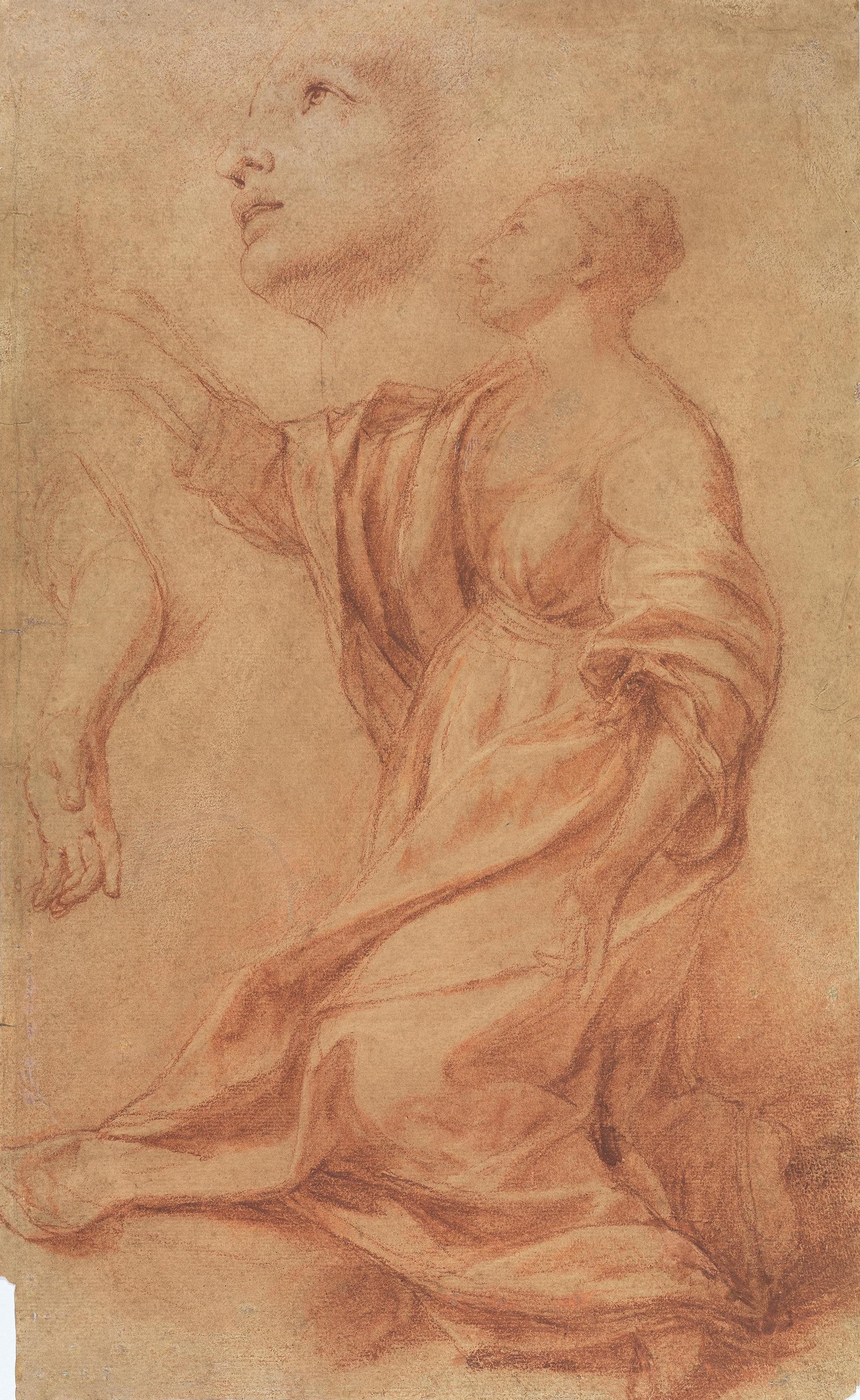
Three studies executed in the Pitti Palace in 1761 by Jean-Honoré Fragonard

1761

$28,627.76
£20,979.37
€24,000VAT Included
CA$39,410.98
A$40,089.29
CHF 22,891.56
MX$484,902.01
NOK 266,927.60
SEK 271,017.45
DKK 183,005.95

About the Item

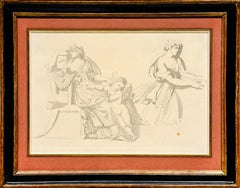
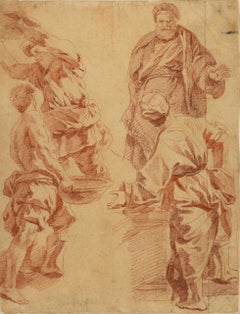
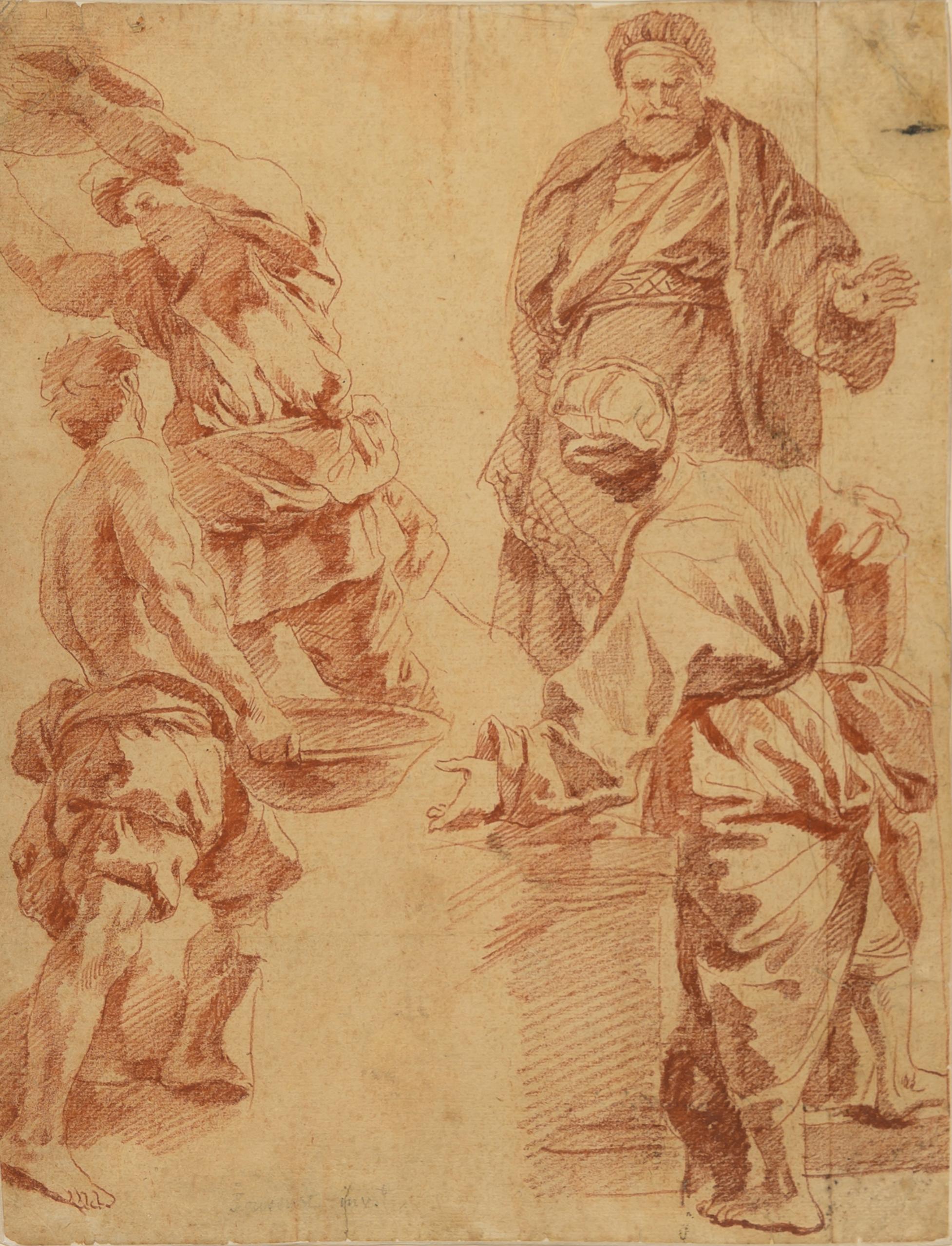
This brilliant study sheet, of which we present here a counterproof, is a souvenir of Fragonard's return journey from Italy. Between April and September 1761, he accompanied the abbot of Saint-Non on his way back to France. Three studies after the masters taken from the Pitti Palace’s gallery in Florence are gathered on this sheet. Although The Ecstasy of Saint Margaret of Cortona by Giovanni Lanfranco and The Holy Family with Saint Elizabeth after Rubens present classical themes, the presence of a mocking angel, a "victorious love" of secular appearance, heralds the gallant scenes that would make the artist famous after his return to Paris. 1. The first stay in Italy, a decisive step in Jean-Honoré Fragonard's artistic development Jean-Honoré Fragonard was born in Grasse in 1732 where his father worked as a glove maker. The family moved to Paris around 1738. At the age of 13, Jean-Honoré's artistic talents were noticed by the notary with whom he worked as a clerk. After briefly attending Jean-Siméon Chardin's workshop, the young Fragonard joined François Boucher's workshop as an apprentice. It was thanks to Boucher that he affirmed his talent and learned to copy the masters. In 1752, he won the Grand Prix of the Royal Academy of Painting, which allowed him to join the Royal School of Protected Pupils directed at the time by Carle Van Loo. In 1756 he left for the French Academy in Rome where he stayed until 1761. During this stay he made friends with Jean-Claude Richard de Saint-Non, the famous abbot of Saint-Non, who became his protector and main patron. Although we do not know the exact date of their meeting, during the summer of 1760 they stayed together at the Villa d'Este in Tivoli for several weeks. In March 1761 the abbot de Saint-Non sent Fragonard to Naples at his own expense. The abbot of Saint-Non then offered Fragonard to accompany him on his return trip to France. Fragonard was 29 years old in 1761 (five years younger than the abbot) and had not yet achieved fame when he left Italy. They left Rome in April 1761 and travelled together for over five months. The abbot wrote to his brother about Fragonard: "Monsieur Fragonard is all fire; his drawings are very numerous: one does not wait for the other; they enchant me. I find spell in them"... 2. The drawings made for the abbot of Saint-Non on his return trip to France As was customary, the patron paid the travel expenses and in return received from the artist the (numerous) studies made during the trip. At this stage, 370 studies, mostly executed in black stone, are known to have been made during this five-month journey. Their itinerary was classic: Siena, Florence, Pisa, Venice (where they stayed for six weeks), Padua, Vincenzo, Verona, Mantua, Reggio, Modena, Bologna, Parma and finally Genoa from where they returned to France by sea. They were in Florence between April 17th and May 6th 1761. We learn from the Journal of the abbot that the Pitti Palace was their first visit in Florence. Most of Fragonard's drawings are not slavish copies of the artworks seen in Italy. As we shall see for the drawing presented here, they present a subjective selection of groups of figures or details that caught the artist's imagination and were deemed interesting as models for his future productions. The counterproofs were made shortly after their return to Paris in September 1761. It is likely that Saint-Non, who owned a press, supervised their production and annotated them with a pen using grey ink, as the annotations in black stone on the original drawings were illegible after transfer. To make a counterproof, a sheet of wet paper was placed on top of the drawing and the whole thing was pressed, allowing the transfer of the image in reverse. These counterproofs were sometimes redrawn to increase their vigour, either by the abbot de Saint-Non or directly by Fragonard. This does not seem to have been the case for the drawing we present. One of the purposes of making the counterproofs was probably to enable both Fragonard and the abbot de Saint-Non to have a complete set of drawings. These counterproofs were at the time as highly regarded as the drawings themselves, and were frequently used by artists as a starting point for new compositions. 3. Description of the artwork and related artworks As always, our counterproof has been pasted on a light cardboard. We believe that it probably comes from a set "composed largely of counterproofs, which has now been divided. [They] belong to descendants of the abbot of Saint-Non living in Paris and its surrounding area". In this work, Fragonard freely combines the main groups of two paintings from the Palatine Gallery of the Pitti Palace: The Ecstasy of Saint Margaret of Cortona by Giovanni Lanfranco (eigth photo in the gallery) and The Holy Family with Saint Elizabeth, after Rubens (last photo in the gallery). It is interesting to note that in each case he retained only a part of the painting, in a very personal aesthetic re-creation process. While only the group of Saint Margaret and the two angels is included in Lanfranco's painting, the figure of Saint Elizabeth is omitted in the painting after Rubens, as Fragonard prefers to concentrate on the group formed by the Virgin, the infant Jesus and Saint John the Baptist. Fragonard balances his sheet by introducing a third element between these two groups, each made of three figures: an evocation of The Victorious Love by Orazio Riminaldi. His sense of interpretation is at its strongest with this painting, as he transforms the dark ephebe painted by the Caravaggio painter into a graceful putto, while taking up the questioning gesture of his hand, which acquires an ironic dimension. It seems to us that this putto is a forerunner of the statues of love that would adorn the love gardens of the painter's mature compositions, as for example in the Swing (Wallace Collection - London - UK). 4. Framing The drawing is presented in a carved and gilded wooden frame in the Louis XVI style. Main bibliographical references : Pierre Rosenberg (with the collaboration of Barbara Brejon de Lavergnée) - Panopticon Italiano - Edizioni dell' Elefante 1986 Pierre Rosenberg - Fragonard - RMN 1987 Perrin Stein (with contributions by Marie-Anne Dupuy-Vachey, Eunice Williams, Kelsey Brosnan) - Fragonard Drawing Triumphant - The Metropolitan Museum of Art, New York 2016
  • Creator:
    Jean-Honoré Fragonard (1732 - 1806, French)
  • Creation Year:
    1761
  • Dimensions:
    Height: 11.25 in (28.58 cm)Width: 8.5 in (21.59 cm)
  • Medium:
  • Movement & Style:
  • Period:
    1760-1769
  • Condition:
    11 ¼” x 8 ½” (285 x 215 mm) - Framed: 18 7/8” x 15 ¾” (48 cm x 40 cm) Catalogue: Ananoff 1096 - Panopticon Italiano 130 Louis XVI style carved and gilded wood frame.
  • Gallery Location:
    PARIS, FR
  • Reference Number:
    1stDibs: LU1568211142202

More From This Seller

View All
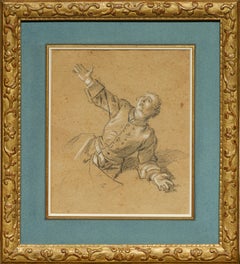
Three drawings by François Boucher in a mounting  by Jean-Baptiste Glomy

Three drawings by François Boucher in a mounting by Jean-Baptiste Glomy

By François Boucher

Located in PARIS, FR

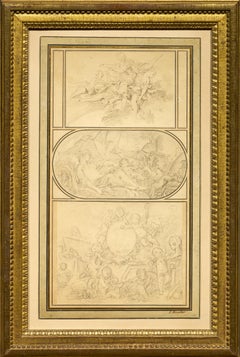
We would like to thank Juliette Parmentier-Courreau of the Custodia Foundation for her welcome and support during the consultation of Glomy’s Journal des Ouvrages. This spectacularly large "feuille de desseins ajustés" commissioned by François Boucher from Jean-Baptiste Glomy is emblematic of the painter's art and mastery of rocaille. It is also fully representative of the taste of this period in the field of decorative arts. The largest of these three drawings, placed at the bottom of the composition, is particularly interesting: dating from around 1756, it constitutes a modello (apparently unpublished) for the frontispiece of the "Catalogue des tableaux de Monsieur de Julienne"), preserved in the Morgan Library in New York. 1. François Boucher, the master of French rocaille The extraordinary career of Francois Boucher was unmatched by his contemporaries in versatility, consistency and output. For many, particularly the writers and collectors who led the revival of interest in the French rococo during the last century, his sensuous beauties and plump cupids represent the French eighteenth century at its most typical. His facility with the brush, even when betraying the occasional superficiality of his art, enabled him to master every aspect of painting – history and mythology, portraiture, landscape, ordinary life and, as part of larger compositions, even still life. He had been trained as an engraver, and the skills of a draftsman, which he imbued in the studio of Jean-Francois Cars (1661 – 1738), stood him in good stead throughout his career; his delightful drawings are one of the most sought-after aspects of his oeuvre. As a student of Francois Lemoyne (1688 - 1737), he mastered the art of composition. The four years he spent in Italy, from 1727-1731, educated him in the works of the masters, classics and history, that his modest upbringing had denied him. On his return to Paris in 1734, he gained full membership of the Royal Academy of Painting and Sculpture with his splendid Rinaldo and Armida (Paris, Musée du Louvre). Although, throughout his career, he occasionally painted subjects taken from the Bible, and would always have considered himself first as a history painter, his own repertoire of heroines, seductresses, flirtatious peasant girls and erotic beauties was better suited to a lighter, more decorative subject matter. His mastery of technique and composition enabled him to move from large scale tapestry...

Category

1750s Old Masters Figurative Drawings and Watercolors

Materials

Chalk, Ink

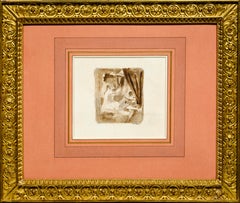
A preparatory drawing by Eugène Delacroix on the back of one of his prints

A preparatory drawing by Eugène Delacroix on the back of one of his prints

By Eugène Delacroix

Located in PARIS, FR

Rapidly executed with the tip of a brush, this wash bordering on abstraction seduced us with its great spontaneity. This (unsigned) study is a first thought for a small licentious ca...

Category

1820s Romantic Interior Drawings and Watercolors

Materials

Paper, Ink, Pencil

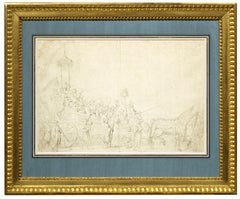
Study for « The Chinese Masquerade » by Jean-Baptiste Pierre (1714 - 1789)

Study for « The Chinese Masquerade » by Jean-Baptiste Pierre (1714 - 1789)

By Jean-Baptiste Pierre

Located in PARIS, FR

Arriving in Rome in June 1735 as a resident at the Royal Academy, Pierre was unable to attend the Winter Carnival festivities of 1735, which he nevertheless immortalised in an engrav...

Category

1730s Old Masters Figurative Drawings and Watercolors

Materials

Graphite

You May Also Like

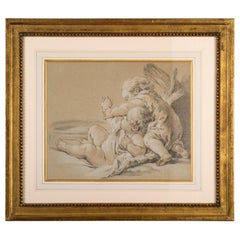
Drawing of Children Playing, Circle of Francois Boucher

Drawing of Children Playing, Circle of Francois Boucher

By François Boucher

Located in Kittery Point, ME

Drawing of children playing besides a basin of water. Framed in a Louis XVI giltwood frame. Typical of the style and subjects of Francois Boucher. Chalk and pencil on paper.

Category

Antique Late 18th Century French Rococo Drawings

Materials

Paper

The Death of Coresus, 18th Century Watercolor and Ink Drawing, Framed

The Death of Coresus, 18th Century Watercolor and Ink Drawing, Framed

By Jean-Baptiste Greuze

Located in Paris, Île-de-France

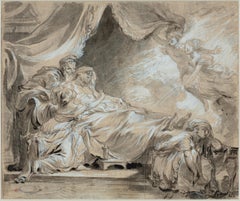
JEAN-BAPTISTE GREUZE (Tournus 1725 - 1805 Paris) The Death of Coresus, circa 1750 Pen and brown ink, black ink tips, gray wash on black chalk, 455 x 385 cm Bears on the reverse in ...

Category

18th Century Old Masters Figurative Drawings and Watercolors

Materials

Ink, Watercolor

Peaceful Maternity : the Sleeping Baby - Etching

Peaceful Maternity : the Sleeping Baby - Etching

By François Boucher

Located in Paris, IDF

Francois BOUCHER Peaceful Maternity : the Sleeping Baby Etching Unsigned On Vellum 38 x 50 cm (c. 15 x 20 in) Probably edited c. 1950 Excellent condition

Category

20th Century Mannerist Figurative Prints

Materials

Etching

18th Century French Red Chalk Study After Jouvenet, Figures from Jouvenet

18th Century French Red Chalk Study After Jouvenet, Figures from Jouvenet

Located in Paris, Île-de-France

This refined 18th-century French red chalk study sheet presents a group of figures derived from The Feast at the House of Simon the Pharisee by Jean Jouvenet, through the intermediar...

Category

1760s Figurative Drawings and Watercolors

Materials

Chalk, Laid Paper

Two Putti's in Flight Attributed to Francois Boucher

Two Putti's in Flight Attributed to Francois Boucher

By François Boucher

Located in Ottawa, Ontario

Two Putti's in Flight Attributed to Francois Boucher (Paris 1703-1770), Black chalk and stamping, with red and white chalk on buff paper. Bears signature in pen and brown ink: F.Bouc...

Category

Antique Mid-18th Century German Neoclassical Drawings

Materials

Paper

After Fragonard French 19th Century Oil on Canvas Progress of Love-Lover Crowned

After Fragonard French 19th Century Oil on Canvas Progress of Love-Lover Crowned

By (After) Jean-Honoré Fragonard

Located in Los Angeles, CA

A large French 19th century oil on canvas (laid down on a masonite) "Les progrès de l'amour dans le cœur d'une jeune fille" The Progress of Love: The Lover Crowned, after Jean-Honoré...

Category

Antique 19th Century French Rococo Paintings

Materials

Masonite, Gesso, Canvas, Giltwood