Want more images or videos?
Request additional images or videos from the seller
1 of 5

Luca Cambiaso
The Flight into Egypt

$50,000
£37,804.62
€44,261.12
CA$71,137.61
A$72,359.92
CHF 41,527.21
MX$869,851.16
NOK 484,413.30
SEK 488,973.62
DKK 330,892.08

About the Item

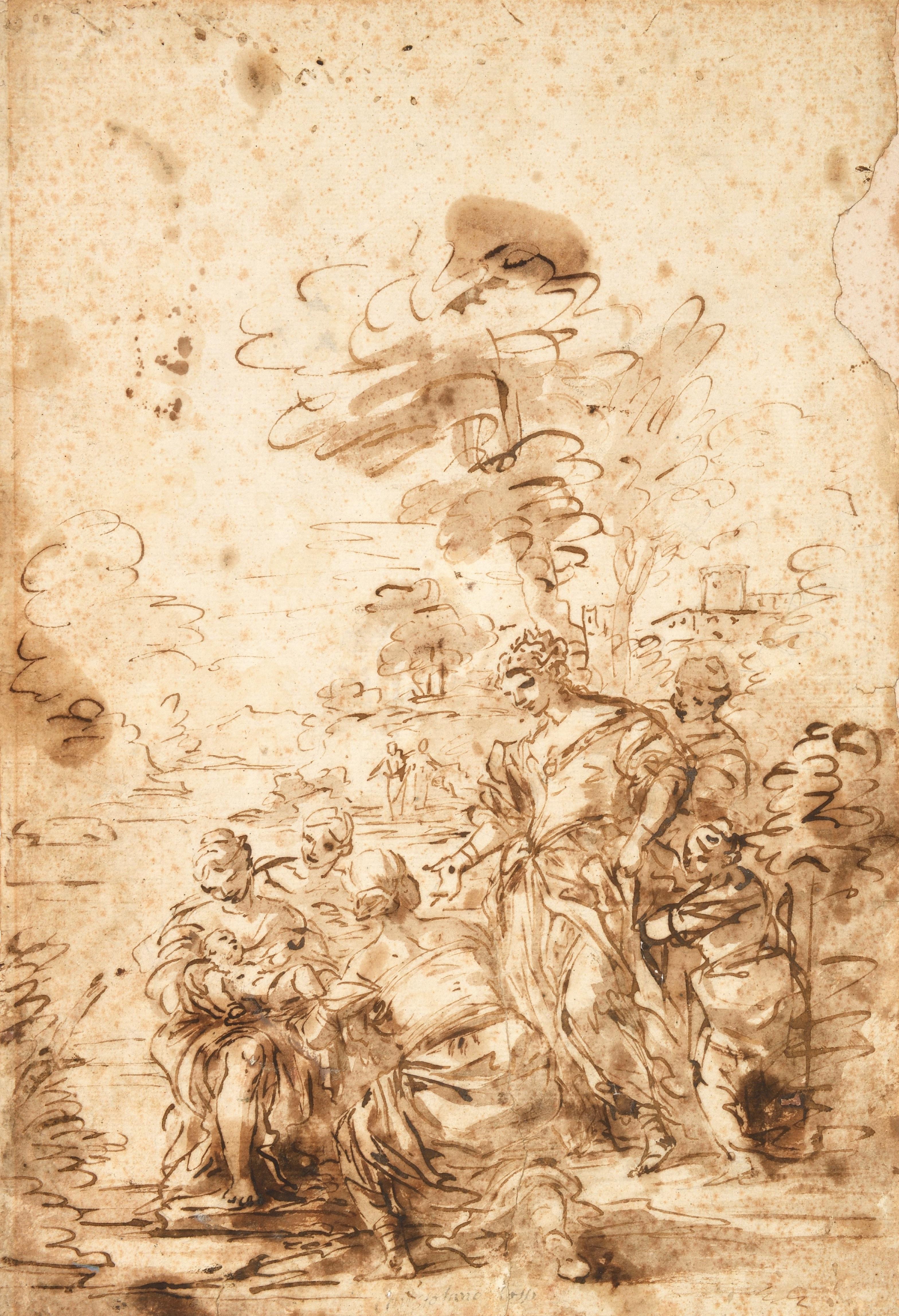
Inscribed: 3. una Madonna che va in Egitto, verso, and Madonna che va in Egitto, recto Provenance: Private Collection, UK, since 1999 This expressive and boldly executed drawing is the work of Luca Cambiaso, the leading artistic personality in Genoa in the sixteenth century and one of the most dynamic draughtsmen in European art. The drawing dates from the mid-1550s to early 1560s at the height of the artist’s power. At this moment in his career, defined by his “serene style,” Cambiaso’s compositions became more focused and reduced to their essential elements. The mule’s hind quarters dominate the visual field and the outdoor setting is indicated by little more than the tree standing along the left edge of the sheet. The large scale of the drawing and the calligraphic penmanship, which lends a motion and drama to the scene, provide significant visual interest and appeal to the modern eye. Cambiaso’s spontaneous handling fully exploits the dynamics of the quill pen—the lines are vigorous, animated, and possess a great suggestive power. Both vibrant and audacious in its depiction of the Flight into Egypt, this drawing represents an exceptional addition to Cambiaso’s graphic oeuvre. Cambiaso infuses the otherwise inert biblical narrative with dynamism by placing the figures close to the pictorial plane and orienting them along a steep diagonal, from the upper left to the lower right, giving the appearance that they are about to descend a steep slope and disappear from view. The artist employed a similar vertiginous compositional device in his drawing of the Chariot of the Setting Sun, in which the horses are similarly conceived. More explicitly, and using the same media, Cambiaso’s drawing of Saint Martin and Beggar in the Princeton Art Museum displays a horse almost identically envisaged (Fig. 1). A horse seen from behind with its right rear leg raised was a leitmotif for the artist, with some details, such as the diagonal hatching to indicate the shadow on the underside of the hoof, closely repeated. Regarding the representation of the mule in the present drawing, it is important to note Cambiaso’s acute sensitivity to the subject matter, even when composing with speed. In contrast to his many drawings that include horses with elaborate tack, such as the Saint Martin and the Beggar, our composition shows a plain stirrup and strap across the mule’s hindquarters and its tail is not elaborately plaited. The treatment is in keeping with the theme of poverty that underlies this biblical subject (Matthew 2:13-15). The Holy Family were, after all, refugees, and the fact that Herod was intent on killing the child would appear to explain Joseph’s somewhat anxious glance over his shoulder. The drawing displays many of the salient characteristics of Cambiaso’s draughtsmanship. In a manner entirely consistent with his working method, he first sketched his preliminary ideas with thin pen lines in a lighter ink over faint traces of black chalk and later confirmed or corrected them with a darker tone of brown. As is typical of the artist, spare hatching suggests the surrounding space and foreground terrain. Half-moon like circlets indicate pebbles in the foreground, with long looping lines defining the leaves of the palm tree, terminating in hooks as the pen shifts from right to left. Typically, limbs, hands, lips, noses and eyelids are slightly geometricized with circlets, triangles, ticks and hooks, and quick flicks of the pen indicate knees, muscles and tendons. The articulation of the Virgin’s hand and the physiognomy of the infant Christ are nearly identical to those in Cambiaso’s Virgin and Child with Putti, formerly in the collection of the Rugby School (Fig. 2). Tellingly, so too is the relationship between mother and child, as the Virgin intimately embraces the infant Christ. Within the context of Cambiaso’s drawings, the scale and format of this work, the quality of execution, and above all its striking interpretation of the subject suggest that it was conceived as an autonomous work rather than a preparatory study for a painting. Its monumentality, dynamism, and the clarity of narrative appear to connect it with a number of comparably large drawings illustrating the early life of Christ. These include two versions of the Holy Family at Rest preserved in the Rijksmuseum and the First Steps of the Infant Christ in Edinburgh. The early inscription on the verso of this sheet—“3. una Madonna che va in Egitto”—suggests it may have been the third in sequence of a series of subjects drawn on a similar scale in the same technique owned by an early collector. Cambiaso’s only known treatment of the subject in paint is an altarpiece of La Fuga in Egitto that is mentioned in an early guidebook to Genoa as in the church of Santa Maria delle Grazie al Molo outside the city, close to the Porta Lanterna (current location unknown).
  • Creator:
    Luca Cambiaso (1527 - 1585, Italian)
  • Dimensions:
    Height: 14.875 in (37.79 cm)Width: 11.25 in (28.58 cm)
  • Medium:
  • Movement & Style:
  • Period:
  • Condition:
  • Gallery Location:
    New York, NY
  • Reference Number:
    1stDibs: LU1029077782

More From This Seller

View All
A Guardian Angel Leading a Child

A Guardian Angel Leading a Child

Located in New York, NY

Provenance: Private Collection, Argentina; there acquired by Mr. and Mrs. Ernest T. Harper, New York, by 1960; by descent to: Mr. and Mrs. Alan Harper, New York, until 2024. This s...

Category

18th Century Old Masters Figurative Paintings

Materials

Canvas, Oil

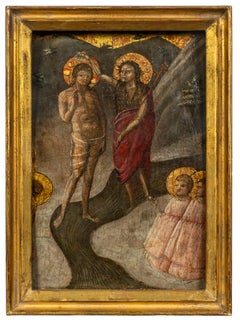
Baptism of Christ

Baptism of Christ

Located in New York, NY

Provenance: Achillito Chiesa, Milan Luigi Albrighi, Florence, by 1 July 1955 with Marcello and Carlo Sestieri, Rome, 1969 Private Collection, Connecticut Exhibited: Mount Holyoke College Art Museum, South Hadley, Massachusetts (on loan, 2012) Literature: Carlo Volpe, “Alcune restituzioni al Maestro dei Santi Quirico e Giulitta,” in Quaderni di Emblema 2: Miscellanea di Bonsanti, Fahy, Francisci, Gardner, Mortari, Sestieri, Volpe, Zeri, Bergamo, 1973, pp. 19-20, fig. 18, as by the Master of Saints Quiricus and Julitta (now identified as Borghese di Piero). This fine predella panel depicting the Baptism...

Category

15th Century and Earlier Old Masters Figurative Paintings

Materials

Tempera, Wood Panel

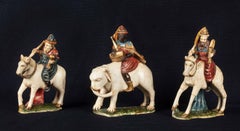
The Three Magi

The Three Magi

Located in New York, NY

Provenance: Private Collection, Spain. Known as Peruvian alabaster for its translucency and workability, Piedra de Huamanga is a highly prized material from the province of Ayacucho in Peru. In the 17th and 18th centuries, local craftsman in the town of Huamanga began to specialize in the production of small-scale, polychrome religious sculptures made from this distinctive stone. Huamanga sculptures are among the most accomplished examples of carving from the Spanish Americas, where polychrome wood sculpture was a far more common sculptural medium. These works, which were created as independent sculptures or as sculptural groups—such as our three Magi—were intended for ecclesiastical as well as domestics settings. Our three figures likely formed part of a larger Nativity group—a New World variant of the tradition of the Neapolitan Crèche...

Category

Late 18th Century Figurative Sculptures

Materials

Alabaster

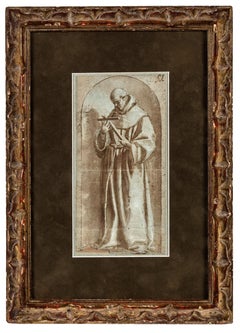
Study of a Franciscan Saint, probably San Diego de Alcalá

Study of a Franciscan Saint, probably San Diego de Alcalá

Located in New York, NY

Provenance: Ivan E. Phillips, Montreal and New York, until 2023. The brothers Bartolomé Carducho and Vicente Carducho, both born and trained in Florence, settled in Spain where they made their careers. Vicente worked on numerous commissions for both the church and the Spanish court...

Category

17th Century Old Masters Drawings and Watercolor Paintings

Materials

Paper, Chalk, Ink, Pen

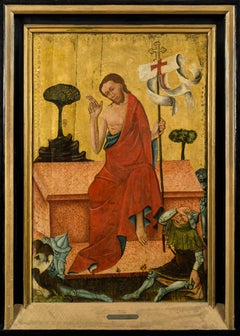
The Resurrection of Christ

The Resurrection of Christ

Located in New York, NY

Provenance: with “Mr. Scheer,” Vienna, by July 1918; where acquired by: Jindřich Waldes, Prague, 1918–1941; thence by descent to: Private Collection, New York Literature: Rudolf Kuchynka, “České obrazy tabulové ve Waldesově obrazárně,” Památky archeologické, vol. 31 (1919), pp. 62-64, fig. 5. Jaroslav Pešina, “K datování deskových obrazů ve Waldesově obrazárně,” Ročenka Kruhu pro Pěstování Dějin Umění: za rok (1934), pp. 131-137. Jaroslav Pešina, Pozdně gotické deskové malířství v Čechách, Prague, 1940, pp. 150-151, 220. Patrik Šimon, Jindřich Waldes: sběratel umění, Prague, 2001, pp. 166, 168, footnote 190. Ivo Hlobil, “Tři gotické obrazy ze sbírky Jindřicha Waldese,” Umění, vol. 52, no. 4 (2004), p. 369. Executed sometime in the 1380s or 1390s by a close associate of the Master of the Třeboň Altarpiece, this impressive panel is a rare work created at the royal court in Prague and a significant re-discovery for the corpus of early Bohemian painting. It has emerged from an American collection, descendants of the celebrated Czech industrialist and collector Jindřich Waldes, who died in Havana fleeing Nazi-occupied Europe. The distinctive visual tradition of the Bohemian school first began to take shape in the middle of the fourteenth century after Charles IV—King of Bohemia and later Holy Roman Emperor—established Prague as a major artistic center. The influx of foreign artists and the importation of significant works of art from across Europe had a profound influence on the development of a local pictorial style. Early Italian paintings, especially those by Sienese painters and Tommaso da Modena (who worked at Charles IV’s court), had a considerable impact on the first generation of Bohemian painters. Although this influence is still felt in the brilliant gold ground and the delicate tooling of the present work, the author of this painting appears to be responding more to the paintings of his predecessors in Prague than to foreign influences. This Resurrection of Christ employs a compositional format that was popular throughout the late medieval period but was particularly pervasive in Bohemian painting. Christ is shown sitting atop a pink marble sarcophagus, stepping down onto the ground with one bare foot. He blesses the viewer with his right hand, while in his left he holds a triumphal cross with a fluttering banner, symbolizing his victory over death. Several Roman soldiers doze at the base of the tomb, except for one grotesque figure, who, beginning to wake, shields his eyes from the light and looks on with a face of bewilderment as Christ emerges from his tomb. Christ is wrapped in a striking red robe with a blue interior lining, the colors of which vary subtly in the changing light. He stands out prominently against the gold backdrop, which is interrupted only by the abstractly rendered landscape and trees on either side of him. The soldiers’ armor is rendered in exacting detail, the cool gray of the metal contrasting with the earth tones of the outer garments. The sleeping soldier set within a jumble of armor with neither face nor hands exposed, is covered with what appears to be a shield emblazoned with two flies on a white field, somewhat resembling a cartouche (Fig. 1). This may be a heraldic device of the altarpiece’s patron or it may signify evil, referencing either the Roman soldiers or death, over both of which Christ triumphs. This painting formed part of the collection assembled by the Czech industrialist and founder of the Waldes Koh-i-noor Company, Jindřich Waldes, in the early twentieth century. As a collector he is best remembered for establishing the Waldes Museum in Prague to house his collection of buttons (totaling nearly 70,000 items), as well as for being the primary patron of the modernist painter František Kupka. Waldes was also an avid collector of older art, and he approached his collecting activity with the goal of creating an encyclopedic collection of Czech art from the medieval period through to the then-present day. At the conclusion of two decades of collecting, his inventory counted 2331 paintings and drawings, 4764 prints, and 162 sculptures. This collection, which constituted the Waldesova Obrazárna (Waldes Picture Gallery), was first displayed in Waldes’ home in Prague at 44 Americká Street and later at his newly built Villa Marie at 12 Koperníkova Street. This Resurrection of Christ retains its frame from the Waldes Picture Gallery, including its original plaque “173 / Česky malíř z konce 14 stol.” (“Czech painter from the end of the 14th century”) and Waldes’ collection label on the reverse. The Resurrection of Christ was one of the most significant late medieval panel...

Category

15th Century and Earlier Old Masters Paintings
Materials

Tempera, Panel

You May Also Like

The Flight into Egypt- Drawing - 1930s

The Flight into Egypt- Drawing - 1930s

Located in Roma, IT

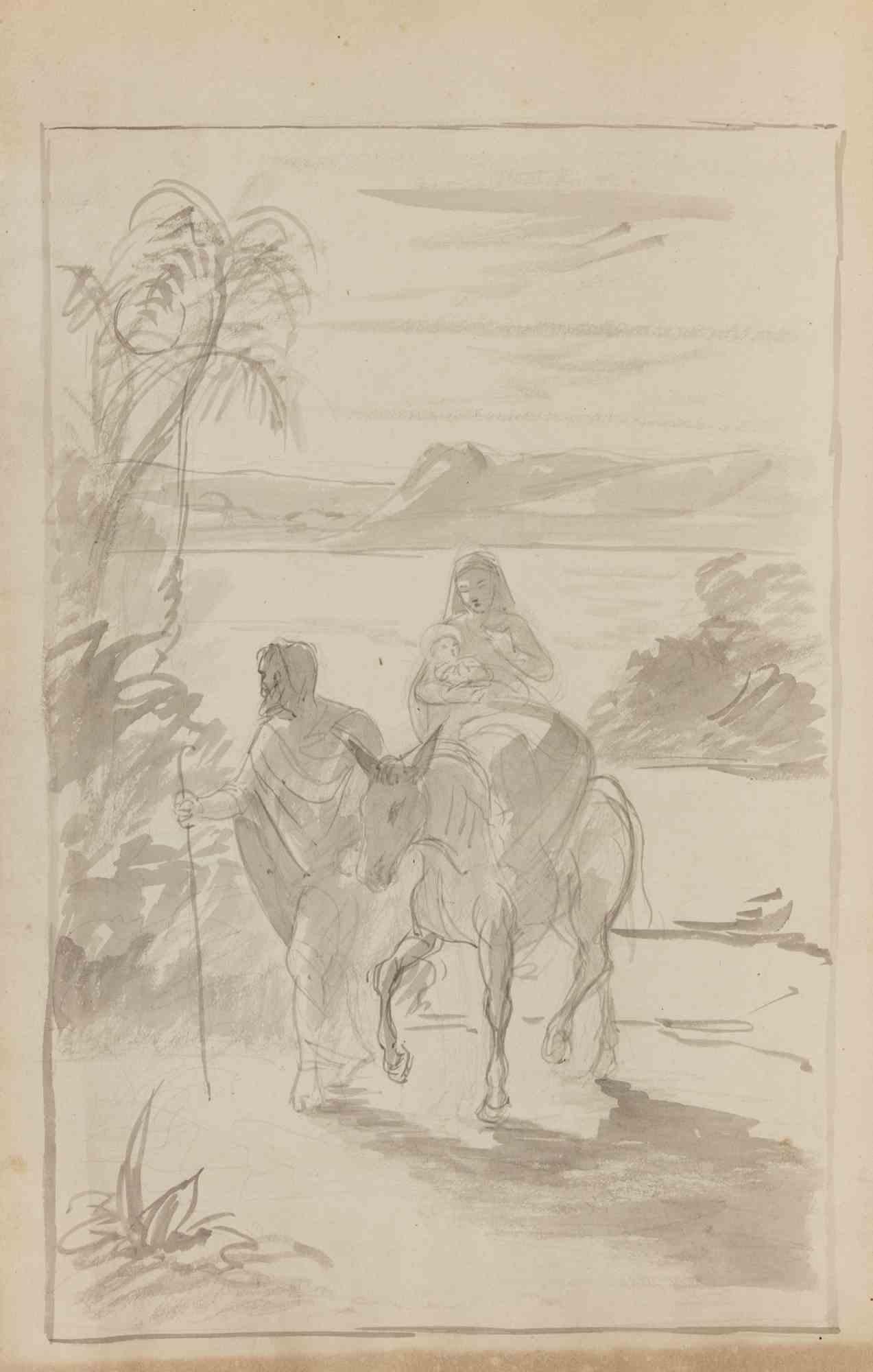
Pencil and watercolor drawing realized b an unknown french artist in the 1930s. Very good condition.

Category

1930s Modern Figurative Drawings and Watercolors

Materials

Watercolor, Pencil

Flight Into Egypt, Northern Painter Active In Rome, Early 17th Century

Flight Into Egypt, Northern Painter Active In Rome, Early 17th Century

Located in Firenze, IT

Flight into Egypt, Northern Painter Active in Rome, Early 17th Century. Northern painter active between Rome and the former Low Countries. Early 17th century. Oil on panel, cradled....

Category

17th Century Renaissance Figurative Paintings

Materials

Board, Oil

19th Century Watercolour - Rest on the flight to Egypt

19th Century Watercolour - Rest on the flight to Egypt

Located in Corsham, GB

A charming watercolour depiction of the Holy family's flight to Egypt. They stop to rest beneath a tree with an infant St. John the Baptist to the right of the composition. Unsigned....

Category

19th Century Figurative Drawings and Watercolors

Materials

Watercolor

Discovery of 17th Century Moses Drawing in Pen and Ink on Laid Paper

Discovery of 17th Century Moses Drawing in Pen and Ink on Laid Paper

Located in Paris, Île-de-France

GIACINTO BRANDI (Poli 1621 – 1691 Rome) The Discovery of Moses Pen and brown ink, brown wash 43.2 x 29 cm Bears an inscription at the lower edge “Agostino Tassi” and on the revers...

Category

17th Century Old Masters Landscape Drawings and Watercolors

Materials

Ink, Laid Paper

Madonna and Child and Saint with Two Angels

Madonna and Child and Saint with Two Angels

Located in Chicago, IL

This confidently executed drawing is a study related to Maratta’s painting La Vergine appare a S.Stanislao Kotska 1687 in the second chapel to the right, in the church of S. Andrea a...

Category

17th Century Old Masters Drawings and Watercolor Paintings

Materials

Chalk