Want more images or videos?
Request additional images or videos from the seller
1 of 6

Reginald Brill
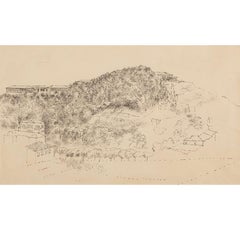
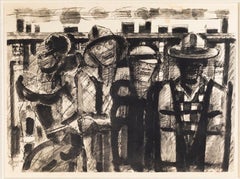
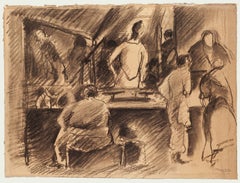
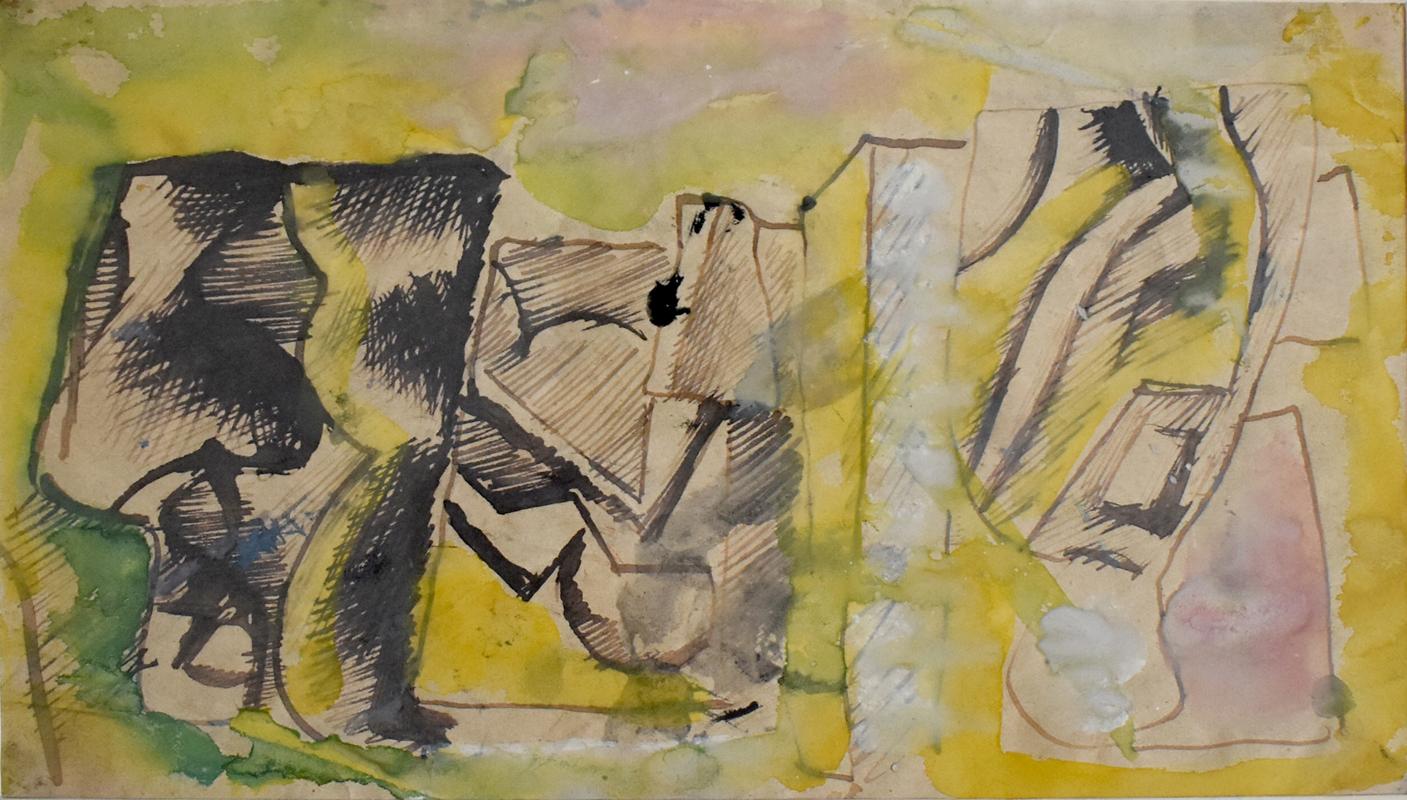
Study for Men in the Trench, Pen, Ink & Watercolour on Paper Painting 1950 circa

1950 circa

Price Upon Request
Price Upon Request
Price Upon Request
Price Upon Request
Price Upon Request
Price Upon Request
Price Upon Request
Price Upon Request
Price Upon Request
Price Upon Request

About the Item

Study for Men in the Trench, Pen, Ink & Watercolour on Paper Painting 1950 circa Additional information: Medium: Pen, ink and watercolour on paper 11 3/4 x 26 in 29.8 x 68.5 cm Reginald " Reggie" Brill was a versastile 20th century artist and teacher. Brill was born in London in 1902 and spent his early childhood there and in Yorkshire. By the time of the First World War, at the age of 13, he was living in lodgings in London, working in a City office and attending St Martins School of Art in the evenings. Considering his lack of education, winning a scholarship to The Slade (now part of University College London) in 1921 where he studied under Henry Tonks for three years, was a huge achievement. On leaving The Slade he found patronage in Lincolnshire, but by the time of the General Strike (1926) he had returned to London and was working on Lansbury's Labour Weekly. He married Rosalie, also an artist, and in 1927 won the Prix de Rome in Decorative Painting. Following two years at The British School in Rome, Brill went to teach at Blackheath School of Art. During 1930 he spent three months painting in Egypt and it was there that he met Col. T G Gayer-Anderson, one of the twin brothers who were to bequeath The Little Hall in Lavenham as a hostel for art students. It was there that Brill retired to act as warden, thus continuing his nurturing of art students until his death in 1972. Brill took up his appointment at The School of Art, Kingston upon Thames in January 1934. It was situated in the Technical Institute (Kingston Hall Road) and Brill found it bohemian and disorganised. He proceeded to inject enthusiasm, order and discipline. Within 5 years of his appointment a purpose-built School of Art was opened in Knights Park. It remained open throughout the war and by 1945 there was a waiting list for places. Under the skilled and totally dedicated direction of Brill, Kingston School of Art became established with national reputation for excellence. In 1961 Sir Charles Wheeler opened the new building at Knights Park. Costing £100,000, this more than doubled the size of the Art School. Brill, was a well-known figure in Kingston. His eloquence made him popular as a guest speaker and his promotion of Art and Design stretched well beyond the doors of Knights Park. Apart from establishing two of the main buildings which makeup what is now known as the Faculty of Design, one of the most visible local contributions he made was the setting up of a topographical collection of paintings depicting Kingston, which has since become known as The Brill Collection at Kingston Museum. Brill gained huge respect and admiration from the hundreds of pupils who studied at Kingston during his 30-year leadership. He published two books, Modern Painting 1946 and Art as a Career 1962, both bearing a strong educational angle. He regularly exhibited along with leading artists of his era at The Royal Academy, both his paintings and his acutely observed drawings. All the while he was a prolific artist, although reading his diaries, intensely self-critical. His perfectionism, acute powers of observation and relentless research can be seen in his drawings, which via the media and methods he explored throughout his life reflect mid 20th century British Art at its most typical. His major series of work, known as 'The Martyrdom of Man', was carried on in parallel to his career as a teacher. These paintings reflect his care for fellow man and depict people at work, e.g., The Operation, The Jury, Linemen, Waiting Room and Rest, which recently sold at Sotheby’s and was specially restored for The Brill Retrospective. His smaller works also play with the theme of everyday events and communication amongst people, such as The Bull Ring and Market Place paintings. Brill's name is associated particularly with human figure compositions, but he also worked on landscapes, portraits and details of plants, animals, interiors etc. As one would expect he moved from one media to another, and his unusual hand painted and cut paper mosaics are beautifully designed and worked. The Englishness of his work, with its narrative theme and the emphasis on people in their environment, combined with his interest and concern in human behaviour results in a legacy of excellence as yet unexploited.
  • Creator:
    Reginald Brill (1902 - 1974, English)
  • Creation Year:
    1950 circa
  • Dimensions:
    Height: 11.75 in (29.85 cm)Width: 26 in (66.04 cm)
  • Medium:
  • Period:
  • Condition:
  • Gallery Location:
    Kingsclere, GB
  • Reference Number:
    1stDibs: LU2718214573232

More From This Seller

View All
Italian Scene, Pen and Ink with Wash Painting by Reginald Brill, 1950s circa

Italian Scene, Pen and Ink with Wash Painting by Reginald Brill, 1950s circa

By Reginald Brill

Located in Kingsclere, GB

Italian Scene, Pen and Ink with Wash Painting by Reginald Brill, 1950s circa Additional information: Medium: Pen and ink with wash 33 x 48.3 cm 13 x 19 in Reginald " Reggie" Brill was a versastile 20th century artist and teacher. Brill was born in London in 1902 and spent his early childhood there and in Yorkshire. By the time of the First World War, at the age of 13, he was living in lodgings in London, working in a City office and attending St Martins School of Art in the evenings. Considering his lack of education, winning a scholarship to The Slade (now part of University College London) in 1921 where he studied under Henry Tonks for three years, was a huge achievement. On leaving The Slade he found patronage in Lincolnshire, but by the time of the General Strike (1926) he had returned to London and was working on Lansbury's Labour Weekly. He married Rosalie, also an artist, and in 1927 won the Prix de Rome in Decorative Painting. Following two years at The British School in Rome, Brill went to teach at Blackheath School of Art. During 1930 he spent three months painting in Egypt and it was there that he met Col. T G Gayer-Anderson, one of the twin brothers who were to bequeath The Little Hall in Lavenham as a hostel for art students. It was there that Brill retired to act as warden, thus continuing his nurturing of art students until his death in 1972. Brill took up his appointment at The School of Art, Kingston upon Thames in January 1934. It was situated in the Technical Institute (Kingston Hall Road) and Brill found it bohemian and disorganised. He proceeded to inject enthusiasm, order and discipline. Within 5 years of his appointment a purpose-built School of Art was opened in Knights Park. It remained open throughout the war and by 1945 there was a waiting list for places. Under the skilled and totally dedicated direction of Brill, Kingston School of Art became established with national reputation for excellence. In 1961 Sir Charles Wheeler opened the new building at Knights Park. Costing £100,000, this more than doubled the size of the Art School. Brill, was a well-known figure in Kingston. His eloquence made him popular as a guest speaker and his promotion of Art and Design stretched well beyond the doors of Knights Park. Apart from establishing two of the main buildings which makeup what is now known as the Faculty of Design, one of the most visible local contributions he made was the setting up of a topographical collection of paintings depicting Kingston, which has since become known as The Brill Collection at Kingston Museum. Brill gained huge respect and admiration from the hundreds of pupils who studied at Kingston during his 30-year leadership. He published two books, Modern Painting 1946 and Art as a Career 1962, both bearing a strong educational angle. He regularly exhibited along with leading artists of his era at The Royal Academy, both his paintings and his acutely observed drawings. All the while he was a prolific artist, although reading his diaries, intensely self-critical. His perfectionism, acute powers of observation and relentless research can be seen in his drawings, which via the media and methods he explored throughout his life reflect mid 20th century British Art at its most typical. His major series of work, known as 'The Martyrdom of Man', was carried on in parallel to his career as a teacher. These paintings reflect his care for fellow man and depict people at work, e.g., The Operation, The Jury, Linemen, Waiting Room and Rest, which recently sold at Sotheby’s and was specially restored for The Brill Retrospective. His smaller works also play with the theme of everyday events and communication amongst people, such as The Bull Ring and Market Place paintings. Brill's name is associated particularly with human figure compositions, but he also worked on landscapes, portraits and details of plants, animals, interiors etc. As one would expect he moved from one media to another, and his unusual hand painted and cut paper mosaics...

Category

20th Century Landscape Paintings

Materials

Pen

Italian Landscape, Pen Painting by Reginald Brill, 1950 circa

Italian Landscape, Pen Painting by Reginald Brill, 1950 circa

By Reginald Brill

Located in Kingsclere, GB

Italian Landscape, Pen Painting by Reginald Brill, 1950 circa Additional information: Medium: Ink 20 x 34 cm 7 7/8 x 13 3/8 in Reginald " Reggie" Brill was a versastile 20th century artist and teacher. Brill was born in London in 1902 and spent his early childhood there and in Yorkshire. By the time of the First World War, at the age of 13, he was living in lodgings in London, working in a City office and attending St Martins School of Art in the evenings. Considering his lack of education, winning a scholarship to The Slade (now part of University College London) in 1921 where he studied under Henry Tonks for three years, was a huge achievement. On leaving The Slade he found patronage in Lincolnshire, but by the time of the General Strike (1926) he had returned to London and was working on Lansbury's Labour Weekly. He married Rosalie, also an artist, and in 1927 won the Prix de Rome in Decorative Painting. Following two years at The British School in Rome, Brill went to teach at Blackheath School of Art. During 1930 he spent three months painting in Egypt and it was there that he met Col. T G Gayer-Anderson, one of the twin brothers who were to bequeath The Little Hall in Lavenham as a hostel for art students. It was there that Brill retired to act as warden, thus continuing his nurturing of art students until his death in 1972. Brill took up his appointment at The School of Art, Kingston upon Thames in January 1934. It was situated in the Technical Institute (Kingston Hall Road) and Brill found it bohemian and disorganised. He proceeded to inject enthusiasm, order and discipline. Within 5 years of his appointment a purpose-built School of Art was opened in Knights Park. It remained open throughout the war and by 1945 there was a waiting list for places. Under the skilled and totally dedicated direction of Brill, Kingston School of Art became established with national reputation for excellence. In 1961 Sir Charles Wheeler opened the new building at Knights Park. Costing £100,000, this more than doubled the size of the Art School. Brill, was a well-known figure in Kingston. His eloquence made him popular as a guest speaker and his promotion of Art and Design stretched well beyond the doors of Knights Park. Apart from establishing two of the main buildings which makeup what is now known as the Faculty of Design, one of the most visible local contributions he made was the setting up of a topographical collection of paintings depicting Kingston, which has since become known as The Brill Collection at Kingston Museum. Brill gained huge respect and admiration from the hundreds of pupils who studied at Kingston during his 30-year leadership. He published two books, Modern Painting 1946 and Art as a Career 1962, both bearing a strong educational angle. He regularly exhibited along with leading artists of his era at The Royal Academy, both his paintings and his acutely observed drawings. All the while he was a prolific artist, although reading his diaries, intensely self-critical. His perfectionism, acute powers of observation and relentless research can be seen in his drawings, which via the media and methods he explored throughout his life reflect mid 20th century British Art at its most typical. His major series of work, known as 'The Martyrdom of Man', was carried on in parallel to his career as a teacher. These paintings reflect his care for fellow man and depict people at work, e.g., The Operation, The Jury, Linemen, Waiting Room and Rest, which recently sold at Sotheby’s and was specially restored for The Brill Retrospective. His smaller works also play with the theme of everyday events and communication amongst people, such as The Bull Ring and Market Place paintings. Brill's name is associated particularly with human figure compositions, but he also worked on landscapes, portraits and details of plants, animals, interiors etc. As one would expect he moved from one media to another, and his unusual hand painted and cut paper mosaics...

Category

20th Century Landscape Paintings

Materials

Pen

Student Life, Morning (Gunter Grove, Chelsea), Watercolour Painting, 1941

Student Life, Morning (Gunter Grove, Chelsea), Watercolour Painting, 1941

Located in Kingsclere, GB

Student Life, Morning (Gunter Grove, Chelsea), Watercolour Painting, 1941 Additional information: Medium: Watercolour over pen and ink 12 x 15 in 30.5 x 38.1 cm Signed and dated; si...

Category

20th Century Figurative Drawings and Watercolors

Materials

Watercolor

Cornish Coast, Gouache Painting by Peter Potworowski, 1952/3

Cornish Coast, Gouache Painting by Peter Potworowski, 1952/3

Located in Kingsclere, GB

Cornish Coast, Gouache Painting by Peter Potworowski, 1952/3 Additional information: Medium: Gouache 20.3 x 33 cm 8 x 13 in Tadeusz Piotr (Peter) Potworowski was a Polish abstract and figurative painter who lived and exhibited in Paris, Poland, Sweden and England. Potworowski was born in Warsaw in 1898. After serving in the First World War, Potworowski enrolled at the Warsaw University of Technology to study architecture, though his studies were halted by the Bolshevik campaign. After the end of the Polish-Soviet War in 1921, Potworowski returned to Warsaw and began to study art at the school of Konrad Krzyżanowski. By the following year, he had taken a place at the Academy of Fine Arts in Krakow, where he studied under Józef Pankiewicz. It was Pankiewicz who incorporated Potworowski into the Paris Commute, or Kapists, a group of Polish artists who travelled to the French capital in 1924. During his seven years in Paris he became personally acquainted with Pablo Picasso, Pierre Bonnard, Jean Cocteau, Constantin Brancusi and attended for a short time Fernand Léger's studio. It was through this job that he met his first wife Magdalena Mańkowska, a student of anthropology in Paris. After marrying in France, and visiting Britain in 1928, the couple returned to Poland in 1930, where their first son John was born. In 1931, Warsaw was the locale of the first Kapists exhibition, entitled New Generation, which took place at the Artist's Club, Hotel Polonia, and the Institute of Art Propaganda. Here, Potworowski received a prize for his painting Three Women in the Interior. The following year, he held his first solo exhibition at the Makowski Salon in Poznań. This success was sustained through 1937 when the artist received a silver medal at the International Exhibition of Art and Technology in Paris, as well as the award from the Minister of Foreign Affairs. After this strong development, Potworowski had a travelling solo exhibition arranged, held in 1938 at the Institute of Propaganda of Art in Warsaw and then in Lviv. Following the invasion of Poland in 1939, Potworowski escaped to Sweden via Lithuania. It was from here that the artist, with his wife and two young children, made his way to Britain, arriving in 1943. After serving in Scotland, Potworowski settled in London, and in January 1946, an exhibition of 33 of his works was held at the Redfern Gallery. This was followed by regular exhibitions with the Redfern, Gimpel Fils (1948 onwards) and The London Group, to which he was elected a member in 1949. He was also the president of the Association of Polish Artists and published regularly in the monthly magazine "Nowa Polska". Potworowski's teaching career included eight years as Professor of Painting at the Bath Academy of Art, Corsham (1949-57), where he had considerable European influence, specifically on abstraction, and was acknowledged by contemporaries including Peter Lanyon, Bryan Wynter...

Category

20th Century Abstract Paintings

Materials

Gouache

Coastal Scene, Gouache Painting by Peter Potworowski, 1950s circa

Coastal Scene, Gouache Painting by Peter Potworowski, 1950s circa

Located in Kingsclere, GB

Coastal Scene, Gouache Painting by Peter Potworowski, 1950s circa Additional information: Medium: Gouache 17 x 21.5 cm 6 3/4 x 8 1/2 in Tadeusz Piotr (Peter) Potworowski was a Polish abstract and figurative painter who lived and exhibited in Paris, Poland, Sweden and England. Potworowski was born in Warsaw in 1898. After serving in the First World War, Potworowski enrolled at the Warsaw University of Technology to study architecture, though his studies were halted by the Bolshevik campaign. After the end of the Polish-Soviet War in 1921, Potworowski returned to Warsaw and began to study art at the school of Konrad Krzyżanowski. By the following year, he had taken a place at the Academy of Fine Arts in Krakow, where he studied under Józef Pankiewicz. It was Pankiewicz who incorporated Potworowski into the Paris Commute, or Kapists, a group of Polish artists who travelled to the French capital in 1924. During his seven years in Paris he became personally acquainted with Pablo Picasso, Pierre Bonnard, Jean Cocteau, Constantin Brancusi and attended for a short time Fernand Léger's studio. It was through this job that he met his first wife Magdalena Mańkowska, a student of anthropology in Paris. After marrying in France, and visiting Britain in 1928, the couple returned to Poland in 1930, where their first son John was born. In 1931, Warsaw was the locale of the first Kapists exhibition, entitled New Generation, which took place at the Artist's Club, Hotel Polonia, and the Institute of Art Propaganda. Here, Potworowski received a prize for his painting Three Women in the Interior. The following year, he held his first solo exhibition at the Makowski Salon in Poznań. This success was sustained through 1937 when the artist received a silver medal at the International Exhibition of Art and Technology in Paris, as well as the award from the Minister of Foreign Affairs. After this strong development, Potworowski had a travelling solo exhibition arranged, held in 1938 at the Institute of Propaganda of Art in Warsaw and then in Lviv. Following the invasion of Poland in 1939, Potworowski escaped to Sweden via Lithuania. It was from here that the artist, with his wife and two young children, made his way to Britain, arriving in 1943. After serving in Scotland, Potworowski settled in London, and in January 1946, an exhibition of 33 of his works was held at the Redfern Gallery. This was followed by regular exhibitions with the Redfern, Gimpel Fils (1948 onwards) and The London Group, to which he was elected a member in 1949. He was also the president of the Association of Polish Artists and published regularly in the monthly magazine "Nowa Polska". Potworowski's teaching career included eight years as Professor of Painting at the Bath Academy of Art, Corsham (1949-57), where he had considerable European influence, specifically on abstraction, and was acknowledged by contemporaries including Peter Lanyon, Bryan Wynter...

Category

20th Century Abstract Paintings

Materials

Gouache

You May Also Like

Untitled China Ink and Watercolor Drawing, Signed, 1951, Contemporary

Untitled China Ink and Watercolor Drawing, Signed, 1951, Contemporary

By Marcel Gromaire

Located in Roma, IT

Untitled is a wonderful China ink and watercolor original drawing on paper, realized in 1951 by the French artist, Marcel Gromaire (Noyelles-sur-Sambre, 1892 - Paris, 1971). Dated a...

Category

1950s Contemporary Figurative Drawings and Watercolors

Materials

Ink

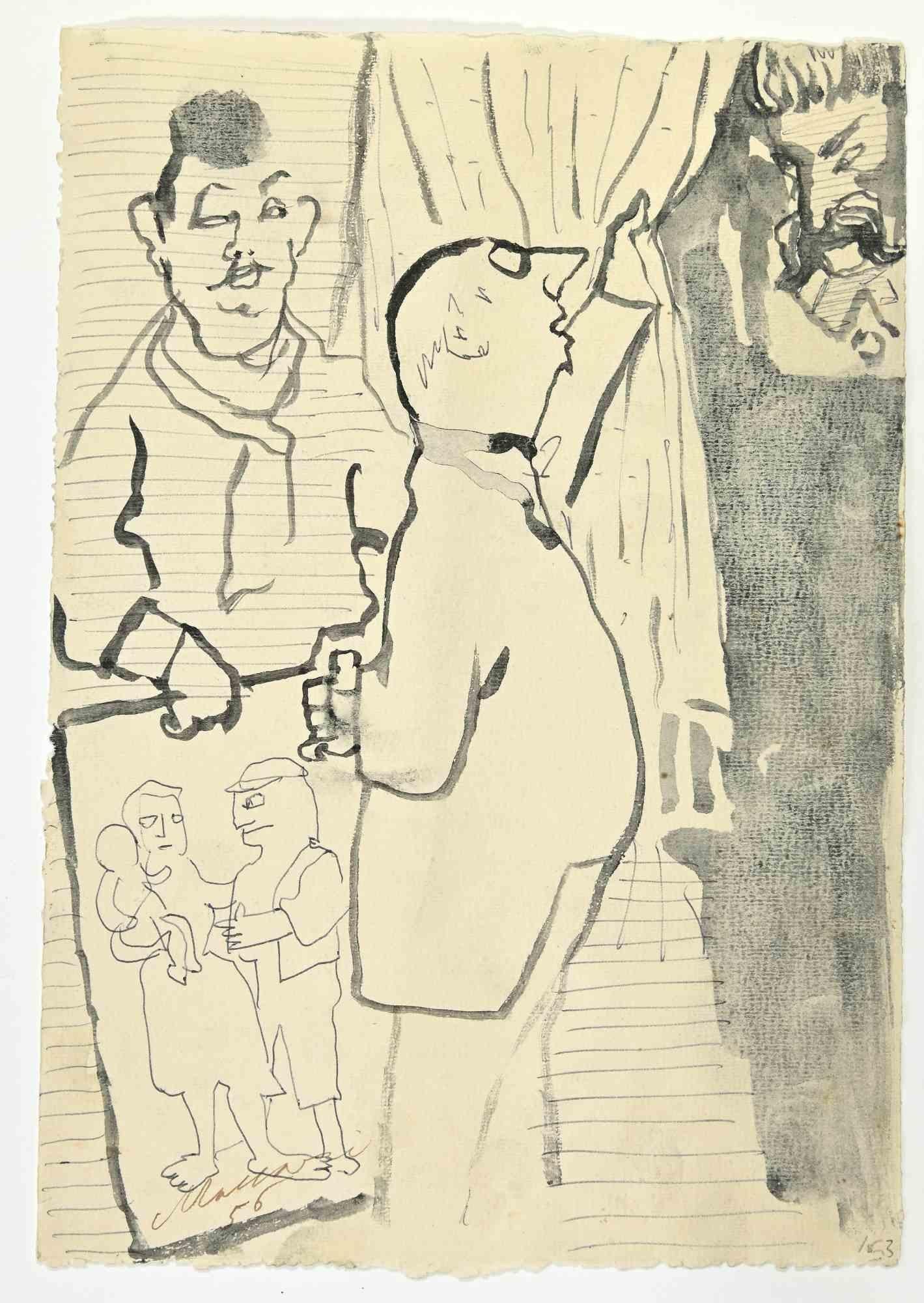
The Painter Ink and Watercolor Drawing, Modern Style, Signed, 1956

The Painter Ink and Watercolor Drawing, Modern Style, Signed, 1956

By Mino Maccari

Located in Roma, IT

The Painter is an ink and Watercolor Drawing realized by Mino Maccari (1924-1989) in 1956. Hand-signed on the lower and dated Good conditions. Mino Maccari (Siena, 1924-Rome, Jun...

Category

1950s Modern Figurative Drawings and Watercolors

Materials

Watercolor, Ink

The Men on The Bridge - Pencil Drawing By Norbert Meyre - Mid 20th Century

The Men on The Bridge - Pencil Drawing By Norbert Meyre - Mid 20th Century

By Norbert Meyre

Located in Roma, IT

The Men on The Bridge is a Drawing on paper realized by French painter Norbert Meyre in the mid-20 century. Drawing in China ink and pastel. The artwork is represented through deft...

Category

Mid-20th Century Modern Figurative Drawings and Watercolors

Materials

Pastel, Ink

Figures in Interior - Original Drawing on Paper by P.Guastalla - 20th Century

Figures in Interior - Original Drawing on Paper by P.Guastalla - 20th Century

By Pierre Guastalla

Located in Roma, IT

Figures is an original drawing in pencil and charcoal on paper, realized by Pierre Guastalla (1891- 1986). Hand-signed on the lower right. In good condition and edged except some s...

Category

Late 20th Century Figurative Drawings and Watercolors

Materials

Pencil, Charcoal

Figures - Ink and Watercolor by Leo Guida - 1970s

Figures - Ink and Watercolor by Leo Guida - 1970s

By Leo Guida

Located in Roma, IT

Figures is an original artwork realized by Leo Guida. Watercolor drawing on ivory paper. Good conditions. Not signed.

Category

1970s Modern Figurative Drawings and Watercolors

Materials

Watercolor, Ink