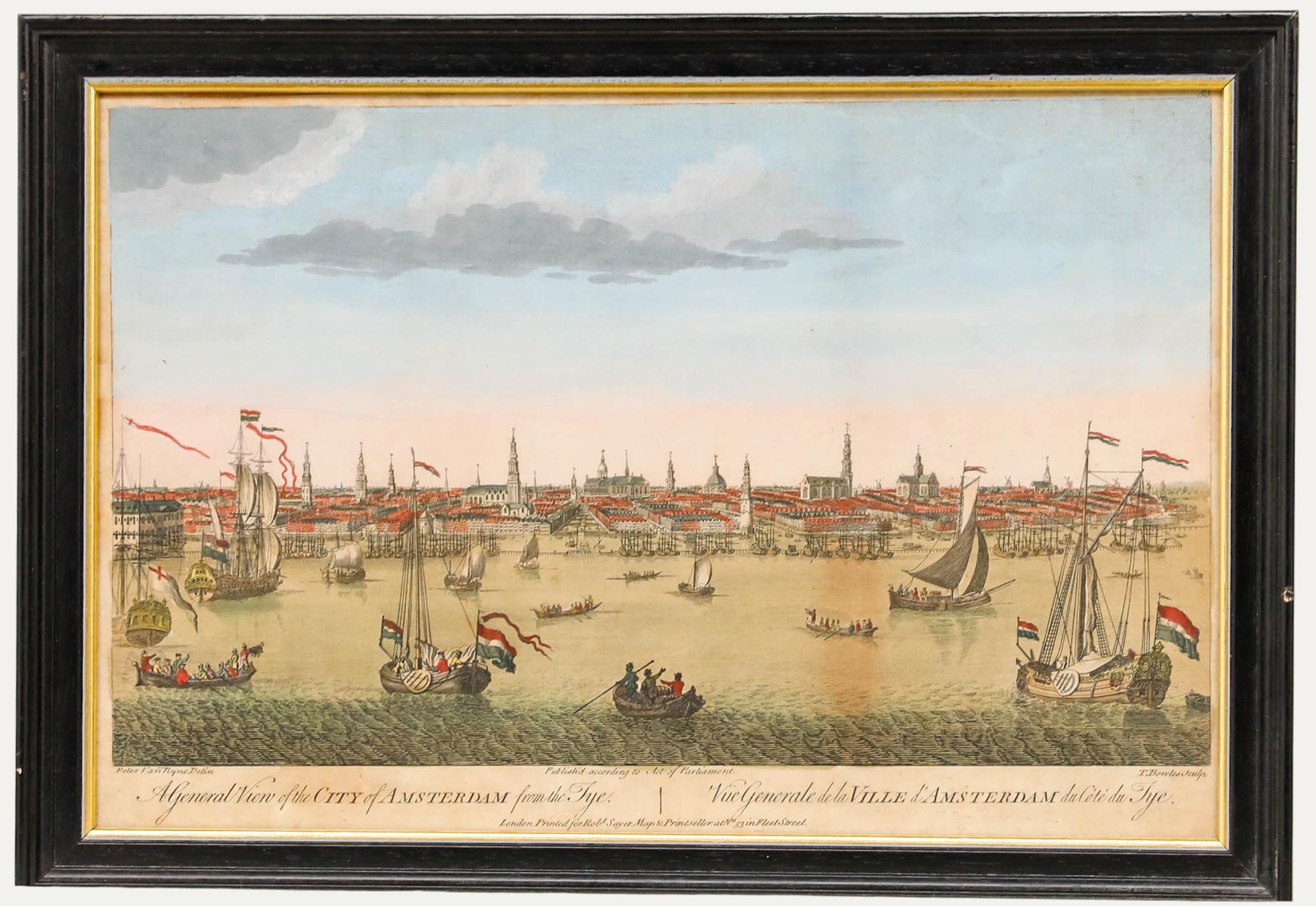
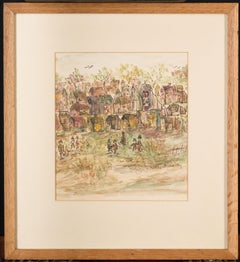
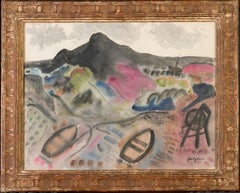
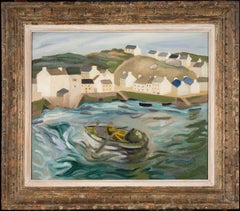
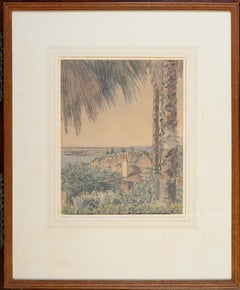
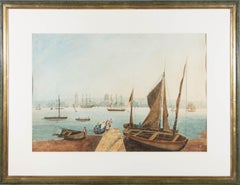
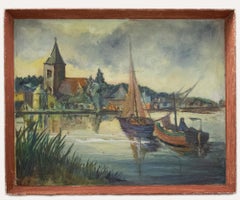
19th Century watercolour, Dutch view, unsigned.
The picture is in ink and watercolour and displays the view of a Harbour with a distant town in the background which at this point is still unknown despite many hours research of our staff searching. This picture has been the property of a well known and important London gallery, we acquired the picture on the assumption of discovering the painter, which we now believe to be Richard Dadd 1817-1886, due to the picture being subject to having been painted with obsessive detail, and the date, which due to the images highlighted within the additional depictions there is a date of 1838, it is worth noting that Dadd would have only been around the age of or 21-22 when this picture was painted and although Dadd was admitted to the Royal Academy Art Schools at the age of 20 he was considered to be among the leading Victorian artists of the day. In 1842 he was chosen to travel through Europe on his way to the middle East including, Greece, Turkey , Syria , Jerusalem , Jorden and Egypt. Dadd had a vivid imagination and he could well have imagined this picture without actually visiting the scene, it is after all a strange position to hold of the view , consequently this maybe the reason for our failure to discover the scene. The painter, according to the level of the eye would have to have been sitting in a crows nest on a ship, which is highly unlikely due stillness required for the detail, or the whole composition is imaginary, which we now think highly probable. Dad was of unsound mind and admitted to a psychiatric Hospital where he remained for the rest of his life, however he was encouraged to continue to paint and this is where he produced some of his best pictures, there are exhibits of his works in the Tate Gallery , the British Museum, Yale and the Louvre among many others.
I have included a further extensive biography of Dadd which you may find of interest.
Richard Dadd (1817–1886) was a singular figure in Victorian art whose career was tragically and definitively bisected by mental illness. Originally a rising star of the London art scene, Dadd is today recognized for his technical precision and a visionary style that flourished during more than four decades of institutional confinement.
Born in Chatham, Kent, Dadd was a precociously talented student at the Royal Academy Schools, where he became a founding member of "The Clique," a group of artists who challenged academic conventions. He gained early acclaim for his delicate "fairy paintings," a popular Victorian genre he imbued with unusual psychological depth.
In 1842, Dadd accompanied Sir Thomas Phillips on a ten-month "Grand Tour" of Europe and the Middle East to document the journey. The grueling trip, particularly the exposure to the sun and intense environments of Egypt and Syria, is often cited as the catalyst for his mental collapse. During this time, he began to experience religious delusions, believing himself to be under the influence of the Egyptian god Osiris.
Upon his return to England in 1843, Dadd’s condition deteriorated into what modern scholars identify as a form of schizophrenia. In August of that year, acting on a perceived divine command, he murdered his father in Cobham Park, Kent. After fleeing to France and attempting further violence, he was apprehended and subsequently committed to the "criminal lunatic" department of Bethlem Royal Hospital (Bedlam) in 1844. He was later transferred to the newly opened Broadmoor Hospital in 1864, where he remained until his death in 1886.
Despite his incarceration, Dadd was encouraged by enlightened physicians to continue painting. His asylum works are characterized by:
His technique involved an "obsessive" and "painstaking" application of paint, often utilizing a stippling method derived from miniature painting.
Barred from the natural world, Dadd relied on his extraordinary visual memory of his Middle Eastern travels to create complex landscapes and genre scenes.
His most celebrated masterpieces, The Fairy Feller’s Master-Stroke (Tate Britain) and Contradiction: Oberon and Titania, were both produced during his confinement.
He produced a notable series titled Sketches to Illustrate the Passions, which explored human emotions through a cryptic, often disturbing lens.
Long forgotten after his death, Dadd’s work was rediscovered in the 1960s and 70s, leading to a major retrospective at the Tate in 1974. Today, he is studied not merely as a clinical curiosity, but as a sophisticated artist who successfully translated an inner "terra incognita" into some of the most compelling imagery of the 19th century.