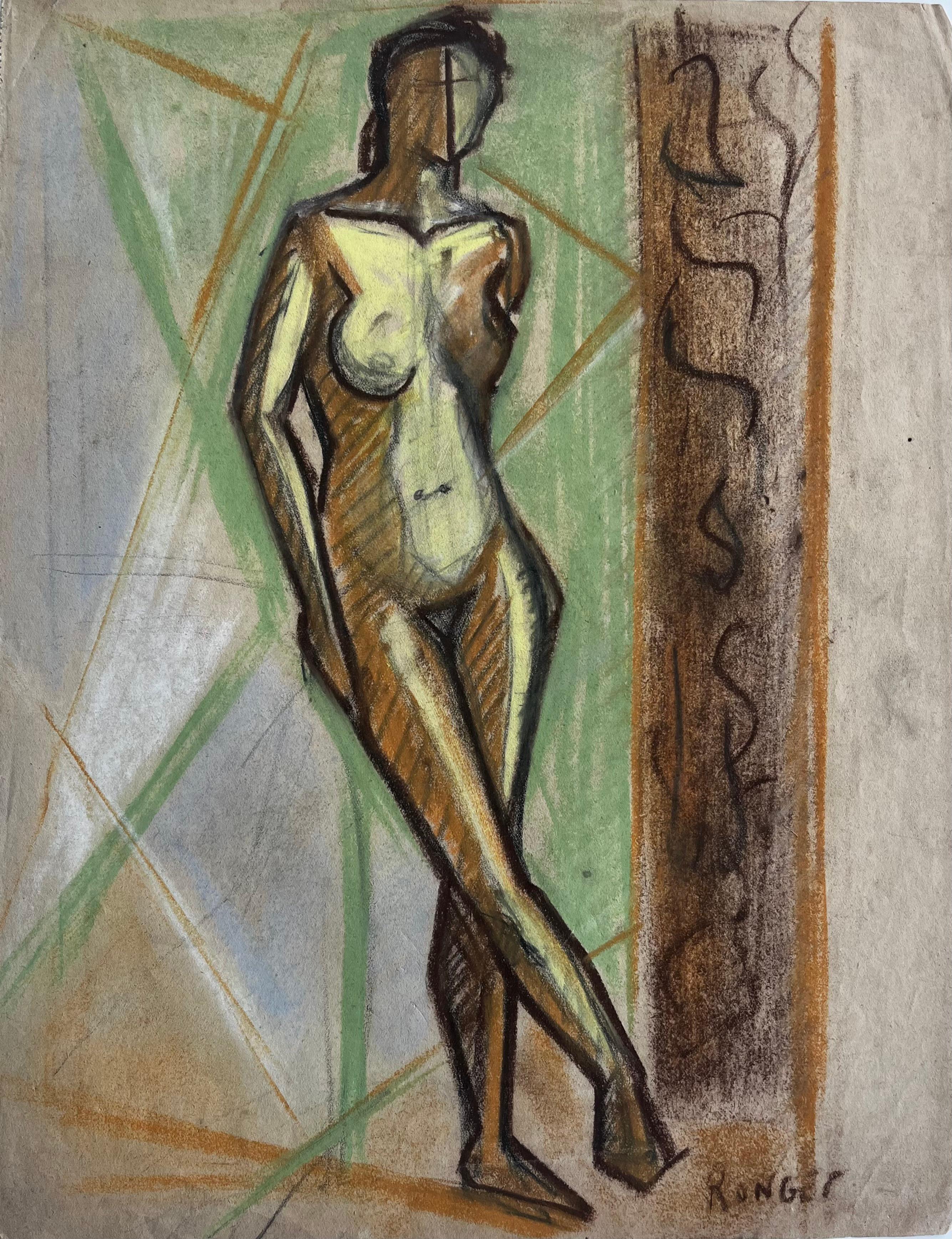
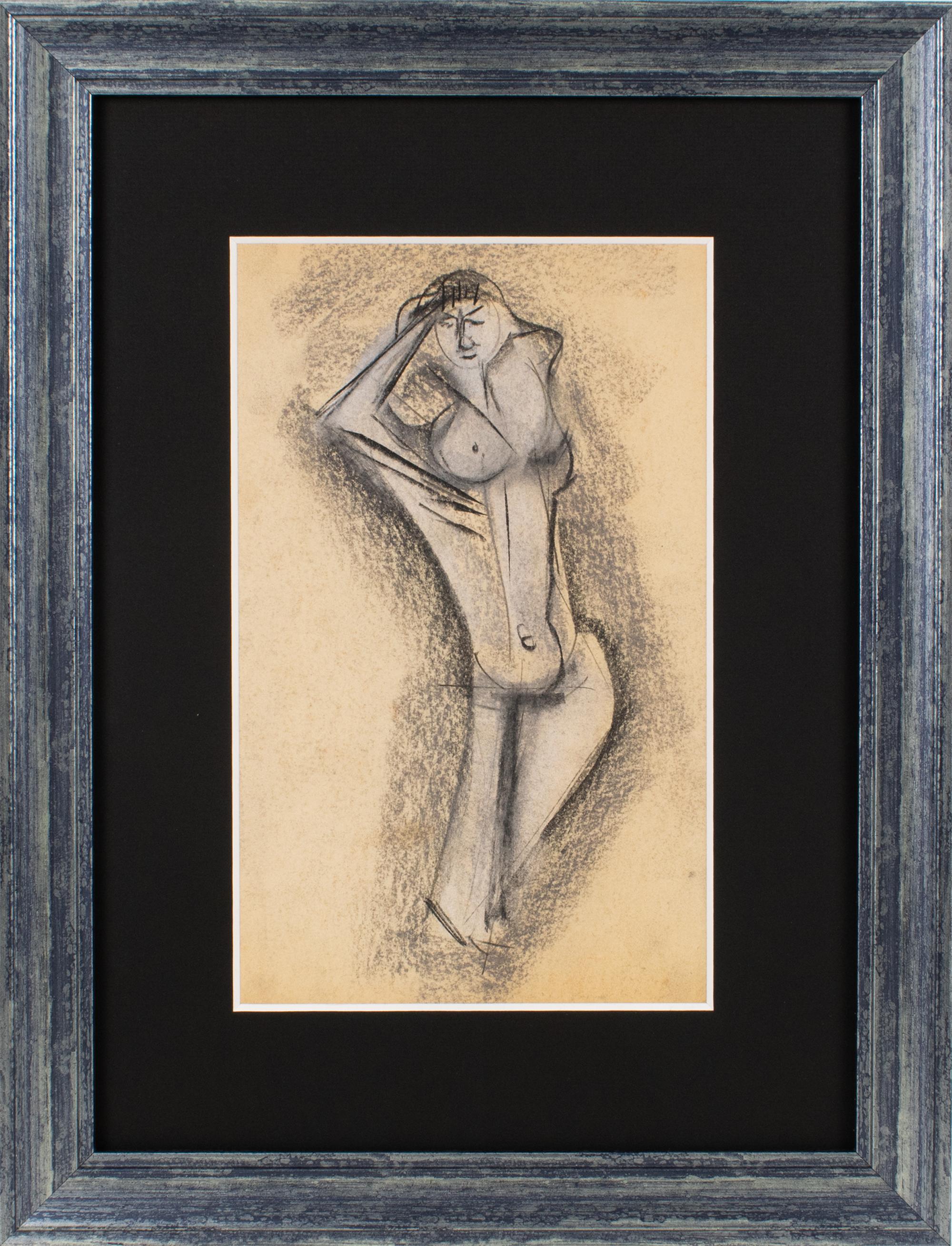
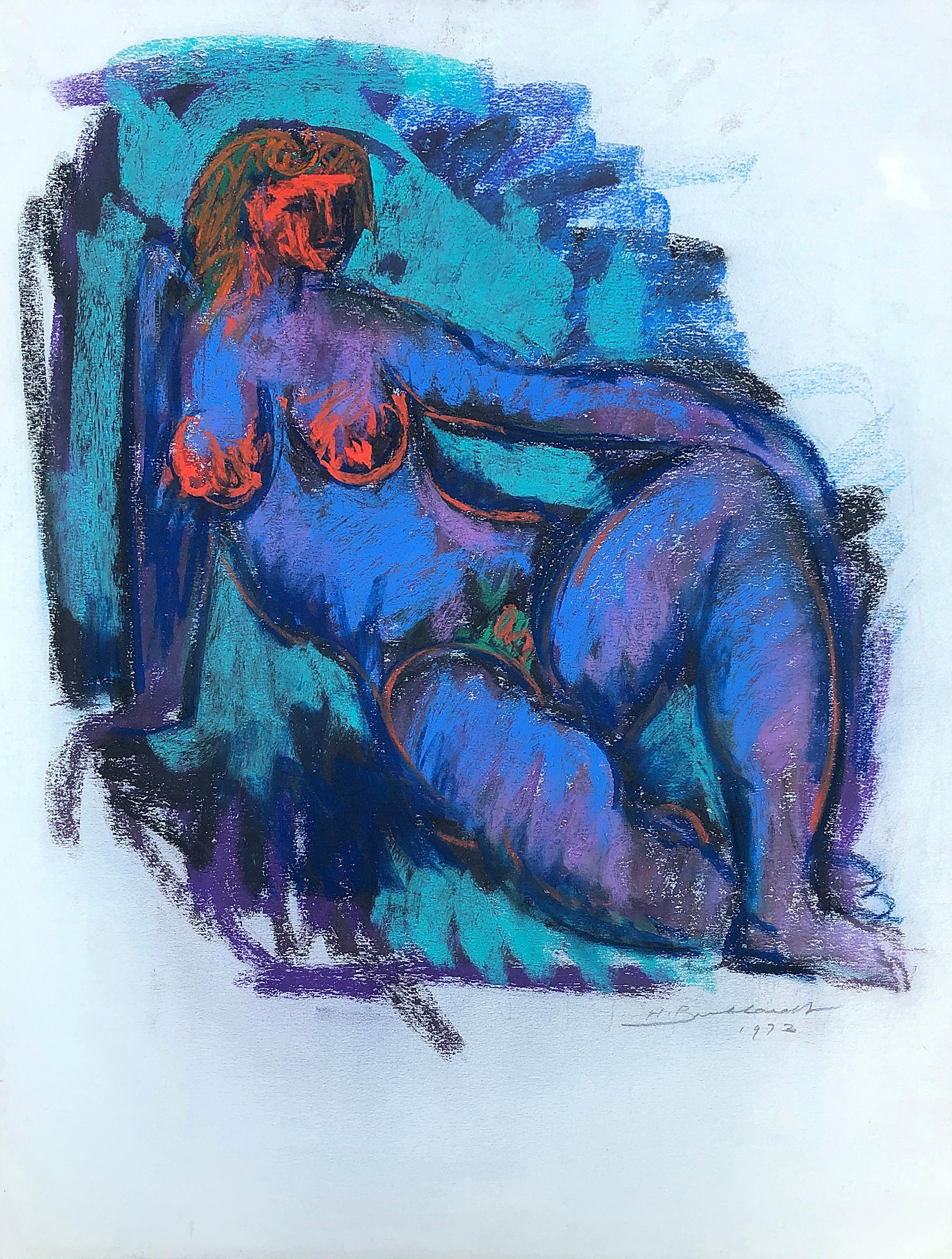
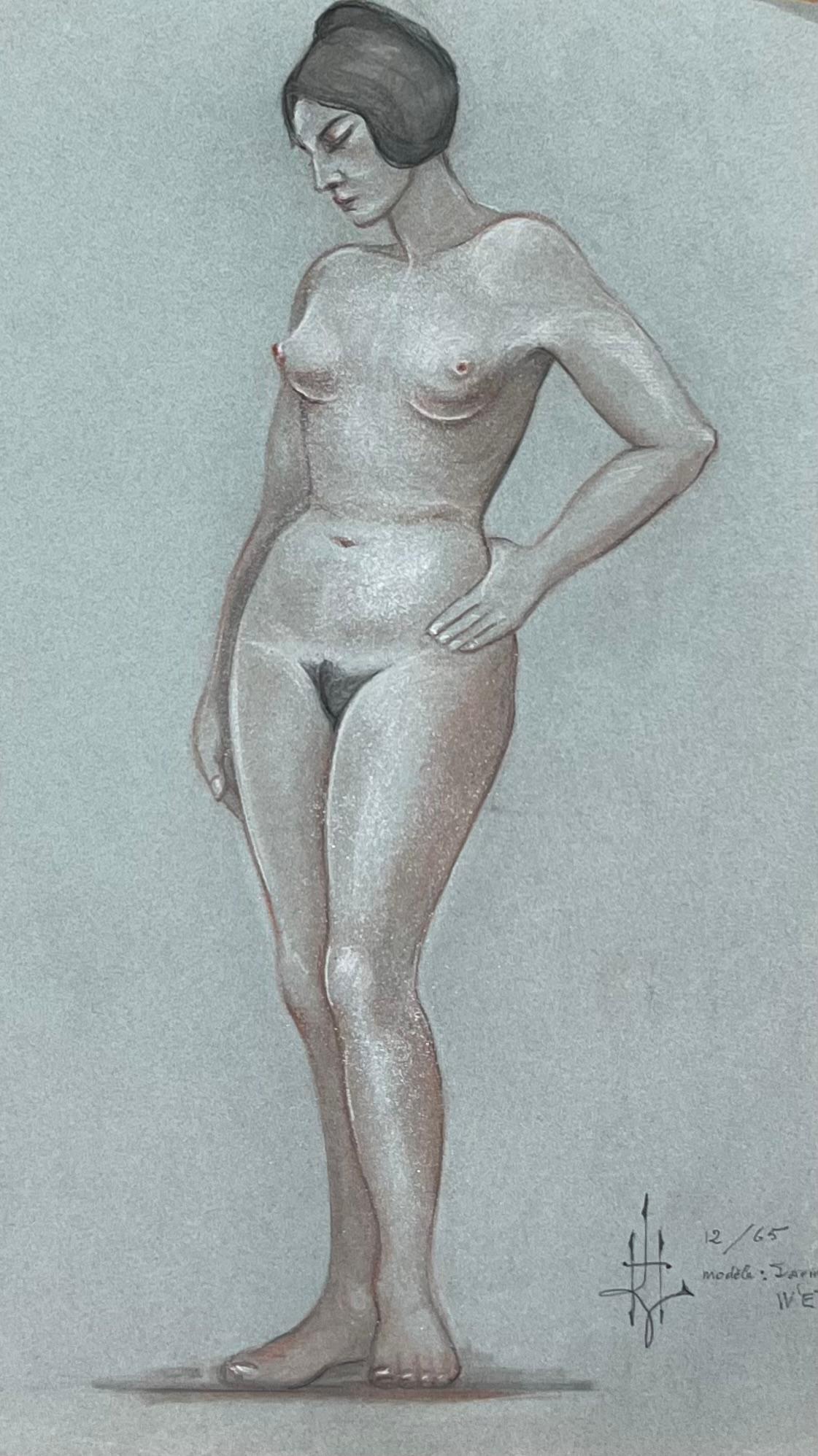
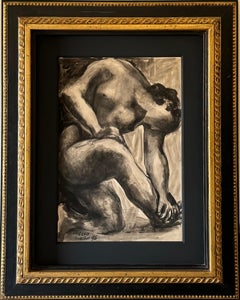
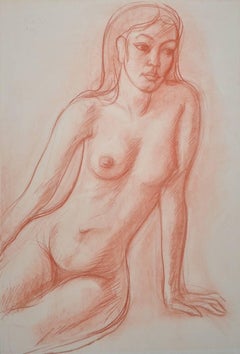
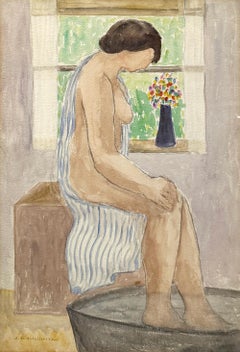
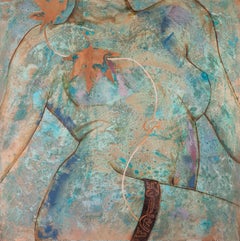
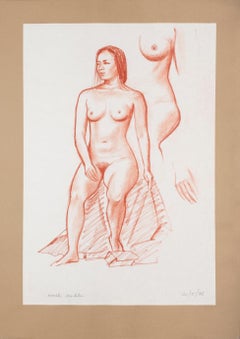
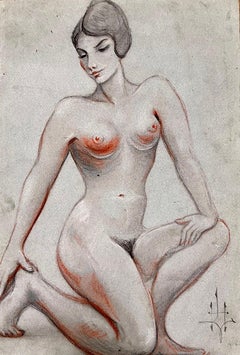
This pastel on paper NUDE I by Natalie Eynon Grauer offers a striking view into mid century American modernism and the enduring power of the human figure as a vehicle for abstraction. Exhibited at the Cleveland Museum of Art’s 31st May Show in 1949, the work represents both Grauer’s personal maturity as an artist and a broader moment in which regional artists were absorbing international modernist ideas while remaining grounded in direct observation from life.
Measuring 19 by 10.5 inches, NUDE I is a tall, narrow composition that emphasizes the vertical sweep of the standing female body. Grauer positions the figure with her back to the viewer, subtly twisting at the waist so that the torso and hips become the dominant visual elements. The pose is intimate yet anonymous: the head is only lightly indicated and turned away, and the limbs are reduced to abbreviated arcs and planes. This deliberate withholding of facial detail and gesture shifts attention from individual identity to the formal drama of line, volume, and shadow.
The drawing reveals an economy of means that borders on the sculptural. Grauer uses sweeping charcoal or dark pastel strokes to carve out the curve of the spine, the weight of the hips, and the fullness of the thighs. Instead of modeling every anatomical detail, she blocks forms into broad, rounded shapes, then lets areas of untouched paper serve as highlights. The resulting figure appears simultaneously solid and simplified, like a carved stone form brought to life. Soft, smudged passages around the flanks and legs create a halo of shadow that lifts the body off the background and suggests movement or an afterimage, as if the model has just shifted her weight.
The choice of toned paper intensifies the sense of warmth and tactility. Against the mid value ground, Grauer’s dark contours and shaded passages create a limited but expressive value range. The paper’s natural color echoes human skin, allowing the artist to suggest light and surface without resorting to descriptive color. This restraint aligns the drawing with modernist figure studies of the 1930s and 1940s, in which artists explored the body as a structure of rhythms rather than a site of anecdotal detail. At the same time, the voluptuous curvature of the hips and back preserves an unmistakable sensuality; NUDE I never feels coldly analytical.
Grauer’s simplified, rhythmically repeated contours place her in conversation with contemporaneous tendencies in European and American modern art, particularly the abstraction of the figure found in artists such as Henry Moore and certain strands of cubism and expressionism. Yet there is a distinctly personal, human scale to the work. This is not an exercise in theory but a record of close looking. The artist’s hand remains visible in every stroke, from the quick linear notations at the shoulders to the more worked passages around the lower back. The drawing balances discipline and spontaneity, structure and improvisation.
The title, NUDE I, suggests that Grauer conceived the work as part of a series or ongoing exploration of the subject. The numerical designation emphasizes the study like, investigative character of the piece: this is the first in a sequence of attempts to understand how the body can be transformed into an arrangement of arcs, ovals, and shadows while retaining emotional resonance. Shown in the Cleveland Museum of Art’s May Show, a juried regional exhibition that highlighted the best work from artists in the area, the piece also testifies to the seriousness with which Grauer pursued her practice in the final decade of her life.
Within Grauer’s lifetime, many women artists who worked in modernist modes remained underrecognized, particularly when they focused on subjects—like the female nude—that had long been dominated by male perspectives. NUDE I quietly challenges that tradition. Here, a woman artist draws the female body with authority, empathy, and a clear formal agenda. The gaze is neither voyeuristic nor sentimental; instead, it is analytical and admiring, interested in the strength and presence of the figure as an abstract structure as much as in its sensual appeal.
Viewed today, NUDE I stands as an evocative document of postwar American modernism and of Natalie Eynon Grauer’s own artistic voice. In a modest format and with a limited palette, she achieves a surprisingly monumental effect. The drawing captures the tension between solidity and flux, anonymity and intimacy, that defines so many of the most compelling modern figure studies. It is a small but potent work that invites slow looking and rewards attention to the subtleties of line, light, and form.
Signed lower right
Exhibited at the Cleveland Museum of Art’s 31st May Show in 1949, Cleveland, Ohio
The Artist, Cleveland, Ohio;
PROVENANCE: Acquired from the above over a 50 year period by a relative of the artist, Rancho Santa Fe, California.
Framed Dimensions: 30 x 22 inches