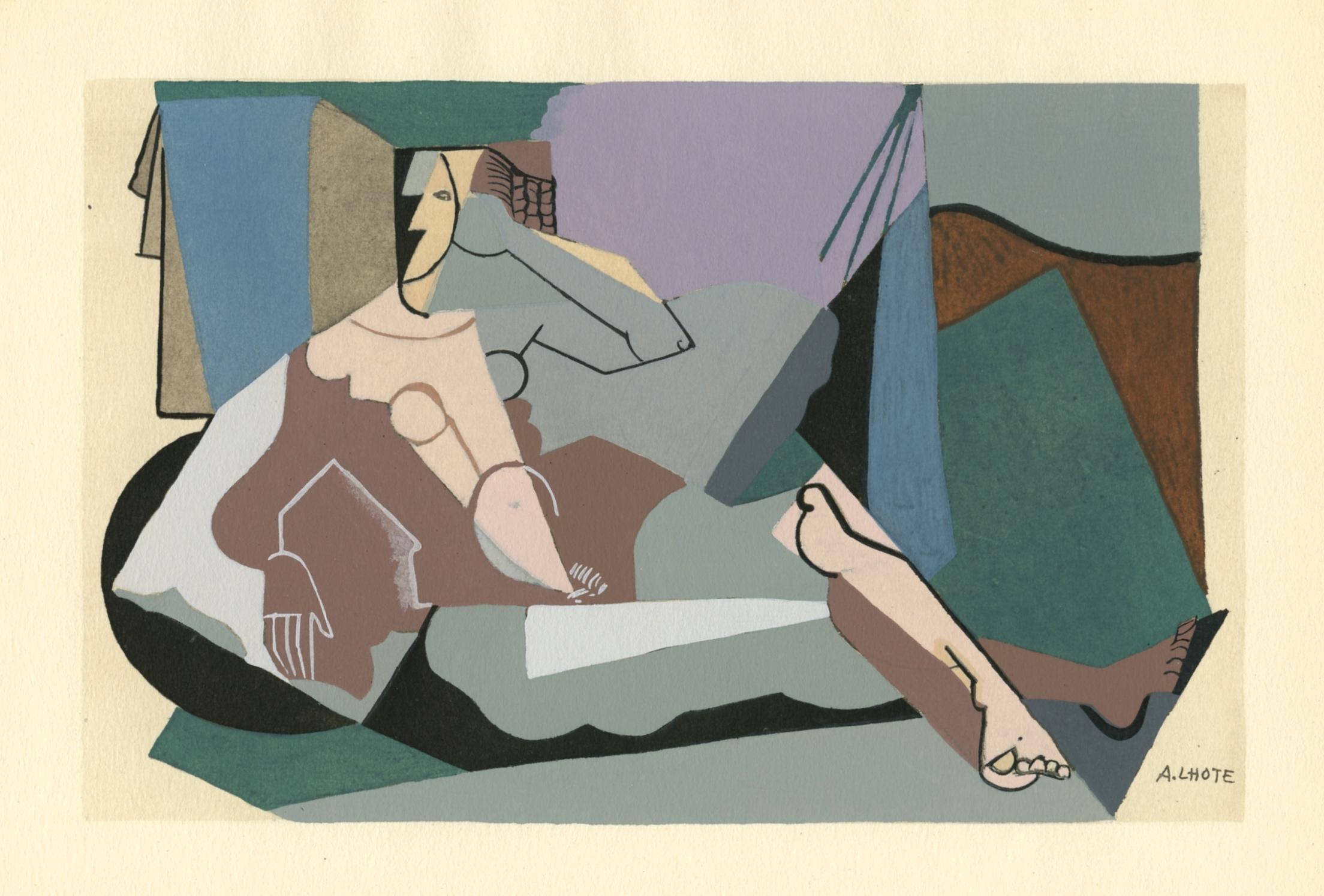
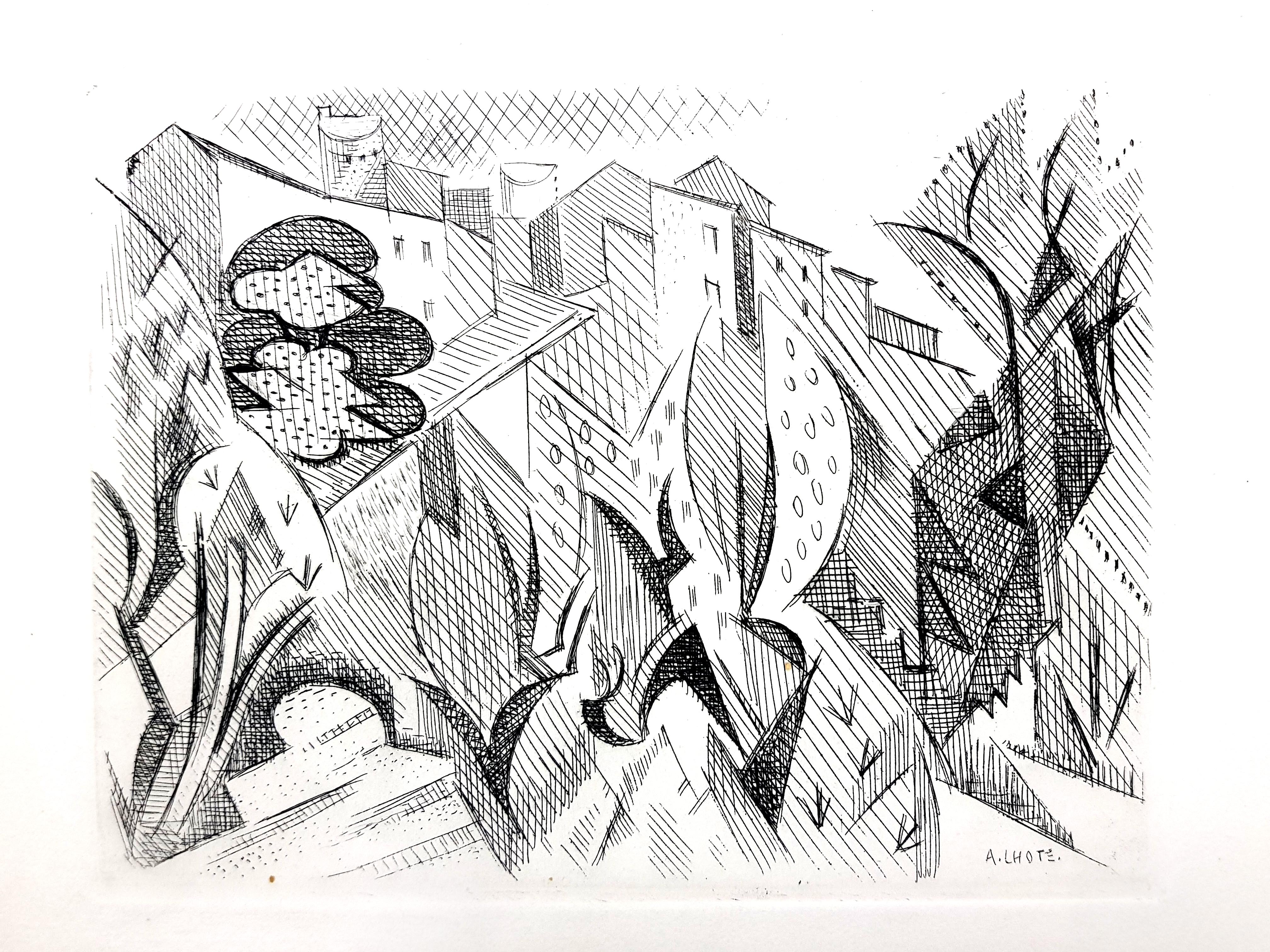
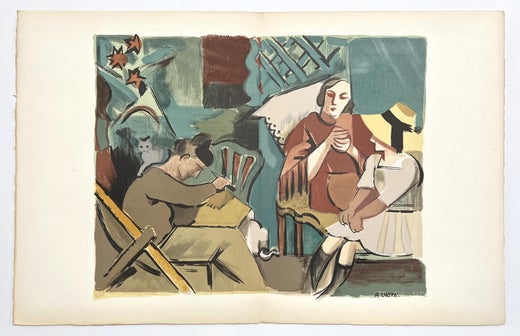
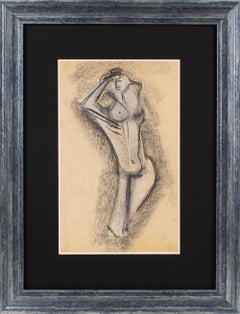
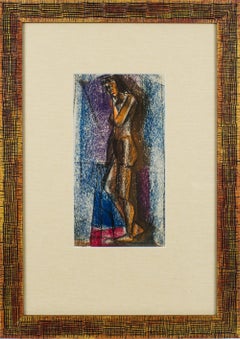
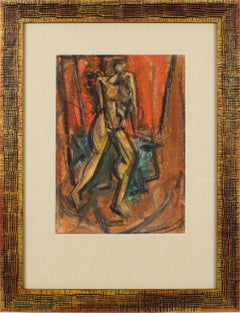
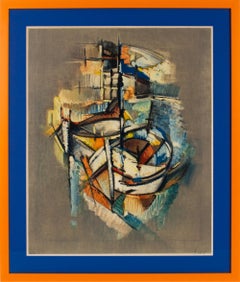
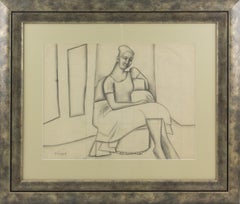
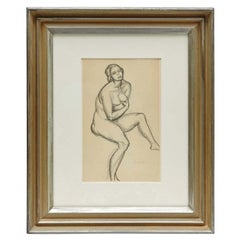
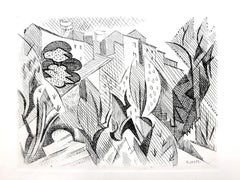
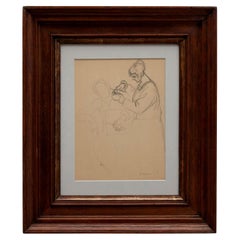
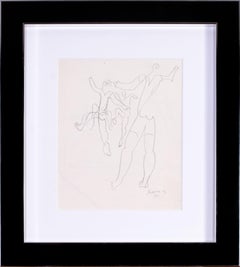
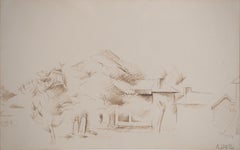
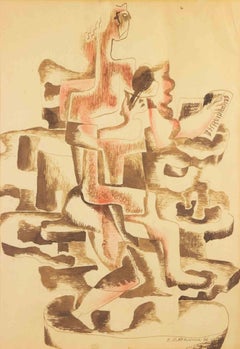
This cubist black ink pen drawing by André Lhote (1885 - 1962), circa 1910, features a still-life composition, a bowl with fruits on a table with a cubist geometric design.
We added photos of the drawing before framing. This original drawing by André Lhote was hand-made on the back of a letterhead sheet from the Hotel de Paris in Monte Carlo.
It is conceivable that the artist created this drawing "on the back of an envelope" as a draft for a potential larger piece, such as an oil painting on canvas.
The handwritten signature is present in the bottom right corner.
Newly reframed in a dark brown wood frame with texture, a chocolate brown matte with a white accent, and acrylic glass protection.
Measurements:
With frame: 17.94 in wide (45.5 cm) by 14.75 in high (37.5 cm).
Opening: 10 in wide (25.5 cm) by 6.69 in high (17 cm).
Reference:
André Lhote (5 July 1885 – 24 January 1962) was a French Cubist painter of figure subjects, portraits, landscapes, and still life. He was also very active and influential as a teacher and writer of art.
Lhote was born on 5 July 1885 in Bordeaux, France, and learned wood carving and sculpture from the age of 12, when his father apprenticed him to a local furniture maker to train as a wood sculptor. He enrolled at the École des Beaux-Arts in Bordeaux in 1898 and studied decorative sculpture until 1904.
While there, he began to paint in his spare time, and he left home in 1905, moving into his studio to devote himself to painting. His influences are Gauguin and Cézanne. He held his first single exhibition at the Galerie Druet in 1910, four years after he had moved to Paris.
After initially working in a Fauvist style, Lhote shifted towards Cubism and joined the Section d'Or group in 1912, exhibiting at the Salon de la Section d'Or. He was alongside some of the fathers of modern art, including Gleizes, Villon, Duchamp, Metzinger, Picabia, and La Fresnaye.
The outbreak of the First World War interrupted his work. After discharge from the army in 1917, he became one of the groups of Cubists supported by Léonce Rosenberg. In 1918, he co-founded Nouvelle Revue Française, the art journal to which he contributed articles on art theory until 1940.
Lhote taught at the Académie Notre-Dame des Champs from 1918 to 1920 and later taught at other Paris art schools—including the Académie de la Grande Chaumière and his school, the Academy André Lhote, which he founded in Montparnasse in 1922.
His students included Henri Cartier-Bresson, Tamara de Lempicka, and others.
Lhote lectured extensively in France and other countries, including Belgium, England, Italy, and, from the 1950s, also in Egypt and Brazil.
The Grand Prix National de Peinture rewarded his work in 1955. The UNESCO Commission for Sculpture appointed Lhote president of the International Association of Painters, Engravers, and Sculptors.
Lhote died in Paris in 1962.
(Credit: Wikipedia)