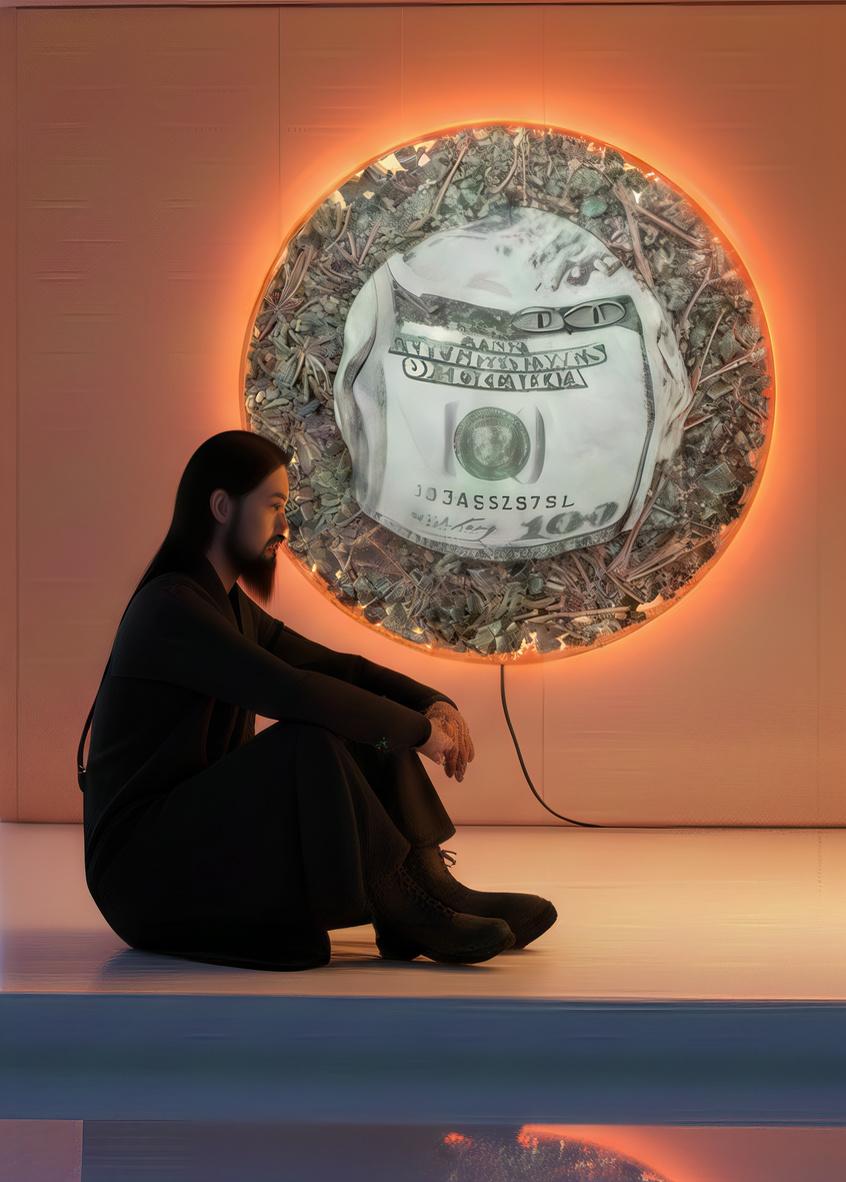
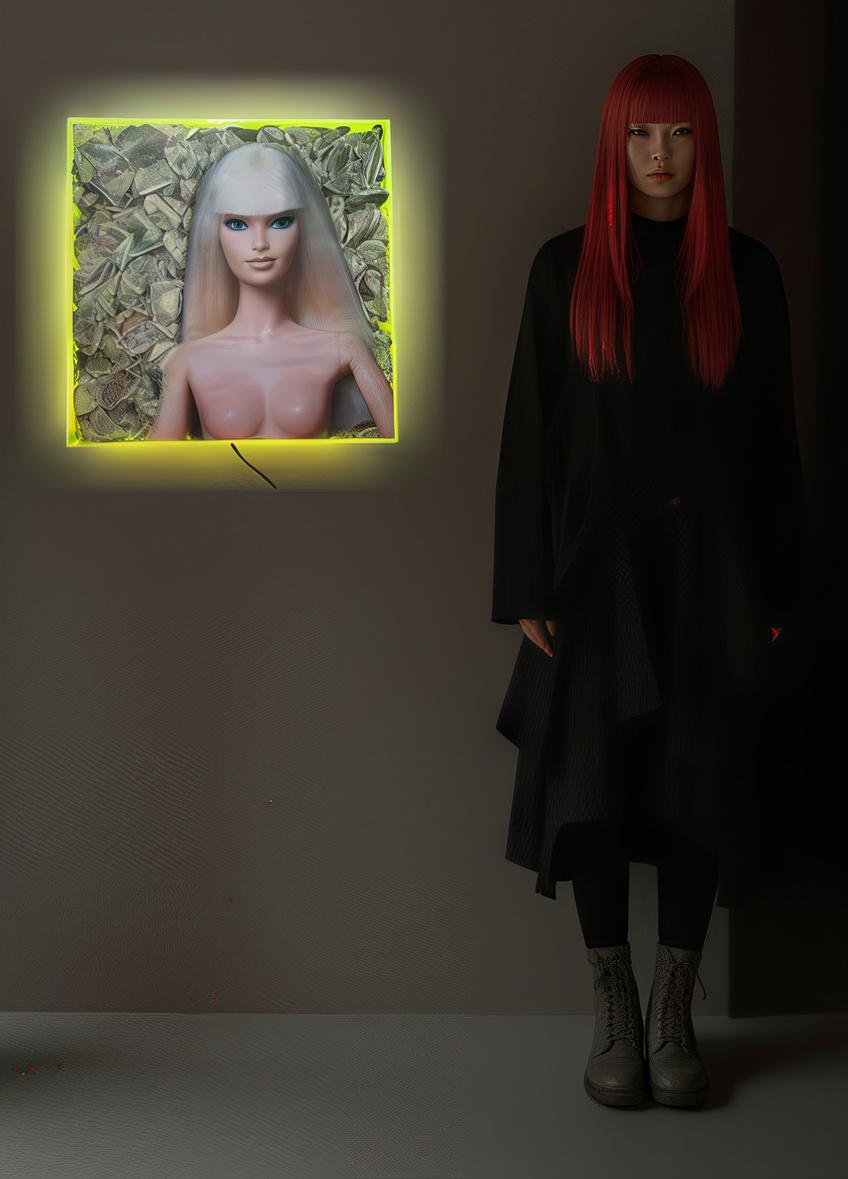
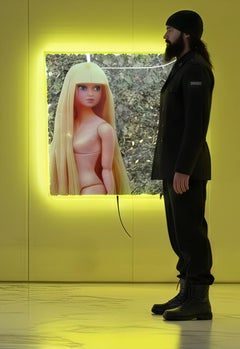
Dreamland Dollhouse is a wall-mounted sculpture by Kumikaho Oshima from the series Dollar Dreams in Neon Barbie World, where the artist assembles dollar bills and fragmented Barbie heads inside a plexiglass enclosure illuminated by vivid pink LED light. The composition immediately draws attention through the scattering of doll faces emerging from a dense monetary background, creating a visual dialogue between constructed identity and economic symbolism. These floating visages appear suspended in a landscape of currency, transforming the surface into a psychological terrain where childhood fantasy and financial aspiration intersect.
The color pink plays a crucial conceptual role in the perception of the work. Often associated with innocence, femininity, and pop culture, it is recontextualized here as a critical lens. Under the pink glow, the dollar bills acquire an almost surreal softness, while the Barbie heads seem to drift within an artificial dreamscape shaped by consumer values. This chromatic atmosphere blurs the boundary between tenderness and commodification, revealing how early visual influences can shape perceptions of success and self-worth.
In Dreamland Dollhouse, fragmentation becomes a powerful visual language. The repetition of Barbie heads dispersed among the currency suggests the multiplicity of identities shaped by social expectations and media representation. By isolating these faces from their bodies, Oshima evokes the disconnection between appearance and individuality, highlighting how standardized ideals of beauty and achievement can fragment personal identity. The viewer is invited to reflect on how cultural archetypes are internalized and reproduced across generations.
The plexiglass enclosure reinforces the sense of observation and distance. Transparency allows full visibility, yet the sealed surface establishes a boundary that echoes the separation between aspiration and reality. The pink LED illumination equalizes every element within the frame, dissolving hierarchies between object and symbol while referencing commercial display environments where color becomes a persuasive tool. Oshima subverts this visual strategy by exposing its psychological implications rather than celebrating its allure.
As a major member of the studio CrazyNoodles, Oshima contributes to a broader dialogue on how globalization influences Japanese visual culture. In this piece, the juxtaposition of Western icons—Barbie imagery and American currency—reveals the fluid exchange of symbols across cultures and the tensions between imported ideals and local identity formation. The artwork becomes a reflection of how contemporary aspirations are shaped by globally circulated images.
The conceptual legacy fostered within the collective by Hiro Ando is evident in Oshima’s ability to merge visual seduction with sociological depth. Dreamland Dollhouse exemplifies this balance: its playful aesthetic invites engagement, while the layered symbolism encourages critical reflection on how desire, identity, and economic imagery intertwine. The luminous pink frame acts as both an invitation and a boundary, emphasizing the constructed nature of the dream it contains.
Through its dynamic composition, chromatic intensity, and symbolic complexity, Dreamland Dollhouse captures the viewer’s attention while rewarding sustained observation. Oshima demonstrates her ability to transform familiar pop imagery into a nuanced exploration of contemporary cultural dynamics. By its poised composition, refined execution, and subtle emotional resonance, Dreamland Dollhouse stands out as a highly collectible work. Particularly suited for collectors of contemporary Japanese art, Neo-Pop, and sculptures exploring the intersections of identity, consumer culture, and visual psychology.
LITERATURE ABOUT THE SERIE “Dollar Dreams in Neon Barbie World”
Within the series Dollar Dreams in Neon Barbie World, Kumikaho Oshima presents a cohesive body of five works that engage critically with the visual language of Japanese Neo-Pop while probing the psychological architecture of contemporary desire. By repeatedly combining Barbie figures, dollar bills, plexiglass enclosures, and intensely saturated LED lighting, the artist constructs luminous tableaux that function like symbolic vitrines. These works do not merely juxtapose global icons; they stage a confrontation between childhood mythology, economic aspiration, and the performative construction of identity in a hyper-visual society.
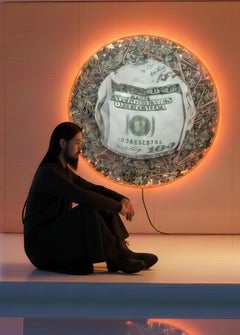
Throughout the series, the dollar evolves from a simple emblem of currency into a pervasive psychological texture. Multiplied, folded, and layered, it becomes an environment rather than an object, evoking the constant presence of economic metrics in personal ambition. Oshima reframes money as a visual system that silently dictates value, shaping both collective imagination and individual self-worth. The repetition of the bill suggests that financial success is no longer an endpoint but a continuous horizon that conditions how dreams are formulated and pursued.
The Barbie figure emerges as a powerful archetype of projected femininity and standardized beauty. Transplanted into a Japanese context, it embodies a cultural intersection where Western ideals merge with local expectations, often producing a subtle yet persistent tension. Oshima reveals the rigidity embedded within this icon: the fixed smile, idealized proportions, and immaculate appearance transform the doll into a symbol of performative identity. Encased within glowing structures, these figures appear simultaneously celebrated and confined, mirroring the paradox experienced by many young women navigating visibility, autonomy, and societal expectation.
Material choices play a crucial conceptual role across the series. Plexiglass suggests transparency while enforcing separation, reinforcing the gap between aspiration and lived reality. LED illumination, rendered in vivid hues such as orange, pink, and yellow, echoes the sensory overload of contemporary urban environments where brightness becomes synonymous with desirability. In Oshima’s visual vocabulary, light functions both as attraction and interrogation: it draws viewers inward while exposing the artificial frameworks that shape emotional responses and consumer behavior.
From a sociocultural perspective, the works reflect the pressures placed on young Japanese women in a rapidly globalizing society. The tension between individuality and conformity, independence and collective expectation, is subtly embedded within each composition. The dolls’ synthetic perfection contrasts with the chaotic layering of currency, suggesting how personal identity is often negotiated within systems that prioritize visibility and economic validation. Oshima captures this contradiction with sensitivity, portraying vulnerability not as weakness but as a site of introspection and resilience.
Psychologically, the series conveys an acute awareness of how contemporary individuals internalize external projections. The luminous enclosures resemble stages on which ideals are continuously performed, revealing the emotional labor required to maintain socially acceptable images of success. Oshima’s approach suggests that beneath the surface allure lies a complex negotiation between authenticity and adaptation, where aspiration can inspire yet simultaneously constrain.
As a major member of the studio CrazyNoodles, Oshima contributes to a broader redefinition of Japanese Neo-Pop, particularly under the conceptual influence of Hiro Ando. However, her practice is distinguished by a more introspective tone, where pop aesthetics become tools for critical inquiry rather than celebration. The five works in Dollar Dreams in Neon Barbie World transform familiar symbols into reflective devices that question how globalization, gender constructs, and economic values intersect within contemporary visual culture.
Ultimately, the series extends beyond aesthetic experimentation to become a cultural mirror, revealing the mechanisms through which desire is shaped and circulated. By illuminating seductive surfaces while exposing their conceptual fragility, Kumikaho Oshima offers a lucid examination of the emotional and social dynamics defining modern life. These luminous sculptures invite viewers to reconsider their relationship with images of success and perfection, emphasizing not only what is seen, but how and why it continues to captivate.