Provenance:
with “Mr. Scheer,” Vienna, by July 1918; where acquired by:
Jindřich Waldes, Prague, 1918–1941; thence by descent to:
Private Collection, New York
Literature:
Rudolf Kuchynka, “České obrazy tabulové ve Waldesově obrazárně,” Památky archeologické, vol. 31 (1919), pp. 62-64, fig. 5.
Jaroslav Pešina, “K datování deskových obrazů ve Waldesově obrazárně,” Ročenka Kruhu pro Pěstování Dějin Umění: za rok (1934), pp. 131-137.
Jaroslav Pešina, Pozdně gotické deskové malířství v Čechách, Prague, 1940, pp. 150-151, 220.
Patrik Šimon, Jindřich Waldes: sběratel umění, Prague, 2001, pp. 166, 168, footnote 190.
Ivo Hlobil, “Tři gotické obrazy ze sbírky Jindřicha Waldese,” Umění, vol. 52, no. 4 (2004), p. 369.
Executed sometime in the 1380s or 1390s by a close associate of the Master of the
Třeboň Altarpiece, this impressive panel is a rare work created at the royal court in Prague and a significant re-discovery for the corpus of early Bohemian painting. It has emerged from an American collection, descendants of the celebrated Czech industrialist and collector Jindřich Waldes, who died in Havana fleeing Nazi-occupied Europe.
The distinctive visual tradition of the Bohemian school first began to take shape in the middle of the fourteenth century after Charles IV—King of Bohemia and later Holy Roman Emperor—established Prague as a major artistic center. The influx of foreign artists and the importation of significant works of art from across Europe had a profound influence on the development of a local pictorial style. Early Italian paintings, especially those by Sienese painters and Tommaso da Modena (who worked at Charles IV’s court), had a considerable impact on the first generation of Bohemian painters. Although this influence is still felt in the brilliant gold ground and the delicate tooling of the present work, the author of this painting appears to be responding more to the paintings of his predecessors in Prague than to foreign influences.
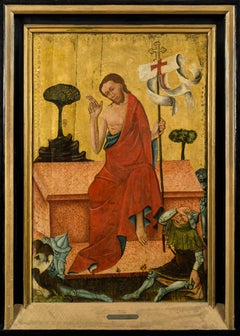
This Resurrection of Christ employs a compositional format that was popular throughout the late medieval period but was particularly pervasive in Bohemian painting. Christ is shown sitting atop a pink marble sarcophagus, stepping down onto the ground with one bare foot. He blesses the viewer with his right hand, while in his left he holds a triumphal cross with a fluttering banner, symbolizing his victory over death. Several Roman soldiers doze at the base of the tomb, except for one grotesque figure, who, beginning to wake, shields his eyes from the light and looks on with a face of bewilderment as Christ emerges from his tomb. Christ is wrapped in a striking red robe with a blue interior lining, the colors of which vary subtly in the changing light. He stands out prominently against the gold backdrop, which is interrupted only by the abstractly rendered landscape and trees on either side of him.
The soldiers’ armor is rendered in exacting detail, the cool gray of the metal contrasting with the earth tones of the outer garments. The sleeping soldier set within a jumble of armor with neither face nor hands exposed, is covered with what appears to be a shield emblazoned with two flies on a white field, somewhat resembling a cartouche (Fig. 1). This may be a heraldic device of the altarpiece’s patron or it may signify evil, referencing either the Roman soldiers or death, over both of which Christ triumphs.
This painting formed part of the collection assembled by the Czech industrialist and founder of the Waldes Koh-i-noor Company, Jindřich Waldes, in the early twentieth century. As a collector he is best remembered for establishing the Waldes Museum in Prague to house his collection of buttons (totaling nearly 70,000 items), as well as for being the primary patron of the modernist painter František Kupka. Waldes was also an avid collector of older art, and he approached his collecting activity with the goal of creating an encyclopedic collection of Czech art from the medieval period through to the then-present day. At the conclusion of two decades of collecting, his inventory counted 2331 paintings and drawings, 4764 prints, and 162 sculptures. This collection, which constituted the Waldesova Obrazárna (Waldes Picture Gallery), was first displayed in Waldes’ home in Prague at 44 Americká Street and later at his newly built Villa Marie at 12 Koperníkova Street. This Resurrection of Christ retains its frame from the Waldes Picture Gallery, including its original plaque “173 / Česky malíř z konce 14 stol.” (“Czech painter from the end of the 14th century”) and Waldes’ collection label on the reverse.
The Resurrection of Christ was one of the most significant late medieval panel...
Category
15th Century and Earlier Old Masters Paintings