Artist: Lowell Nesbitt (1933–1993)
Title: Shoulder and Lily '64
Year: 1964
Medium: Oil on linen
Size: 44 × 36 inches
Condition: Excellent
Inscription: Signed, dated, and titled by the artist, verso
Provenance: Estate of Lowell Blair Nesbitt,
New York, New York
Notes: This exquisite oil painting by Lowell Nesbitt (1933-1993), titled Shoulder and Lily '64, from the artist's celebrated X-Ray series, was executed in 1964. The masterfully conceived composition represents one of the most innovative and intellectually ambitious bodies of work from Nesbitt's early career, created during
a period in which he was actively exploring the intersection of science, anatomy, beauty, and perception.
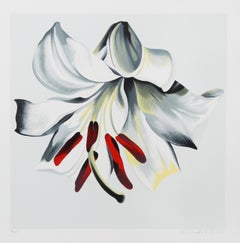
Combining the clinical precision of radiographic imagery with the lyrical elegance of botanical form, the painting juxtaposes an enlarged x-ray view of the human shoulder and ribcage against the luminous image of a white lily suspended within a dark circular field. The striking contrast between skeletal structure and
delicate blossom creates a powerful meditation on fragility, mortality, growth, and renewal, while simultaneously challenging conventional distinctions between scientific observation and
aesthetic experience. Rather than presenting anatomy as purely medical information, Nesbitt transforms the skeletal form into an object of beauty and contemplation, revealing the hidden architecture that exists beneath the surface of life. The lily functions as both a visual counterpoint and symbolic complement, embodying purity, vitality, and transcendence. Executed with the clarity, precision, and compositional sophistication that characterize Nesbitt's finest early works, Shoulder and Lily '64 demonstrates the artist's remarkable
ability to elevate ordinary imagery into a poetic and philosophical statement. The painting occupies an important position within the X-Ray series, a landmark group of works that anticipated many later artistic investigations into the relationship between the visible and invisible worlds while establishing Nesbitt as one of the most original voices within American realism during the 1960s.
LOWELL BLAIR NESBITT (1933–1993) was an American painter whose radical rethinking of realism, monumental sense of scale, and uncompromising engagement with modern subject matter positioned him as one of the most intellectually forceful and visually distinctive figures of postwar American art, emerging in New York in the early 1960s and rejecting the notion that realism was conservative or secondary to abstraction by transforming ordinary motifs such as flowers, skulls, industrial machinery, tools, architectural fragments, X rays, and scientific imagery into commanding, psychologically charged compositions whose exaggerated scale and tactile surfaces confront the viewer with an almost sculptural presence; deeply informed by the formal and conceptual breakthroughs of Pablo Picasso, Alexander Calder, Alberto Giacometti, Salvador Dali, Joan Miro, Wassily Kandinsky, Marcel Duchamp, and Man Ray, Nesbitt synthesized lessons from Cubism, Surrealism, abstraction, and conceptual art while maintaining a fiercely independent visual language grounded in observation, material density, and perceptual intensity; he moved within influential artistic circles that included Andy Warhol, Roy Lichtenstein, Robert Rauschenberg, Jasper Johns, and Alex Katz, yet deliberately resisted alignment with Pop or Photorealism as fixed categories, instead asserting that realism itself could be experimental, confrontational, and philosophically ambitious; by isolating and enlarging everyday objects to monumental proportions, Nesbitt challenged traditional hierarchies of subject matter and forced a reconsideration of what constituted significance, beauty, and meaning in contemporary life; his fearless approach to scale, surface, and conceptual realism has exerted a lasting influence on later figurative, Pop-adjacent, and contemporary realist painters who continue to explore realism as a vehicle for intellectual inquiry rather than mere description; widely exhibited and collected, his work remains a touchstone for artists and scholars interested in the intersection of realism and modernism, confirming his lasting relevance within the canon of postwar American art.