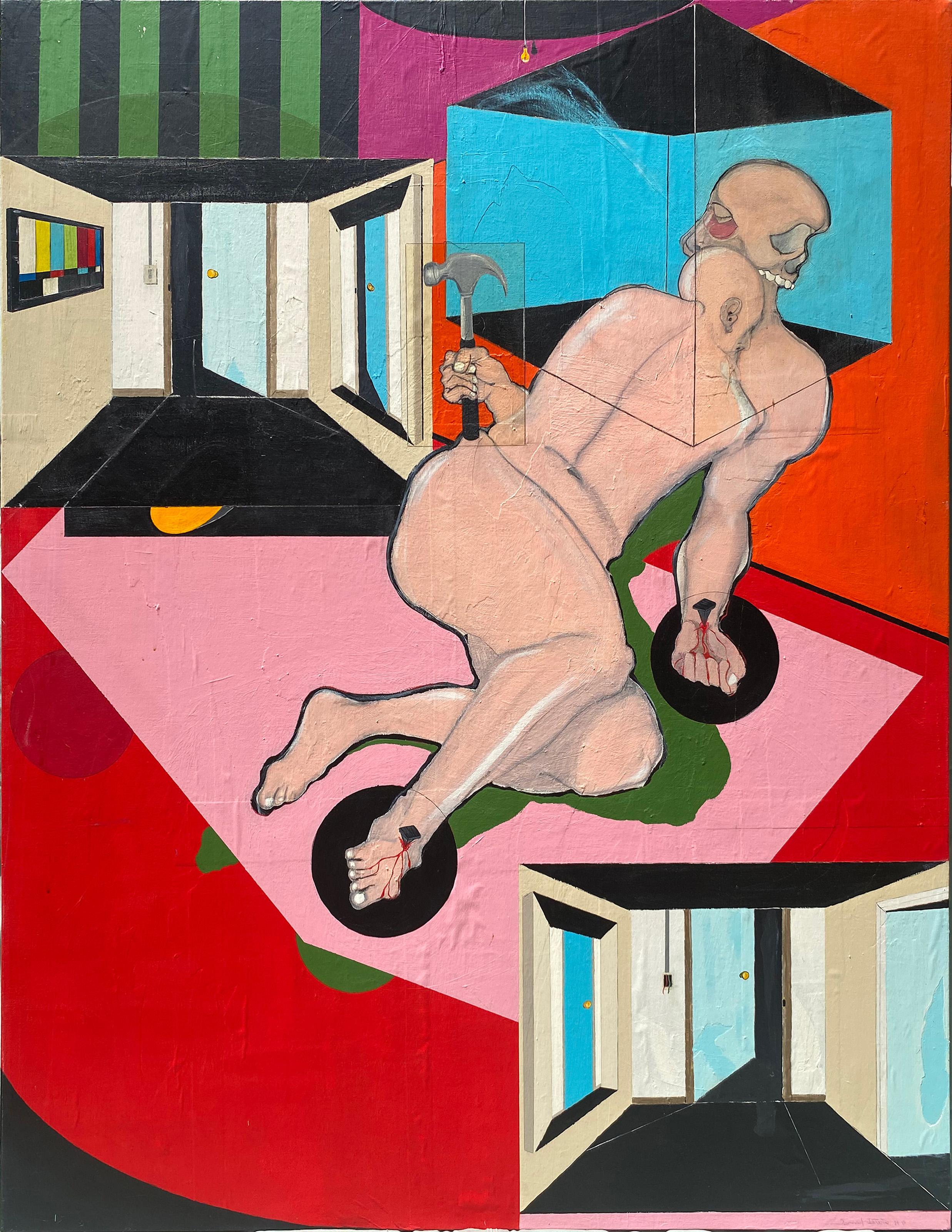
This painting is artwork of Patrick Faure, Creator of Faurism. The painting is unframed, oil on paper.
About the Artwork:
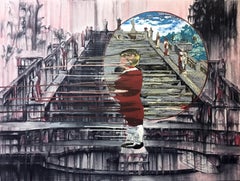
‘In this subtle instant when man looks back on his life, Sisyphus going back toward his rock, contemplates this chain of actions without links that has become his destiny’ Albert Camus tells us. Vir Absurdus captures this moment, when Sisyphus let the rock roll back down the hill and has the time to look at the Mediterranean shore. We can imagine that it is his love for the sea, for the world of the Mediterranean that he incurs the wrath of the gods. He looks on that shore that is forever forbidden to him and over which hand the clouds of Hades. He is turning into a rock himself. Having been so close to a rock for such a long time, one cannot but imagine that he is becoming rock himself, suggests Camus. The objects lose their meaning.
The rock has turned into the five ball of a billiard set. Isn’t Sisyphus constantly behind the eight ball, as people say? But the eight had become a five to illustrate the number of letters in Cams name, which happen to be the same as in Faure. The bridge leads nowhere, and the words Vir Absurdus (absurd man) hide in the background of a world in decomposition. Is it a storm, a war, or man’s absurdity that had denuded the landscape? The telephone wires are linked to nothing and reflect the isolation of Sisyphus. Far into the distance, he can see the lights of the villages coming on as the sun goes down. They are out of his reach – he will never go back. Does he even remember the reason of his exile?
In the foreground, the plant gives birth to a deadly fruit, the hand grenade.
About the Artist:
Patrick Faure was born in Monaco and gained recognition as a significant painter of Native Americans and highly realistic auto racing, Formula 1 (F1) paintings. Faure also developed as a surrealist painter, and invented a new style of painting ‘Faurism’ that challenges our understanding of the human condition based on philosophical concepts. His controversial and graphic paintings question the interrelationship of man and cosmos and his contemporary art form “Faurism” refers to a visual art style that expresses the convergence of dreams, desire, knowledge and erudition. Commonly mistaken with surrealism, his paintings hold myriad hidden messages and symbols which deal with the brutality of human consciousness and sub-consciousness. They denounce the addiction of humankind for war, and their hunger for sexual gratification, money and power. In his paintings Patrick Faure challenges our values by juxtaposing war against peace, reality against utopia, mythology and history against present and future, and ignorance against knowledge.
Meticulous eyes will discover inspiration and references from philosophers and writers such as Plato, Epictetus, Homer, Albert Camus, Jean-Paul Sartre and Franz Kafka. His belief is that regardless how many civilizations are destroyed by the monetization of human life, the obsession for power, and the egocentric selfishness of man, art will prevail and knowledge will be restored. Faure believes that without art and knowledge, there is no human race.
Faure routinely conducts an extensive program of exhibits that include shows in Italy, England, UNESCO, and the United Nations. He is the published author of four books and has illustrated many articles and been published in many magazines and lives in London with his English partner.
Surrealism, Mythical Oil Painting, Conceptual Art.