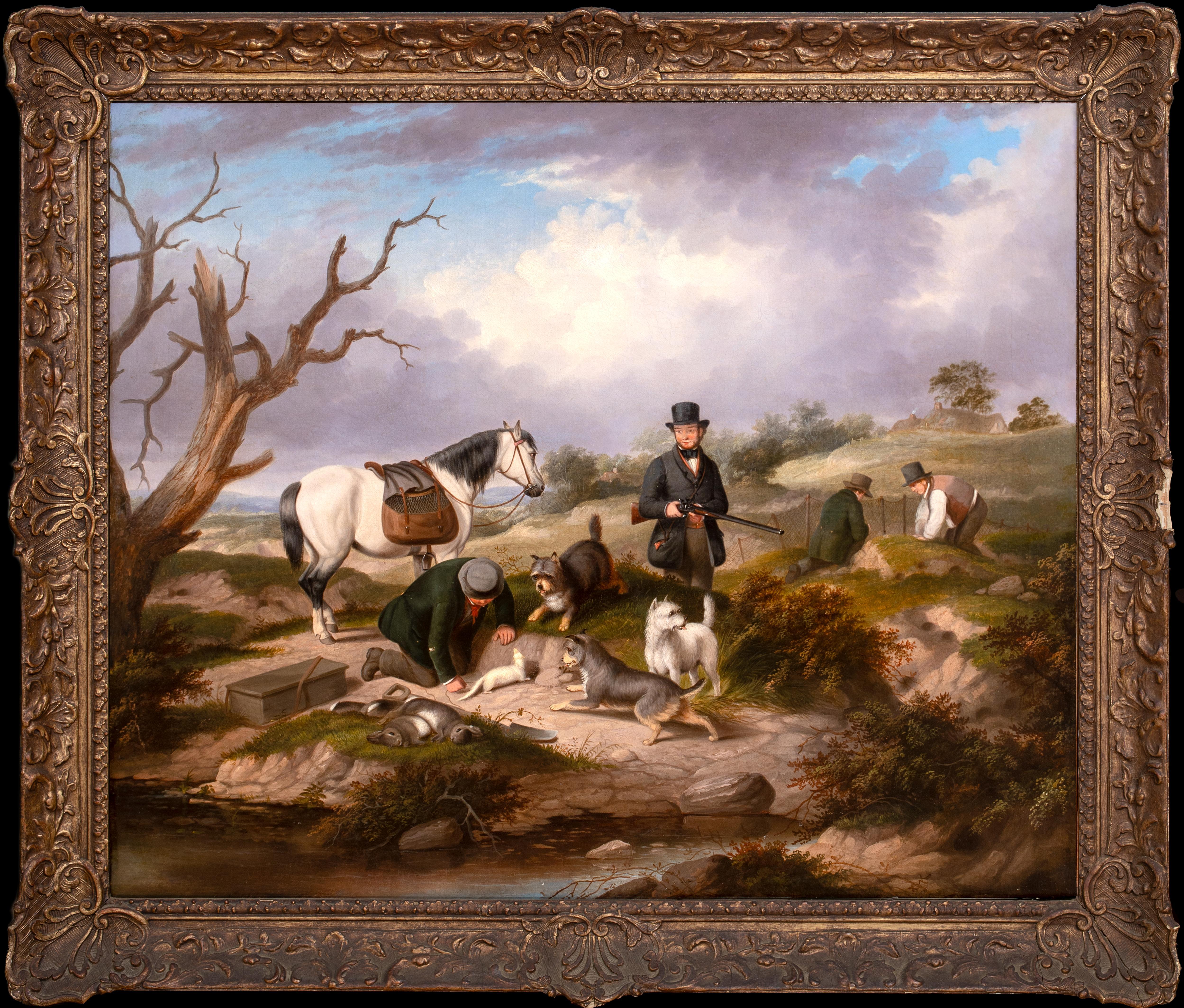
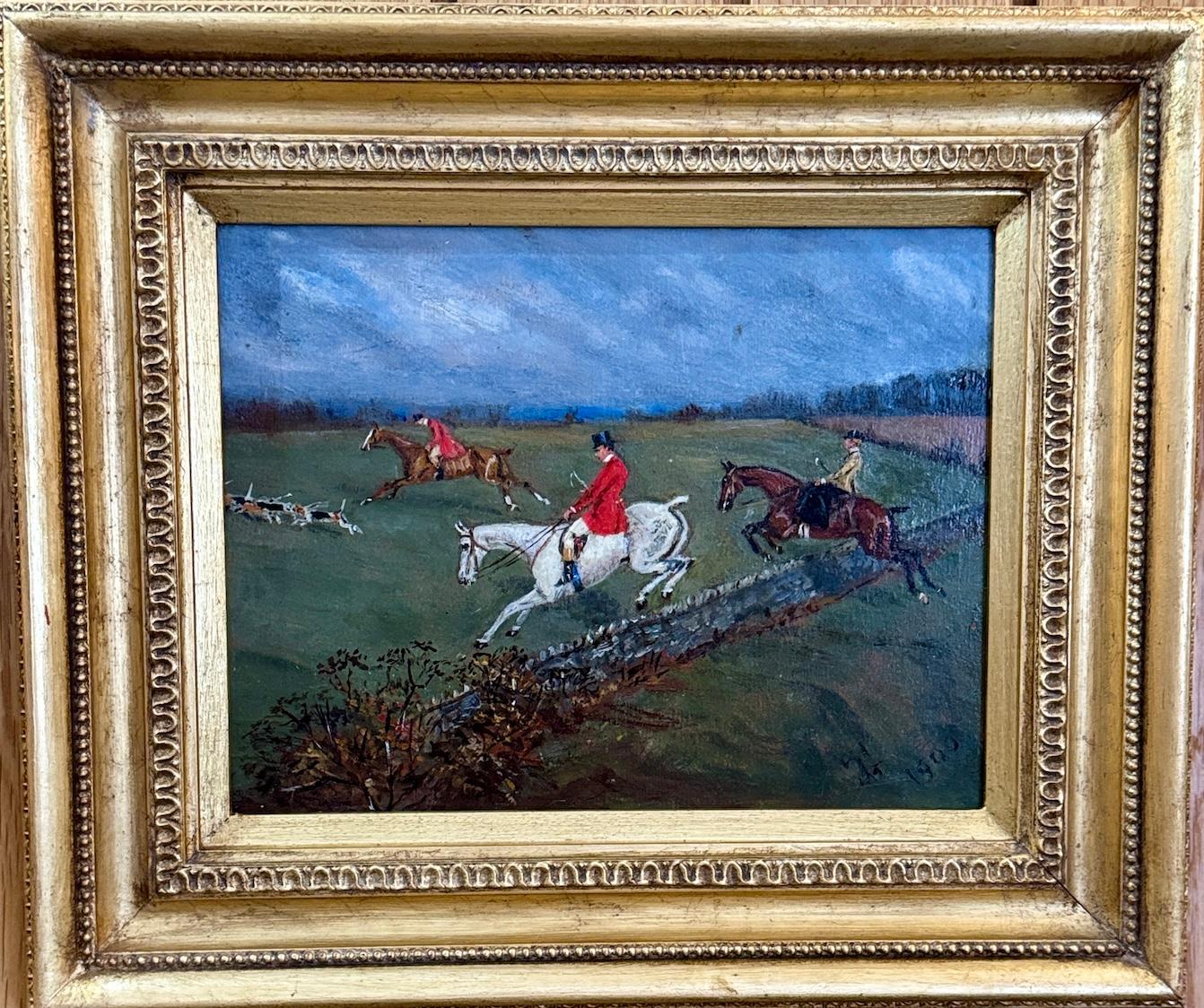
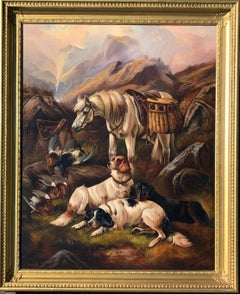
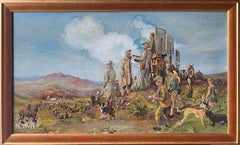
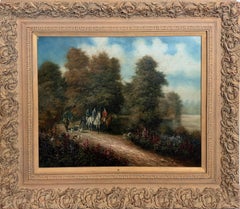
This painting is a copy by Sinclair of Carl Suhrlandt's Grouse Shooting on the Glentanar Estate in Aberdeenshire, 1889.
The painting presents a lively rural scene, unfolding across an open landscape of rolling hills and soft, diffused light. The composition captures a moment of pause within the rhythm of country life, where figures, animals, and vehicles gather in a loosely orchestrated arrangement that feels both spontaneous and carefully observed.
At the center, a horse-drawn cart carries a group of dogs—likely hounds—clustered together, their pale coats forming a bright focal point against the earthier tones of the landscape. The driver, seated atop the cart and dressed in a vivid green coat, raises his arm as if directing or signaling, introducing a sense of movement and command. The cart itself, with its sturdy wooden wheels and simple construction, anchors the scene in the practical realities of rural transport.
In the foreground, a pack of dark-coated dogs stands alert, their attention directed toward the central activity. Beside them, two men dressed in hunting attire—long coats and hats—appear engaged in conversation or preparation. Their posture suggests anticipation, as though the hunt is about to begin or has just concluded.
To the left, a heavily laden horse stands quietly, its burden carefully strapped, offering a moment of stillness that contrasts with the more animated grouping at the center. Further back, additional figures and a second cart recede into the distance, creating depth and reinforcing the communal nature of the scene.
The landscape itself is gently rendered, with low hills stretching across the horizon under a pale sky. The colors are warm and natural—greens, browns, and muted yellows—applied with a soft, blended technique that prioritizes atmosphere over sharp detail. Light is even and diffused, avoiding dramatic contrasts and instead enveloping the scene in a calm, pastoral unity.
The brushwork is controlled and descriptive, particularly in the depiction of animals and figures, while the background remains more loosely handled. This balance situates the work within a tradition of late 19th- to early 20th-century sporting and genre painting, where narrative clarity and decorative appeal coexist.
Overall, the painting captures not a dramatic event, but a transitional moment—one of gathering, preparation, and quiet coordination—reflecting the social and practical rituals of rural sporting life.
Biography of William Hardie Sinclair:
William Hardie Sinclair was a Scottish painter active in the late 19th and early 20th centuries, known for his depictions of rural life, sporting scenes, and landscapes. Although not among the most widely documented artists of his time, Sinclair’s work reflects a strong engagement with the traditions of British genre and animal painting.
Working within a cultural context in which hunting and equestrian activities were both social and artistic subjects, Sinclair developed a particular sensitivity to the portrayal of animals, especially dogs and horses. His compositions often center on moments of preparation or rest rather than action, emphasizing observation and atmosphere over dramatic narrative.
Stylistically, Sinclair’s paintings are characterized by a naturalistic palette and careful attention to detail in the rendering of figures and animals. At the same time, his landscapes are often treated with a softer, more atmospheric approach, allowing the setting to support rather than dominate the scene.
Though detailed archival information about his life remains limited, Sinclair’s work aligns with a broader group of British artists who contributed to the enduring popularity of sporting art. His paintings would have appealed to collectors interested in country life and the visual culture surrounding hunting traditions.
Today, William Hardie Sinclair is appreciated for his ability to capture the quiet, transitional moments of rural activity, offering a glimpse into a world defined by tradition, routine, and a close relationship with the natural environment.
Measurement without the frame: 40cm x 51.5cm