Want more images or videos?
Request additional images or videos from the seller
1 of 17

William Sidney Cooper
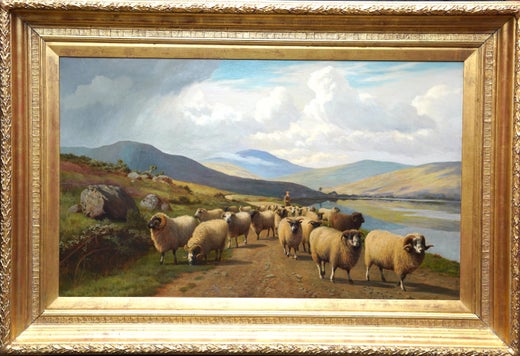
Sheep by Loch - British Victorian art Scottish landscape oil painting

1899

$13,305.29
$16,631.6120% Off
£9,600
£12,00020% Off
€11,415.46
€14,269.3220% Off
CA$18,473.53
CA$23,091.9120% Off
A$18,524.59
A$23,155.7420% Off
CHF 10,717.48
CHF 13,396.8420% Off
MX$225,567.13
MX$281,958.9120% Off
NOK 124,373.13
NOK 155,466.4220% Off
SEK 126,765
SEK 158,456.2520% Off
DKK 85,345.54
DKK 106,681.9320% Off

About the Item

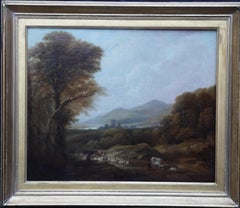
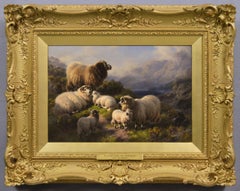
This stunning large British Victorian Scottish landscape oil painting is by noted Kent artist William Sidney Cooper. William trained with his great-uncle Thomas Sidney Cooper at his School of Art in Canterbury. Painted in 1899 when the artist was 45 years old, the composition is a herd of long horn sheep walking towards the artist/viewer on a path beside a Scottish loch. The shepherd is behind the sheep and beyond him rise mountains under a blustery sky, all beautifully reflected in the loch. The vantage point is quite low, so the sheep appear as if they are about to walk into your sitting room! The gold tones of the sheep are echoed in the surrounding landscape and beautiful gold frame the work is housed in. The details in the sheep's soft shaggy coats, contrasted with their amazing long and some curly horns is superb. In contrast, the landscape features are more impressionist blocks of colour, all with incredible dramatic effect. This is a simply stunning British Victorian animal landscape oil painting and a lovely example of Cooper's work. Signed and dated W. Sidney Cooper 1899 lower left Provenance: Sale, Christie's Edinburgh, 26th October 2006, lot 48 Purchased at the above sale Condition. Oil on canvas, image size is 50 inches by 30 inches and in good condition. Frame. Housed in a gilt frame. Framed size is 63 inches by 43 inches and in good condition. William Sidney Cooper (1854–1927) was a British landscape artist, best known for his watercolour paintings of the countryside and farm animals around Herne Bay in Kent. William trained with his great-uncle Thomas Sidney Cooper at his School of Art in Canterbury. William became a successful artist exhibiting at the Royal Academy, the Royal Society of British Artists (Suffolk Street galleries, London) and the Royal Watercolour Society. Cooper married in 1882, and in 1890 moved to Herne Bay in Kent where he remained for the rest of his life. As well as painting professionally, he was a keen golfer and liked to play Tennis and Bowls. He was also a musician and took part in local musical events. He built many houses in and around Canterbury, the best known being, Alcroft Grange. Much of Cooper's work reflects the countryside around Herne Bay and often contain cattle (which were his speciality) and sheep as in his Great Uncle's work. He died in 1927 and is buried in the churchyard at Eddington, Kent.
  • Creator:
    William Sidney Cooper (1854 - 1927, British)
  • Creation Year:
    1899
  • Dimensions:
    Height: 43 in (109.22 cm)Width: 63 in (160.02 cm)Depth: 2 in (5.08 cm)
  • Medium:
  • Movement & Style:
  • Period:
  • Condition:
  • Gallery Location:
    Hagley, GB
  • Reference Number:
    1stDibs: LU853118045162

More From This Seller

View All
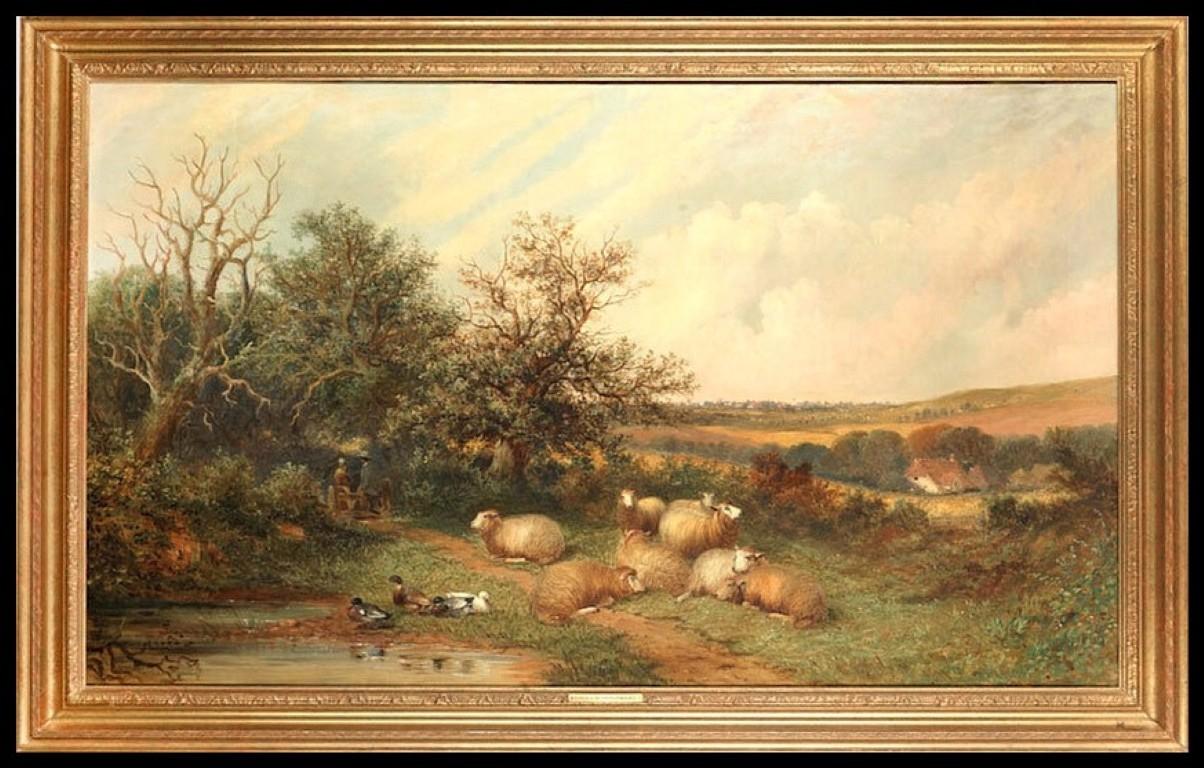
Sheep in a Surrey Landscape - British Victorian art sunny landscape oil painting

Sheep in a Surrey Landscape - British Victorian art sunny landscape oil painting

By George William Mote

Located in Hagley, England

This lovely Surrey landscape oil painting is by noted British exhibited artist George William Mote. Painted circa 1870, the composition is a landscape with a stunning view into the d...

Category

19th Century Realist Landscape Paintings

Materials

Oil

Cattle Watering in a Landscape - British 19th century art Victorian oil painting

Cattle Watering in a Landscape - British 19th century art Victorian oil painting

By Samuel Bough

Located in Hagley, England

This lovely British Victorian landscape oil painting is attributed to noted artist Sam Bough. It was painted circa 1855 after Bough had moved to Hamilton Lanarkshire in Scotland to focus on painting landscapes along side fellow artist Alexander Frazer. The composition is several cattle watering in a stream under the boughs of an ancient tree. There is superb impasto, for example on the clouds and this is a charming 19th century oil painting. Provenance. London estate. Condition. Oil on canvas, 29 inches by 16 inches unframed and in good condition. Frame. Housed in an ornate gilt Victorian frame, 36 inches by 23 inches framed and in good condition. Samuel Bough RSA (1822–1878) was an English-born landscape painter who spent much of his career working in Scotland. He was born the third of five children in Abbey Street, Carlisle in northern England, the son of James Bough (1794-1845), a shoemaker, and Lucy Walker, a cook. He was raised in relative poverty, but with a keen encouragement in the arts. He was self-taught but mixed with local artists such as Richard Harrington and George Sheffield, and was strongly influenced by the work of Turner. After an unsuccessful attempt to live as an artist in Carlisle he obtained a job and as a theatre scenery painter in Manchester in 1845, later also working in Glasgow in the same role. Encouraged by Daniel Macnee to take up landscape painting he moved to Hamilton from 1851-4 and worked there with Alexander Fraser. In 1854 he moved to Port Glasgow to work on his technique of painting ships and harbours. His paintings were noted for their sensitivity to atmosphere and light, were often of cloudy shorelines and busy harbours. He also began supplementing his income by illustrating books, before moving to Edinburgh in 1855. On coming to Edinburgh he lived in a terraced house at 5 Malta Terrace in the Stockbridge area of the city. Following Turner's example, he became a skilful painter of seaports. He was buried in Dean Cemetery Edinburgh on 23 November 1878. The grave bears a bronze medallion of his head by William Brodie...

Category

1850s Victorian Landscape Paintings

Materials

Oil

You May Also Like

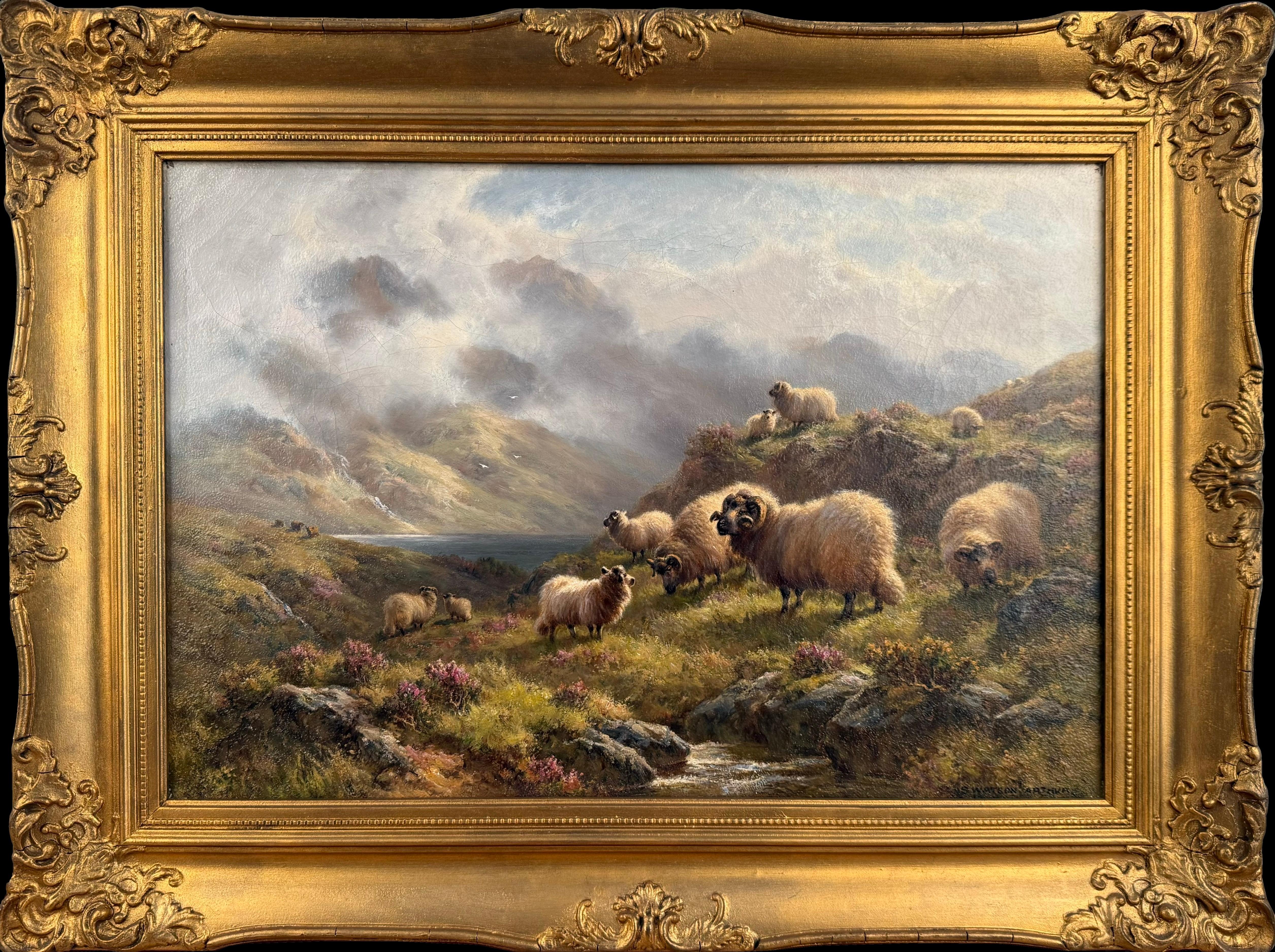
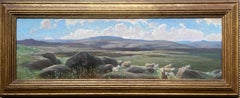
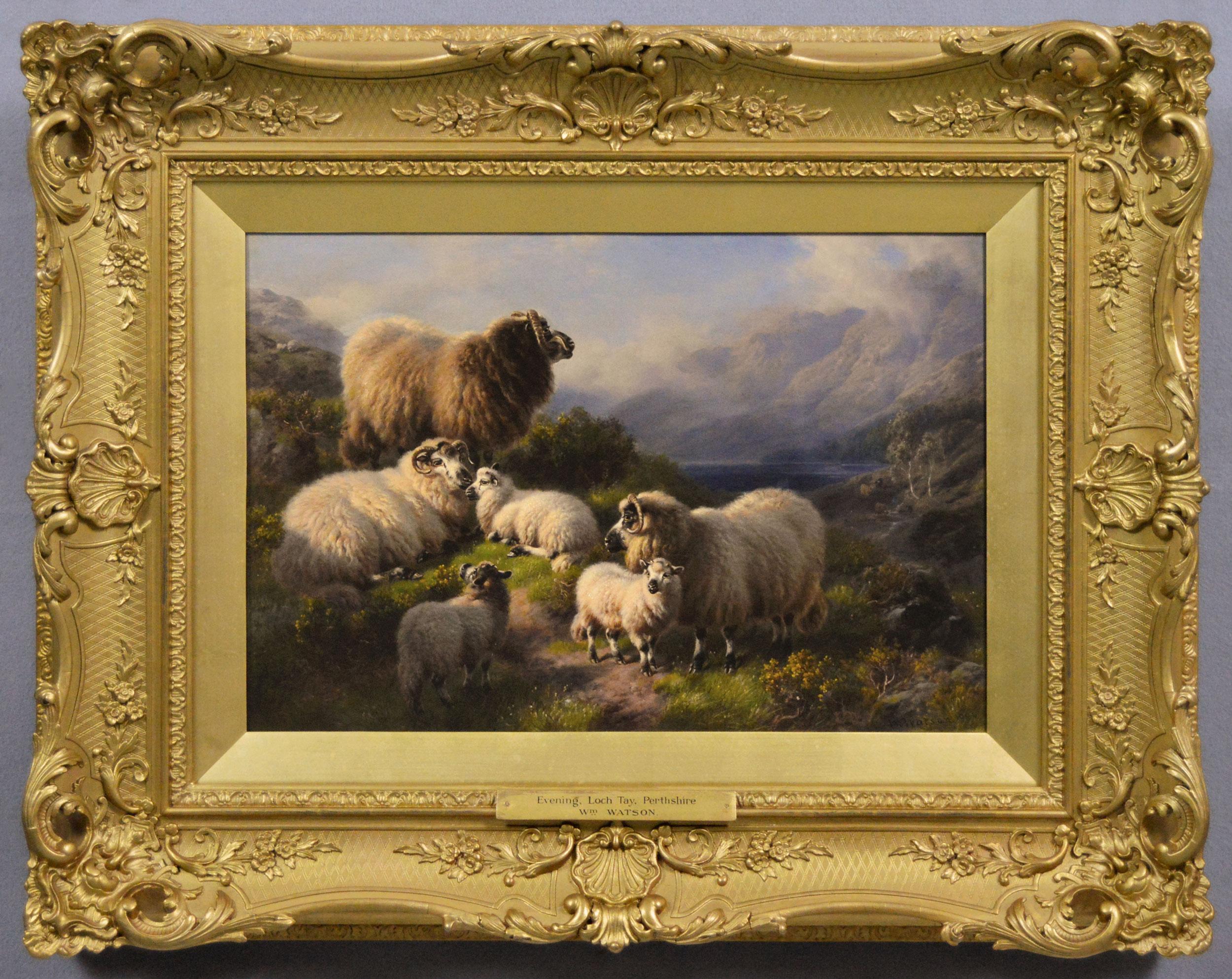
Scottish landscape oil painting of Highland sheep at Loch Tay

Scottish landscape oil painting of Highland sheep at Loch Tay

Located in Nr Broadway, Worcestershire

William Watson Jnr British, (1847-1921) On the Moors, Glen Tay, Perthshire Oil on canvas, signed & dated 1904, further inscribed verso Image size: 12.5 inches x 18.5 inches Size ...

Category

Early 20th Century Victorian Animal Paintings

Materials

Canvas, Oil

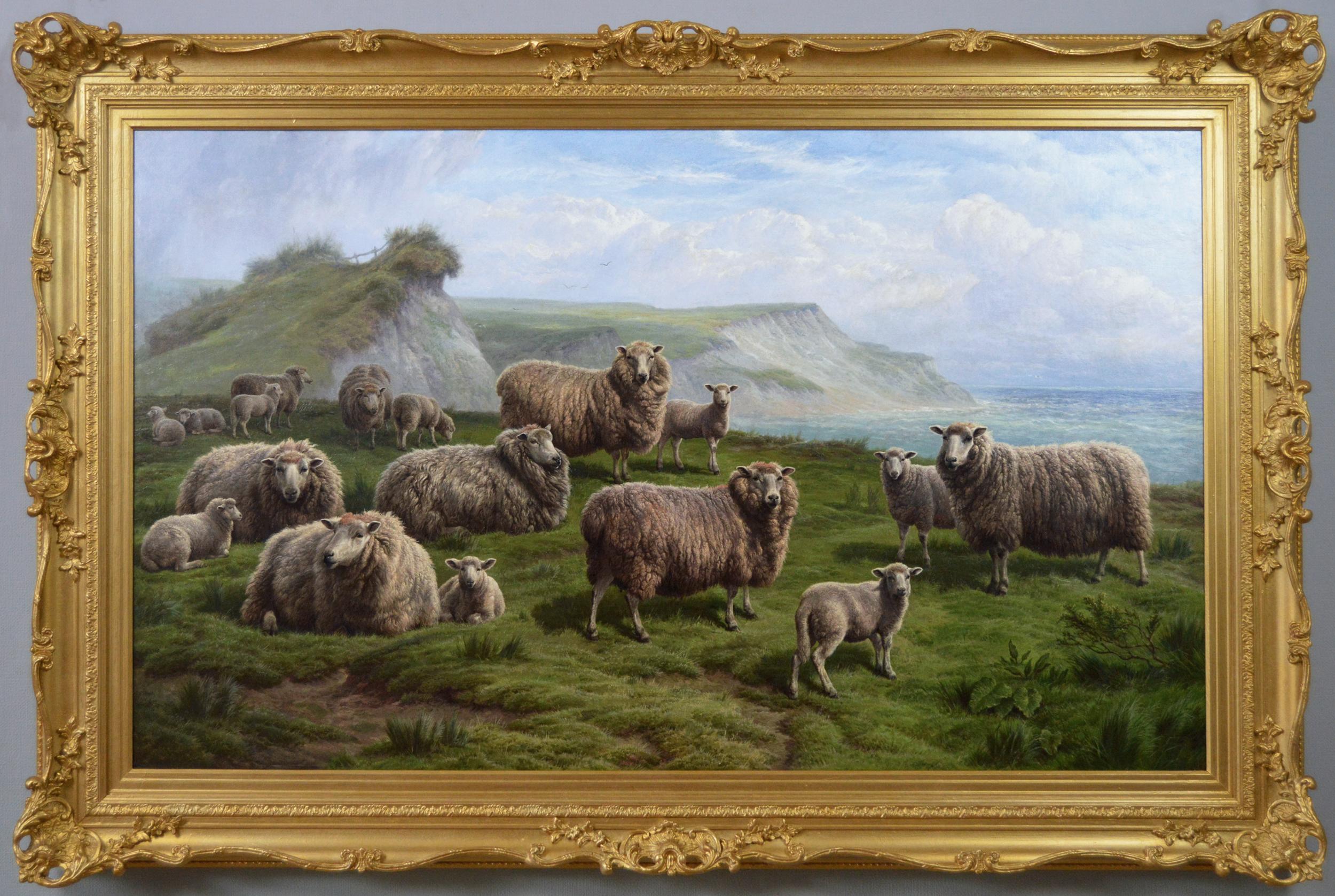
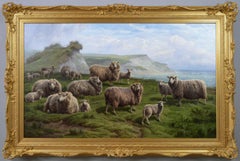
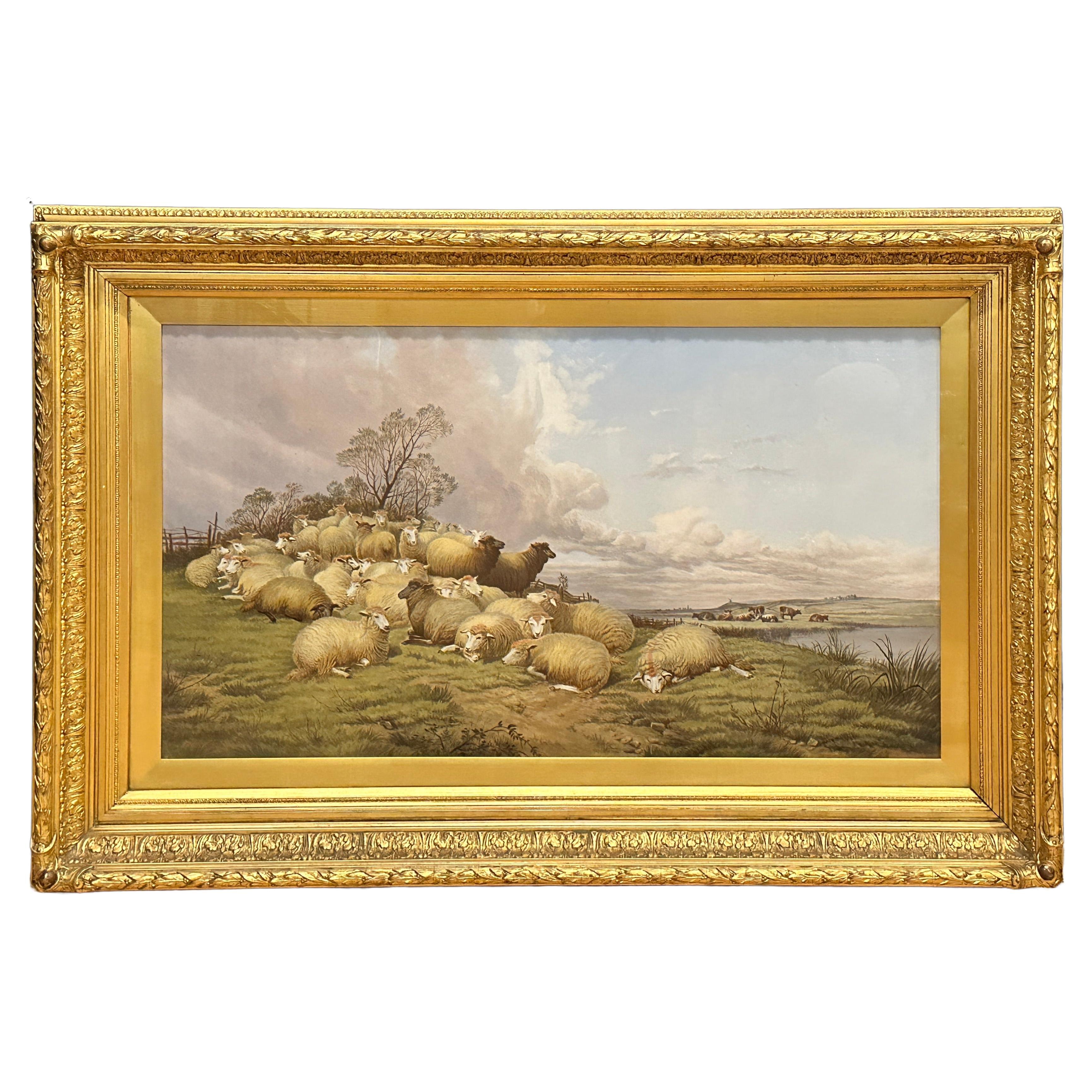
19th Century exhibition size landscape oil painting of Sheep on a cliff

19th Century exhibition size landscape oil painting of Sheep on a cliff

By Charles Jones (b.1836)

Located in Nr Broadway, Worcestershire

Charles Jones British, (1836-1892) Sheep Resting Oil on canvas, signed with monogram & dated 1877, further inscribed verso Image size: 35 inches x 59 inches Size including frame: 47 inches x 71 inches Exhibition Size Painting A fantastic exhibition sized landscape painting of sheep on a cliff top by the coast by Charles ‘Sheep’ Jones. At the time he produced this painting, Jones was living at Heathercroft, Balham Hill in London. Given the size and quality of the work it was most likely an exhibition piece. The topography and landscape suggest that this is the Dorset coast, one of his favourite places to paint. Charles Jones was an animal painter who was born in Stepney, London in 1836. He was the son of the artist Samuel John Egbert Jones (1797-1861) and Dinah Jones. He lived with his parents and 9 siblings in Mile End and was a pupil of his father. In September 1859, he married Frances Rosalinda Downe, who was born in America. His son Arthur Bertram Loud (1863-1930) also became an artist. They lived at 12 Hayes Place, Lisson Grove from where he made his debut in London at the Royal Academy in 1861. He also exhibited at the British Institution, Suffolk Street, New Watercolour Society, Royal Institute of Oil Painters and the Royal Institute of Painters in Watercolours. By 1867, he had become a successful artist and they had moved to 7 Paragon Place, Brixton Hill. From 1874 he lived at Heathercroft, Balham Hill where he spent the rest of his life. Jones became well known for specialising in paintings of sheep, cattle and deer in landscape settings. He spent his time travelling around visiting areas such as Devon, Dorset, Kent, Sussex and the Highlands. However, it is for his skilful painting of sheep that he is perhaps best known, and for which earned him the nickname of ‘Sheep’ Jones. As well as the major London galleries, he also exhibited provincially at various locations including: the Royal Cambrian Academy where he was elected a member in 1886, the Glasgow Institute of Fine Arts, Manchester City Art Gallery, Royal Hibernian Academy, Royal Society of British Artists, Birmingham and the Walker Art Gallery, Liverpool. Some of the smaller more intimate galleries he exhibited at were Arthur Tooth & Sons and Thomas...

Category

19th Century Victorian Animal Paintings
Materials

Canvas, Oil

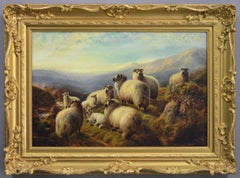
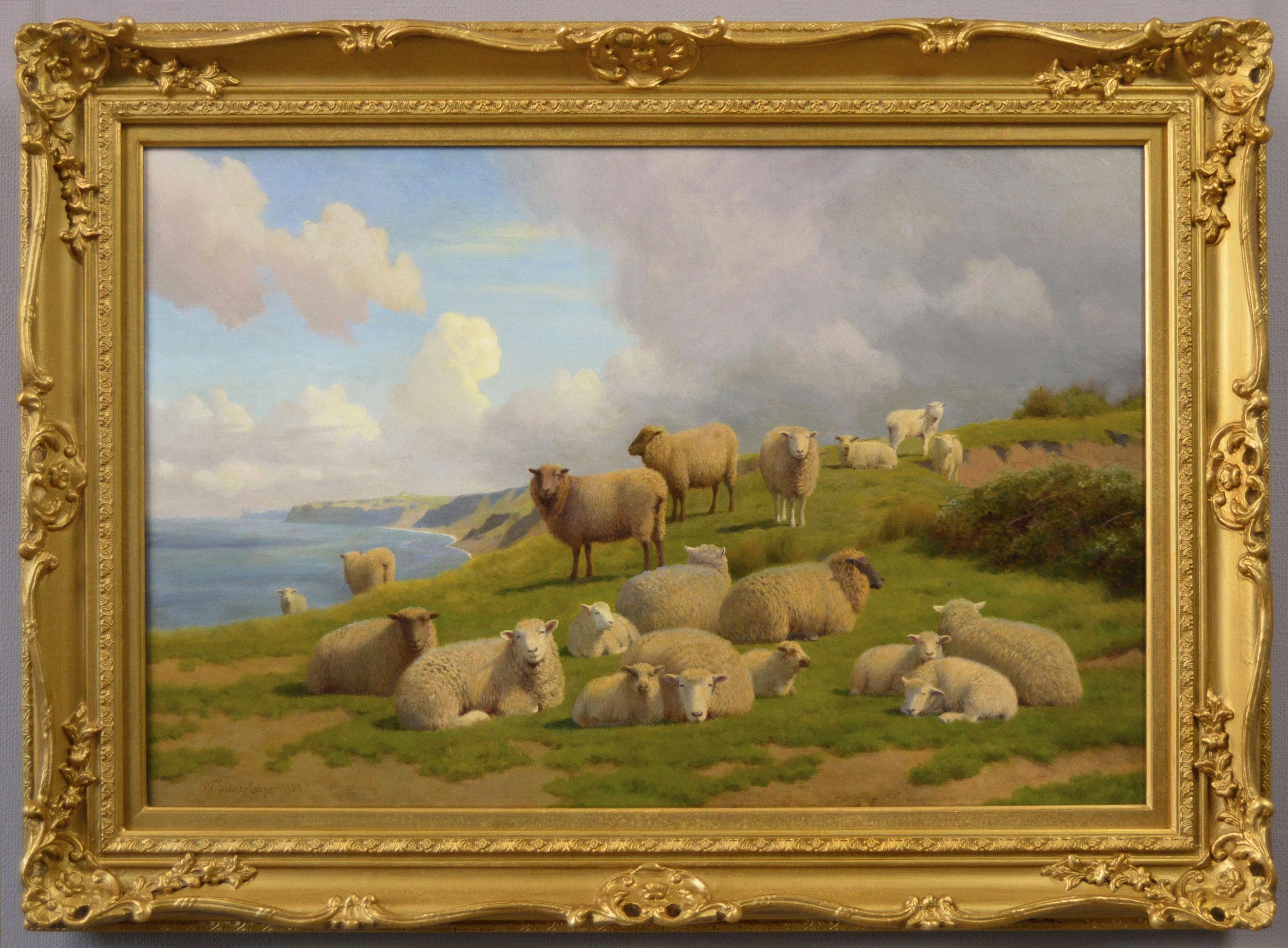
Landscape oil painting of Highland Sheep resting on a mountain

Landscape oil painting of Highland Sheep resting on a mountain

By Robert Watson

Located in Nr Broadway, Worcestershire

Robert Watson British, (1855-1920) Sheep Resting Oil on canvas, signed & dated 1900 Image size: 15.25 inches x 23.25 inches Size including frame: 22.5 inches x 30.5 inches A finely...

Category

Late 19th Century Victorian Animal Paintings
Materials

Canvas, Oil

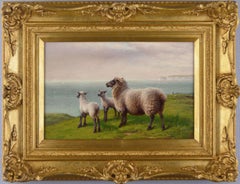
19th Century landscape oil painting of sheep grazing on a clifftop

19th Century landscape oil painting of sheep grazing on a clifftop

By Charles Jones (b.1836)

Located in Nr Broadway, Worcestershire

Charles Jones British, (1836-1892) Sheep Grazing on a Cliff Top Oil on canvas, signed with monogram Image size: 7.5 inches x 11.5 inches Size including frame: 13.5 inches x 17.5 inches A lovely landscape painting of sheep on a coastal cliff by Charles ‘Sheep’ Jones. The sheep and her two lambs are depicted against the backdrop of the sea with shipping and chalk cliffs in the distance. The location is likely to be the Devon coast, an area Jones visited often. Charles Jones was an animal painter who was born in Stepney, London in 1836. He was the son of the artist Samuel John Egbert Jones (1797-1861) and Dinah Jones. He lived with his parents and 9 siblings in Mile End and was a pupil of his father. In September 1859, he married Frances Rosalinda Downe, who was born in America. His son Arthur Bertram Loud (1863-1930) also became an artist. They lived at 12 Hayes Place, Lisson Grove from where he made his debut in London at the Royal Academy in 1861. He also exhibited at the British Institution, Suffolk Street, New Watercolour Society, Royal Institute of Oil Painters and the Royal Institute of Painters in Watercolours. By 1867, he had become a successful artist and had moved to 7 Paragon Place, Brixton Hill. From 1874, he lived at Heathercroft, Balham Hill where he spent the rest of his life. As well as the major London galleries, he also exhibited provincially at various locations including: the Royal Cambrian Academy where he was elected a member in 1886, the Glasgow Institute of Fine Arts, Manchester City Art Gallery, Royal Hibernian Academy, Royal Society of British Artists, Birmingham and the Walker Art Gallery, Liverpool. Some of the smaller more intimate galleries he exhibited at were Arthur Tooth & Sons and Thomas Richardson...

Category

19th Century Victorian Animal Paintings
Materials

Canvas, Oil