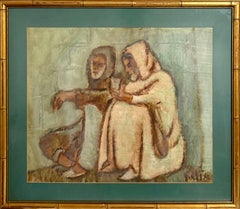
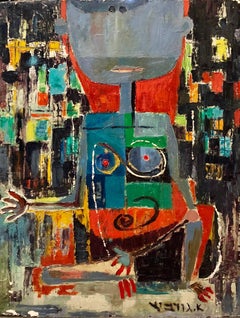
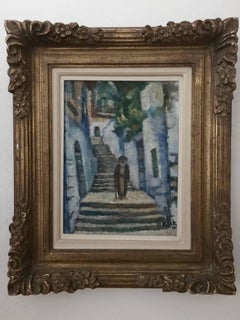
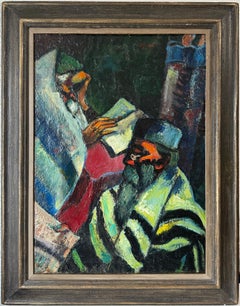
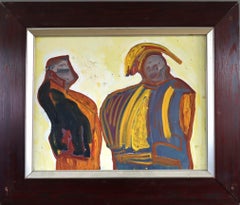
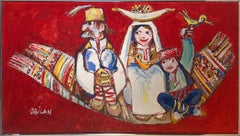
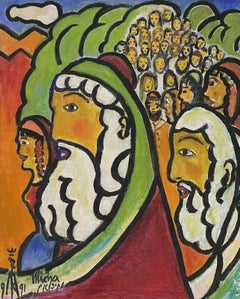
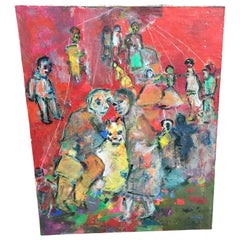
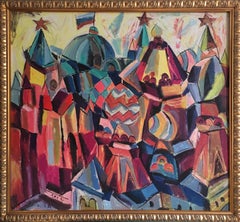
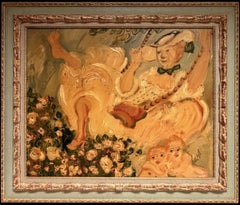
Hand signed lower right and bears old Hungarian Gallery label verso.
Description of the painting
An Orientalist genre scene set in a North African or Middle Eastern desert town at dusk. In the foreground, two robed and turbaned riders sit mounted on horses — one on a pale grey horse wearing golden-yellow robes and a red cap, the other beside him in a dark red robe with a distinctive pointed white hood, mounted on a dark bay horse. A riderless dark horse stands just behind them. The figures are rendered with simplified, almost folk art faces and gestures, one arm raised as if in conversation or greeting.
Behind them, the composition is built from flat, unmodulated color blocks — a deep blue building wall on the left, a glowing ochre-yellow wall or dune rising behind the riders, and a row of dark, spiky palm trees silhouetted against a stormy blue-grey sky streaked with warm light near the horizon. The palette is warm and saturated (mustard yellow, rust red, cobalt blue) against the cooler, moody sky, giving the scene a theatrical, stage-set quality typical of early-20th-century Orientalist painting filtered through a Post-Impressionist or Fauvist color sensibility.
Emőd Aurél
Hungarian Painter of the School of Rome
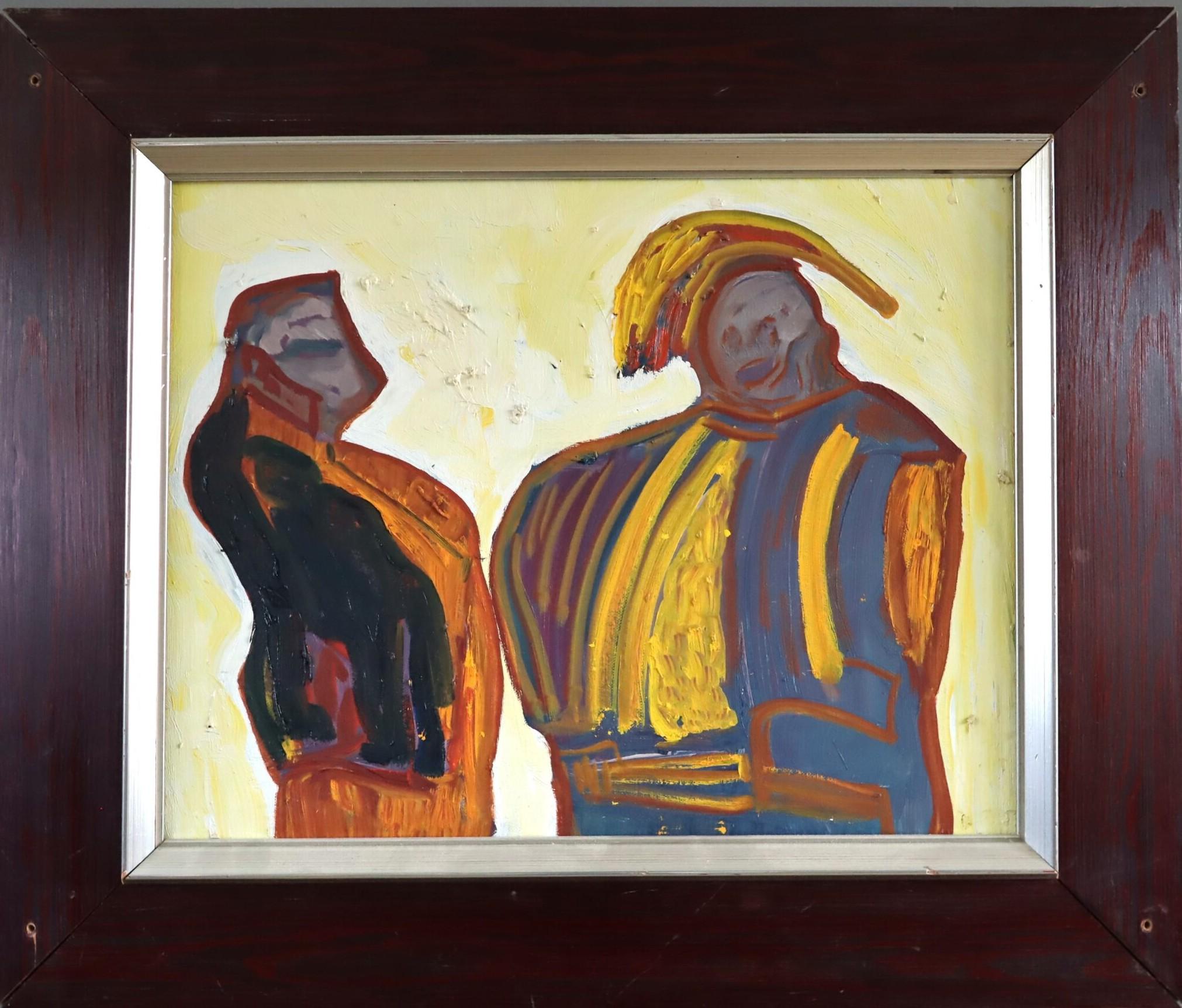
Emőd Aurél (1897–1958) was a Hungarian painter and graphic artist whose work bridged the influence of Post-Impressionist color and the classicizing tendencies of the Italian Novecento movement. Born in Budapest, Emőd trained at the Hungarian Academy of Fine Arts under János Vaszary, one of the most significant Hungarian painters of the early twentieth century, whose own vivid color sense and robust, expressive brushwork left a defining imprint on a generation of students. This work is done in a naïve, boldly colored figural style.
Training Under Vaszary and Italian Influence
Vaszary's studio produced several of the leading Hungarian painters of the interwar period, including Vilmos Aba-Novák, József Egry, and Ödön Márffy, situating Emőd within an important circle of Hungarian modernists. Following his studies, Emőd undertook extended study trips to Italy, Germany, and France, where the Italian Novecento movement — with its emphasis on classical form, solidity, and monumentality — left a particularly strong impression on his developing style, alongside the lasting influence of his teacher Vaszary.
The Collegium Hungaricum and the School of Rome
Between 1933 and 1935, Emőd received a coveted scholarship to the Collegium Hungaricum in Rome, the Hungarian state academy housed in the Palazzo Falconieri. Established in 1928 under art historian Tibor Gerevich, the Collegium's scholarship program gave rise to what became known as the "School of Rome" (Római Iskola) — a movement of young Hungarian artists sent to absorb contemporary Italian art in place of the French and German influences then dominant in Budapest. The School's leading figures included Vilmos Aba-Novák, Károly Patkó, and István Szőnyi, who were the first fellows invited to Rome in 1928, alongside later grantees such as Jenő Medveczky, Pál Molnár C., and Dezső Erdey. Emőd's own Roman sojourn placed him within this same institutional and artistic lineage, absorbing the classicizing, Novecento-inflected style that Gerevich had hoped would forge a new national Hungarian art rooted in Italian, rather than Parisian, tradition.
Career in Budapest
Following his return from Italy, Emőd worked as an art teacher in Budapest, continuing to paint landscapes, still lifes, and figurative scenes — including views of Lake Balaton — that reflect both the coloristic vitality inherited from Vaszary and the structural clarity absorbed during his years in Rome. He remained active as a painter in Hungary until his death in 1958.
Keywords: Emőd Aurél, Emod Aurel, Hungarian painter, School of Rome Hungarian art, Római Iskola, Collegium Hungaricum Rome, János Vaszary student, Vilmos Aba-Novák, Italian Novecento influence, Hungarian Academy of Fine Arts, interwar Hungarian modernism, Lake Balaton painting, 20th century Hungarian art, Budapest painter
EMŐD, AURÉL (Budapest 1897-1958) A pupil of János Vaszary at the Academy of Fine Arts, he then went to Italy, Germany and France on study trips. Not only his master but also the Italian novecento affected him strongly. He worked as an art teacher in Budapest. From 1933 and 1935 he won a scholarship to Collegium Hungaricum.
He was included in the exhibition The Art Of Modern Hungary 1931 and other exhibitions along with Vilmos Novak Aba, Count Julius Batthyany, Pal Bor, Bela Buky, Denes Csanky, Istvan Csok, Bela Czobel, Peter Di Gabor, Bela Ivanyi Grunwald, Baron Ferenc Hatvany, Lipot Herman, Odon Marffy, C. Pal Molnar, Istvan Szonyi, Istvan Pekary, Janos Vaszary, Sandor Ziffer, Bela Kadar, Nagy Ilosvai Varga Gyula Batthyany, Hugo Scheiber, and Jozsef Egry