Video Loading
Want more images or videos?
Request additional images or videos from the seller
1 of 15

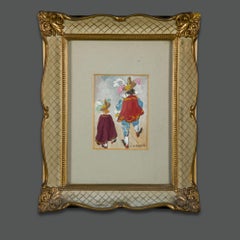
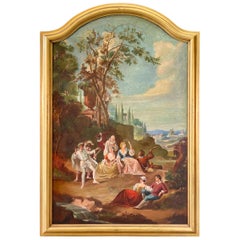
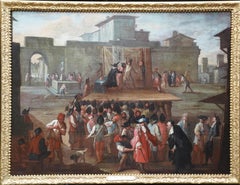
Franz De Paula Ferg (Attributed), Figures Of The Commedia dell'Arte

c. 1720

$6,206.36List Price

You May Also Like

Travelling Comic Theatre - Italian 18thC art figurative landscape oil painting

Travelling Comic Theatre - Italian 18thC art figurative landscape oil painting

By Marco Marcola

Located in Hagley, England

This interesting Italian 18th century Old Master oil painting is by noted artist Marco Marcola, also known as Marco Marcuola. It was painted circa 1770 and has excellent provenance. ...

Category

1770s Old Masters Figurative Paintings

Materials

Oil

Modern Italian Oil Paint Masks Painting Signed Angelo Urbani del Fabbretto

Modern Italian Oil Paint Masks Painting Signed Angelo Urbani del Fabbretto

By Angelo Urbani del Fabbretto

Located in Roma, IT

Modern Italian Oil Paint Masks Painting Signed Angelo Urbani del Fabbretto This wonderful painting is an oil on panel by Angelo Urbani del Fabbretto, titled *Masks*. The work fully ...

Category

1950s Italian School Figurative Paintings

Materials

Oil, Panel

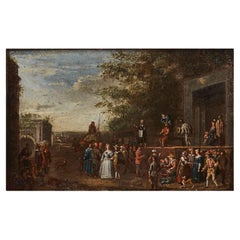
Dipinto Fiammingo su Rame 1650 circa Scena di Genere con Commedia delle Arti

Dipinto Fiammingo su Rame 1650 circa Scena di Genere con Commedia delle Arti

Located in Milano, MI

Dipinto Fiammingo del 1600 a olio su rame raffigurante uno scorcio di paesaggio con figure, una scena di genere con una moltitudine di personaggi affollati in una strada con delle ar...

Category

Antique Mid-17th Century Baroque Paintings

Materials

Copper

French Mod Surrealist Commedia dell'arte Circus Scene Oil Painting J.P. Serrier

French Mod Surrealist Commedia dell'arte Circus Scene Oil Painting J.P. Serrier

By Jean Pierre Serrier

Located in Surfside, FL

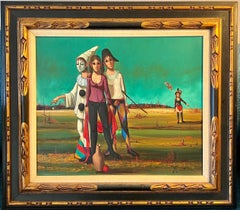
Jean Pierre Serrier (French, 1934-1989) Oil on canvas painting depicting four figures Hand signed lower right. Measures (frame) 26.5" x 30" wide, and (sight) 18.25." x 22.25" wide. Jean Pierre Serrier (1934 – 1989) was a French painter known for surrealism and absurdist art. Jean-Pierre Serrier was born in Montparnasse, Paris and attended the Académie des Beaux-Arts in Paris. the son of Louis and Solange Serrier. His father fought in World War II and became a prisoner of war. In 1940, as a six-year-old, he and his mother fled Paris for Corrèze in southwest France. Childhood memories of close escapes from German bombardments would later influence his absurdist philosophy of life. Passionate about drawing, in 1951 he applied and was admitted to the École nationale supérieure des arts appliqués et des métiers d'art in Paris. He shared an attic apartment in the 16th arrondissement with fellow student Jean-Baptiste Valadié. For income, he decorated shop windows. A trip to Spain provided motifs for early works. His student work might be characterized as art naïf (Naive art). While still a student, he sold a ceramic artwork to the poet and publisher Pierre Seghers, who would later commission drawings from him. He frequented jazz clubs in Saint-Germain des Près, and while listening to Sidney Bechet at the Vieux Colombier, he met his wife, Yvette.One of the last French Surrealist and follower of Nietzsche. His art conveyed the message to all of mankind that we are only human. The other Surrealist to center his art in philosophy was Rene Magritte whose paintings reflect his understanding of Sigmund Freud. He had his first exhibition in 1955, before being sent to Algeria to complete his military service. After graduating in 1955, he was drafted for military service, spent time in Germany and Morocco, and was sent to the front lines of the Algerian War. In 1959 he exhibited works at two Parisian galleries and at Juan-les-Pins on the Côte d'Azur. From 1961, he exhibited annually at the Salon des Artistes Français. In 1962, the City of Paris purchased his painting Un dimanche In 1961, Serrier made his first visit to the United States to exhibit at a New York gallery. In 1975 and 1979, he had successful exhibitions in New Orleans, and his work was included in art and news magazines, including Time and Newsweek. Beginning in the 1950s, his works included stylized portraits similar in some ways to the "big eyes" art of Margaret Keane, though it is uncertain that either artist influenced the other. Keane painted children, and so did Serrier, sometimes from life, but Serrier’s models are usually somewhat older, though uniformly slender and with androgynous features. A gallery owner introduced Serrier to American collectors Edgar Garbisch and his wife, Bernice Chrysler (daughter of Chrysler founder Walter P. Chrysler), who had a particular interest in naïve art; they commissioned a series of portraits from Serrier. At the same time, he met Reine Ausset in Paris, who in 1961 invited him to New York to take part in an exhibition at Galerie Norval on 57th Street. The show also included work by Moïse Kisling, and the exhibition program explicitly linked the two artists, saying that Serrier, who considered Moise Kisling "the Master," had found his own technique, but "the same vision joins the grand Kisling to the young Serrier: plenitude of shapes, sureness of palette, precision in outlines." In the 1960s he began painting slender, young, androgynous figures in groups, set in sparse landscapes with suggestions of the surreal and sometimes wearing costumes of the Commedia dell'arte. In some of these paintings the eyes of the figures are completely black, a motif that would continue in his later work. In 1965, he exhibited at Forest and Reed Gallery in London. Also in 1965, he discovered the small town of Martel, and with his old roommate Jean-Baptiste Valadié purchased a house that they opened as the gallery La Licorne (The Unicorn) in 1967. Responding to the political upheavals of May 1968 in France, and following the advice of Geneva gallery owner Roger Ferrero, Serrier's work became increasingly complex, idiosyncratic, and surreal. Imagery included the Tower of Babel, bodies suspended in space, and crowds of people all dressed alike, with identical features and entirely black eyes. Mannequins, playing cards, nudes, and levitating orbs also figured in the work. In a nod to Magritte, his men sometimes wear bowler hats. Another influence may have been the works of the Franco-Belgian surrealist Gaston Bogaert (1918-2008). Serrier's first major exhibit of these works, in Geneva in 1971, was titled Le Réalisme Fantastique. (Magic Realism) In 1972, he was made a member of the Société du Salon d'Automne, under whose auspices he was invited by the Polish government to exhibit in Warsaw in 1973, as part of a cultural exchange across the Iron Curtain. In 1976, he served on the jury of the Salon d'Automne. In 1975, New Orleans gallery owner Kurt E. Schon brought his work to several cities in the United States. A copiously illustrated monograph in English, Surrealism and the Absurd: Jean Pierre Serrier, was published in 1977. Author Thomas M. Bayer wrote: Serrier's world is one where—to use Friedrich Nietzche's term—the "human herd animal" is being confronted with the overwhelming task of coping with the world, his solitude, and at times, his resignation in the face of its monstrous size and duration. It is a world where the characterless, "blind" man faces the institutions, rules and symbols that made him into the being he now is…But Serrier does not lose himself in this world he portrays. He never forgets the old French tradition, the "black" humor, à la Molière. This classical humor at times is more felt than seen, in a manner that can be terribly funny, because it is horrifying, laughable, poignant and always true. Serrier told a friend, "In each of my paintings there's a message of hope amid the crowd of stereotypical figures. It could be an escaping dirigible, or a nymphet who flees like a deer under the red and blue trees of paradise...

Category

Mid-20th Century Surrealist Figurative Paintings
Materials

Canvas, Oil

Carnival IVenice Harlequin Landscape Marcola paint 18th Century Oil on canvas

Carnival IVenice Harlequin Landscape Marcola paint 18th Century Oil on canvas

Located in Riva del Garda, IT

Marco Marcola (Verona, 1711 - 1780) Carnival scene with masks from the commedia dell'arte with Harlequin Oil on canvas, 60 x 82 cm In frame 77 x 100 cm The canvas reflects ty...

Category

18th Century Old Masters Landscape Paintings

Materials

Oil

20th Century Spanish Party Painting Oil on Canvas by Riccardo Pellegrini

20th Century Spanish Party Painting Oil on Canvas by Riccardo Pellegrini

By Pellegrini

Located in Milan, IT

Riccardo Pellegrini (Milan 1863 - Crescenzago 1934) Spanish party before the bullfight Oil on canvas, 29 x 39 - with frame, 45 x 55 cm The painting, given the signature, is the ...

Category

20th Century Italian Paintings

Materials

Canvas

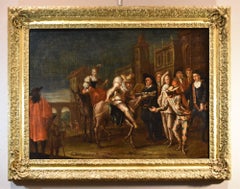
Commedia dell’arte O/C in Giltwood Architectural Frame

Commedia dell’arte O/C in Giltwood Architectural Frame

Located in Hanover, MA

Italian large scale oil on canvas painting from the Commedia dell’arte genre depicting nobles and masked figures in a pastoral setting. Apparently unsigned.

Category

Vintage 1950s Italian Hollywood Regency Paintings

Materials

Giltwood

19th Century Oil on Canvas Painting Attributed to Eugenio Lucas Villamamil

19th Century Oil on Canvas Painting Attributed to Eugenio Lucas Villamamil

Located in Marbella, ES

Antique 19th century oil on canvas people painting attributed to Eugenio Lucas Villamamil, with acanthus and foliate gilt wood and gesso frame Dimensi...

Category

Antique 19th Century Spanish Paintings

Materials

Canvas

19th Century "Italian Renaissance Party" Oil on Canvas by Carl Emil Doepler

19th Century "Italian Renaissance Party" Oil on Canvas by Carl Emil Doepler

Located in Los Angeles, CA

Enchanting oil on canvas by Carl Emil Doepler, protected by a beautiful hand-carved giltwood frame with a metal label titled "Italian Renaissance Party", depicting a traditional Ital...

Category

Antique 19th Century German Paintings

Materials

Canvas, Giltwood

Signed Cavalier Antique Oil Painting by Georges Appert

Signed Cavalier Antique Oil Painting by Georges Appert

Located in St. Albans, GB

Georges Appert (1850-1934) Picture size 24 x 15", 61 x 38cm Frame size 31 x 22.5", 79 x 57cm Georges Appert (1850-1934) was a French painter of the Belle Époque period. ...

Category

19th Century French School Figurative Paintings

Materials

Canvas, Oil

More From This Seller

View All
A Surprise, Mid-19th-Century German Genre Painting

A Surprise, Mid-19th-Century German Genre Painting

Located in Cheltenham, GB

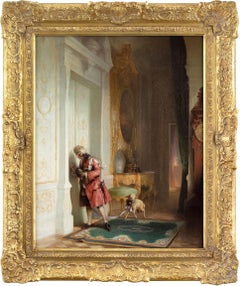
This exquisite mid-19th-century genre painting by German artist Pancrasz Körle (1823-1875) captures a moment of theatrical anticipation within a lavish Rococo interior. Titled 'A Sur...

Category

1860s Rococo Interior Paintings

Materials

Canvas, Oil

Mid-16th-Century Romagnola School The Adoration Of The Magi, Nativity

Mid-16th-Century Romagnola School The Adoration Of The Magi, Nativity

Located in Cheltenham, GB

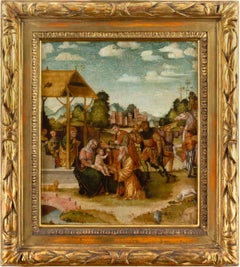
This exquisite early 16th-century Italian panel captures one of Christianity’s most cherished moments - the Adoration of the Magi. Painted around 1530, this panel belongs to a moment...

Category

16th Century Renaissance Figurative Paintings

Materials

Oil, Panel

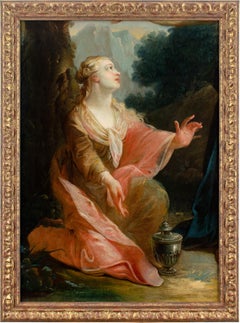
Late 18thC Venetian School Mary Magdalene Noli Me Tangere Oil Painting

Late 18thC Venetian School Mary Magdalene Noli Me Tangere Oil Painting

Located in Cheltenham, GB

US buyers pay no import tariffs on this item. This late 18th-century Italian oil painting fragment depicts Mary Magdalene kneeling alongside an alabaster jar. Christ’s hand is parti...

Category

18th Century Italian School Figurative Paintings

Materials

Canvas, Oil

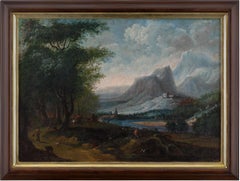
Mid-17th-Century Dutch School, Mountainous Landscape With Wood, River & Figures

Mid-17th-Century Dutch School, Mountainous Landscape With Wood, River & Figures

Located in Cheltenham, GB

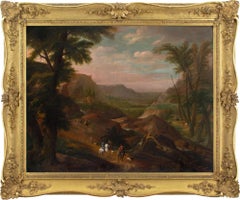
This mid-17th-century Dutch landscape painting, executed in oil on canvas, depicts travellers moving through a broad river valley beneath dramatic mountainous peaks. Set within an ex...

Category

1660s Dutch School Landscape Paintings

Materials

Oil, Canvas

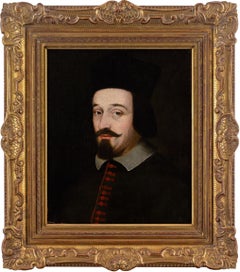
Mid-17th-Century Spanish School Oil Painting, Portrait Of A Theologian

Mid-17th-Century Spanish School Oil Painting, Portrait Of A Theologian

Located in Cheltenham, GB

This mid-17th-century Spanish oil on canvas depicts a dignified man of learning - a theologian, or perhaps a cathedral canon. Dressed in a black cassock, marked by a vertical row of...

Category

Mid-17th Century Baroque Portrait Paintings

Materials

Canvas, Oil