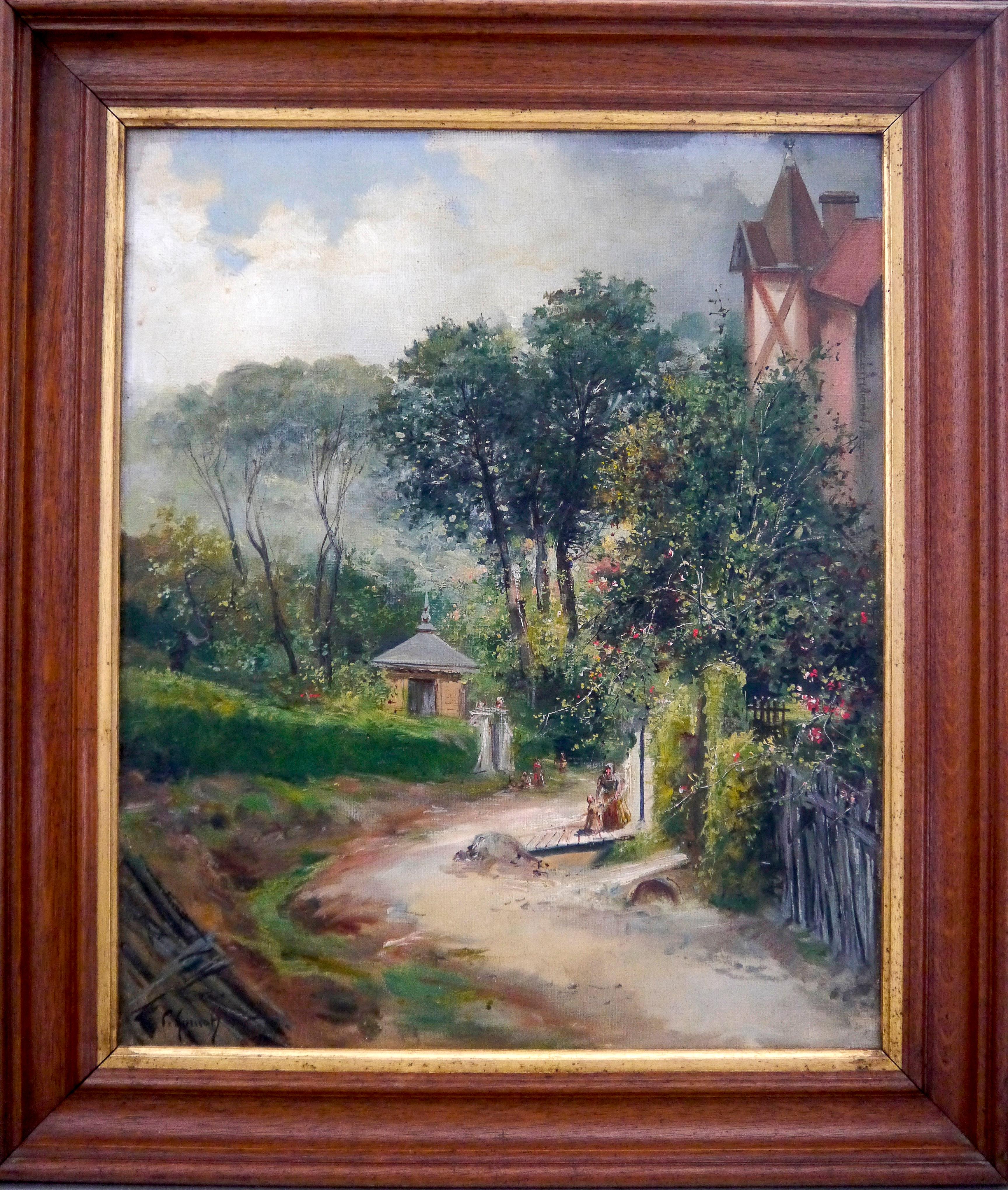
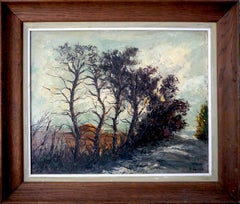
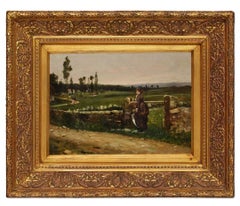
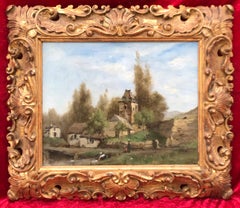
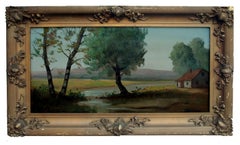
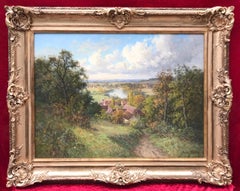
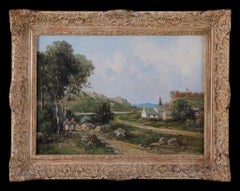
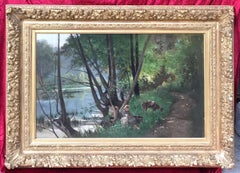
➡️ Landscape Forest Path with Figures Anonym school of Barbizon⬅️
⏩It is signed Colet⏪
⭐Medium:⭐ Oil on canvas
⭐Technique: ⭐Impasto painting with expressive brushwork.
⭐Size:⭐24x33cm / 9.4x13 inch
with frame 30.5x39.5cm / 12x15.6 inch
⭐Date: probably end of 19th or early 20th⭐
⭐Condition : ⭐ Good condition. Vivid colors. There are cracks in the sky of the landscape, but they are not structural.
⭐Provenance:⭐ Private collection - France.
⭐Shipping:⭐ from France is fast 4-6 days with Fedex / DHL
🟢🟢🟢🟢🟢🟢🟢🟢🟢🟢🟢🟢🟢🟢🟢🟢🟢🟢
About the painting:
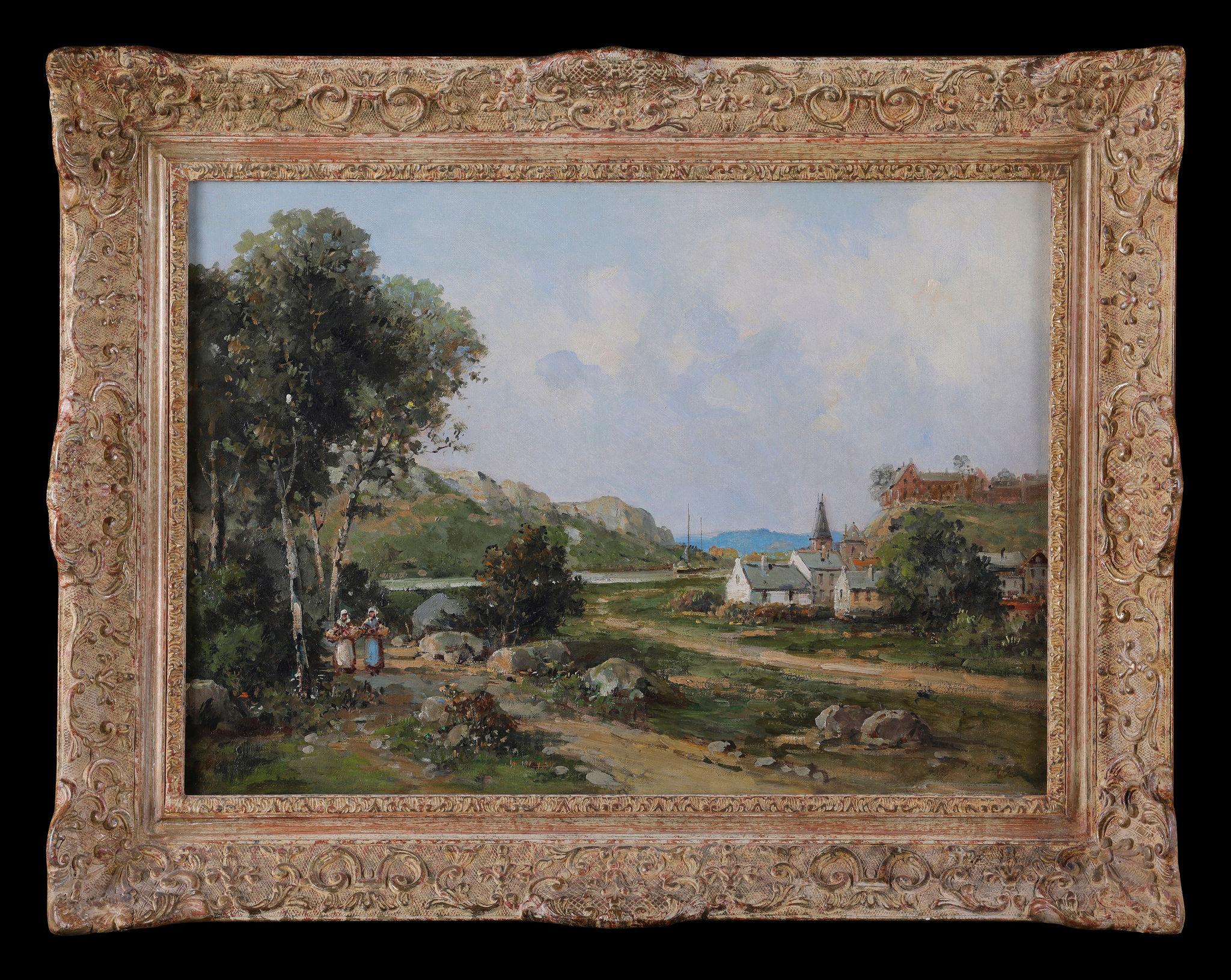
This rural landscape, attributed to the artist Colet and likely painted during the late nineteenth or early twentieth century, belongs to the long tradition of European naturalist landscape painting that flourished in the decades following the success of the Barbizon School. The composition depicts a peaceful countryside scene in which a solitary figure walks along a dirt path leading toward a distant village, framed by tall trees and open fields. Through its subtle handling of light, atmosphere, and space, the painting conveys both a sense of tranquility and a deep attachment to the rural world.
At first glance, the viewer's eye is immediately drawn to the winding path that cuts diagonally through the composition. Beginning in the foreground and extending toward the horizon, this road serves as the principal compositional device, guiding the viewer into the landscape and creating a powerful sense of depth. The inclusion of a lone figure walking along the path adds a narrative dimension while emphasizing the scale of the surrounding countryside. Rather than dominating the scene, the individual appears small and integrated within nature, suggesting a harmonious relationship between humanity and the landscape.
The composition is carefully balanced between openness and enclosure. On the right side, a group of tall birch trees rises dramatically toward the upper edge of the canvas. Their slender white trunks provide a striking vertical counterpoint to the horizontal sweep of the fields and sky. The artist has used these trees as a natural frame, creating a visual boundary that draws attention toward the central pathway and the distant village. Their dark foliage contrasts effectively with the luminous sky, adding depth and richness to the scene.
The village itself appears only faintly in the distance, nestled within the landscape and partially obscured by atmospheric effects. A cluster of rooftops and what appears to be a church tower emerge from the horizon, suggesting a quiet rural community. This subtle treatment reflects the artist's interest not in architectural detail but in the broader harmony of the countryside. The village functions as a destination within the composition, providing a focal point toward which both the road and the viewer's gaze naturally converge.
Light plays a particularly important role in the painting. The sky occupies a substantial portion of the composition and is rendered in pale, luminous tones that suggest either early morning or late afternoon. Rather than depicting dramatic weather conditions, Colet chooses a calm and diffused light that bathes the landscape in a gentle atmosphere. This restrained illumination contributes significantly to the painting's mood of serenity and contemplation.
The color palette is dominated by natural greens, earth tones, and muted blues. The artist avoids excessive chromatic intensity, instead favoring subtle tonal relationships that unify the composition. The greens of the foliage and grass are varied and nuanced, ranging from deep forest tones in the shadows to lighter, almost golden hues where sunlight touches the landscape. These carefully modulated colors reveal a keen observation of nature and suggest that the painting may have been executed partly from direct outdoor study.
Technically, the work demonstrates many characteristics associated with the naturalist and Barbizon traditions. Brushwork remains relatively loose in the vegetation and distant landscape while becoming more defined in key structural elements such as the trees and pathway. This balance between precision and spontaneity creates an impression of immediacy without sacrificing compositional coherence. The artist's handling of atmospheric perspective is particularly effective, as distant forms gradually dissolve into softer tones, enhancing the illusion of space.
Stylistically, the painting recalls the influence of the Barbizon School, whose artists sought inspiration in the forests, fields, and villages of rural France during the nineteenth century. Painters such as Jean-Baptiste-Camille Corot, Charles-François Daubigny, and Théodore Rousseau established a vision of landscape based on direct observation and emotional sincerity rather than academic idealization. Colet's work appears to continue this tradition into the early twentieth century, when many regional painters remained committed to naturalistic landscape subjects despite the emergence of modernist movements elsewhere in Europe.
The painting also reflects broader cultural values associated with rural life during this period. As industrialization transformed cities and societies, many artists turned toward the countryside as a symbol of stability, continuity, and authenticity. The quiet road, the solitary traveler, and the distant village collectively evoke a world governed by traditional rhythms rather than modern urban pressures. This nostalgic dimension would have resonated strongly with contemporary audiences and continues to appeal to viewers today.
Overall, this landscape is a refined and atmospheric example of late nineteenth- or early twentieth-century naturalist painting. Through its carefully structured composition, harmonious palette, and sensitive treatment of light, Colet succeeds in transforming an ordinary rural scene into a poetic meditation on nature and human presence. The painting's enduring charm lies not in dramatic subject matter but in its ability to capture the timeless beauty and quiet dignity of the countryside.