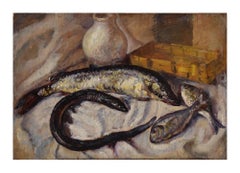
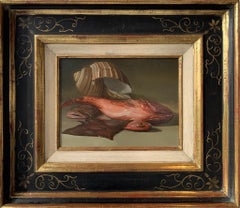
Gian Carozzi Still Life with Cuttlefish 1942
The textural elegance of Mid-century Italian Ligurian Realism
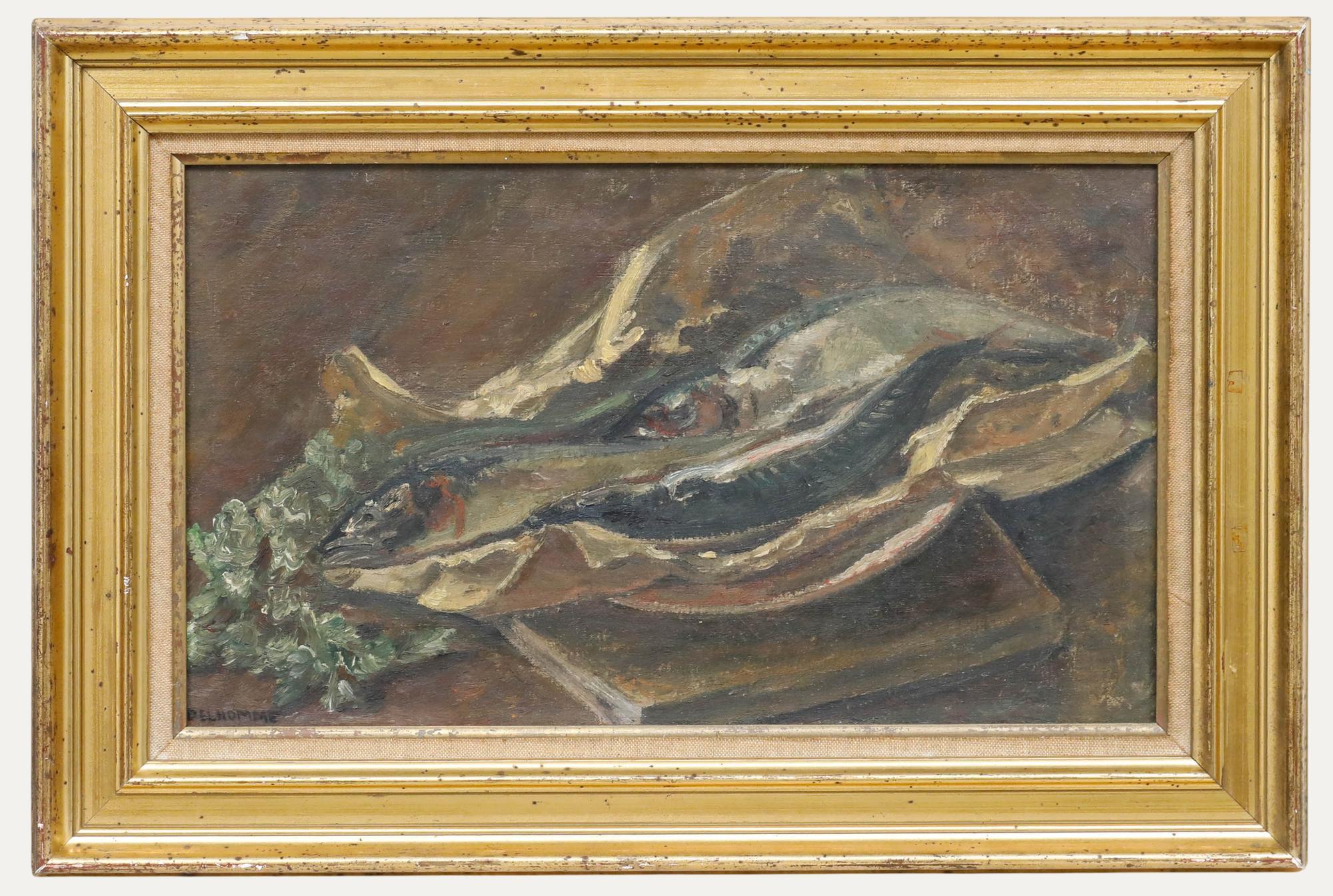
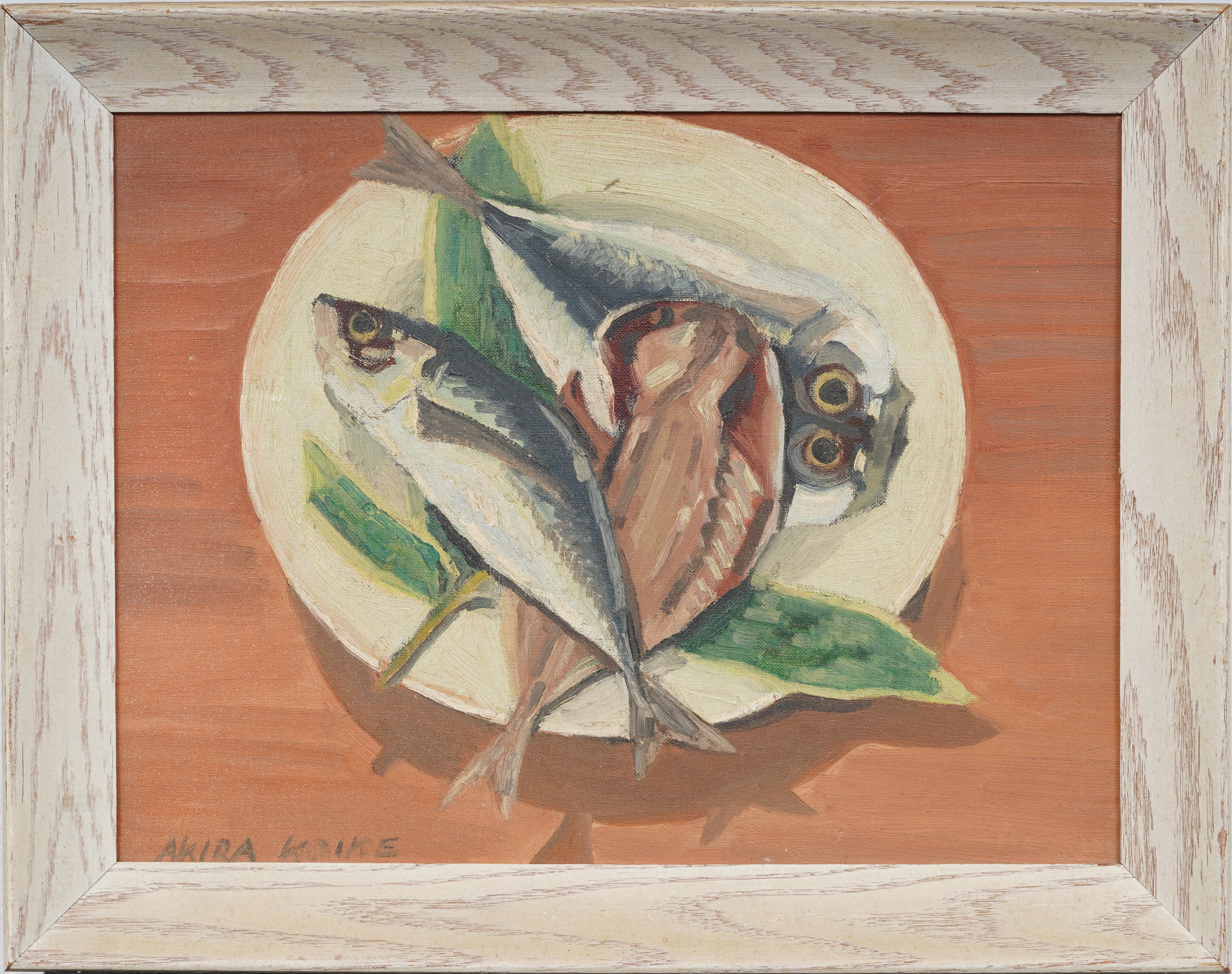
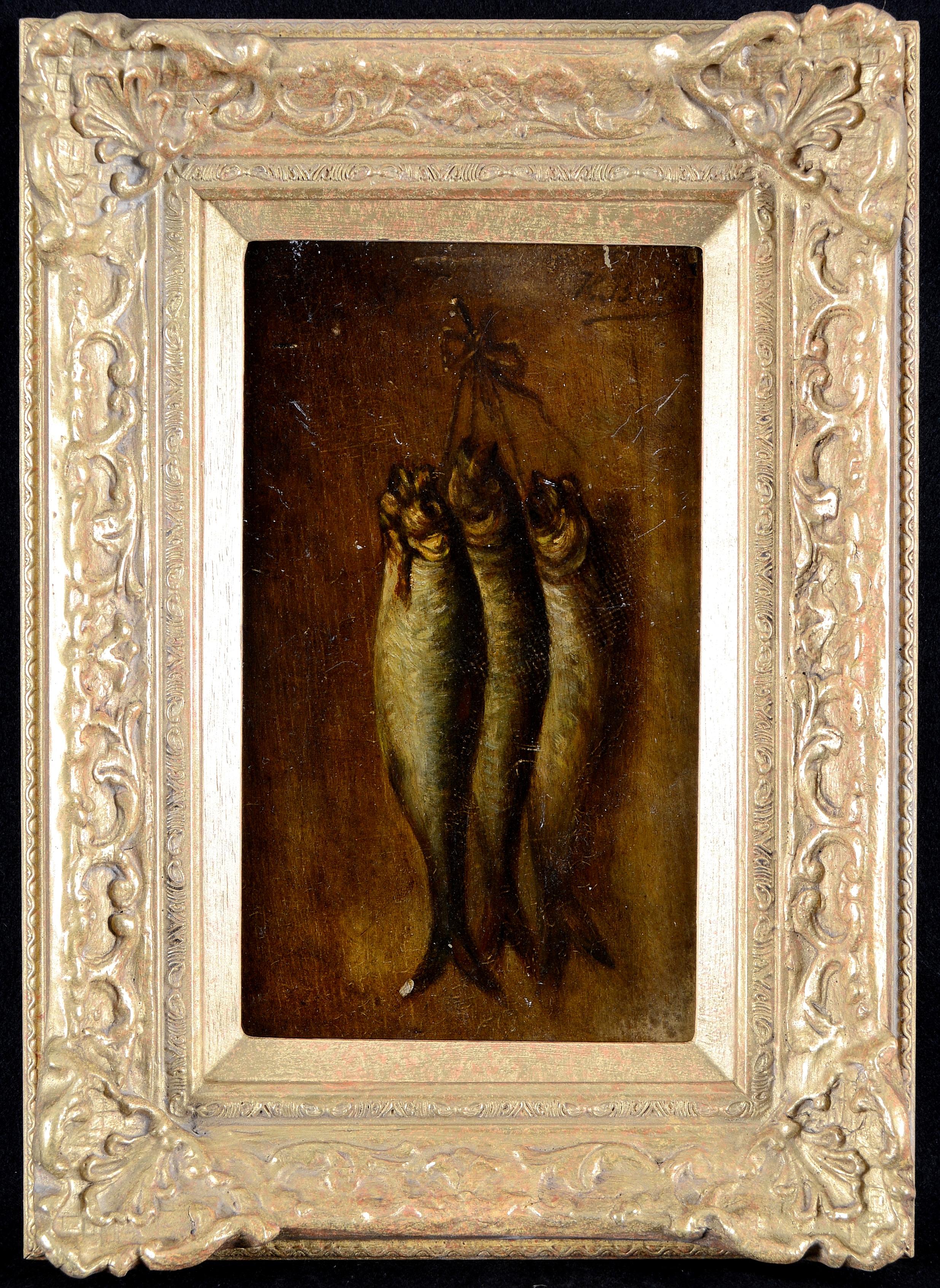
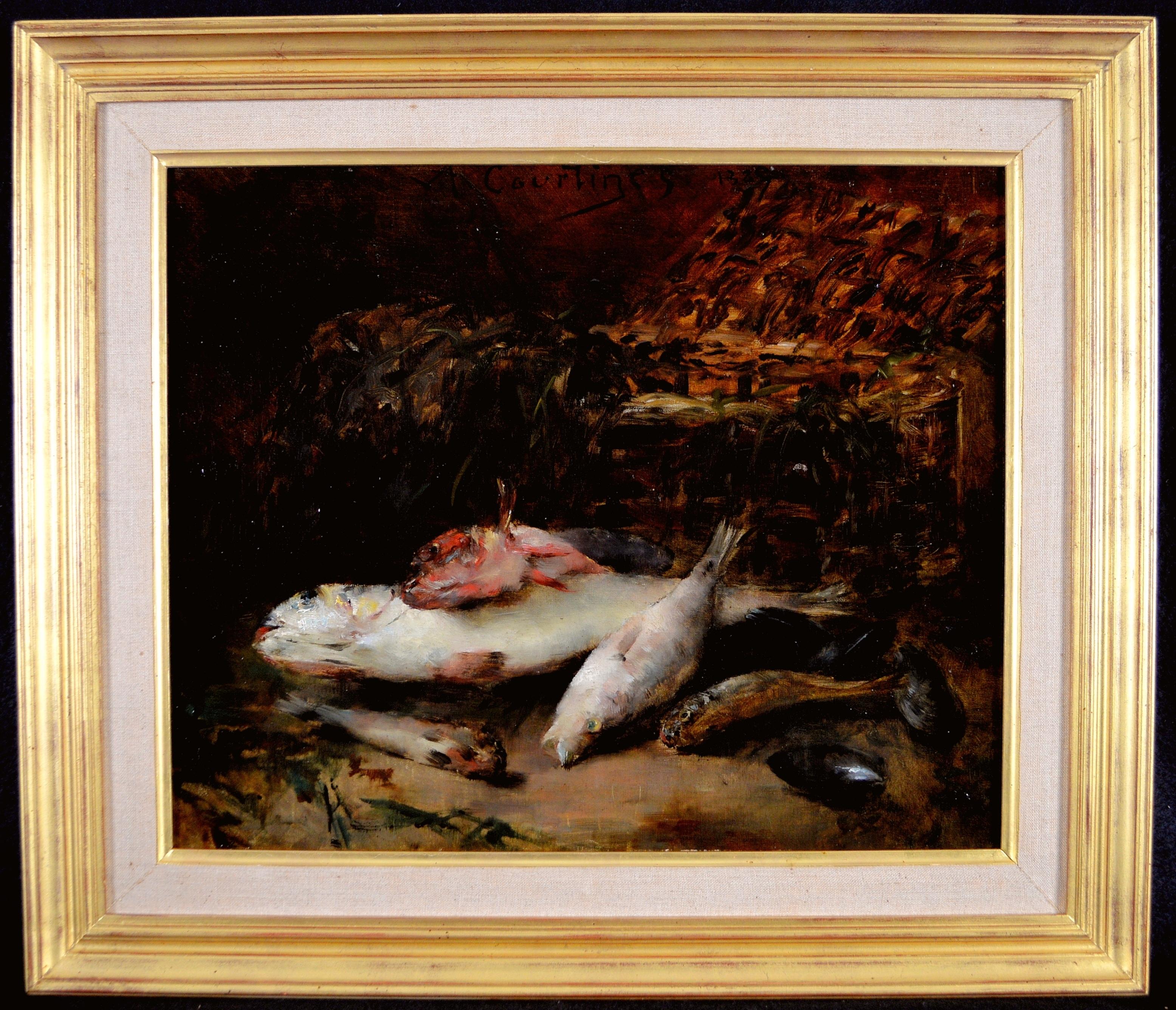
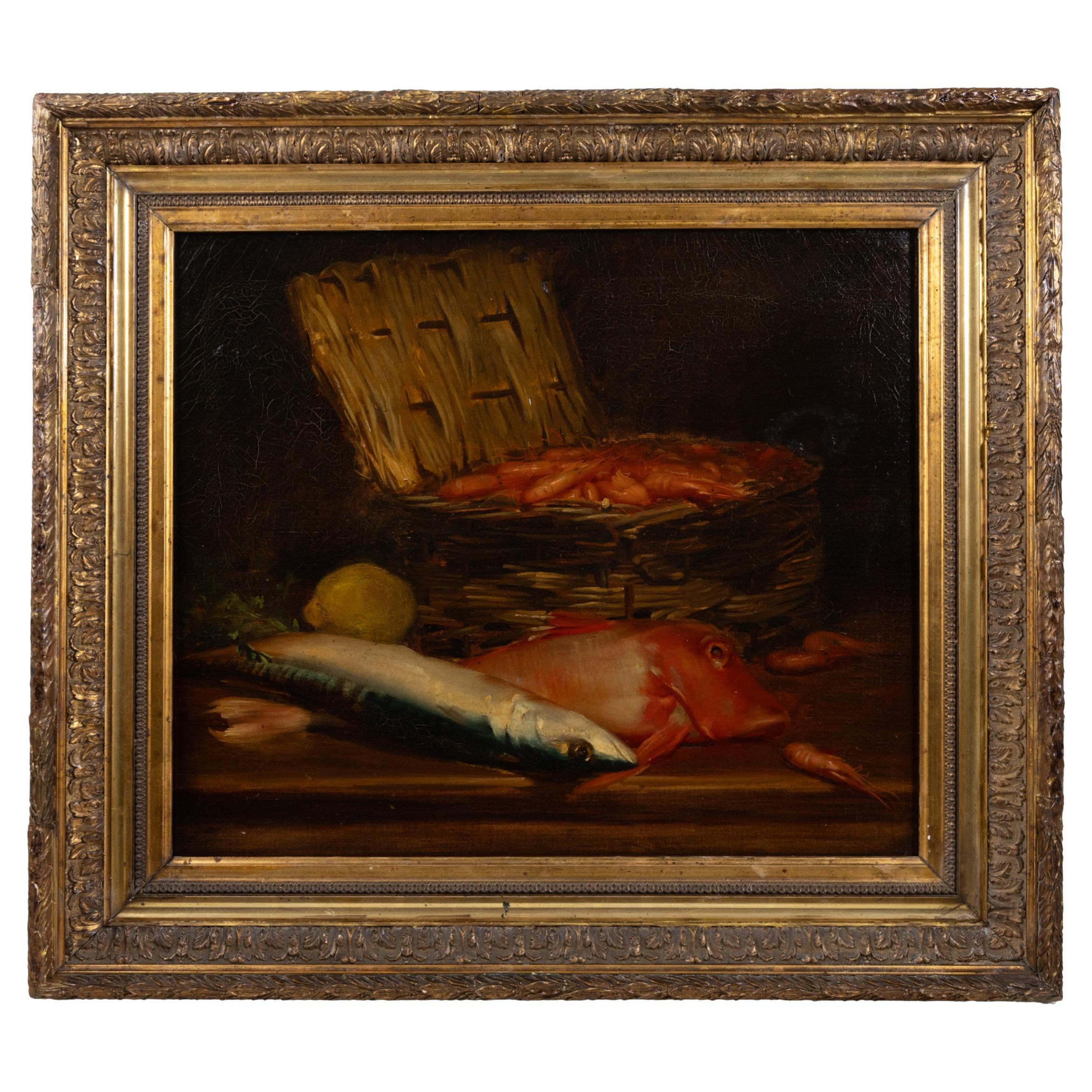
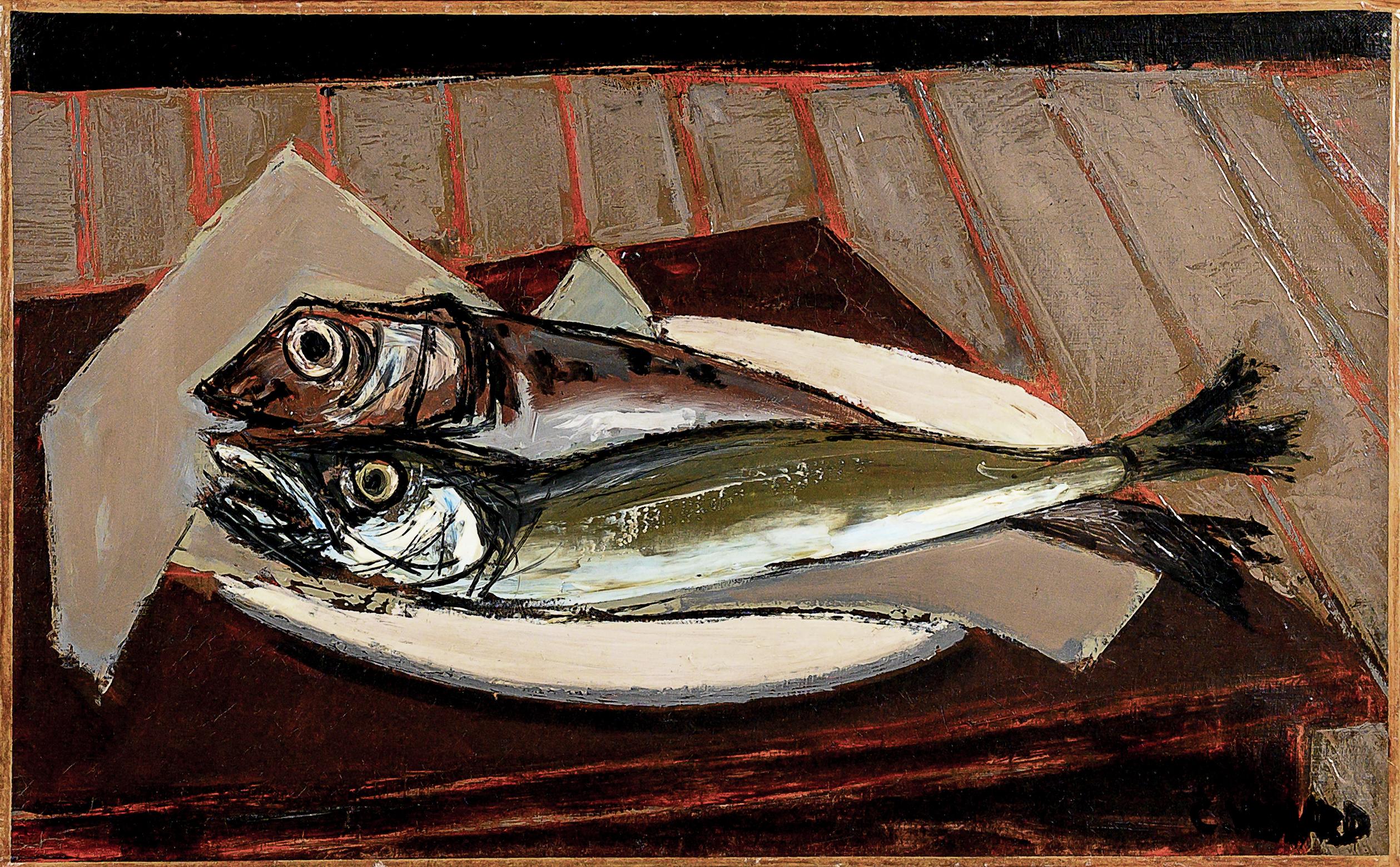
This still life with cuttlefish by Gian Carozzi (1942), dating from his early years in La Spezia, depicts two cephalopods against a dark background rendered in earthy tones and fluid brushstrokes, evoking the Ligurian tradition of marine compositions.
Oil on panel, in a realist style with an emphasis on texture and natural light, the work reflects his early interest in organic matter, prior to his move to Milan.
In 1942, Gian Carozzi took part in the 17th edition of the Littoriali exhibition in Trieste and Vienna. Dilvo Lotti wrote in *Meridiano di Roma* that Carozzi’s work was one of the revelations of the exhibition.
Also in 1942, he took part in the 1st National Art Exhibition celebrating agriculture, fruit, flowers and animals in Verona – Verona Prize.
The work, signed and dated by the artist, was exhibited at the 1942 Littoriali, highlighting his involvement in the Fascist art scene, yet with an introspective and anti-rhetorical undertone.
This artwork, never before on the market, comes from an important European private collection and is beautified by an impressive original frame in laquered wood, in very good condition.
Our company has been present on this platform for many years, with more than 100 sales made and just as many excellent reviews received that you can under our Furniture account.
Giancarlo Carozzi called Gian (La Spezia, March 29, 1920 - Sarzana, January 20, 2008) was an Italian painter, exponent of the space movement.
Carozzi's artistic training begins by attending the Artistic High School of Genoa, where he decides to cultivate his youthful attitude towards drawing and painting.
The solid historical-artistic education, moreover, derives from the curious self-taught effort, more than from school teaching.
He recently embarked on a career as an artist when at the age of twenty-two he was called to arms and assigned to force in Greece.
Back in Italy around the summer of 1943, he decided to join the partisan gangs of Justice and Freedom.
During the militancy he escapes a German roundup in Val di Magra.
With the unconsciousness of his young age, the partisan Carrozzi goes unharmed from story to story until '45.
In the summer of '45 he went by bicycle to Florence, where - together with his writer friend Manlio Cancogni - he visited an exhibition of French art set up at Palazzo Pitti and curated by Bernard Berenson: he was struck by the painting by Paul Cézanne, of which he admired eleven paintings belonging to the collection of Egisto Paolo Fabbri and Charles Alexander Loeser.
From that fundamental encounter with the work of the artist from Aix-en-Provence, the research undertaken by Carozzi since the first years of training becomes even more rigorous and fanatical, that is, the attempt to grasp, by means of painting, the essence of reality, the true content of the meaning of objects, leaving out what is superfluous and - for this reason alone - ephemeral.
At that time, Carozzi's days were in fact all spent analyzing the Cézannian construction in his studio.
In La Spezia in 1947, thanks to the irrepressible activism of Vincenzo Frunzo and the ethical-critical support of Corrado Cagli, the Group of the Seven of which Carozzi joins (the other associates are: Gino Bellani, Carlo Giovannoni, Guglielmo Carro, Vincenzo Frunzo, Bruno Guaschino, and Giacomo Porzano). The following year he visited a particularly significant edition of the Venice Biennale, coming into contact for the first time with non-figurative painting: he had the opportunity to appreciate the work of Kandinskij, a painter on whom he changed his judgment over the years, as well as - in the Guggenheim collection - he was impressed by Jackson Pollock, then a semi-unknown artist.
Once the Cézannian experience is over, he tackles abstract painting, following and reworking the intuitions of the artists who had most inspired him: the results of that time are original and instinctive works.
The influence of abstract expressionism is therefore evident above all in the paintings of '48, canvases that, however, already anticipate Carozzi's more innovative subsequent painting.
In 1949, the year of the rebirth of the Golfo della Spezia Painting Prize, Carozzi was immediately awarded by a commission chaired by Valentino Bompiani and composed of Carlo Carrà and Carlo Ludovico Ragghianti for the work "Metamorphoses of the Blue Grotto", an example of the surreal echo that characterizes his art until his departure for Milan.
In those years the Italian capital of art was Milan, where the pictorial movements - avant-garde and non-avant-garde - multiplied and merged.
Giancarlo Carozzi thus leaves La Spezia in 1949 for Milan when he is already technically mature, among academic fundamentals, Cézanzani's youthful passion and a first conversion to the artistic avant-garde.
Being abstract painters represents at that moment, more than a choice of field, a sort of fideistic conversion, an abrupt way of cutting ties with figurative tradition.
In Milan he participates in the Diomira Prize for young artists under the age of thirty; the work he exhibits strikes the attention of Carlo Cardazzo who dedicates a personal exhibition to him at the Galleria del Naviglio.
Beniamino Joppolo, in the introduction to Carozzi's 1950 exhibition, defines him as "a surrealist but surrealist painter of a surrealism who has been able to follow surrealism in its logical future.
In fact, the planes, the atmospheres, and also the objects, the forms, the movements move in an existing intuited reality but not controllable with eyes, touch, ears».
Biomorphic forms of a more extra-terrestrial than natural reality, rocks with organic genesis that take possession of a dreamy stage that recalls the metaphysical experience of De Chirico, projected on an infinity with planets and stars: this makes Gian Carozzi's surrealism a "third way" closer to abstractionism: the painting does not include a reality made of dreamlike elements but plausible (as in Dalí's painting), but rather a fantastic reality, achievable and realized only in the form of thought.
1950 is a very prolific year for Carozzi, in fact he participates in the XXV Edition of the Venice Biennale and obtains at the "Gulf Prize" the recognition of the jury chaired by Carlo Ludovico Ragghianti and composed of Renato Guttuso, Felice Casorati, Carlo Carrà, Marco Valsecchi and Ubaldo Formentini.
Meanwhile, Lucio Fontana arrives in Milan from Buenos Aires and brings the "White Manifesto" with him and begins to propose various documents on Spatialism to the artistic community.
At the Galleria del Naviglio in Milan Carozzi sees "Ambiente spatial a luce nera" and listens to the conference by Beniamino Joppolo, painter and theoretical writer of Spatialism; in those days he witnesses the definitive split (both political and cultural) of the New Arts Front; he goes to the presentation of the fourth folder, at the Galleria Salto, of Concrete Art (with lithographs, among others, of Afro, Soldati, Veronesi, Dorfles and Fontana).
He then reads with growing curiosity the "Proposal for a regulation of the Space Movement" obviously signed by Lucio Fontana and Milena Milani, Giampiero Giani, Beniamino Joppolo, Roberto Crippa and Carlo Cardazzo.
He is among the founders of Spatialism and the Carozzi exhibition at the Navigli is a huge success.
Fontana, seeing his paintings, approaches him to tell him: "You are a space painter". A few days later the Space Art Manifesto is written and Carozzi will sign - with greater awareness but never with excessive conviction - the Space Art Manifesto for television.
From 1950 to 1952 he participated in the life and exhibitions of the Spatialists: "Giancarozzi" (this is the alias with which he appears on the posters) exhibits at the group's exhibitions with Lucio Fontana, Roberto Crippa, Gianni Dova, Beniamino Joppolo, Cesare Peverelli, Mario Deluigi.
Many debates are remembered at the Galleria del Naviglio, meetings in which Joppolo has the function of theorist of the movement; despite his young age, Gian Carozzi is considered by many of the group a leader and a master.
His talent prevents him from adhering to the spatialist poetics and from pushing himself far beyond the charm towards Lucio Fontana, a much more mature man and artist with a great genius.
Gian Carozzi slowly detaches himself from the group and his style oriented towards the non-contingent is observed, developing new shapes and symbols belonging to the subconscious or - better yet - brilliant intuitions of an imaginary reality, which evokes the known reality without representing it.
In '57 he left Milan and headed to Paris; a love was born that would last twenty years. Rent a studio on rue d'Assas, right next to the sculptor Zadkine and the Luxembourg garden.
In Paris he found Cancogni who was a correspondent of the Espresso, and Joppolo who, having moved away from Spatialism, had already lived there for a year.
Life in Paris is very hard for a painter, Carozzi knows famous painters who spend a miserable life, working a lot and living with very little "in Paris - says Carozzi - no one is called a master as it happens in Italy". He exhibits at the Salon d'Automne, the Salon des Réalité Nouvelle, the Salon de Versailles and the Gran Palais at the Présence Européenne and Art Contemporaine International exhibition where he represents Italy with Arnaldo Pomodoro, Alberto Burri, Lucio Fontana, Giuseppe Capogrossi and Roberto Matta.
For the French I.T.T., he performs large paintings for the boardroom and in the Saint Omer factories, as well as a series of wall paintings.
He became friends with the Russian painter Simon Segal, one of the last exponents of the Paris School and proponent of a particularly effective neo-expressionism in the portrait; he met some Italian artists who lived in Paris including the old Gino Severini (futurist of the first hour), Alberto Magnelli and the sculptor Carlo Sergio Signori.
His friendship with the sculptor Émile Gilioli instead begins in '62: Carozzi goes to his studio and Gilioli's works fascinate him very much.
In turn, Gilioli visits Carozzi's atelier and expresses his appreciation. The Parisian sculptor, who after a very hard life had reached success a few years earlier with an important exhibition from Carré, is famous for not paying any help to other artists.
However, to Carozzi's great surprise, he shows up one day in his studio with a Belgian collector who buys several canvases.
The meetings are very frequent, often the two meet in a camp near the Montparnasse Cemetery where they hold, with other artists, airce bowls games. Gilioli likes to have painters and sculptor friends for dinner in his studio; from him Gian Carozzi knows - among others - Serge Poliakoff, Jean Dewasne, Yaacov Agam, Jean Deyrolle.
These contacts can lead us to think that Carozzi has a "worldly and brilliant" life, in truth they are short and occasional breaks within a lonely life.
The Louvre is his real home.
The artist likes to spend hours in front of Italian painting, in addition to a particular predilection for Poussin, Chardin and Corot.
I think I understood in Paris what painting is, I mean, however, what Roberto Longhi called painting-painting.
I think there is no other way but to turn to the masters of the past and to a few contemporaries: Giotto, Masaccio, Piero della Francesca, Giovanni Bellini, Chardin, Corot, Cézanne, in short, the same painters that Morandi loved to whom, of course, I add Morandi himself»
(Gian Carozzi, Interview by Ferruccio Battolini, 1984)
In his paintings, especially in recent years, the lessons of these masters are evident.
Gian Carozzi spends whole days in front of the tripod, but often the canvas remains white or, after working, destroys what he has done, suffering from an eternal dissatisfaction that will torment him for his entire career.
He follows all the exhibitions, which are very many, and his ideas are getting more and more confused; in Paris, however, Carozzi has the opportunity to overcome the crisis of overcrowding of images by taking refuge in the Jeu de Paume where he can - for the umpteenth time - dialogue in silence with "his" Cézanne, a watershed author of his training and youthful passion never extinguished.
However, he realizes that with abstract experience, he has completely abandoned drawing, he has lost the constructive capacity learned over the years of study.
He therefore decides to abandon painting for the moment and devote himself only to drawing. In Montparnasse, the district where he lives, there is the Academy of the Great Chaumière, where illustrious painters worked, from Corot to Matisse.
There, from morning to night, the models succeed each other in all possible poses, and you work, together with 20-30 other people from sixteen to eighty years old, in absolute silence.
Gian Carozzi often draws with the model throughout the day, going from large charcoal drawings well studied to quick and immediate sketches.
This dark and tiring work lasts three years but is - for the painter - indispensable: the experience of the Great Chaumière, together with the tireless study of the greats, induces Gian Carozzi to a slow revision of his art.
Paris therefore meant for the artist a sort of long preparatory exercise, perhaps more human than aesthetic, to his splendid return to figuration.
In 1979 the artist decided to return to the land of origin, the Val di Magra, choosing in particular the city of Sarzana, where he is the author of the fourteen color plates of the book La cucina della Lunigiana, published by Longanesi.
In his decisive artistic maturation he voluntarily renounces the "color-color", he works essentially with the "lands" which are basically the color of the fresco. "This does not mean - Carozzi specifies - that I do not love the great colorists, and Matisse first"; the choice of colors helps to understand the atmosphere that, with the preponderant "lands", the artist wants to recreate, that is, the human-natural reality that he assimilated and transformed during the Parisian stay, into a permanent appointment with the core of things: his still lifes, his landscapes, even some of his portraits, are a praise of the micros in place of the macros, where the micros arises to synthesis and constructed geometry, in line with the unreachable Cèzanni model.
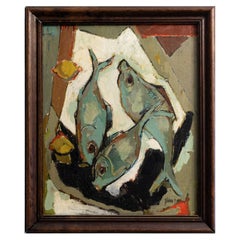
In still lifes Carozzi recalls the experience of Chardin and Cézanne through the plastic-emotional evidence of the forms and the perspective approach just forced to allow us a deep and global vision of the image.
The figurative production of the last thirty years of life is anxiety for synthesis, tension to the abstract, reduction to the essential to grasp the original meaning of things; but this long research, begun in the forties, cannot germine the essence of reality and can only turn into an infinite cycle between figuration and abstraction: the last forces of Carozzi - tireless painter - will be used in an extreme, interrupted, return to abstractionism that encloses in itself the meaning of the artist's entire work.
In August 2000 the city of Sarzana dedicated a large exhibition to him, divided into two prestigious spaces: the works of the Milanese space period from 1949 to 1955 are exhibited in one section, in another the recent works from 1985 to 2000. 2003 is instead the exhibition "Carozzi, 1956-1960, organized by the Sarzano gallery Cardelli & Fontana.
Dimensions are frame included
Under existing legislation, any artwork created over 70 years ago by an artist who has died can requires a license for export regardless of the work’s market price. The shipping may require additional handling days to require the license according to the destination of the artwork.