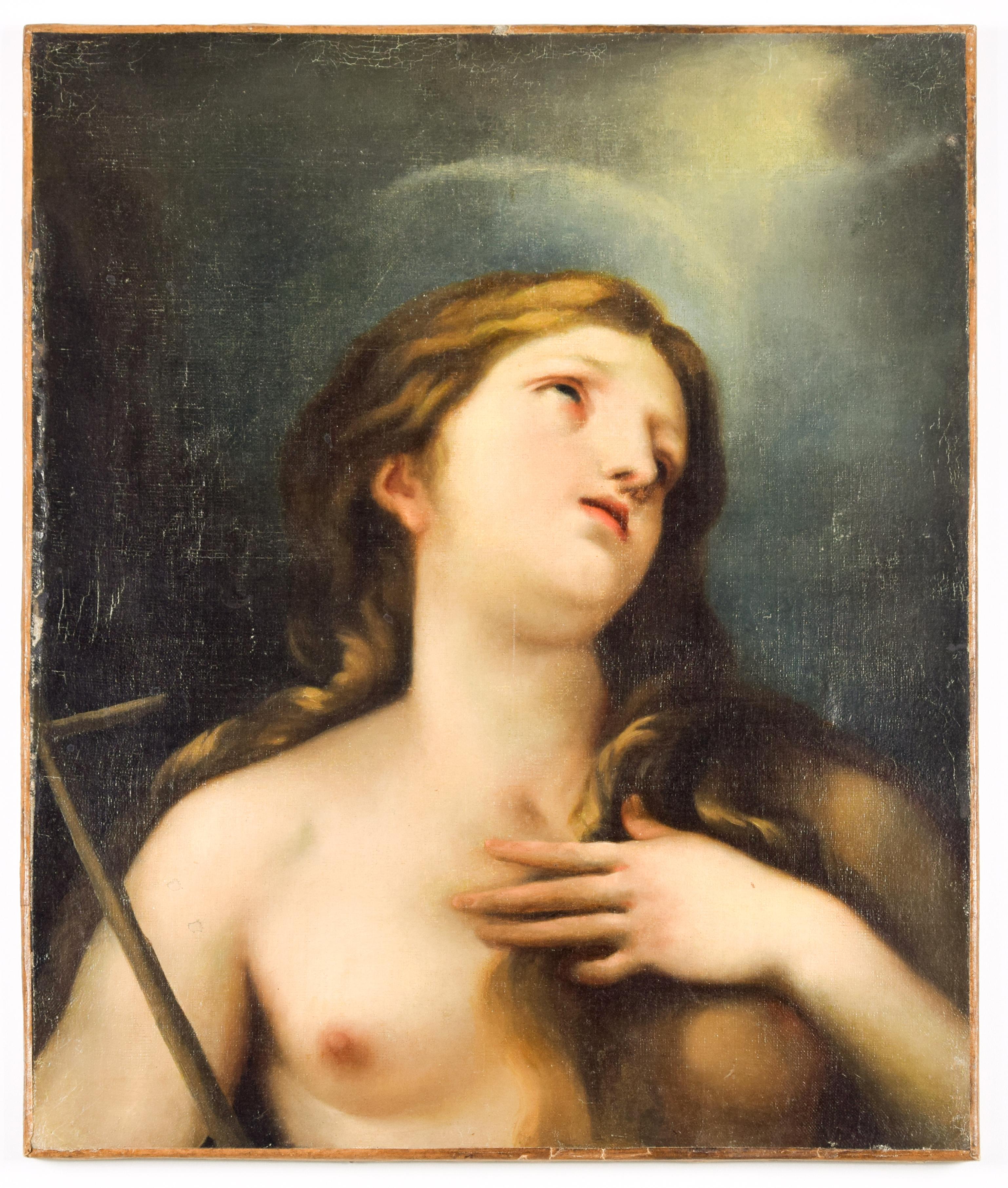
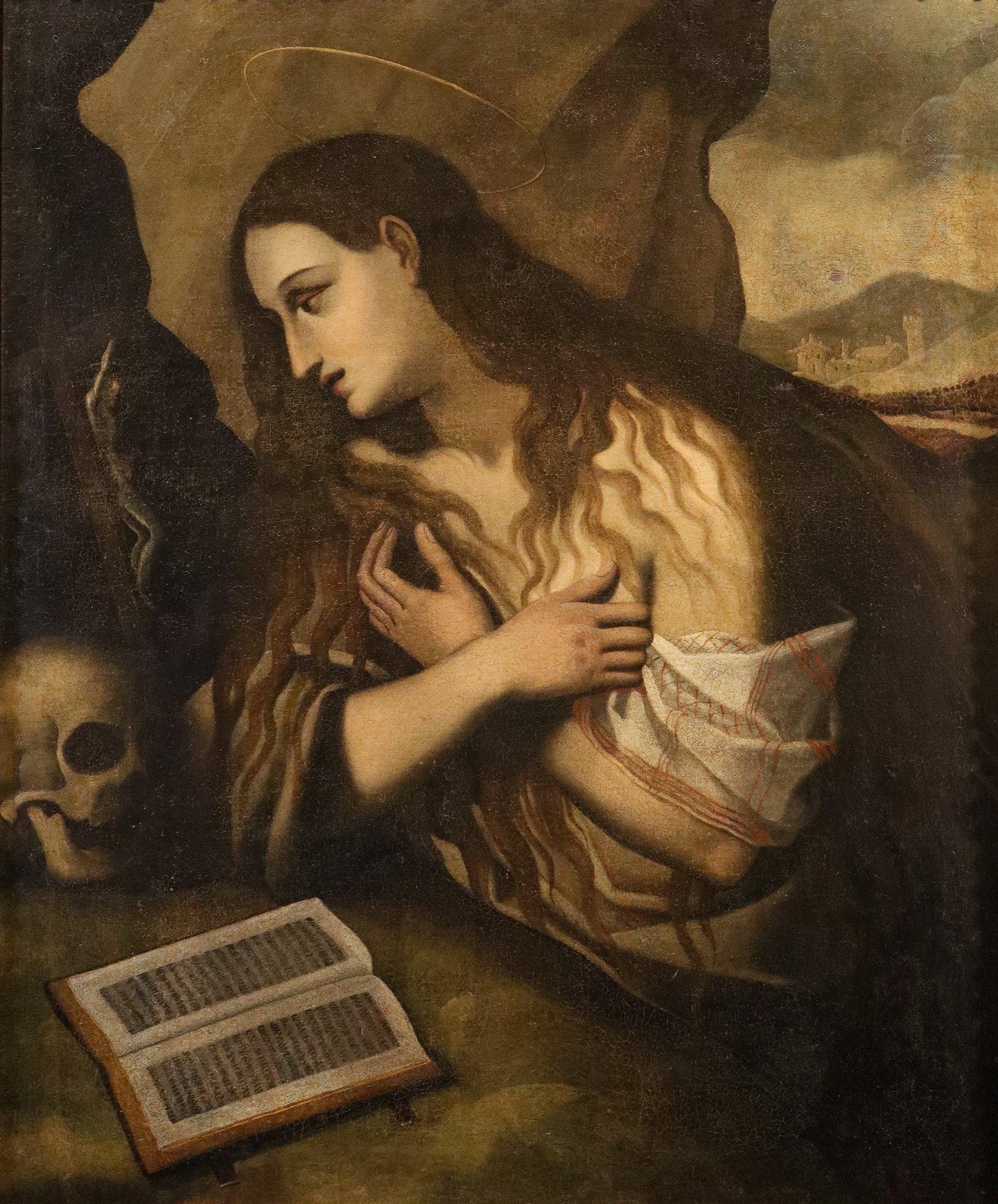
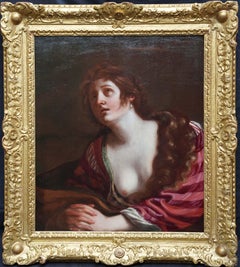
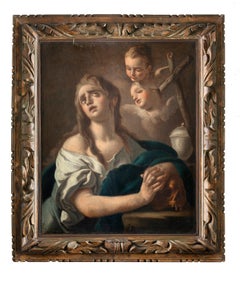
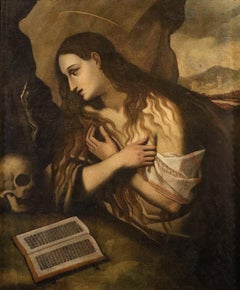
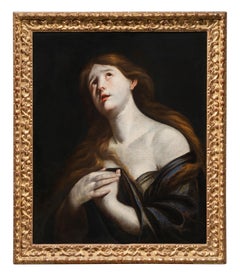
Painting done in oil on canvas. The figure of Magdalene is depicted here, in keeping with tradition, with long red hair; with a gesture of sorrowful dedication she fixes her gaze on the crucifix, which she holds with her left hand pressed against her right arm, the latter in turn folded in a sign of collected penitence.
The whole body is rendered with a splendid opposing twist, which has the effect of making the viewer feel the tension of the moment experienced by the saint. On her left is visible the skull, her traditional attribute, and in the background we can make out the outline of the cave in which she is placed.
The part of the body emerges, thanks to the intense brightness of the arms, connected to the red ochre hues of the hair and face, also thus accentuating the erotic character of the scene, recalling the exuberant painting of Rubens, who had great influence on Crespi's work.
This captivating and highly pleasing figure of Magdalene follows the widely popular trend in the 1600s and 1700s of depicting saints with an undertone of human sensuality, revealing the patrons' preference for sacred themes imbued with secular elements.
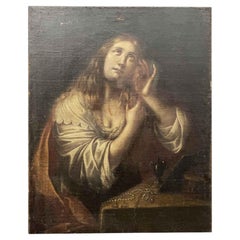
The present painting, datable to about the mid-1800s, is derived from the original versions by Crespi, a very active painter of Bolognese origin, of whom at least two versions are known.
The first, kept at the Bologna picture gallery, formerly from the Florentine Loeser collection, later acquired by a private Englishman, was purchased by the picture gallery in 1996.
The second, closer to ours in the design of the details, was part of Angelo Cecconi's collection in Florence, then acquired in 1947 in the Briganti collection, then passed to a private collection in Como, was auctioned at Dorotheum in 2018.
Giuseppe Maria Crespi, known as Lo Spagnuolo, was an indefatigable and prolific artist, totally devoted to his painting activities; at least 300 works are surely his autograph, already documented years ago by Mira Merriman.
An early detailed account of his life is left to us by Abbot Giampietro Zanotti in his "Storia dell'Accademia Clementina" printed in Bologna in 1739, and then more news comes to us from the writings of his son Luigi, also a painter.
Their accounts show how Crespi surrounded himself with a considerable number of young painters, whom he had in his workshop, along with his three painter sons, Luigi, Ferdinando and Antonio Liborio.
To all, on the strength of his experience, he never ceased to recommend the exercise of copying, "that is why he continually exhorted his pupils to imbibe the manners of great men, in order to have them then present to their imagination, when they operated: that is finally, how he formed in his own way."
While there are no elements to glimpse direct interventions by the master in the present painting, its high pictorial quality, combined with some details of luministic rendering, and the identical measurements to the two original versions by Crespi, may lead us to speculate that it is a copy made in his own sphere, by some of his pupils or children.