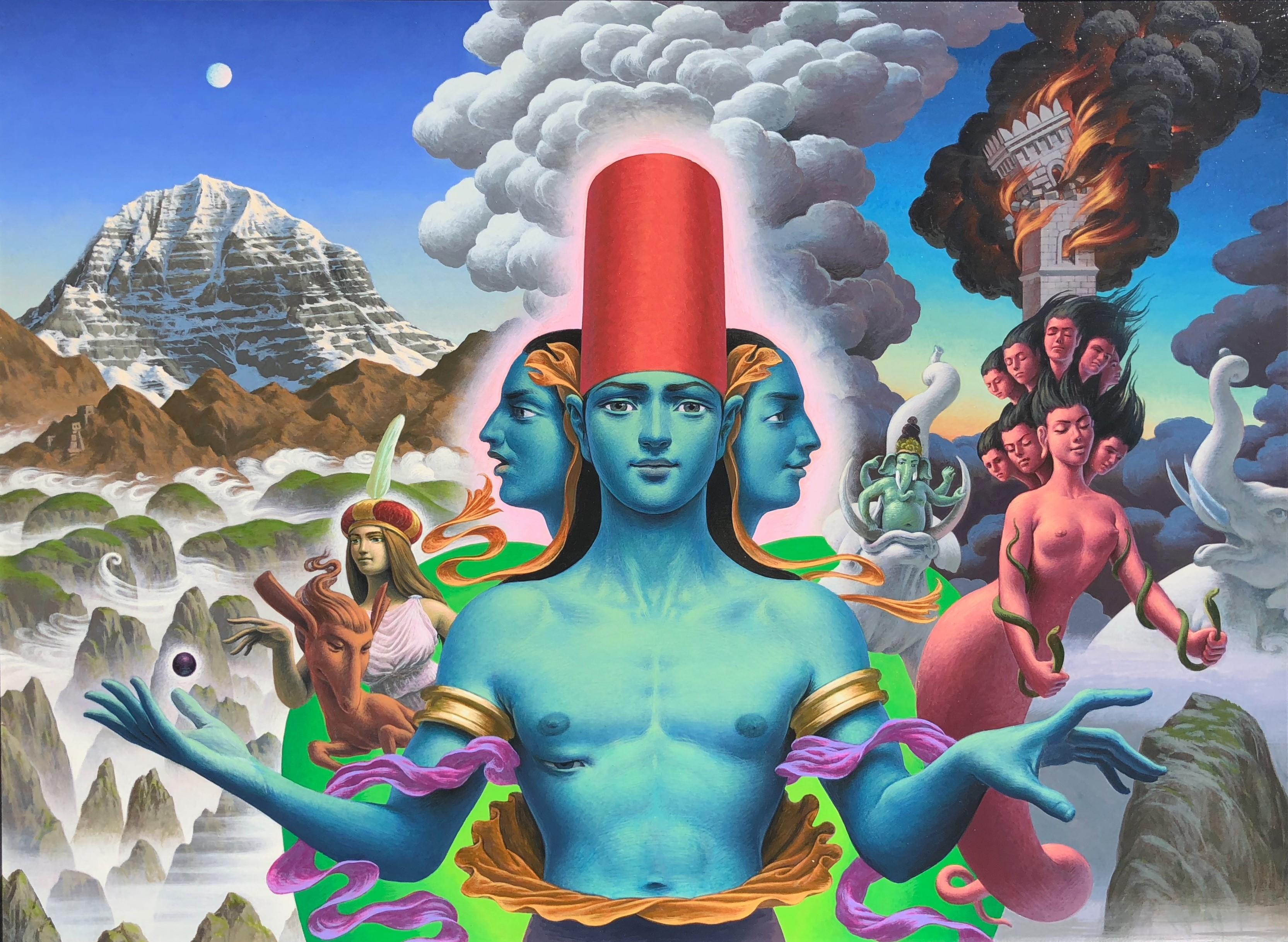
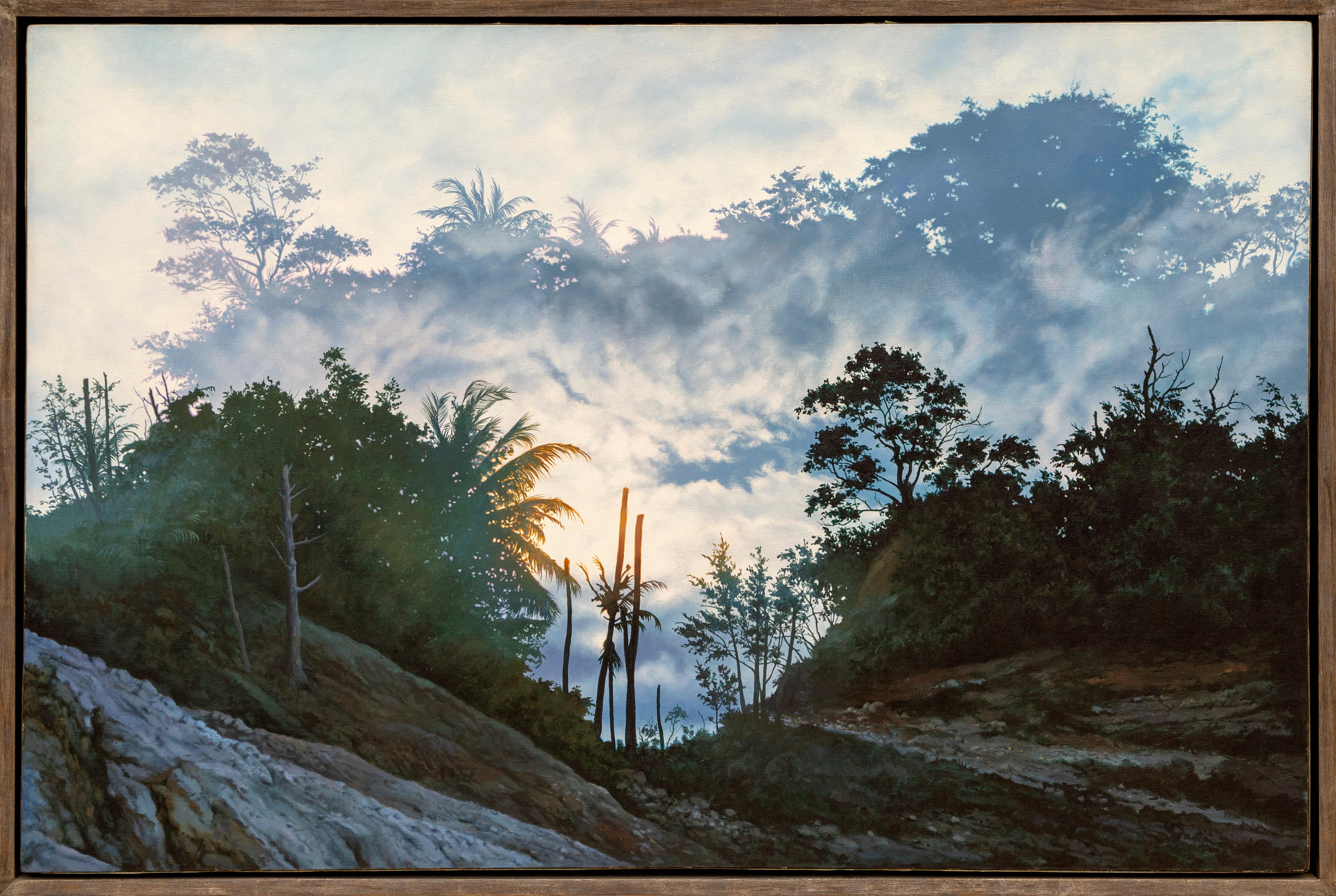
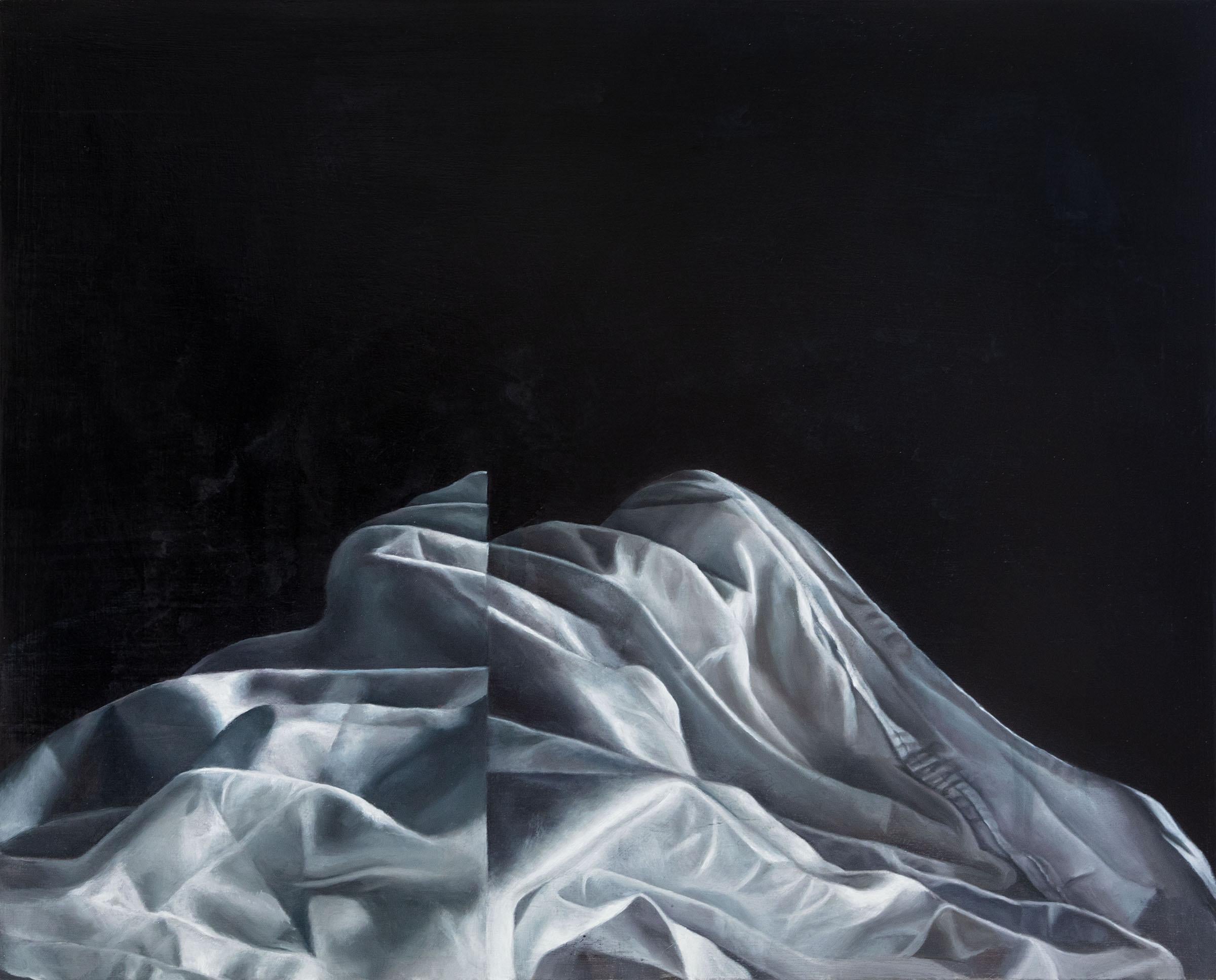
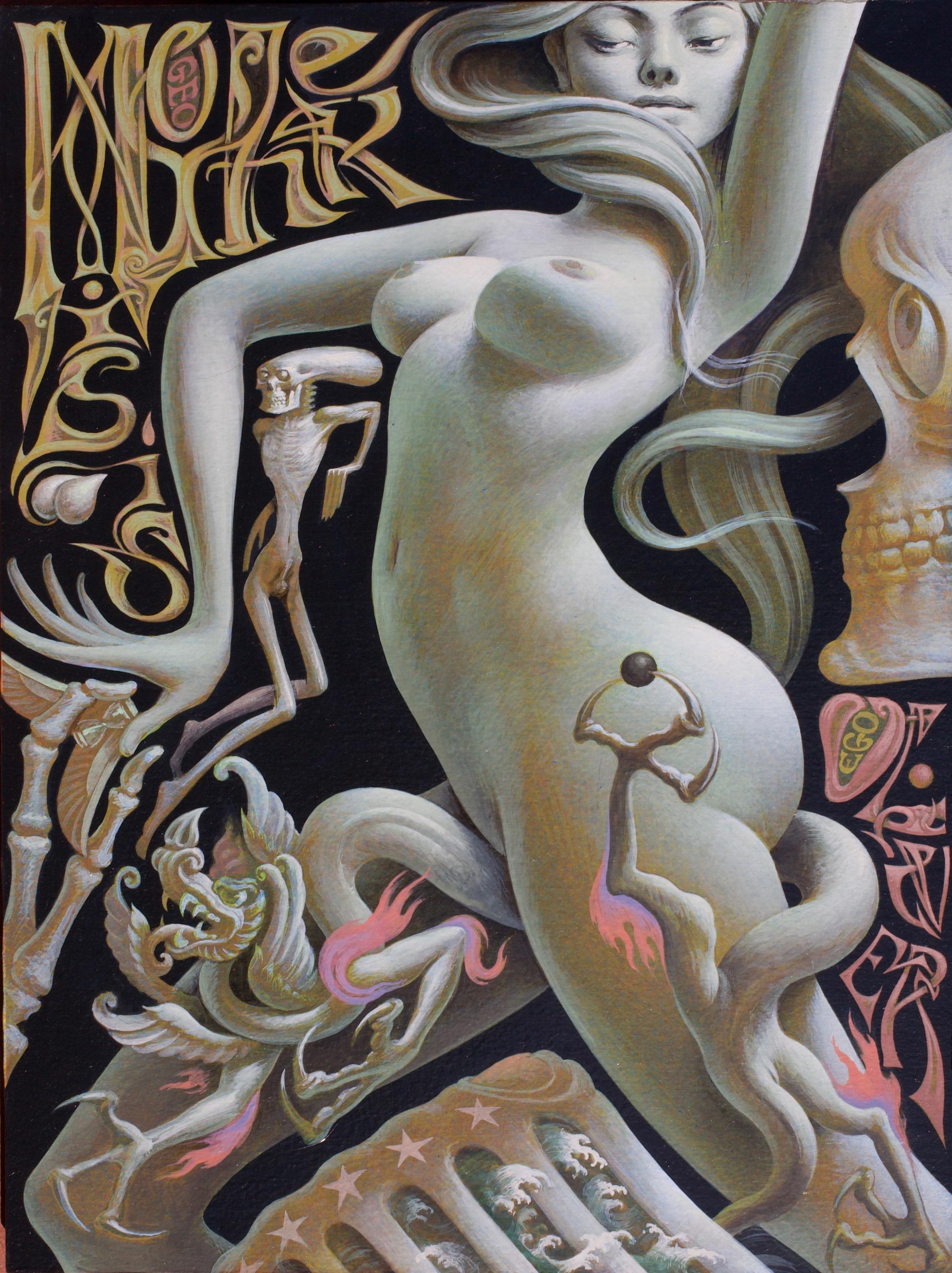
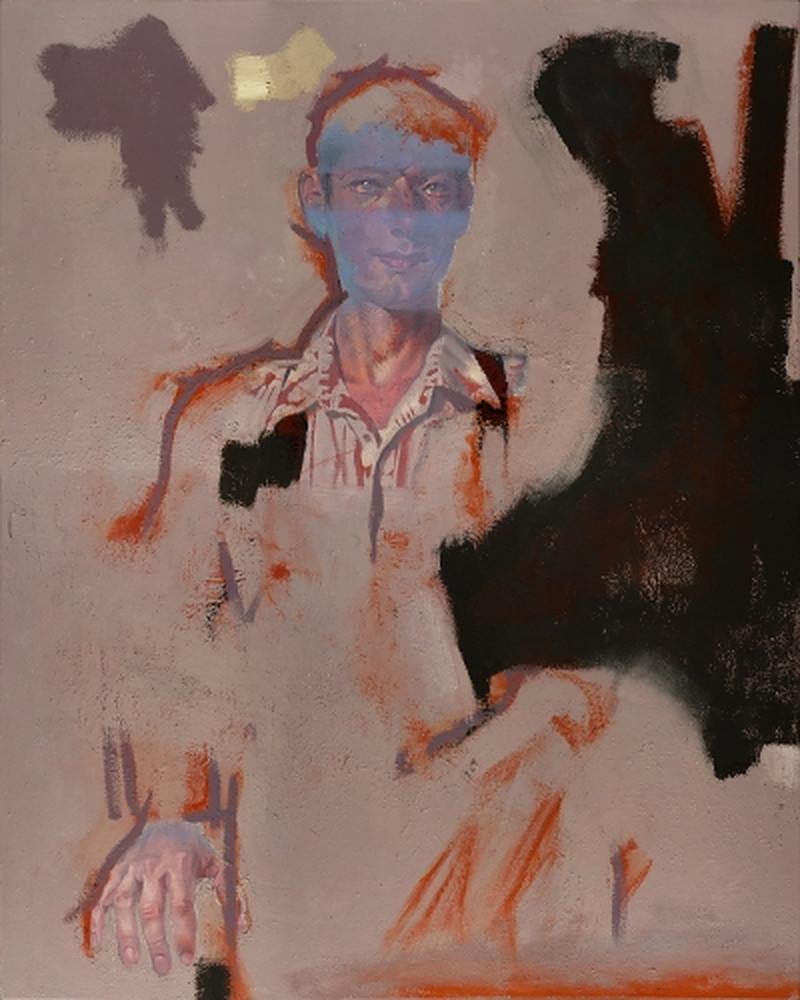
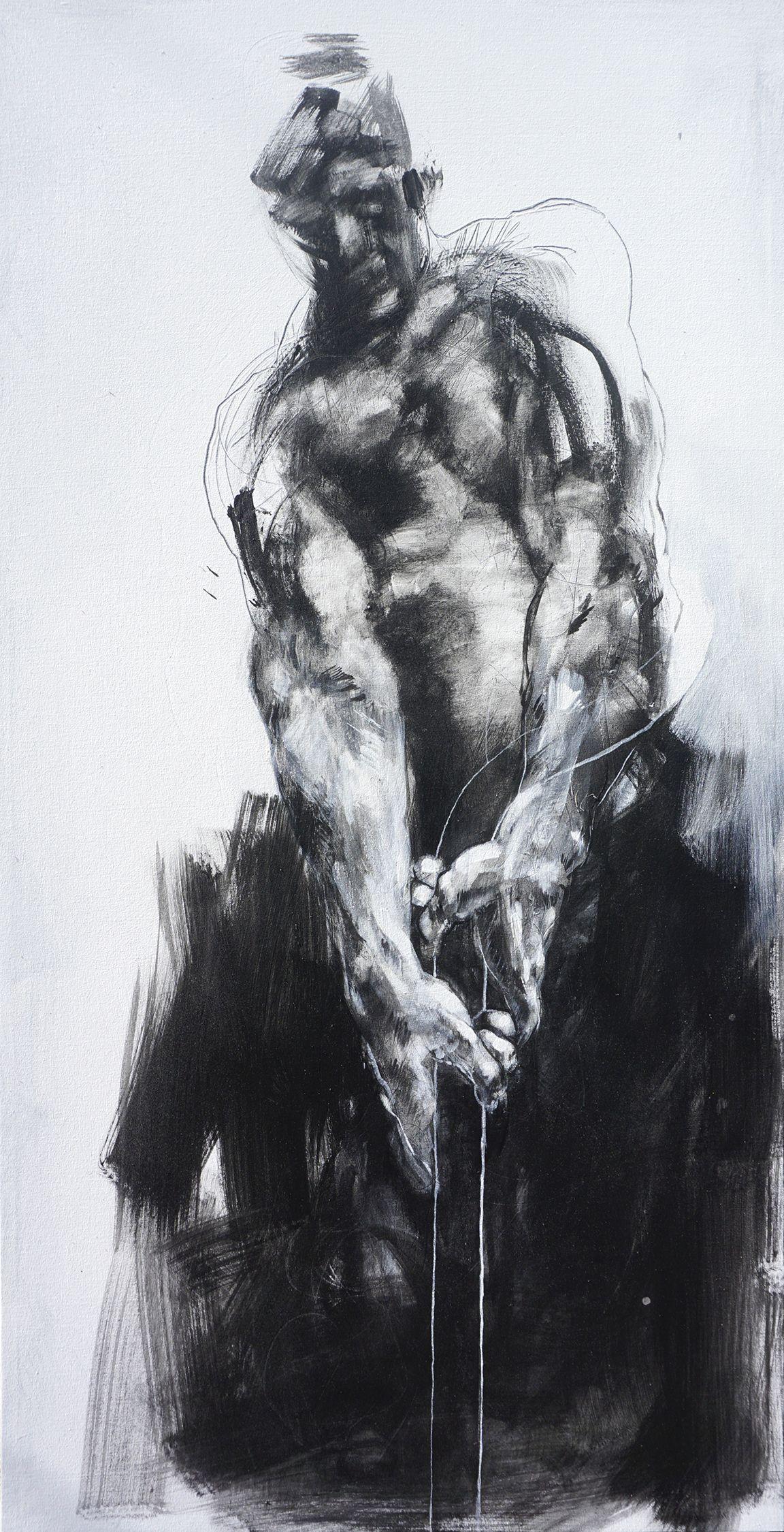
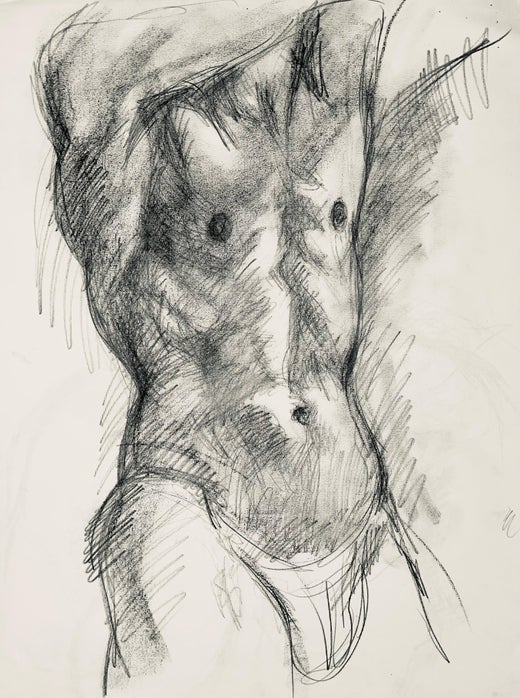
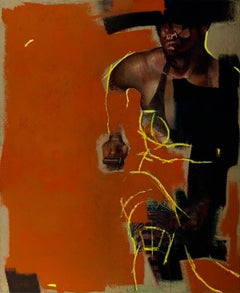
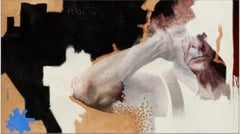
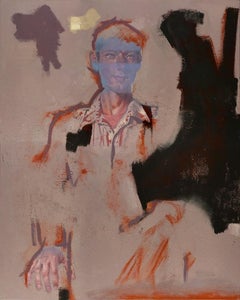
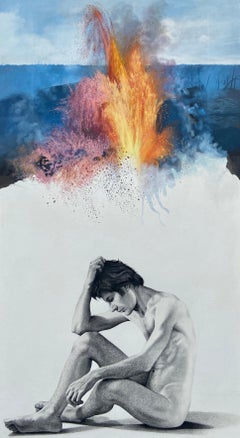
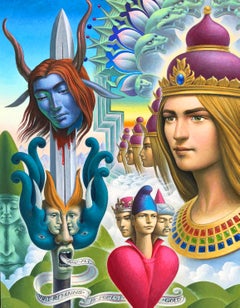
This exquisite acrylic painting by Ian Hornak (1944–2002), titled Sorcerer Series: Beast Head, Spider Web, was executed in 1969. The masterfully conceived composition exemplifies Hornak’s early synthesis of Photorealism, Surrealism, symbolism, and metaphysical inquiry, presenting a haunting arrangement of human and animal forms suspended within a complex illusionistic environment. The floating nude figure, crouching beast-headed hybrid, geometric framing devices, and radiating spider web are rendered with extraordinary precision and dramatic tonal contrast, transforming the composition into a meditation on transformation, duality, consciousness, mythology, and the hidden structures that govern existence. Through his remarkable command of anatomy, spatial ambiguity, and symbolic imagery, Hornak creates a visual experience that transcends conventional realism, inviting contemplation of humanity’s relationship to instinct, imagination, and the subconscious mind. Executed during a pivotal period in the artist’s development, the painting reflects Hornak’s transition from the visionary and surrealist concerns of his early career toward the technical rigor and conceptual sophistication that would later establish him as a pioneering force in Photorealism and Hyperrealism. The composition demonstrates his lifelong fascination with illusion, symbolic narrative, and the integration of classical imagery with contemporary artistic innovation.
Executed in acrylic on canvas, this work measures 72 x 48 inches (182.88 x 121.92 cm). Signed and dated by the artist, verso.
Artwork Details:
Artist: Ian Hornak (1944–2002)
Title: Sorcerer Series: Beast Head, Spider Web
Medium: Acrylic on canvas
Dimensions: 72 x 48 inches (182.88 x 121.92 cm)
Inscription: Signed, dated by the artist, verso
Date: 1969
Condition: Well preserved, consistent with age and medium
Provenance: Stable Gallery, New York, New York; Tibor de Nagy Gallery, New York, New York; Bernice Fox Weinstein, Washington D.C.
About the Artist:
Ian Hornak (1944–2002) was an American painter, draughtsman, printmaker, and pioneering force in Photorealism and Hyperrealism whose extraordinary technical mastery, visionary imagination, and innovative approach to realism established him as one of the most distinctive and original artists of the late twentieth century. Widely recognized as a founding member of both the Photorealist and Hyperrealist movements, Hornak helped redefine the possibilities of contemporary realism by combining photographic precision with symbolism, romanticism, mythology, environmental awareness, art historical references, and metaphysical inquiry, creating a body of work that stands apart within postwar American art for both its visual brilliance and intellectual ambition. Born in Philadelphia and raised in Michigan before establishing his career in New York and East Hampton, Hornak emerged during one of the most transformative periods in modern art and developed a highly individual visual language that transcended conventional artistic categories. While many of his contemporaries focused on strict photographic transcription, urban imagery, or detached observation, Hornak utilized realism as a foundation for exploring profound themes of memory, beauty, mortality, spirituality, environmental fragility, and humanity’s relationship with nature, producing works that operate simultaneously as visual spectacles and philosophical meditations. His artistic vision reflects an awareness of the revolutionary innovations introduced by Pablo Picasso, Alexander Calder, Alberto Giacometti, Salvador Dali, Joan Miro, Wassily Kandinsky, Marcel Duchamp, and Man Ray, while simultaneously drawing inspiration from the Hudson River School, particularly Frederic Edwin Church, Martin Johnson Heade, Thomas Cole, and Albert Bierstadt, as well as the spiritual landscapes of Caspar David Friedrich and the botanical precision of Dutch Golden Age masters such as Jan van Huysum and Rachel Ruysch. Through this extraordinary synthesis of influences, Hornak created a visual language that united scientific observation, photographic realism, romantic grandeur, allegorical symbolism, and philosophical reflection into a form entirely his own. During the late 1960s and early 1970s, Hornak emerged as one of the earliest artists associated with the newly developing Photorealist movement, producing panoramic landscapes of astonishing complexity and technical sophistication that challenged prevailing assumptions regarding realism and representation. These groundbreaking paintings incorporated the visual effects of multiple-exposure photography, allowing Hornak to present numerous viewpoints, shifting perspectives, and compressed moments in time within a single composition, years before such approaches became commonplace in contemporary art. He was also among the first contemporary artists to extend pictorial imagery beyond the edges of the canvas and onto elaborately painted frames, dissolving the boundary between artwork and object and anticipating later developments in installation art and expanded-field painting. These innovations earned widespread critical acclaim and positioned Hornak alongside major contemporaries such as Chuck Close, Richard Estes, Audrey Flack, Ralph Goings, Robert Bechtle, Malcolm Morley, Richard McLean, and Don Eddy, yet his work remained distinguished by its emotional resonance, romantic sensibility, and deep engagement with both art history and the natural world. As his career evolved, Hornak increasingly moved beyond the concerns of mainstream Photorealism and developed a more personal and ambitious artistic vision, culminating in the monumental botanical, allegorical, and symbolic masterpieces of the 1980s and 1990s that many scholars regard as the pinnacle of his achievement. These extraordinary paintings combined hyperreal floral imagery, celestial phenomena, rare minerals, birds, insects, architectural motifs, mythological references, and complex still-life arrangements into dazzling visual orchestrations that reward prolonged viewing and intellectual engagement. Major works such as Raphael’s Stairway, Echo Loses Narcissus, Hannah’s Mirror, Very Baroque Flowerpiece, and the celebrated Last Song series transformed traditional genres into contemporary meditations on beauty, mortality, history, science, religion, art history, and the cosmos. Unlike many photorealists whose work remained rooted primarily in observation, Hornak elevated realism into a vehicle for symbolic and philosophical exploration, creating paintings that function simultaneously as technical masterpieces, visual narratives, intellectual puzzles, and poetic reflections on existence itself. Throughout his career, Hornak was represented by influential galleries including Stable Gallery, Tibor de Nagy Gallery, Fischbach Gallery, and Katharina Rich Perlow Gallery, exhibiting extensively in New York and internationally. His work received praise from leading critics and publications, including The New York Times, which described him as being “right at the top of romantically descriptive painters today.” His paintings entered important private, corporate, and institutional collections, and his reputation has continued to grow through significant posthumous exhibitions at institutions including the Forest Lawn Museum, the Board of Governors of the Federal Reserve System in Washington, D.C., the Washington County Museum of Fine Arts, the Anton Art Center, and the Moss-Thorns Gallery of Art. Hornak’s influence extends far beyond Photorealism into later generations of realist, hyperrealist, symbolic, environmental, and representational painters who continue to explore the intersection of photography, illusion, narrative, environmental awareness, and metaphysical content. Today, his paintings, drawings, and prints remain highly sought after by collectors who recognize their rarity, beauty, technical excellence, and historical importance, while his personal papers are preserved in the Smithsonian Institution’s Archives of American Art, affirming his place within the broader narrative of twentieth-century American art. As international interest in museum-quality realism continues to expand and collectors increasingly seek historically significant artists whose scholarly importance exceeds their current market valuations, Hornak’s work has attracted growing attention for its originality, ambition, and uniqueness within American art. His highest recorded sale was achieved in 2017, when Large Orchid Bouquet (1988) was sold in a private transaction conducted in association with the heir of the Ian Hornak estate to the Van Andel family, co-owners of Amway, for US$165,000 ($219,168.11 USD, calculated for inflation in 2025), underscoring the growing recognition of an artist whose significance within the history of American realism continues to expand.
Ian Hornak Sorcerer Series Beast Head Spider Web, Ian Hornak acrylic painting, Ian Hornak surrealist painting, Ian Hornak 1969, Stable Gallery, Tibor de Nagy Gallery, Hyperrealist precursor, museum quality realism, symbolic American art.