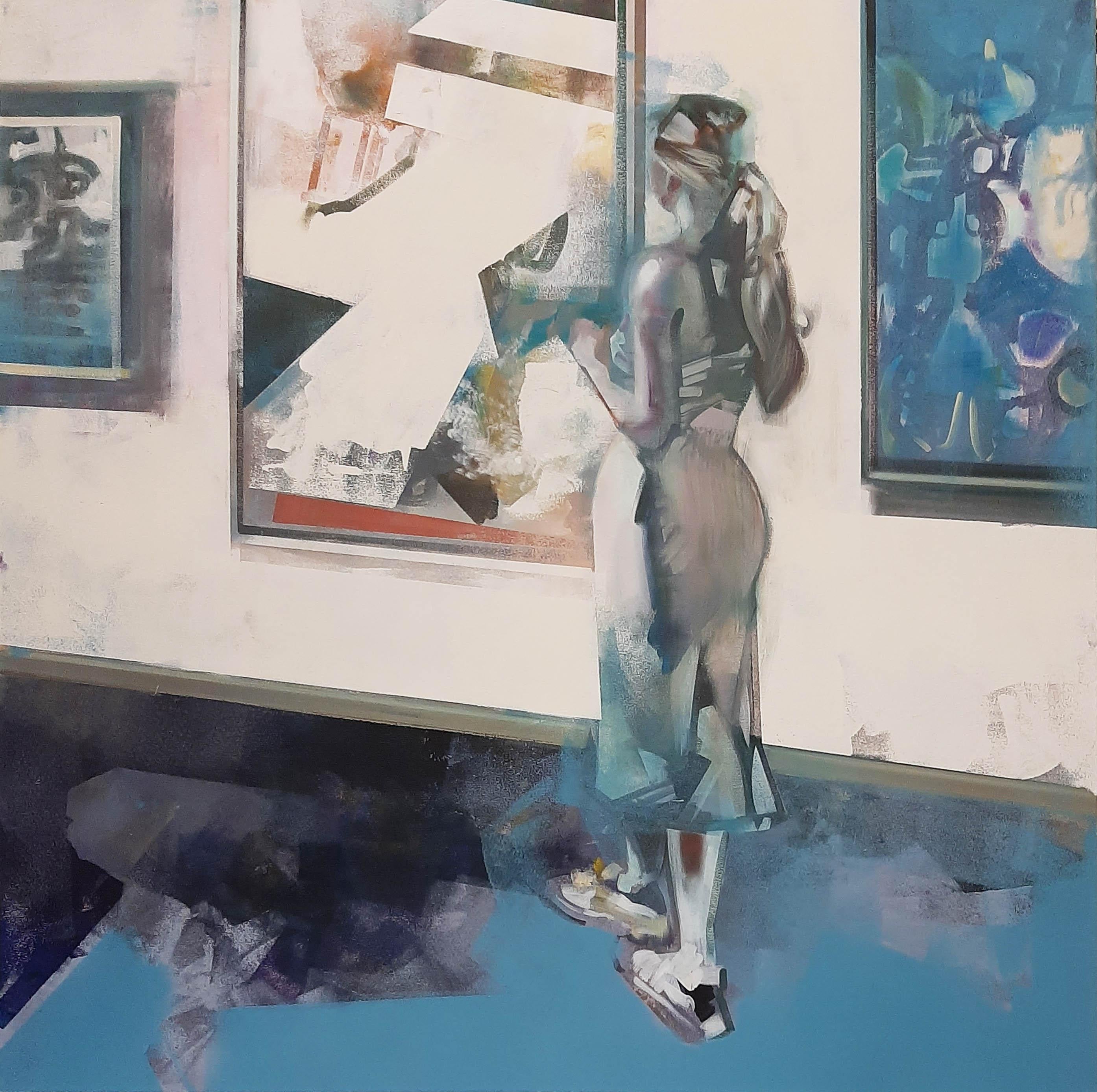
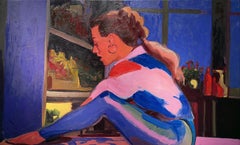
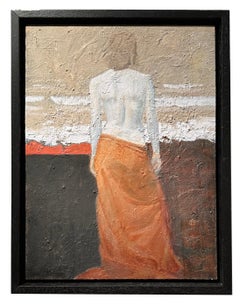
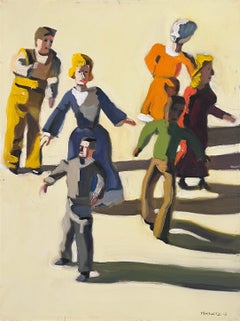
The painting depicts a contemporary gallery interior during a social viewing, likely an opening. The room is spare and luminous, with pale walls and a reflective floor that captures the figures’ movement and pauses. Several viewers inhabit the space, all seen from behind or partially cropped, their identities withheld. The emphasis is not on who they are, but on how they look, stand, and circulate.
On the left wall, a large horizontal painting commands focused attention from a solitary viewer. At one end of this work is a flat, graphic portrait unmistakably in the manner of Alex Katz—cool, stylized, and immediately legible. The title, Peggy’s Katz, explicitly names this work, framing it as both recognizable and owned. It reads like insider shorthand, suggesting familiarity and social currency as much as aesthetic value.
Opposite it, on the right wall, hangs a materially dense, relief-like abstraction composed of countless small, shard-shaped elements. Its surface is built rather than painted, accumulating into a vibrant, almost sculptural mass. The work strongly recalls the Aggregations of Chun Kwang Young, whose practice is defined by precisely this kind of labor-intensive, modular construction. Yet the painting withholds a name. Unlike the Katz, this work remains visually dominant but verbally anonymous.
This imbalance is crucial. The Katz is identifiable, nameable, casually referenced. The other work—possibly by Chun Kwang Young—is experienced primarily through material presence rather than reputation. Together, they establish a quiet hierarchy: one artwork circulates as a known entity, the other as a force that resists easy labeling.
The figures in the room mirror this tension. A central woman in black stands poised between the two works, while another viewer leans toward the dense abstraction. In the foreground, a cropped figure holding a drink draws the viewer into the social intimacy of the scene. Art viewing here is not solitary or reverent, but social, performative, and uneven.
Taken as a whole, the painting becomes a meditation on recognition, ownership, and the social life of art. By pairing a named, iconic Katz with an unnamed, materially intense abstraction that evokes Chun Kwang Young, Nicastri explores how artworks are valued not only for what they are, but for how easily they can be spoken about—and how some works must be encountered before they can be named.
Joe Nicastri
Peggy's Katz
oil on linen
35h x 57w x 1.25d in
88.90h x 144.78w x 3.17d cm
JOC002
Joe Nicastri’s artworks explore moments of quiet observation and human presence, often set within galleries, domestic interiors, or psychologically charged spaces. Working primarily in oil, he blends realism with subtle abstraction, using warm light, cropped compositions, and reflective surfaces to heighten intimacy and tension. His figures are frequently seen from behind or partially obscured, emphasizing anonymity and the act of looking itself. Across his work, Nicastri is less concerned with narrative than with atmosphere—capturing fleeting pauses where viewers, bodies, and artworks seem to merge into a single contemplative experience.