Want more images or videos?
Request additional images or videos from the seller
1 of 6

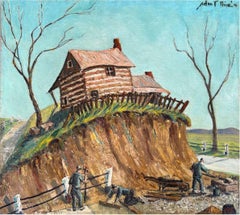
Joseph (Green) Butler III
Knight’s Lodging

$2,750
£2,083.90
€2,428.89
CA$3,930.94
A$3,980.17
CHF 2,264.31
MX$48,371.57
NOK 26,765.25
SEK 26,624.64
DKK 18,156.57

About the Item

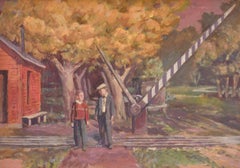
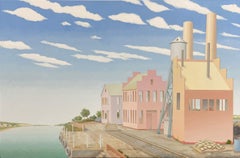
This painting is part of our exhibition American Coast to Coast: Artists of the 1930s Knight’s Lodging, 1941, oil on canvas panel, signed and dated lower left, 16 x 20 inches, exhibited: 1) 6th Annual Exhibition, Massilllon Museum November 2 to December 1, 1941, no. 50; 2) 59th Annual, Portland Maine, March, 1942; 3) 4th Annual, Parkersburg, West Virginia, May, 1942; 4) Spring Salon, Butler Art Institute, May, 1943; 5) Canfield Fair, Canfield, Ohio, September, 1944 and 6) USO Exhibition, Youngstown, Ohio; presented in original painted frame About the Painting Butler’s Knight’s Lodging is a cheeky play on words and symbols as the artist portrays an unhoused man assuming the part of a knight contemplating his evening’s accommodations in an abandoned carpenter gothic railroad depot. Painted in 1941, almost a decade removed from most dire years of the Great Depression, Butler likely felt some freedom to depict what had by that time become an unkind stereotype of the 1930s, the wandering "hobo." Unlike many of the works of his Social Realist contemporaries, Butler's scene is not one of obvious want, as the plump protagonist cuts an ample figure to the right of the composition. Knight's Lodging is the sort of painting which inspired a critic writing about Butler's 1948 solo exhibition to comment that his works from the early 1940s had a "subdued humor that often went unnoticed." As the country exchanged the Great Depression for the new tragedy of World War II, Butler's "humor" was likely seen by many viewers as nostalgic, if offbeat, comic relief when it was exhibited extensively during the first half of the decade. That Butler was one of the most privileged artists of the period apparently passed without comment. About the Artist Joseph Green Butler III was an Ohio Regionalist painter and arts administrator. The grandson of the founder of The Butler Institute of American Art, Joseph Green Butler III was born in Youngstown, Ohio. He graduated from Phillip Exeter Academy and Dartmouth College. Butler studied art with Ceylon Hollingsworth and Clyde Singer and in 1934 became the Director of his grandfather's namesake institution, the first museum in the county dedicated exclusively to American art, a position he held until his death in 1981. From the late 1930s, Butler exhibited at the Institute's Mid Year exhibitions, the Pennsylvania Academy of Fine Arts, the American Watercolor Society (New York), the Audubon Artists (New York), the Mississippi Art Association (prize) and at numerous regional museums in the Midwest and East. During World War II, Butler served in the United States Army Air Corps, eventually achieving the rank of Major. The Akron Society of Artists hosted a one-man exhibition in 1948. During the late 1940s and beyond, Butler served on the jury of exhibitions in Michigan, New York and Ohio. In 1962, he was awarded the Patron of American Arts prize by the Chautauqua Institute and the Ohio Arts Council granted him an award in 1970 for his thirty-five years of service to the state's art community. Butler is listed in Who Was Who in American Art and all other standard references.
  • Creator:
    Joseph (Green) Butler III (1901 - 1989, American)
  • Dimensions:
    Height: 16 in (40.64 cm)Width: 20 in (50.8 cm)Depth: 2 in (5.08 cm)
  • More Editions & Sizes:
    16 x 20Price: $2,750
  • Medium:
  • Movement & Style:
  • Period:
  • Condition:
  • Gallery Location:
    Los Angeles, CA
  • Reference Number:
    1stDibs: LU1859213056462

More From This Seller

View All
Six O'Clock

Six O'Clock

Located in Los Angeles, CA

Six O-Clock, c. 1942, oil on canvas, 30 x 20 inches, signed and titled several times verso of frame and stretcher (perhaps by another hand), marked “Rehn” several times on frame (for the Frank K. M. Rehn Galleries in New York City, who represented Craig at the time); Exhibited: 1) 18th Biennial Exhibition of Contemporary American Oil Paintings from March 21 to May 2, 1943 at The Corcoran Gallery of Art in Washington, D.C. #87, original price $450 (per catalog) (exhibition label verso), 2) Craig’s one-man show at the Frank K. M. Rehn Galleries, New York City, from October 26 to November 14, 1942, #10 (original price listed as $350); and 3) Exhibition of thirty paintings sponsored by the Harrisburg Art Association at the State Museum of Pennsylvania in Harrisburg in March, 1944 (concerning this exhibit, Penelope Redd of The Evening News (Harrisburg, Pennsylvania) wrote: “Other paintings that have overtones of superrealism inherent in the subjects include Tom Craig’s California nocturne, ‘Six O’Clock,’ two figures moving through the twilight . . . .” March 6, 1944, p. 13); another label verso from The Museum of Art of Toledo (Ohio): original frame: Provenance includes George Stern Gallery, Los Angeles, CA About the Painting Long before Chris Burden’s iconic installation outside of the Los Angeles County Museum of Art, Urban Light, another artist, Tom Craig, made Southern California streetlights the subject of one of his early 1940s paintings. Consisting of dozens of recycled streetlights from the 1920s and 1930s forming a classical colonnade at the museum’s entrance, Burden’s Urban Light has become a symbol of Los Angeles. For Burden, the streetlights represent what constitutes an advanced society, something “safe after dark and beautiful to behold.” It seems that Craig is playing on the same theme in Six O-Clock. Although we see two hunched figures trudging along the sidewalk at the end of a long day, the real stars of this painting are the streetlights which brighten the twilight and silhouette another iconic symbol of Los Angeles, the palm trees in the distance. Mountains in the background and the distant view of a suburban neighborhood join the streetlights and palm trees as classic subject matter for a California Scene painting, but Craig gives us a twist by depicting the scene not as a sun-drenched natural expanse. Rather, Craig uses thin layers of oil paint, mimicking the watercolor technique for which he is most famous, to show us the twinkling beauty of manmade light and the safety it affords. Although Southern California is a land of natural wonders, the interventions of humanity are already everywhere in Los Angeles and as one critic noted, the resulting painting has an air of “superrealism.” About the Artist Thomas Theodore Craig was a well-known fixture in the Southern California art scene. He was born in Upland California. Craig graduated with a degree in botany from Pomona College and studied painting at Pamona and the Chouinard Art School with Stanton MacDonald-Wright and Barse Miller among others. He became close friends with fellow artist Milford Zornes...

Category

1940s American Modern Landscape Paintings

Materials

Canvas, Oil

Civilization

Civilization

Located in Los Angeles, CA

Civilization, c. 1948, oil on canvas, signed lower left, 20 x 24 inches, label verso reads “Eugene M. Dyczkowski / Grand Inland, N. Y. / Civilization,” inscribed verso in the artist’...

Category

1940s American Realist Landscape Paintings

Materials

Canvas, Oil

Untitled

Untitled

Located in Los Angeles, CA

Untitled, c. 1940s, oil on Masonite, signed lower right, 19 ¾ x 25 ¾ inches Ava Vorhaus Gabriel was a New York-based painter, lithographer, and designer. Born in Larchmont, Gabriel ...

Category

1940s American Modern Landscape Paintings

Materials

Masonite, Oil

Third Class Carriage (Down South)

Third Class Carriage (Down South)

Located in Los Angeles, CA

Third Class Carriage (Down South), c. 1942 - 45, oil on canvas, 24 x 29 inches, labels verso read: "Painting by Mervin Honig [with address included]" and inscribed verso: "Title: Thi...

Category

1940s American Realist Figurative Paintings

Materials

Canvas, Oil

Highway Derelict

Highway Derelict

Located in Los Angeles, CA

Highway Derelict, May, 1939, oil on canvas board, signed upper right, 18 x 20 inches, exhibited 1) Society of Independent Artists, American Society of Fine Arts (Art Students League), New York, NY, April 19 – May 12, 1940, no. 535 (noted verso, listed in catalog, and see Kantner, Dorothy, Palette Palaver, Pittsburgh Sun Telegraph, April 19, 1940 – “Helen F. Price and Ethel M. Dean, the former of Johnstown, the latter of this city, are two members of the Associated Artists of Pittsburgh who are represented in the Independent Artist’s Exhibition which opens today in New York. Miss Price is represented by . . . ‘Highway Derelict’ . . . .”), 2) Solo Exhibition of Log Cabin Paintings...

Category

1930s American Modern Landscape Paintings

Materials

Canvas, Oil, Board

Johnny Walker’s Place

Johnny Walker’s Place

By Georgina Klitgaard

Located in Los Angeles, CA

Johnny Walker’s Place, by 1929, oil on canvas, signed lower right, 34 x 42 inches, exhibited 1) 28th International Exhibition of Paintings, Carnegie Institute, Pittsburgh, PA, Octobe...

Category

1920s American Modern Landscape Paintings

Materials

Canvas, Oil

You May Also Like

The Home Place

The Home Place

By Joseph Orr

Located in Missouri, MO

Joseph Orr (b. 1949) "The Home Place" Acrylic on Canvas Canvas Size: 9 x 12 Framed Size: approx 12 x 16 Joseph Orr, from Missouri, has been painting profes...

Category

2010s American Realist Landscape Paintings

Materials

Canvas, Acrylic

Made Redundant

Made Redundant

By Ron Rizk

Located in Fairfield, CT

Ron Rizk’s paintings depict the intimate personal history of locales from his life. Ethereal and yet grounded in reality, the paintings tell the stories of very real places as seen ...

Category

2010s American Realist Landscape Paintings

Materials

Oil, Wood Panel

Lost to Time, Original Painting

Lost to Time, Original Painting

By Art Clark

Located in San Francisco, CA

Artist Comments
A weathered yellow cottage with a red roof stands alone on the prairie, surrounded by wildflowers and a rustic fence. Dark clouds gather overhead, adding a se...

Category

21st Century and Contemporary Realist Interior Paintings

Materials

Acrylic

Gem III

Gem III

By Gregory Frux

Located in Brooklyn, NY

Mansard Window, Oil on canvas, cityscape Sixth Avenue, Park Slope, Brooklyn Dr. Rowland S. Russell PhD. writes about his experience directly witnessing Greg's practice as a “plein a...

Category

2010s American Realist Landscape Paintings

Materials

Canvas, Oil