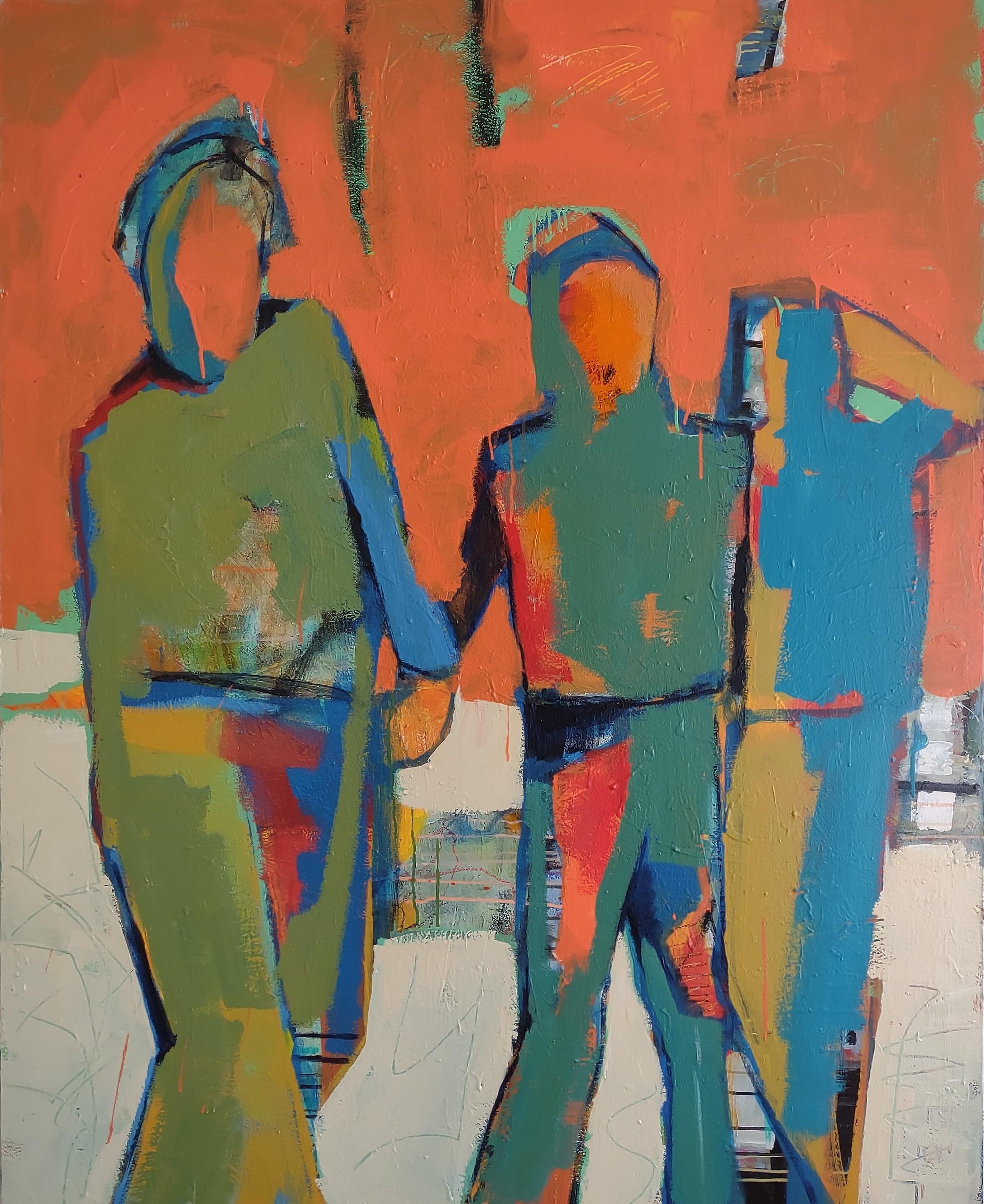
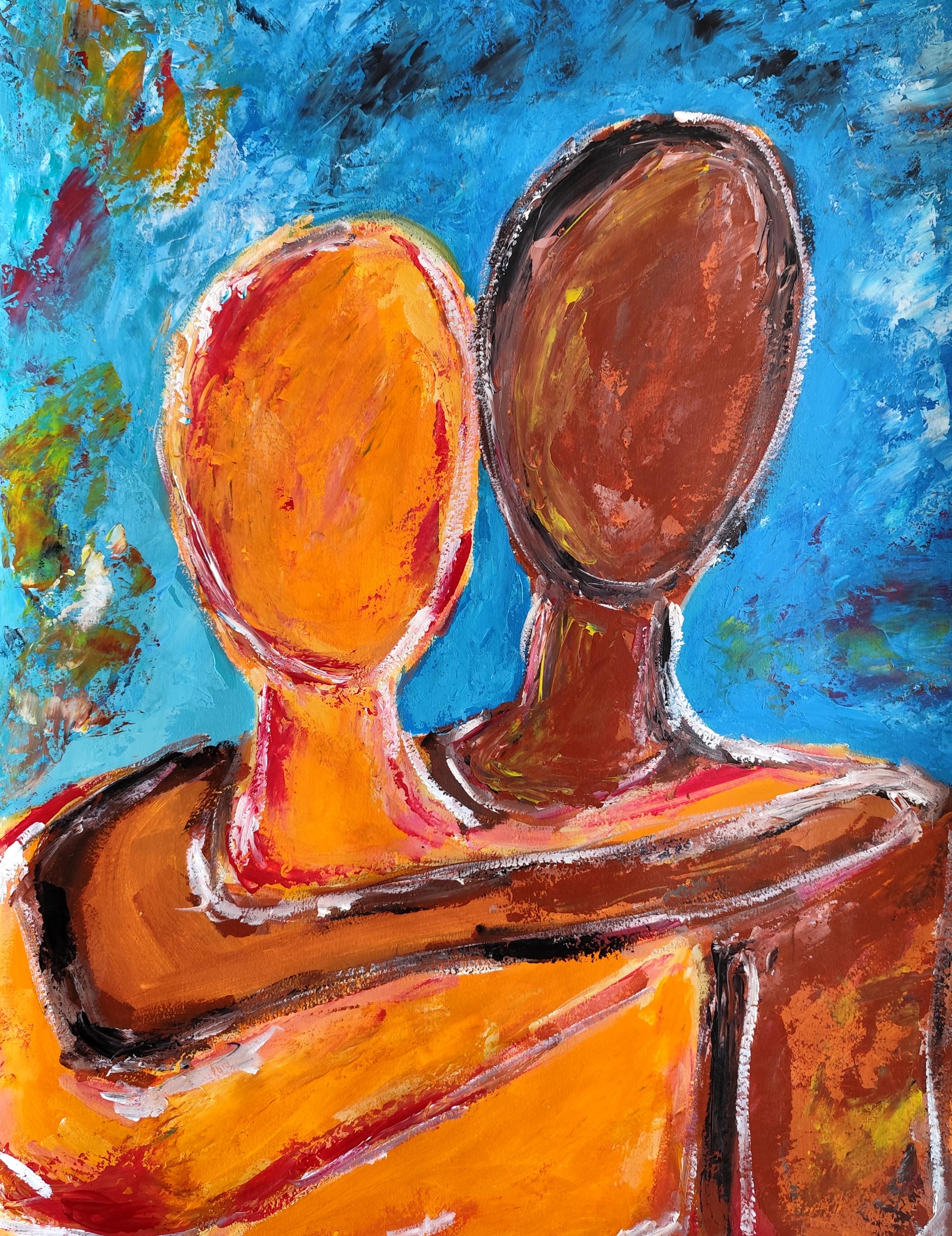
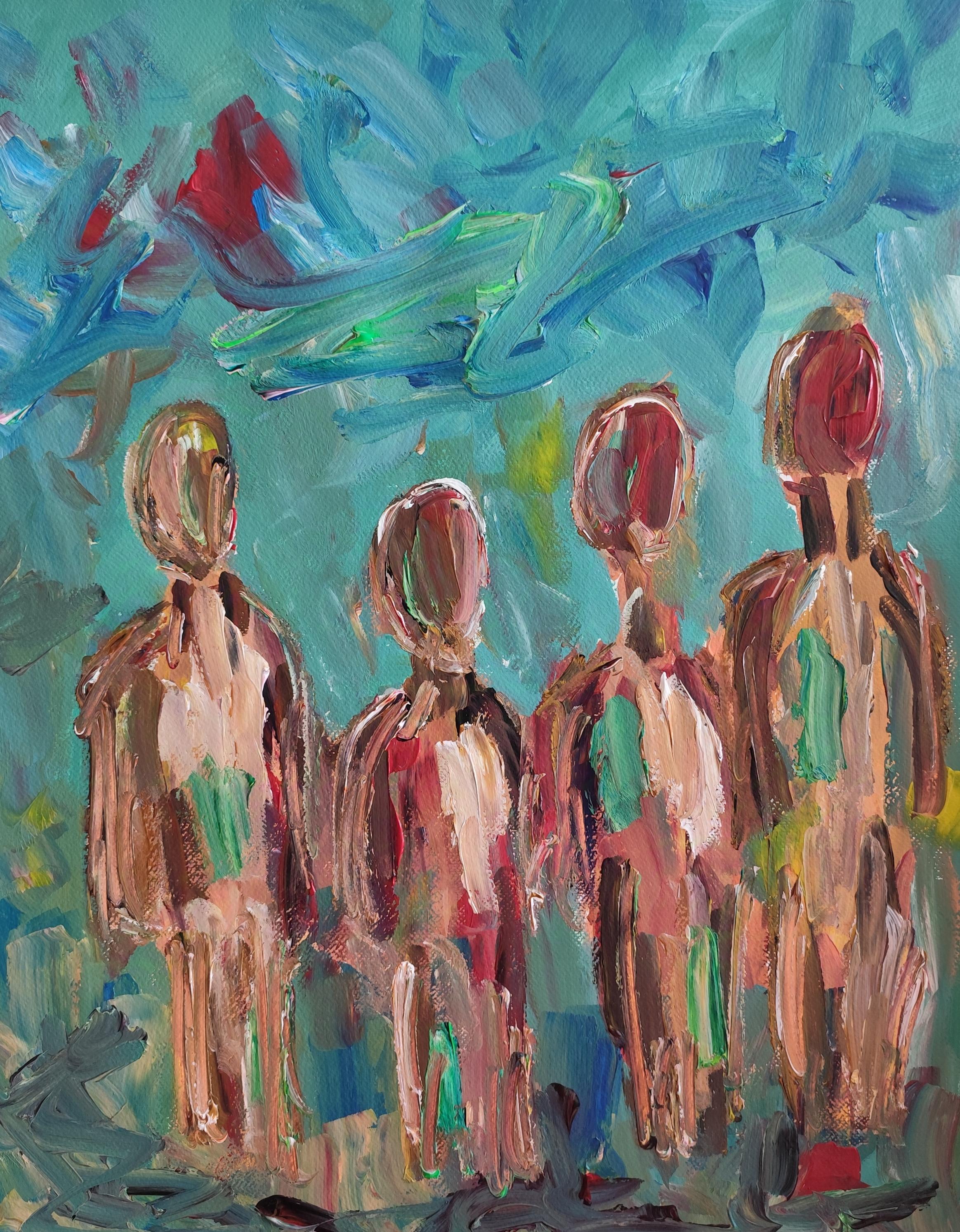
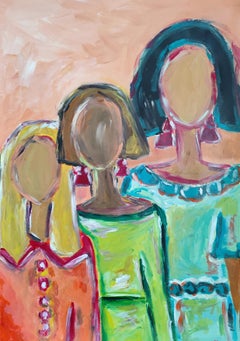
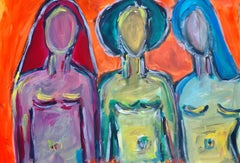
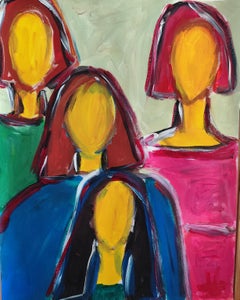
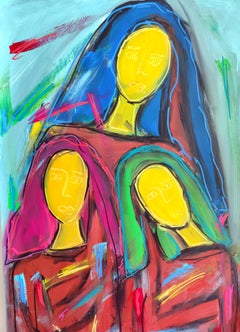
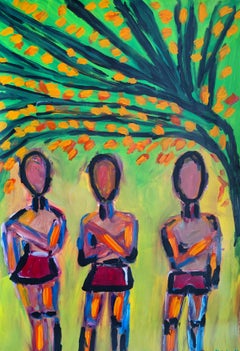
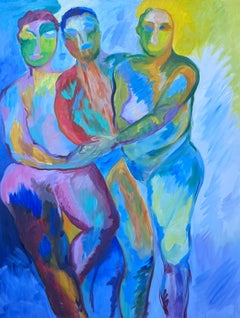
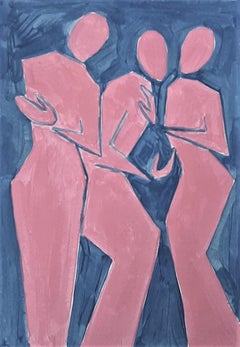
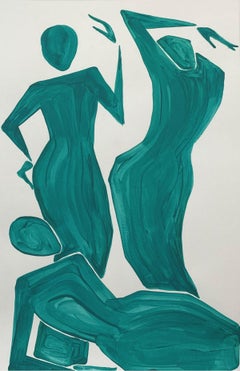
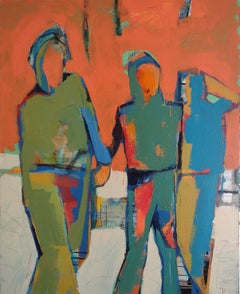
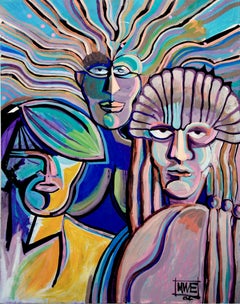
“Three as One” is a contemporary figurative painting by French artist Natalya Mougenot, continuing her recent body of work centered on bond, connection, and human presence. Neither explicitly female nor male, the three figures represent human beings in their most essential form — reduced to silhouettes, gestures, and color, yet deeply connected through emotional proximity.
In this composition, three figures stand close to one another, their bodies subtly overlapping, forming a quiet unity. There are no faces, no individual traits to distinguish them — and this absence is deliberate. By removing identity markers, Mougenot shifts the focus toward what truly connects people: shared presence, emotional closeness, and invisible bonds. The figures seem to lean into one another, suggesting trust, support, and a sense of belonging. Together, they form a single emotional structure — three as one.
Mougenot works intuitively and spontaneously. The brushstrokes are free, direct, and uncorrected, allowing the painting to retain its original energy. Color becomes the primary language: blues, greens, and purples coexist without hierarchy, symbolizing individuality within unity. The soft, luminous background enhances the feeling of calm, safety, and openness — a space where connection can exist without tension.
For Natalya Mougenot, authenticity is central, both in art and in human relationships. She believes that genuine connection cannot be constructed or forced — it must be felt. As she often says:
“Authentic relationships are like honest paintings. You cannot fake them — they either exist, or they don’t.”
This philosophy is mirrored in her artistic process: no preliminary sketches, no corrections, no attempts to perfect. What appears on the canvas is accepted as true.
The theme of honesty runs deeply through her work. Mougenot considers the canvas as a mirror of the artist’s inner state:
“The canvas always reflects who you are at that moment. Your fears, your openness, your truth — everything is visible.”
In Three as One, this honesty manifests through simplicity. The figures are imperfect, almost childlike, yet emotionally precise.
This approach aligns closely with metamodernism, a movement that embraces sincerity after irony and openness after cynicism. Natalya Mougenot often refers to the idea of the “inner child” — not as immaturity, but as a state of openness, trust, and emotional truth.
“The inner child is not naive in a weak sense,” she explains. “It is brave. It dares to feel without protection.”
Her work consciously rejects cynicism, false complexity, and the fear of imperfection. Instead, it calls for emotional maturity — the courage to remain open, to connect honestly, and to accept vulnerability as strength.
“I don’t want perfect paintings,” she says. “I want real ones. Real like human bonds.”
Three as One is therefore not a narrative scene but an emotional state. It invites the viewer to reflect on their own relationships — moments of closeness, silent understanding, and shared presence. The painting does not explain connection; it embodies it.
Ultimately, this work is a quiet affirmation of togetherness — a reminder that connection does not require definition, roles, or labels. It only requires authenticity, honesty, and the courage to stand close.
Details:
Size: 42 × 59.4 cm (approximately 16.5 × 23.4 inches)
Medium: Acrylic paint on heavyweight professional acid-free paper
Finish: Varnished with a special gloss protective coating
Signature: Signed on the front and on the back
Shipping: International delivery from France, shipped carefully flat to ensure optimal protection
Framing: Sold unframed. The images showing the artwork framed in an interior are for inspirational purposes only. Thanks to its standard size, the artwork can be easily framed to suit the collector’s taste and interior style
About the artist:
Natalya Mougenot, born in Pavlodar, Kazakhstan, in 1981, has lived in Lyon, France, since 2003. Raised in a multicultural environment during the Soviet era, her diverse background deeply influences her artistic identity. What began as a therapeutic practice has grown into a rich exploration of themes such as modern femininity, resilience, and personal empowerment. Her emotionally resonant works—blending abstraction, nature, and floral elements—have found homes in private collections across the globe.