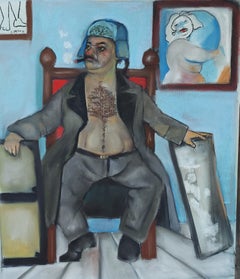
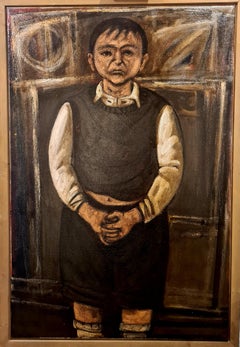
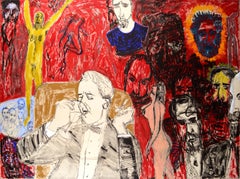
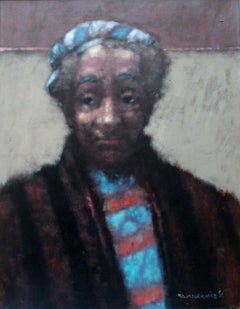
By Fanny Rabel
Located in Detroit, MI
SALE ONE WEEK ONLY
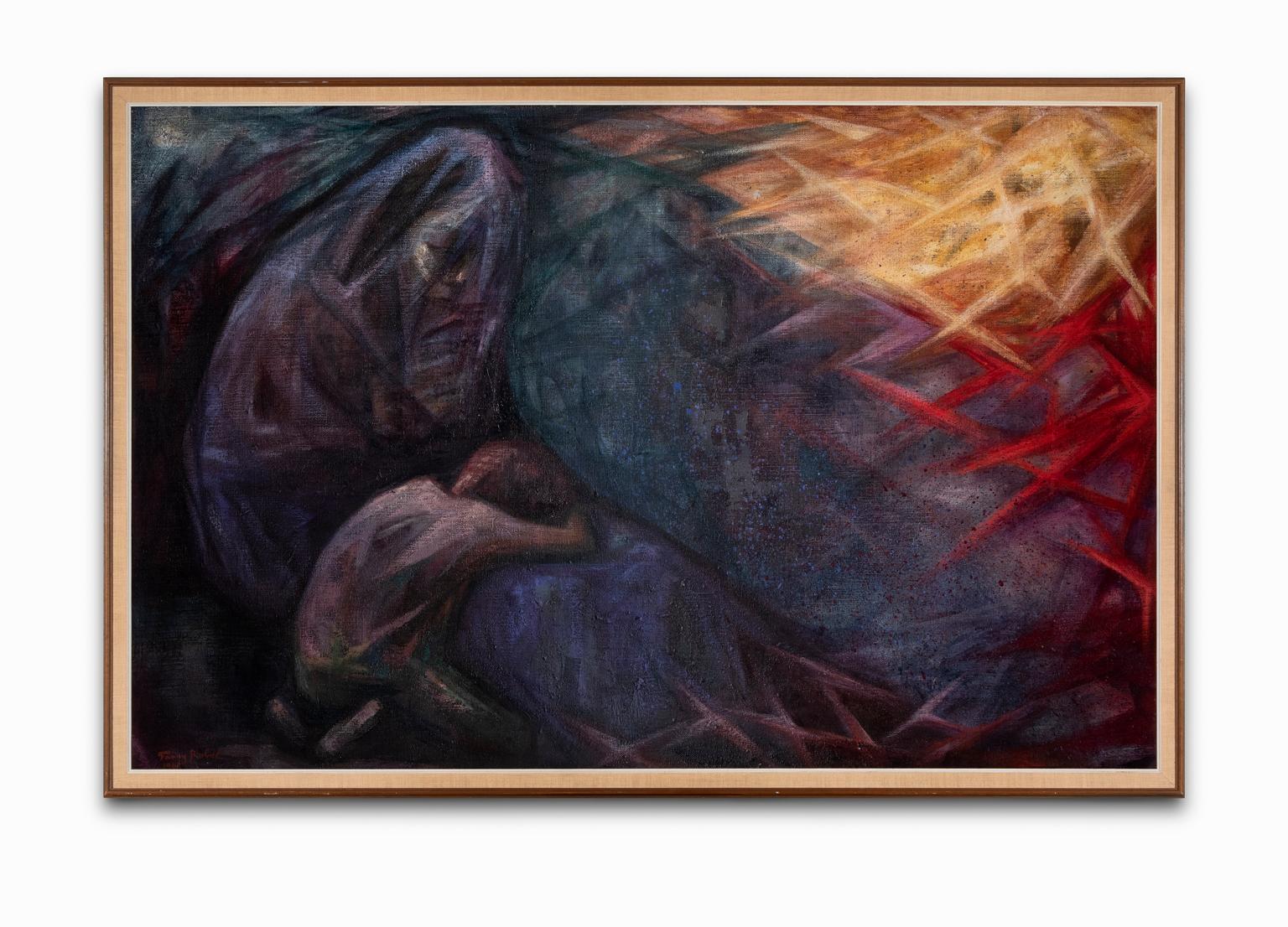
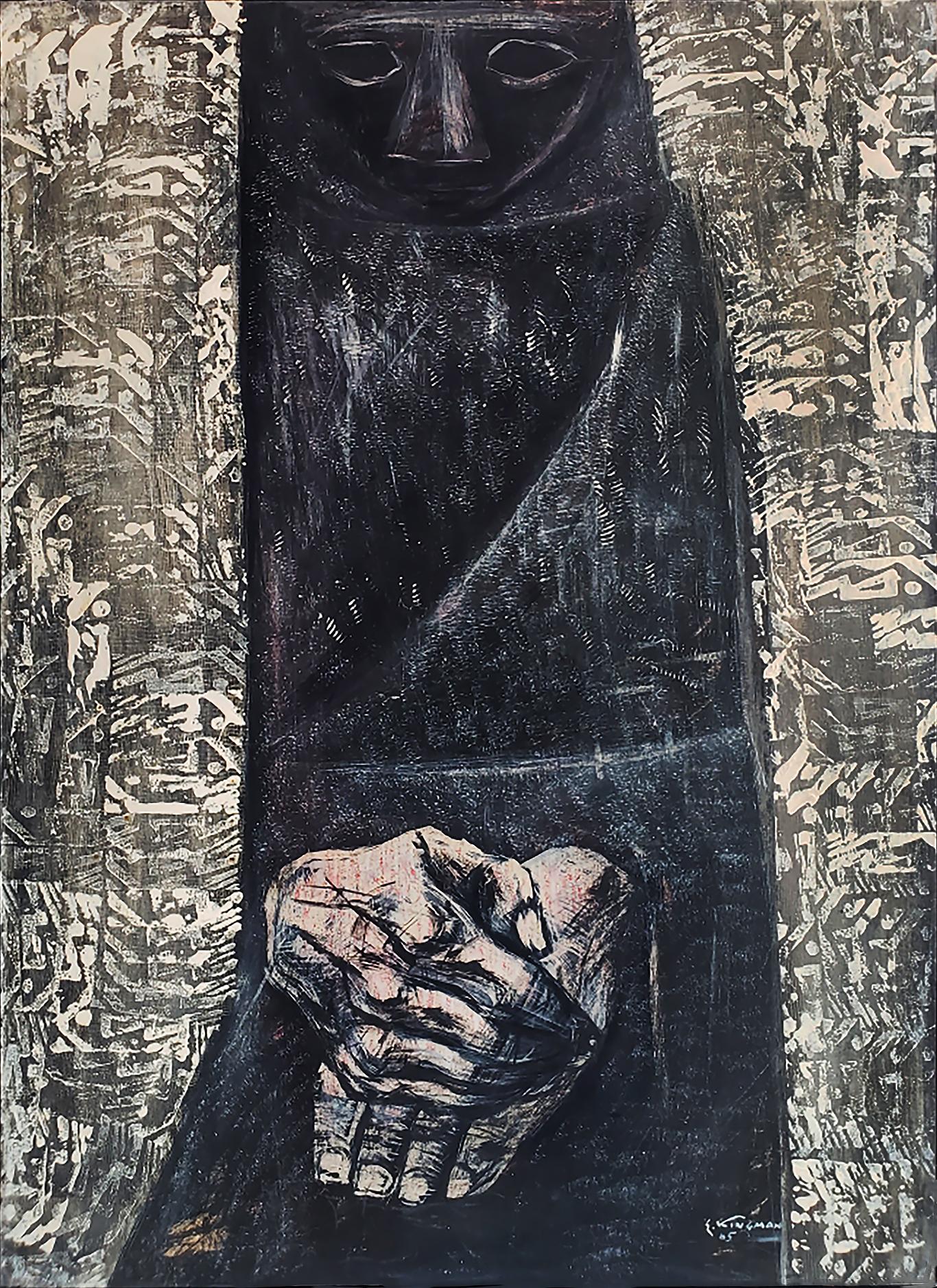
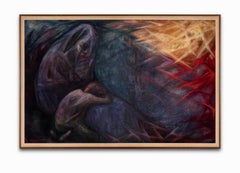
UNTITLED by Fanny Rabel a Mexican artist who was born in Poland in 1922 is a soul wrenching work depicting among other things, the children killed by Nazi bombing in Spain during the Second World War. The lavender and purple surrounding the seated female figure and the kneeling child suggest both grief for the innocents' deaths and the prayers being offered for an end to the carnage. The bright gold and red can be read as either explosions or the hopeful light of redemption after death. Like Picasso's Guernica from 1937, this painting from 1965 can stand as a powerful anti-war statement.
Numerous key galleries and museums such as Morton Auctions, Cerro de Mayka have featured Fanny Rabel's work in the past. Her anti-Nazi and anti-Fascism politics resulted in her participation in a mural called Retrato de la Burguesía in 1940 for the Sindicato Mexicano de Electricistas building on Alfonso Caso Street in Mexico City. Rabel met a group of exiled Spaniards in Mexico along with Antonio Pujol, who invited her to take part in a mural project headed by him, David Alfaro Siqueiros, Joseph Renau, Luis Arenal, Antonio Rodríguez Luna and Miguel Prieto. The artist died in 2008.
Fanny Rabel born August 27, 1922, in Poland born Fanny Rabinovich, was a Polish-born Mexican artist who is considered to be the first modern female muralist and one of the youngest associated with the Mexican muralism of the early to the mid-20th century. She and her family arrived in Mexico in 1938 from Europe and she studied art at the Escuela Nacional de Pintura, Escultura y Grabado "La Esmeralda", where she met and became friends with Frida Kahlo. She became the only female member of “Los Fridos” a group of students under Kahlo’s tutelage. She also worked as an assistant and apprentice to Diego Rivera and David Alfaro Siqueiros, painting several murals of her own during her career. The most significant of these is "Ronda en el tiempo" at the Museo Nacional de Antropología in Mexico City. She also created canvases and other works, with children often featured in her work, and was one of the first of her generation to work with ecological themes in a series of works begun in 1979.
She is considered to be the first female muralist in Mexico. She was an assistant to Diego Rivera while he worked on the frescos for the National Palace and an apprentice to David Alfaro Siqueiros. Her most important mural is Ronda en el tiempo located in the Museo Nacional de Antropología, which was created from 1964 to 1965. She also created murals at the Unidad de Lavaderos Público de Tepalcatitlán (1945), Sobrevivencia, Alfabetización in Coyoacán in 1952 Sobrevivencia de un pueblo at the Centro Deportivo Israelita (1957) Hacia la salud for the Hospital Infantil de México (1982), La familia mexicana at the Registro Público de la Propiedad (1984) (which Rabel preferred to title Abolición de la propiedad privada) and at the Imprenta Artgraf. In collaboration with other artists, she participated in the creation of the murals at the La Rosita pulque bar (disappeared) and at the Casa de la Madre Soltera.
She entered the Escuela Nacional de Pintura, Escultura y Grabado "La Esmeralda" shortly after it was established in 1942, taking classes with José Chávez Morado, Feliciano Peña and Frida Kahlo, with whom she became close friends. She changed her last name from Rabinovich to Rabel during her career.
Rabel married urologist Jaime Woolrich and had two children Abel and Paloma Woolrich, both of whom became actors. The first exhibition of her work was in 1945 with twenty-four oils, thirteen drawings, and eight engravings at the Liga Popular Israelita with Frida Kahlo writing the presentation. In 1955, she had an individual exhibition at the Salón de la Plástica Mexicana. She had a large exhibition at the Museum of the Palacio de Bellas Artes to commemorate a half-century of her work. Her last exhibition was in 2007 at the Universidad Autónoma Metropolitana. Her work can be found in collections in over fifteen countries including those of the New York Public Library, the Library of Congress in Washington, D.C., the Royal Academy of Denmark, the National Library in Paris, the Casa de las Américas in Havana, the Benemérita Universidad Autónoma de Puebla and the Museo de Arte Moderno in Mexico City.
A retrospective of her work after her death called Retrospectiva in Memoriam, Fanny Rabel (1922-2008) was held at the Museum of the Universidad Popular Autónoma del Estado de Puebla . She is considered to be the first modern female muralist in Mexico although she also did significant work in painting, engraving, drawing, and ceramic sculpture. Her work has been classified as poetic Surrealism, Neo-expressionism and is also considered part of the Escuela Mexicana de Pintura (the dominant art movement of the early to mid 20th century in Mexico) as one of the youngest muralists to be associated with it along with Arnold Belkin and José Hernández Delga.
Rabel was more drawn to depicting mankind’s pain rather than happiness, sharing other Mexican muralists' concerns about social injustice. However, she stated to Leopoldo Méndez that she could not create combative works, with clenched fists and fierce faces, and she wanted to leave the Taller de Gráfica Popular. Méndez convinced her to stay, saying that more tender images are important to political struggle as well. Children with Mexican faces...
Category
1960s Expressionist Figurative Paintings