Oil on Board. Central-Italian school of the second half of the 1500s.
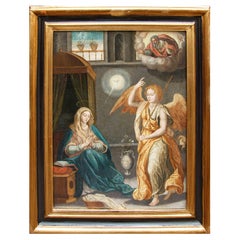
The sacred scene of the Annunciation sees the two protagonist figures placed in the foreground in an interior that corresponds to Mary's room.
The young woman is seated in front of a small wooden desk, supported by angel figures, on which rests the prayer book and a small vase with little flowers; at her feet, the sewing basket.
Mary has her body partially turned backward, in a twisted movement, almost of attempted escape, as if she wanted to get away from the other figure, that of the Archangel Gabriel.
He is standing on the right, majestic and elegant, with one hand holding a lily and the 'other pointing upward above him, where the white dove, symbol of the Holy Spirit, is emerging from a shaft of light.
In the background, tall columns with draperies surmount the platform on which Mary's bed rests.
The composition references, in the figurative style and in color choices, to the painting already mannerist schools of central Italy: in particular there is a strong concordance in style and composition with some works of the same subject by the painter Bastiano Vini Said to be Bastiano Veronese (1525-1530/ 1602), who from about 1540 lived and worked in Pistoia.
It is in that city that some of his Annunciations are found: most notably the one in the Church of Santa Maria delle Grazie (an altarpiece over two meters in height), shows obvious resemblances in form and composition with the one presented here.
There is concordance in the 'setting of the sacred scene: a room, in the background of which is a curtain partially covering a bed, furnished with the elements essential to the narrative, the lectern and chair richly adorned with caryatids of cherubs or angels that appear to be carved in wood. It matches, albeit with slight variations, the compositional scheme, with the two figures arranged "frieze-like" on the same pose plane, and the somatic features of the Virgin and Archangel.
Instead, it differs the floor, which, while it is homogeneous in our table, in the Pistoiese one is presented with alternating checkerboard colors, but it seems that such a floor design was added at a later period, when the altar was rebuilt in 1637-1639, in pendant with that of other work by the same Sebastiano Vini in the same church, a Sacred Conversation.
It therefore seems fairly certain that our panel was painted looking at the work of Bastiano Veronese, probably at the specific request of the patron, and before the change in the floor, thus placing it in the second half of the 16th century.
The painting underwent restoration, with application of two reinforcement at the back of the table.
It is presented in a late 19th-century frame.