Want more images or videos?
Request additional images or videos from the seller
1 of 8

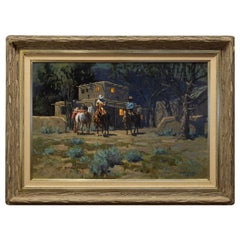
Harold von Schmidt
Under the Pinon Tree

1949

$15,000
£11,362.30
€13,374.89
CA$21,475.62
A$21,911.85
CHF 12,376.48
MX$266,775.28
NOK 148,176.87
SEK 147,814.75
DKK 99,988.70

About the Item

Two men conversing with a stern look on their faces, while a woman is sitting against the pine tree. Signed Lower Right "I guessed this town wasn't going to be big enough for the two of us" Harold von Schmidt grew up in the West a generation after Remington and Russell, but had a close kinship with them and the Old West throughout his painting career. A native Californian, von Schmidt was orphaned at five and reared by his grandfather who had been a Forty-niner. His grandfather’s stories, together with his own experiences as a construction worker, lumberjack, and cowhand gave him authoritative insight into the earlier era. He studied at the San Francisco Art Institute and the California College of Arts and Crafts, also with Worth Ryder and Maynard Dixon. His first art job was as an art director for Foster & Kleiser, followed by illustrating for Sunset magazine. In 1924, von Schmidt came East to study further with Harvey Dunn. He always acknowledged the tremendous effect that Dunn’s teaching had on his career. It was Dunn who taught him to paint the epic aspect of the text rather than the incidental, and he always kept to this high standard. He was a member of the American Olympic Rugby Football team at Antwerp, Belgium, in 1920, and was an ardent athlete all his life; he also played baseball, hockey, and coached the local High School football team once he moved to Connecticut. Feeling that an artist should be active in civic affairs, he served as a Selectman for the Town of Westport for eight years, and was on the Board of Finance, the Police Commission, and the Public Library Board. During World War I, von Schmidt designed posters for the U. S. Navy; during World War II, he was an invited artist-correspondent for the U. S. Air Force in the European Theatre of Operations, and artist-correspondent for King Features Syndicate in the Pacific Theatre of Operations. Twelve of his paintings depicting the westward trek and the Gold Rush of 1849 were hung in the Governor’s office in Sacramento, California; five Civil War paintings are in the permanent collection of the United States Military Academy at West Point, and many others are in important private collections. Von Schmidt as a life trustee of the Artists Guild, New York; president of the Society of Illustrators from 1938-41; a member and officer of the American Indian Defense Association; president of the Westport Artists, 1950-51; and a founding member of the Famous Artists Schools in Westport, Connecticut. He was awarded the first Gold Medal by the trustees of the National Cowboy Hall of Fame in 1968, and was elected to the Society of Illustrators Hall of Fame in 1959. His biography was published by Northland Press in 1972.
  • Creator:
    Harold von Schmidt (1893-1982, American)
  • Creation Year:
    1949
  • Dimensions:
    Height: 30 in (76.2 cm)Width: 30 in (76.2 cm)
  • Medium:
  • Period:
  • Condition:
  • Gallery Location:
    Fort Washington, PA
  • Reference Number:
    Seller: 30031stDibs: LU38431028843

More From This Seller

View All
Botany Bay

Botany Bay

By Harold von Schmidt

Located in Fort Washington, PA

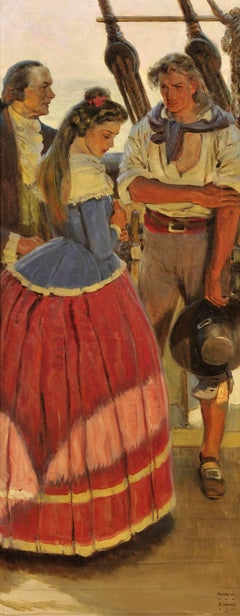
Magazine illustration published in part 2 of 6 of "Botany Bay," published inThe Saturday Evening Post, October 4, 1941. Medium: Oil on Canvas Dimensions: ...

Category

20th Century Figurative Paintings

Materials

Canvas, Oil

Sugarfoot

Sugarfoot

By Harold von Schmidt

Located in Fort Washington, PA

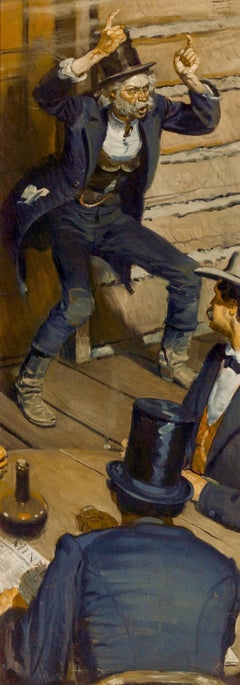
Medium: Oil on Canvas Signature: Signed and Dated '1941' Upper Right This illustration was published for the interior story "Sugarfoot" by Clarence Budington Kelland in the Saturday Evening Post, February 7th, 1942. Signed and dated '1941' upper right Harold von Schmidt grew up in the West a generation after Remington...

Category

1940s Other Art Style Paintings

Materials

Canvas, Oil

Couple Under a Tree

Couple Under a Tree

By Gayle Porter Hoskins

Located in Fort Washington, PA

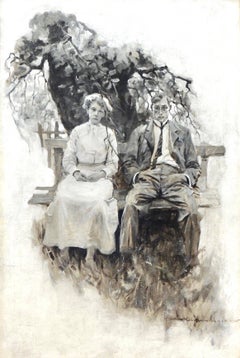
Medium: Oil on Canvas Dimensions: 30.00" x 20.00" Signature: Signed Lower Right

Category

Early 20th Century Figurative Paintings

Materials

Canvas, Oil

Peggy O'Neil, Redbook Magazine Interior Illustration, 1932

Peggy O'Neil, Redbook Magazine Interior Illustration, 1932

By Mead Schaeffer

Located in Fort Washington, PA

Illustration for “Women America Remembers: Peggy O’Neil” by Arthur D. Howden Smith for The Red Book Magazine, published March 1930, illustrated pages 20-21. This painting by Mead Schaeffer depicts a romantic encounter between Peggy O'Neil and her first husband, John Timberlake. The accompanying caption reads: "It was inevitable that Peggy should fall in love—and she did, with John Timberlake, who had little besides his face to recommend him." It was created in 1930 for the third installment of The Red Book Magazine’s “Women America Remembers” series, which features stories of women famous for “personality, beauty, wit or audacity, or because of the tragedy left in their train.” Margaret ("Peggy") O'Neil Eaton remains a figure of historical intrigue, primarily for her central role in the "Petticoat Affair," a significant political scandal during Andrew Jackson's presidency. The circumstances surrounding Peggy’s marriage to John Eaton, occurring shortly after the death of her first husband, John Timberlake, and her family’s background as tavern-keepers, coupled with her perceived impudent personality, subjected her to intense social scrutiny in Washington D.C. Upon John Eaton's appointment as Secretary of War, Peggy faced social ostracism led by Floride Calhoun, wife of Vice President John Calhoun...

Category

1930s Figurative Paintings

Materials

Canvas, Oil

""I Had Tried Several Times to Meet Dawn Woman" Story Illustration

""I Had Tried Several Times to Meet Dawn Woman" Story Illustration

By Frank Schoonover

Located in Fort Washington, PA

Story illustration for "Beaver Woman's Vision" by James Willard Schultz, published in The American Boy, July 1935, pg. 5 The White Buffalo Robe, Schutz, pg. 30 Literature: Schoono...

Category

1930s Figurative Paintings

Materials

Canvas, Oil

Shady Tree, McCall's Illustration

Shady Tree, McCall's Illustration

By Frank Bensing

Located in Fort Washington, PA

Date: 1937 Dimensions: 29.50" x 44.00" Signature: Signed Lower Left 1937 McCalls Magazine A commercial artist with a longtime association with General Electric, Frank C. Bensing di...

Category

1930s Figurative Paintings

Materials

Paint

You May Also Like

Mid-day, Zuni Village

Mid-day, Zuni Village

By Frank Reed Whiteside

Located in Missouri, MO

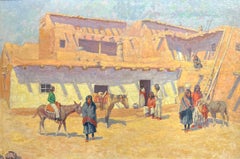
Mid-day, Zuni Village, 1897 By. Frank Reed Whiteside (American, 1866-1929) Unframed: 20" x 30" Framed: 28" x 38" Frank Reed Whiteside, born in Philadelphia on 20 August 1867, became a student of Thomas Anshutz at the Pennsylvania Academy of the Fine Arts (1888-92). He already began exhibiting there during his student years (1887-98). In 1893, he enrolled in the Académie Julian in Paris where he received instruction from Jean-Paul Laurens and Benjamin Constant. After his French academic training, Whiteside taught art in Philadelphia high schools. He took frequent trips to the Southwest between 1890 and 1928 to live with and paint the Zuni Indians. Whiteside depicted ceremonial dances, Zuni buildings, and other genre scenes, usually in blinding afternoon sunlight. He carefully observed the effects of light on vibrant color, using a finely crafted impressionist technique. He was fond of broad areas of color, subtle combinations of hues, and simplified shapes and silhouettes. Whiteside continued to exhibit at the PAFA (1905-15), at the Art Institute of Chicago (1896-1916), at the Carnegie International (1905 and 1907) and at the Corcoran Gallery (1907). He was a member of Philadelphia art societies and beginning in 1909 had a summer studio in Ogunquit, Maine, where he took part in Hamilton Easter Field's discussion groups. Frank's wife, Clara Walker Whiteside, who published Touring New England in 1926, was active in the Ogunquit Art Association. Like Stanford White, Frank Reed Whiteside was the victim of murder, on 19 September 1929, but Whiteside's case remains unsolved. One night, the sixty-three year-old painter answered the doorbell. Two witnesses...

Category

Late 19th Century Other Art Style Figurative Paintings

Materials

Canvas, Oil

"In Old Santa Fe" Original Oil Painting by Martin Weekly

"In Old Santa Fe" Original Oil Painting by Martin Weekly

Located in Coeur d'Alene, ID

Oil on canvas; 24" x 36". Beginning in 1970 Martin devoted himself full time to his painting while living in a home and studio he built for himself in El Dorado Hills, California. Th...

Category

Early 2000s American Paintings

Materials

Paint

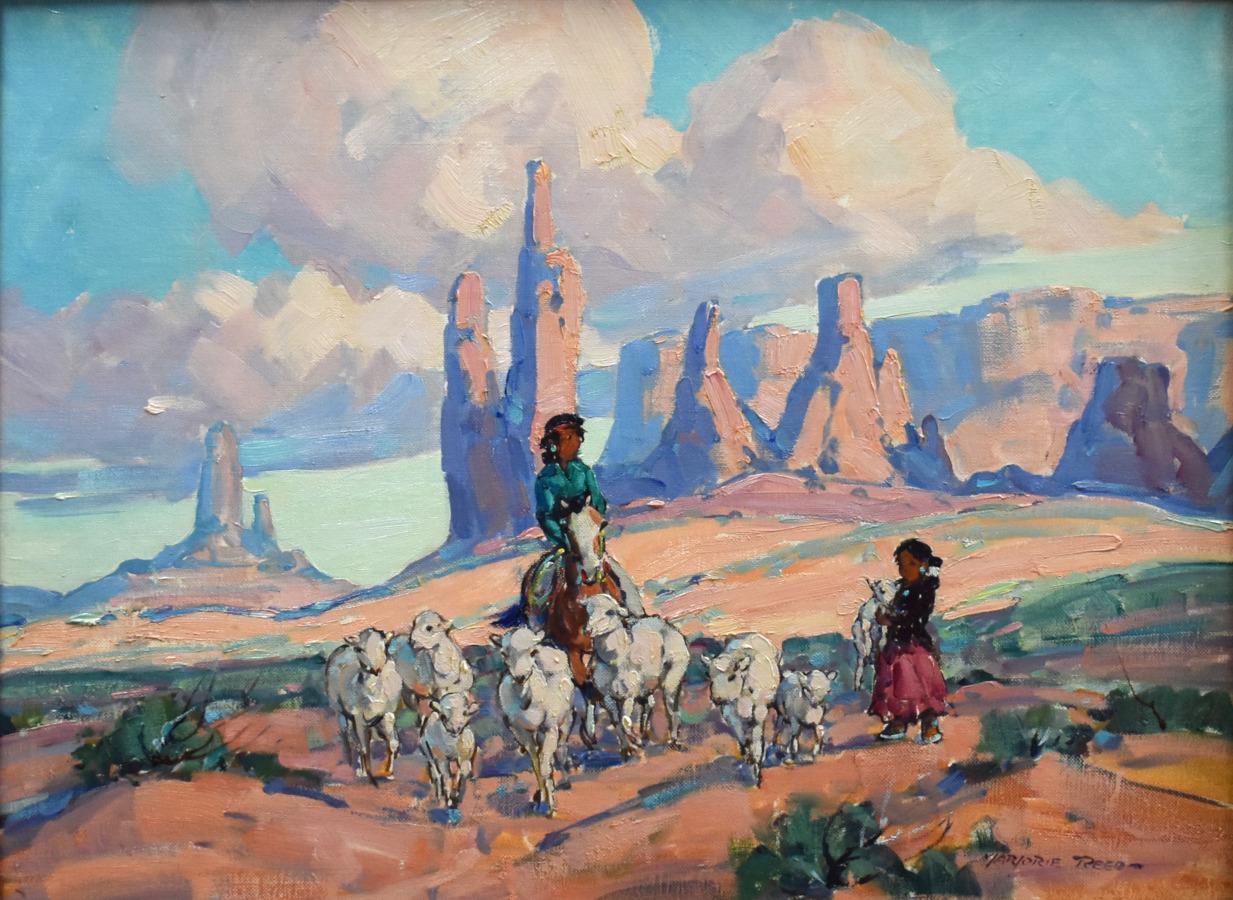
"VALLEY OF THE MONUMENTS" NAVAJO ARIZONA / UTAH HERDERS

"VALLEY OF THE MONUMENTS" NAVAJO ARIZONA / UTAH HERDERS

By Marjorie Reed

Located in San Antonio, TX

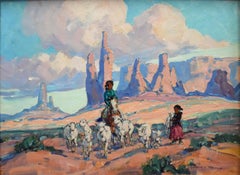
Marjorie Reed a.k.a. Harvey Day (1915-1996) California, Arizona Artist Size: 18 x 24 Frame: 23.25 x 29.25 Medium: Oil on Canvas "Valley of the Monuments" Marjorie Reed Biography Biography Marjorie Reed a.k.a. Harvey Day (1915-1996) Born in Springfield, Illinois and raised in Los Angeles, Marjorie Reed gained a reputation for paintings of western scenes, particularly Butterfield Overland Stagecoaches and other scenes of cowboys, horses and figures associated with the Overland Mail Route. Sometimes she signed her paintings with men's names including Harvey Day and Fred Day. At age three, she began art lessons from her father, Walter Stephen Reed, a commercial artist, whom she later assisted in the designing of Christmas cards and with illustrations for the Mickey Mouse Beverage Company, affiliated with Walt Disney. In fact, she was so accomplished that shortly after, she was hired by Walt Disney Studios to do animation. But she did not like the regimentation of that work. In the mid-1930s, she studied at the Chouinard Art School and took lessons from Jack Wilkinson Smith, a renowned landscape painter who was a key artist in establishing the Biltmore Salon in Los Angeles. Knowing her love of the outdoors and horses, he encouraged her to roam the countryside. She became a friend of Captain William Banning who had been a stagecoach driver for his father Phineas Banning. She learned the romantic story of the Butterfield Overland Mail Stage, which, from 1857 to 1858, ran from San Francisco to the Yuma crossing on the Colorado River. In her Model-T Ford with her Alaskan Husky dog, she, based in Los Angeles from the late 1930s to late 1940s, traveled the stage-coach route and sketched for the paintings of her project to learn about and sketch various points along the route. Her travels included Palm Springs, which she visited many times after her first stop in 1937, and she also spent time in Julian, a California mountain town. Her "Butterfield Stage" series, about the 1858 Butterfield Overland Stage from St. Louis to San Francisco were completed in 1957 after years of travel and research, and a book titled The Colorful Overland Stage was published with twenty of her color reproductions and text by Richard Pourade. In 1967, she finished a second set of Overland Stage illustrations focused on Arizona. A third set was then devoted to New Mexico and Texas and a fourth set to Oklahoma, Arkansas and Missouri. In her later years, she and her fourth husband, Cecil Creese, a miner, became residents of Tombstone, Arizona in 1963 after living in northern California on the Placer River. According to her daughter, Judy Morris, Marjorie Reed died in 1997, living in the desert near the Butterfield Stage Station in California. Exhibition venues included the Biltmore Salon and Ebell Salon in Los Angeles, the Heard Museum in Phoenix, the Desert Inn Gallery in Palm Springs, and the Palm Desert Art...

Category

20th Century Impressionist Landscape Paintings

Materials

Oil

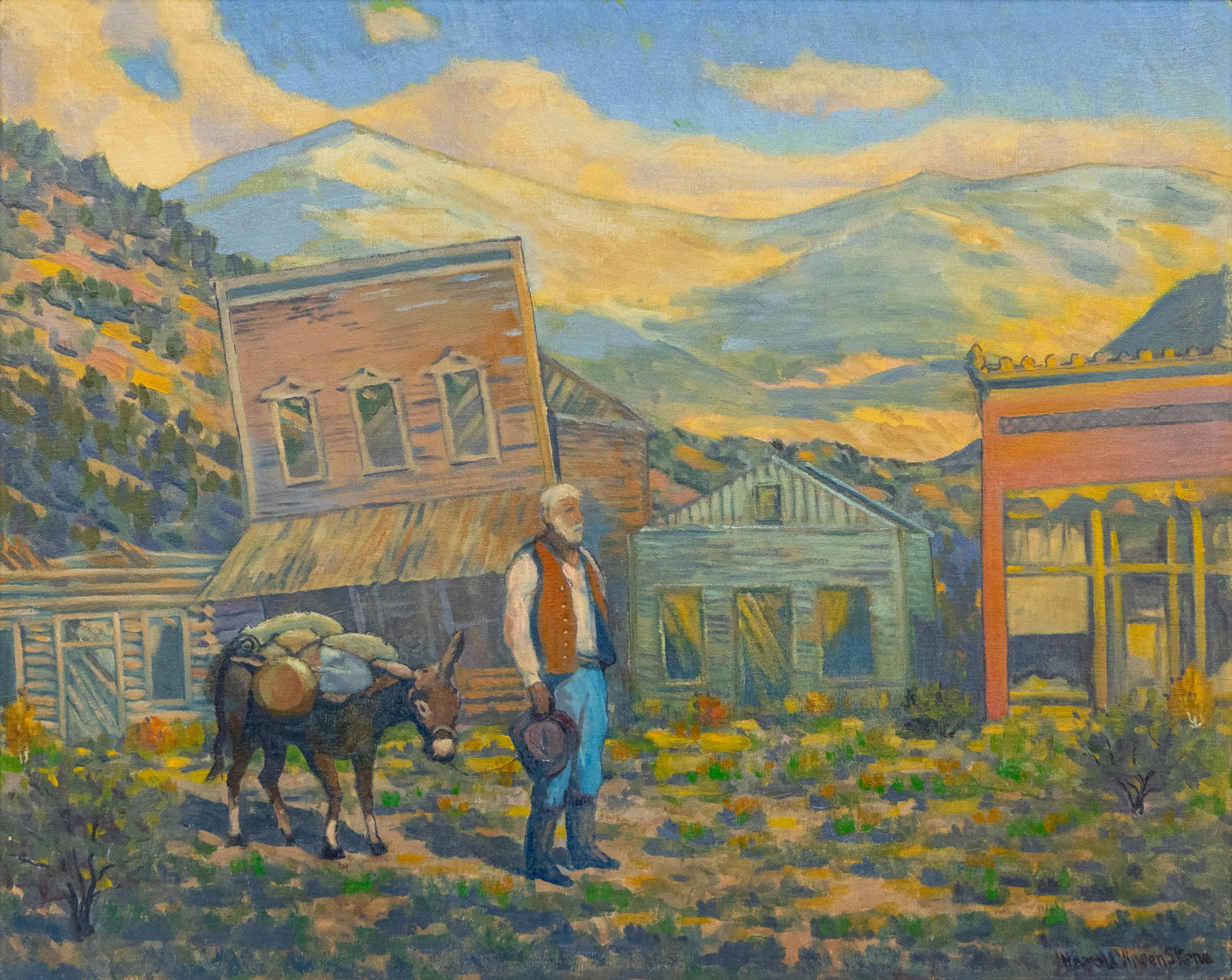
Vintage Colorado Ghost Town Oil Painting by Harold Skene, Western Landscape

Vintage Colorado Ghost Town Oil Painting by Harold Skene, Western Landscape

By Harold Vincent Skene

Located in Denver, CO

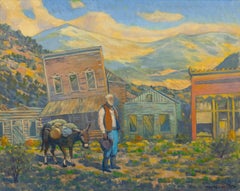
“Ghost Town” by Harold Skene (1883–1978) is a compelling vintage oil painting that evokes the quiet drama of Colorado’s mining past. This atmospheric Western landscape depicts a lone prospector and his pack mule standing among the weathered remnants of an abandoned mountain town. Set in late summer or early autumn, the scene is painted in a rich, earthy palette of golden yellows, sage greens, dusty pinks, and soft blues, capturing the stillness and solitude of the high desert West. Painted in oil on board, the work is signed by the artist at the lower right and titled and dated on the verso, underscoring its authenticity and historical value. Skene’s careful attention to structure and perspective reflects his architectural training, while his expressive handling of landscape conveys the emotional weight of a once-thriving community now reclaimed by nature. The painting measures 24 x 30 inches (image size) and is presented in a classic mahogany frame with overall dimensions of 30 x 35.5 x 2.75 inches, offering strong visual presence and immediate display appeal. A graduate of Harvard’s School of Architecture, Harold Skene studied at the Denver Art Academy and the Broadmoor Art Academy, and served as an assistant to noted Western artist Allen Tupper True...

Category

1960s American Impressionist Landscape Paintings

Materials

Oil

"Encounter" Indian & bear. Santa Fe Utah Colorado, Wyoming, Montana 1930s. Large

"Encounter" Indian & bear. Santa Fe Utah Colorado, Wyoming, Montana 1930s. Large

By Frank Hoffman

Located in San Antonio, TX

Frank Hoffman (1888-1958) New Mexico, Illinois Artist Image Size: 27 x 41 Frame Size: 37 x 50 Medium: Oil Circa 1930s - 1940s "The Encounter" Indian & Bear Frank Hoffman (1888-1958) Growing up in New Orleans where his father raced horses, Frank Hoffman developed a great love for these animals, which was reflected in his paintings. He worked as an illustrator for the "Chicago American" newspaper, which gave him an opportunity to draw many subjects from opera to prize fights, and eventually he became head of the department. During that time, he took formal art training from J. Wellington Reynolds, a portrait painter. In 1916, having been rejected for military service because of poor eyesight, he went West and lived with cowboys and Indian tribes and served as public relations director for Glacier National Park. Eventually he settled on a ranch near Taos, New Mexico, and became part of that art colony and studied with Leon Gaspard, who encouraged him to use color freely. Advertisers including General Motors, General Electric, and the Great Northern Railway hired him because they loved his bold, broad brush work and striking colors. He also did magazine illustrations, specializing in western subjects. Because of the spaciousness of his ranch that he called Hobby Horse Rancho, he kept live models of cow ponies, thoroughbred horses, longhorn steers, several breeds of dogs, eagles, a bear and burros. From 1940 Brown & Bigelow Publishing Company of St. Paul, Minnesota had him under exclusive contract, and during the next 14 years, he produced 150 paintings for that company. Source: Walt Reed, The Illustrator in America, 1860-2000 Known as a traditional Western illustrator, painter and sculptor, Frank Hoffman was born in Chicago, Illinois. He grew up around his father's New Orleans, Louisiana, racing stables. Through a family friend, Hoffman was hired to make sketches for the Chicago American, later becoming head of the art department. While working for the paper, he had five years of formal art training in private lessons from J. Wellington Reynolds, a portrait painter. In 1916, Hoffman went West to paint, living with the Indian tribes and the cowboys. During that time, he also worked as public relations director for Glacier National Park, where he met noted artist John Singer Sargent. In 1920, Hoffman joined the young art colony in Taos, New Mexico. He studied with Leon Gaspard, learning the use of color. Although focusing on his fine art, Hoffman also painted for corporate advertising campaigns and illustrated Western subjects for the leading national magazines in the 1920's. Hoffman became the best-known New Mexico illustrator of the time. As his success grew, he bought his own Hobby Horse Rancho, where he raised quarter horses and kept as live models the longhorns, dogs, eagles, burros, and even a bear that he had begun to sculpt in the 1930's. Later, beginning with 1940, Hoffman was under exclusive contract to Brown and...

Category

1930s Figurative Paintings
Materials

Oil