Want more images or videos?
Request additional images or videos from the seller
1 of 22

Harold Harvey
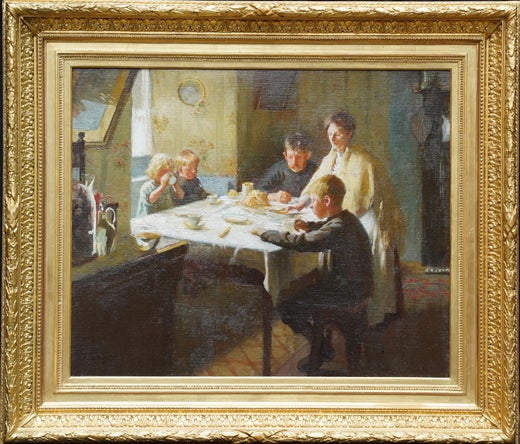
Cornish Family in an Interior - British 1912 Newlyn School art oil painting

Circa 1912

$44,539.05
$55,224.0220% Off
£32,000
£40,00020% Off
€38,133.22
€47,716.7520% Off
CA$61,426.21
CA$76,610.9020% Off
A$62,168.06
A$77,746.0320% Off
CHF 35,645.45
CHF 44,818.9320% Off
MX$754,021.01
MX$941,368.7320% Off
NOK 414,542.16
NOK 520,206.2520% Off
SEK 421,963.88
SEK 525,770.1320% Off
DKK 285,059.61
DKK 356,713.4620% Off

About the Item

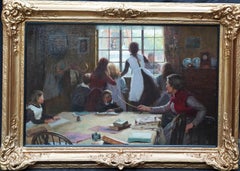
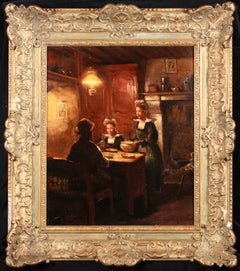
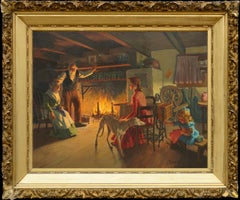
This superb British figurative interior oil painting is by noted Newlyn school artist Harold Harvey. Painted circa 1912 the composition is a Cornish family, bathed in golden light, seated around a table having a simple meal. The mother, dressed in a yellow shawl and standing next to her husband is passing a plate to her son. The two younger children, sat in the bay window, are drinking their tea. The wall paper is also yellow with flowers and the children's hair gleams like gold. There are some lovely little details such as a gold fish in a bowl on a nearby dresser and bellows hanging by the fire surround. The British Impressionist brushwork and impasto are superb. This is a really warm and intimate portrayal of a family and a lovely example of Harvey's earlier work with good provenance. Signed lower left. Provenance. Harry Miller, Johannesburg, South Africa; By descent to his daughter, Pera Lee Helena Miller Chiofolo; By gift to her son Richard Chiofolo; Bequest to Douglas Yoder; Private collection, Florida, 2006 Condition. Oil on canvas, image size 24 inches by 20 inches and in good condition. Frame. Housed in a beautiful gilt frame, 31 inches by 27 inches and in good condition. Harold Harvey (1874–1941) was a Newlyn School painter who painted scenes of working class Cornish fishermen, farmers and miners and Cornish landscapes. He was born in Penzance and trained at the Penzance School of Arts under Norman Garstin and the Académie Julian in Paris (1894–1896). Harold Charles Francis Harvey was born to Mary Bellringer Harvey and Francis McFarland Harvey on 20 May 1874 in Penzance. His father was a bank clerk. During his youth, he was home schooled. In 1896, he studied at both the Académie Delecluse and the Academie Colarossi. Prior to 1911, Harvey lived in Penzance. In 1911, Harvey married fellow artist Gertrude Bodinnar. They first met when Gertrude posed for Harvey. She discovered that she had artistic talent and became an artist in her own right in a wide range of visual and textile arts. The married couple lived in Newlyn at Maen Cottage. Friends of the Harveys included Laura Knight, Harold Knight, Annie Walke, and Father Bernard Walke of St Hilary Church. Late in his life, he converted to Catholicism. After completing his schooling in Paris, Harvey returned to Penzance and began working with Norman Garstin. His works included landscapes and life settings of his native Cornwall, religious themes and interiors. He used oil and watercolour paints. From 1909 to 1913, he was an Associate of the Royal Cambrian Academy of Art, Conwy and, in 1910, he was a member of the South Wales Art Society. From about 1910 and into the early 1930s, he was a member of the Newlyn Society of Artists, particularly with artists from the Lamorna valley. In 1920, Harvey and his best friend Ernest Procter established the Harvey-Procter School in Newlyn, Cornwall. He died in Newlyn on 19 May 1941 and was buried in Penzance at the St Clare Cemetery. Gertrude lived in their cottage until 1960 when she moved into a St Just nursing home. She died six years later.
  • Creator:
    Harold Harvey (1874 - 1941, British)
  • Creation Year:
    Circa 1912
  • Dimensions:
    Height: 27 in (68.58 cm)Width: 31 in (78.74 cm)Depth: 2 in (5.08 cm)
  • Medium:
  • Movement & Style:
  • Period:
  • Condition:
  • Gallery Location:
    Hagley, GB
  • Reference Number:
    1stDibs: LU853114375032

More From This Seller

View All
Portrait of a Family in an Interior - British 1950's art oil painting

Portrait of a Family in an Interior - British 1950's art oil painting

By Charles Ernest Cundall

Located in Hagley, England

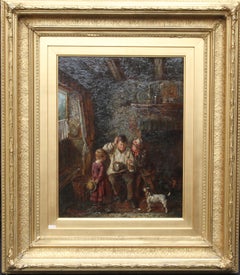
This interesting British Post Impressionist figurative interior oil painting is by noted artist Charles Cundall and entitled A Conversation Piece. Painted circa 1955 the composition is the interior of a living room with a couple and their two young children, cat and dog. It is full of fascinating details such as the display of porcelain figures in the wall unit, The wonky lampshade on the piano with lovely reflections in its metal base, the slightly shabby walls, the two inviting open doors to other rooms, the way the whole family are looking at the dog (of course!) as it eyes up the tray of tea. Perhaps the dog is in fact the conversation piece of the family and life revolves around him the way the painting does. Is it the artist's family? An excellent example of Cundall's work and life with a dog. Signed lower right. Provenance. Gallery label verso. Condition. Oil on canvas, image size is 30 inches by 25 inches and in good condition. Frame. Housed in a gallery frame, 39 inches by 34 inches framed and in good condition. Charles Cundall (1890-1971) - painter, potter and stained glass artist, born in Stratford, Lancashire. After working as a designer for Pilkington's Pottery Company under Gordon Forsyth...

Category

1950s Post-Impressionist Interior Paintings

Materials

Oil

The Artist's Studio - Scottish 1914 Glasgow Boy art exh interior oil painting

The Artist's Studio - Scottish 1914 Glasgow Boy art exh interior oil painting

By Alexander Roche

Located in Hagley, England

This superb RSA exhibited Scottish Edwardian interior oil painting is by Glasgow Boy artist Alexander Ignatius Roche. It was painted circa 1914 when Roche was living at 8 Royal Terrace, on Calton Hill, a very prestigious property in Edinburgh, now the Halcyon Hotel. The painting is a view of Roche's studio, quite possibly one of the rooms at the above address. The painting was exhibited at the Royal Scottish Academy the following year, no. 333 entitled The Studio. The painting shows Roche beneath the vast window in his studio against a red wall that meets pale floorboards. Various items and furniture are scattered about. The balance of the white window and pale floorboards with the red wall intersecting is perfect. A really lovely example of this great Glasgow Boy artist's work and a very personal piece showing his inner sanctum. Signed lower right. Provenance. Exhibited at the Royal Scottish Academy 1915 no. 333, entitled The Studio. Condition. Oil on canvas, 24 inches by 20 inches and in good condition. Frame. Housed in a gilt frame, 32 inches by 28 inches and in good condition. Alexander Ignatius Roche RSA NEAC RP (1861-1921) was a Scottish artist in the late 19th century and an important figure in the “Glasgow Boys. He was born in the Gallowgate in Glasgow, the son of a milliner, Alexander Roche. He attended St Mungo’s Academy in Bridgeton, Glasgow. He originally trained as an architect, but then changed to art, studying at the Glasgow School of Art and, from 1881, at L’Ecole des Beaux Arts in Paris. Here he studied under Gustave Boulanger and Jean-Leon Gerome. In his time here he befriended William Kennedy, John Lavery, Thomas Millie Dow and William Stott. In the early 1880s he joined a colony of Scots artists in Grez-sur-Loing south of Fontainebleau. On his return to Scotland in 1885 he joined with the Glasgow Boys working on murals for the 1888 International Exhibition. In 1888 he travelled to Capri where he befriended Fabio Fabbi and Harold Speed. In following years he visited both Venice and Florence, and married an Italian girl on the latter trip. This marriage was short-lived and they separated. As both were Catholics there seems to have never been any divorce. In 1896 he moved from Glasgow to Edinburgh and began to distance himself from the Glasgow Boys. His work drifted from largely landscape to portraits. In 1906 he remarried (possibly bigamously), to Jean Alexander, daughter of Robert Alexander. During this period they enjoyed the friendship of Joseph Crawhall...

Category

1910s Realist Interior Paintings

Materials

Oil

A Quick Repair  - British art 1880 interior oil painting children clock Horology

A Quick Repair - British art 1880 interior oil painting children clock Horology

By Frederick George Pasmore

Located in Hagley, England

This charming Victorian genre oil painting is by noted British artist Frederick George Pasmore junior. The painting is full of rich colour and tells a story. The scene is a detailed ...

Category

19th Century Realist Interior Paintings

Materials

Oil

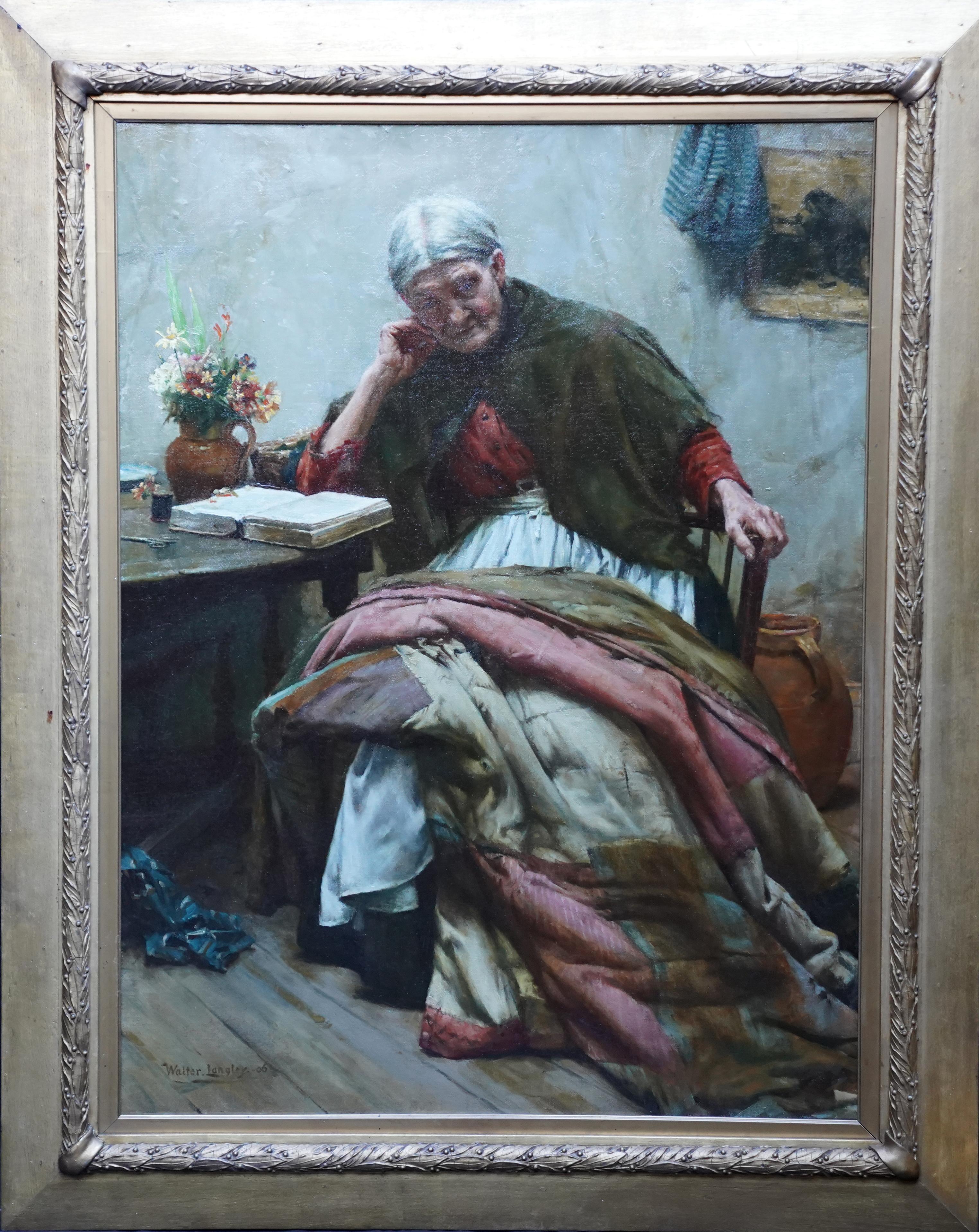
The Evening of Life - Interior Portrait - British 1906 Newlyn Sch oil painting

The Evening of Life - Interior Portrait - British 1906 Newlyn Sch oil painting

By Walter Langley

Located in Hagley, England

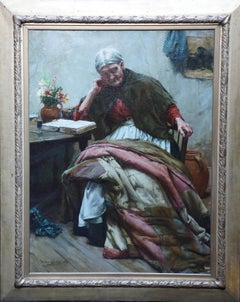
This stunning, large British Edwardian Newlyn School interior portrait oil painting is by much noted and exhibited artist Walter Langley. Originally from Birmingham, Langley and his family moved to St Ives in 1881. He was one of the first artists to settle and painted the local fishermen and their families. Painted in 1906 and entitled The Evening of Life, the painting is a full length seated portrait of an elderly lady in a cottage interior. She is sat by a table on which she has a bible, jug of flowers and her sewing equipment. Across her lap she has a large patchwork quilt to mend but is lost in thought. In fact the same sitter and quilt can be seen in Memories, also painted in 1906 and in the Ferens Art Gallery, Hull. Memories includes more of the cottage interior but the sitter's head is bowed towards her hands. The Evening of Life is more vibrant and the sitters face is much more visible as are the lovely colours of the quilt. The painting has fantastic detail, great brushwork and the Newlyn school palette of colours. The provenance is excellent, having been kept in the same family ownership so fresh to market. The painting appeared in the artist's catalogue Raisonne and was also in 1997 biography by Langely's grandson, Roger Langley, entitled Walter Langley: Pioneer of the Newlyn Art Colony. This a superb example of Langley's work, a good size and composition and a pleasure to gaze upon. Signed lower left and dated (19)06. Provenance. : Ford, 1906 (£63). Long in the previous family ownership and sold by the executors of the estate. Thomas Wood and Sons label verso. Literature: Langley (R) - Walter Langley Pioneer of the Newlyn Art Colony 1997, catalogue raisonne p.170 (under 1906). Condition. Oil on canvas, 40 inches by 30 inches unframed, in good condition and unlined canvas. Frame. Housed in a gilt frame 47 inches by 37 inches and in good condition. Walter Langley (8 June 1852 – 21 March 1922) was an English painter and founder of the Newlyn School of plein air artists. He was born in Birmingham and his father was a journeyman tailor. At 15 he was apprenticed to a lithographer. At 21 he won a scholarship to South Kensington and he studied designing there for two years. The sometimes highly ornate work is mainly in gold and silver and in a Renaissance style. He returned to Birmingham but took up painting full-time, and in 1881 was elected an Associate of the Royal Birmingham Society of Artists. In the same year he was offered £500 for a year's work by a Mr Thrupp (a Birmingham photographer). With this money he and his family moved to Newlyn where he was one of the first artists to settle and began recording the life of the fishing community. Politically left wing for his era, he was noted for his social realist portrayals of working class figures, particularly fishermen and their families. He was a supporter of Charles Bradlaugh, a radical socialist politician. His own working-class background enabled him to identify with the villagers and the hardships they endured, many of his paintings reflect this sympathy with the working-class fisher-folk amongst whom he lived. One of the best known works is the watercolour For Men Must Work and Women Must Weep (1883; Birmingham Museum and Art Gallery) based on Charles Kingsley's poem The Three Fishers (1851). Another is Between The Tides (1901; Warrington Museum & Art Gallery). Although one of the first to settle in the Newlyn artists' colony Newlyn School, Langley initially benefited little from its growing fame, partly because of his working-class origins and partly because until 1892 he painted largely in watercolour rather than the more prestigious medium of oils. His early training in lithography gives his paintings a detail and texture that show his technical skills. In 1884, Langley was elected a member of the RBSA and continued to exhibit widely throughout the UK and abroad. Later in his career his reputation grew. One of Langley's paintings was singled out as "a beautiful and true work of art" by Leo Tolstoy in his book What is Art?, while in 1895 Langley was invited by the Uffizi to contribute a self-portrait to hang alongside those of Raphael, Rubens and Rembrandt in their collection of portraits of great artists. Today his work is considered "vital to the image of the Newlyn School" and "alongside Stanhope Forbes ... the most consistent in style and substantial in output". Exhibited: Royal Society of Artist Birmingham 57, Dudley Gallery 4, Dowdeswell Gallery 17...

Category

Early 1900s Realist Portrait Paintings
Materials

Oil

Scottish Interior - Edwardian art oil painting sitting room interior gilt frame

Scottish Interior - Edwardian art oil painting sitting room interior gilt frame

Located in Hagley, England

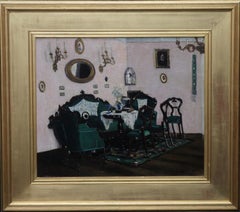
This stunning oil painting was painted circa 1911 and is signed lower right. The painting depicts a Scottish interior- a small occasion or card table surrounded by a variety of mahog...

Category

1910s Impressionist Interior Paintings

Materials

Oil

You May Also Like

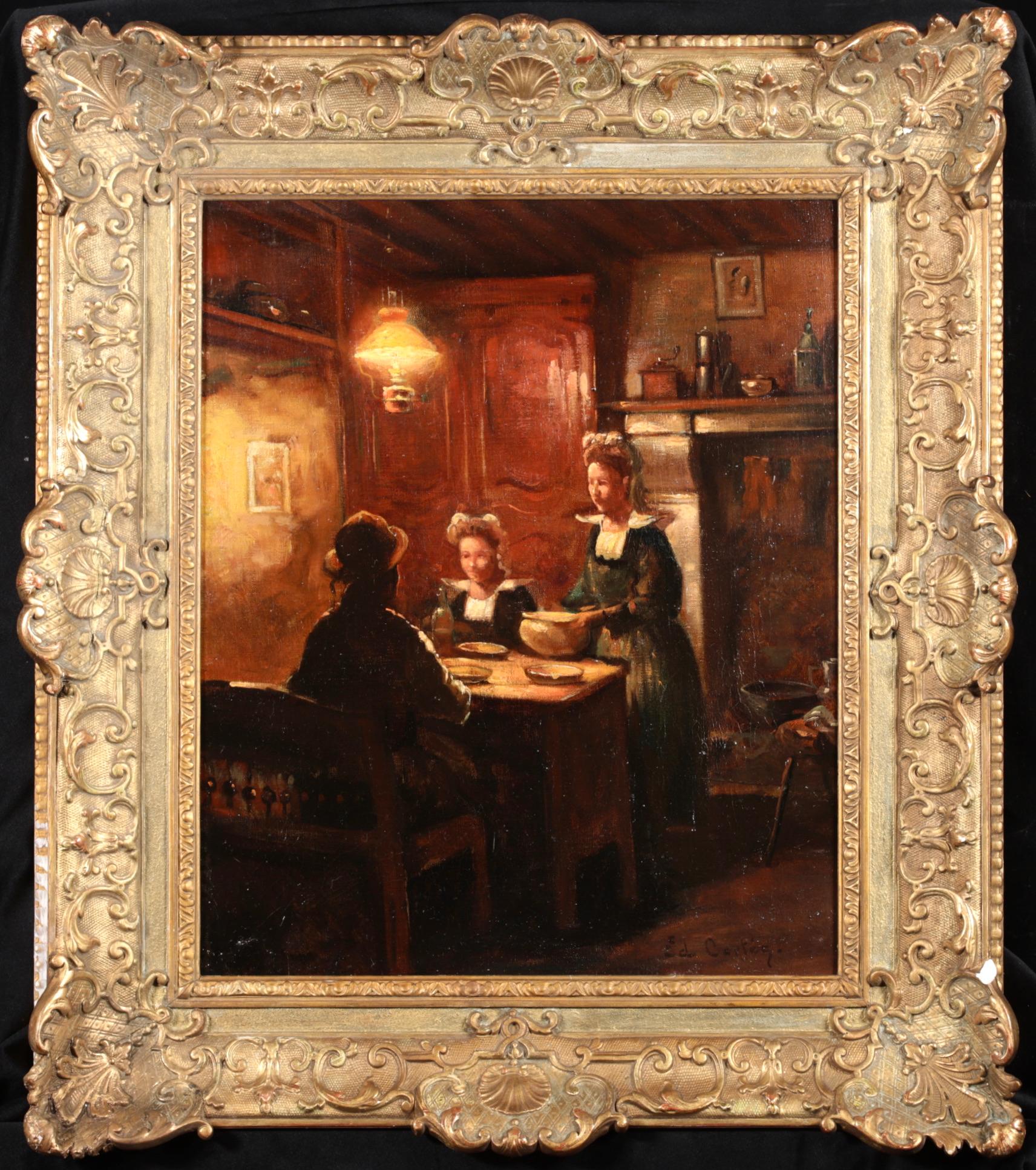
A Breton Interior - Impressionist Interior Oil Painting by Edouard Cortes

A Breton Interior - Impressionist Interior Oil Painting by Edouard Cortes

By Édouard Leon Cortès

Located in Marlow, Buckinghamshire

Signed figures in interior oil on canvas circa 1910 by sought after French impressionist painter Edouard Leon Cortes. This charming and nostalgic work depicts a family enjoying dinne...

Category

Early 20th Century Impressionist Interior Paintings

Materials

Canvas, Oil

Jacques Zon (1872-1932) - Framed 1909 Oil, Gathered at the Table

Jacques Zon (1872-1932) - Framed 1909 Oil, Gathered at the Table

Located in Corsham, GB

A thought-provoking genre scene by Dutch artist Jacques Zon (1872-1932), depicting a young family gathered around a large kitchen table. Zon's rich earth tones and loose brushwork cr...

Category

Early 20th Century Figurative Paintings

Materials

Oil

Newlyn School Late 19th Century Oil - The Fisherman's Family

Newlyn School Late 19th Century Oil - The Fisherman's Family

Located in Corsham, GB

A fine oil study depicting a family perching on the steps of their coastal home. The mother sits on the top step holding a baby while the two other children sit below. Each holding t...

Category

Late 19th Century Figurative Paintings

Materials

Oil

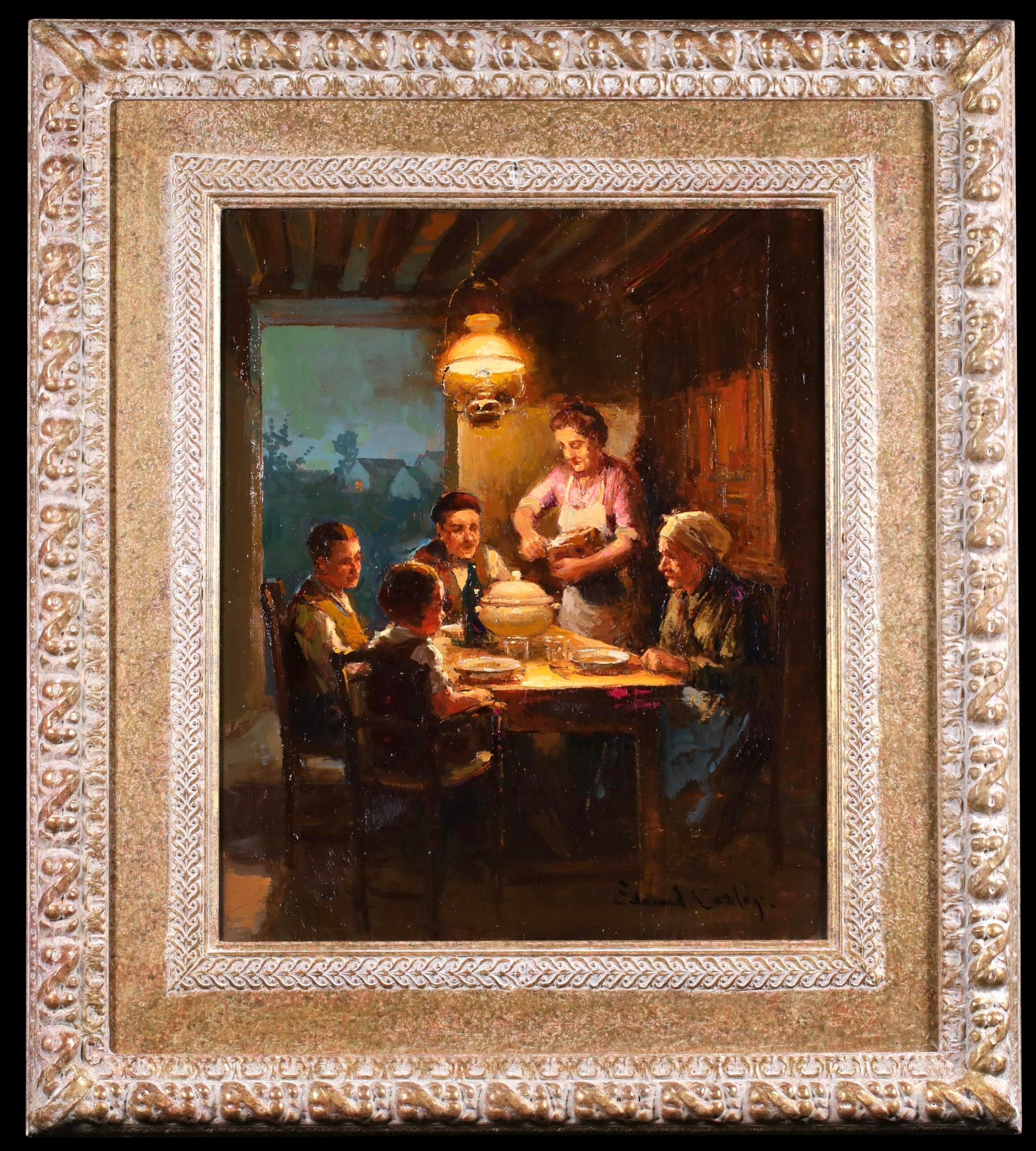
La Famille - Impressionist Interior Figurative Oil Painting by Edouard Cortes

La Famille - Impressionist Interior Figurative Oil Painting by Edouard Cortes

By Édouard Leon Cortès

Located in Marlow, Buckinghamshire

Signed and titled figures in interior oil on panel circa 1920 by sought after French impressionist painter Edouard Leon Cortes. This charming and nostalgic work depicts a family enjo...

Category

1920s Impressionist Figurative Paintings

Materials

Oil, Panel

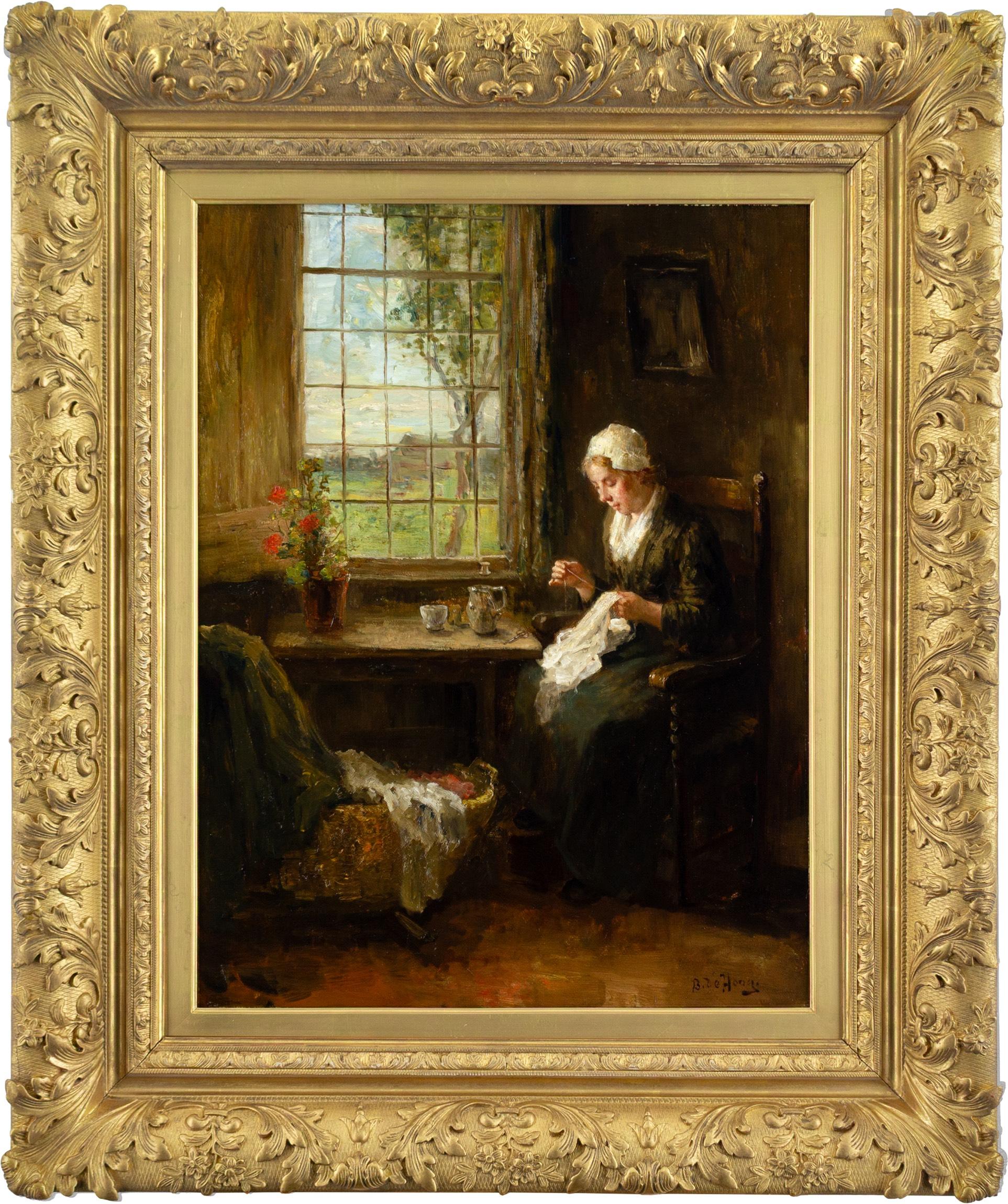
A Quiet Hour, Early 20th-Century Dutch Oil Painting

A Quiet Hour, Early 20th-Century Dutch Oil Painting

By Bernard De Hoog

Located in Cheltenham, GB

This sublime early 20th-century oil painting by Dutch artist Bernard De Hoog (1867-1943) celebrates one of life's quietest luxuries - an hour of uninterrupted contentment. Seated be...

Category

1920s English School Interior Paintings

Materials

Canvas, Oil