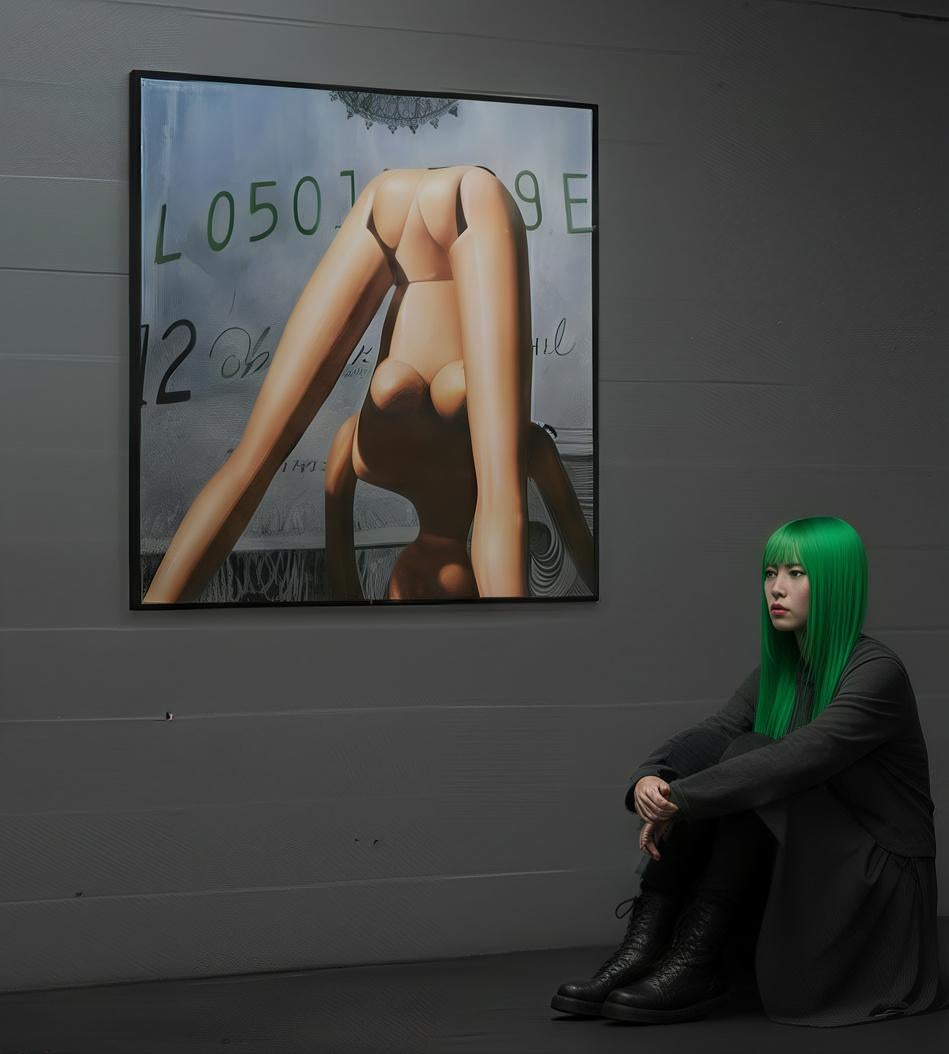
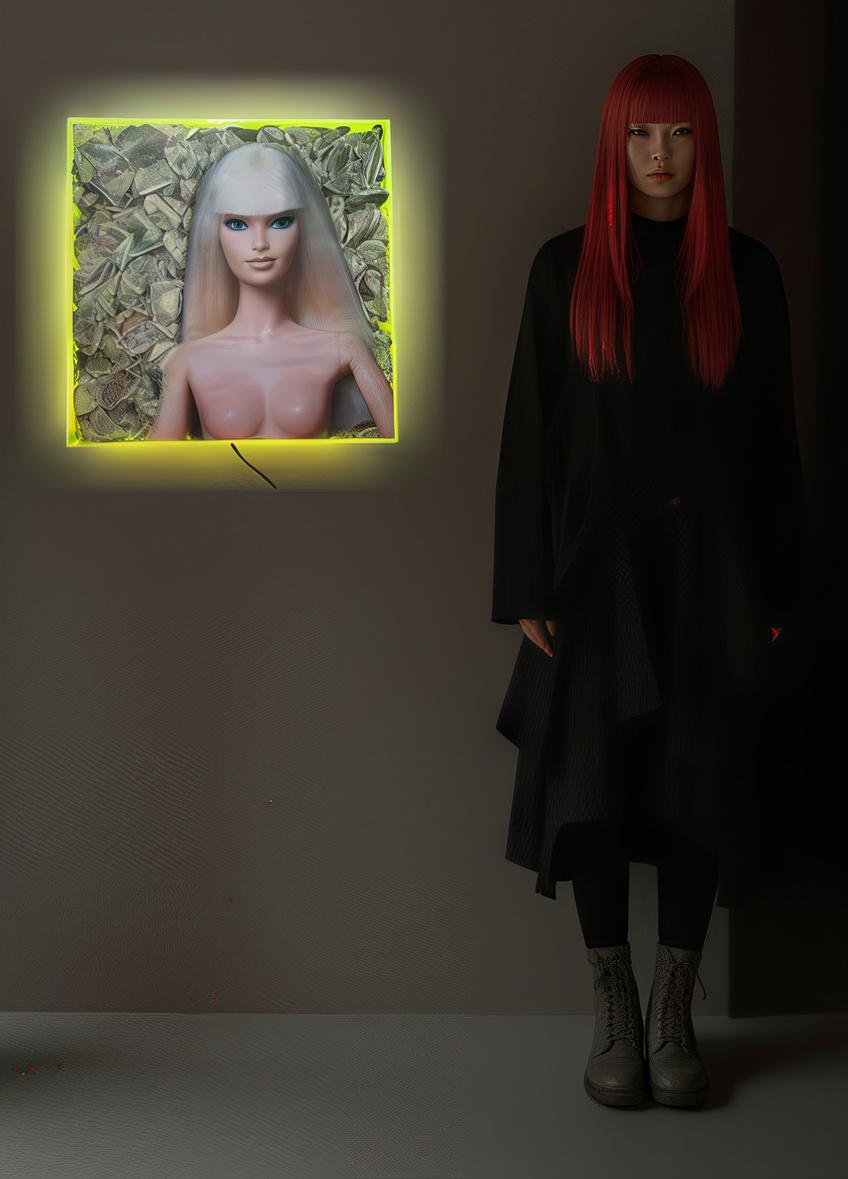
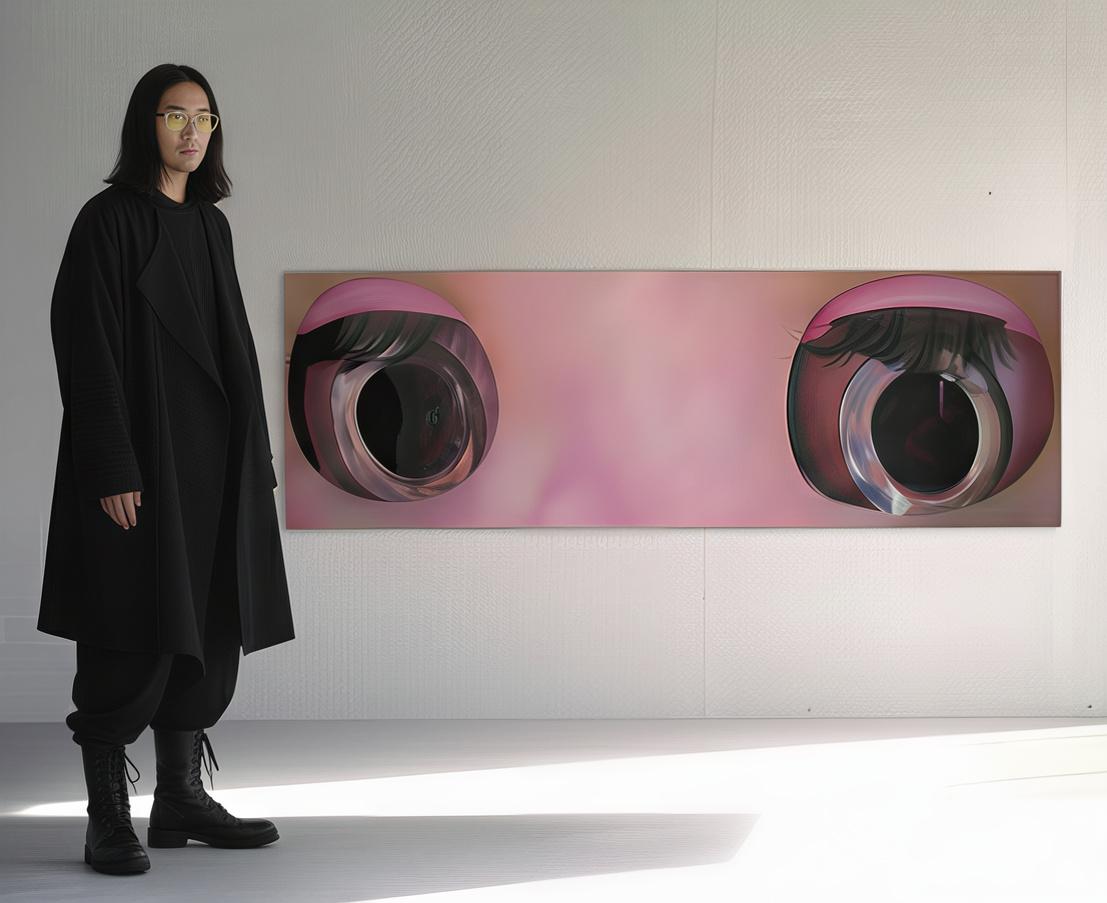
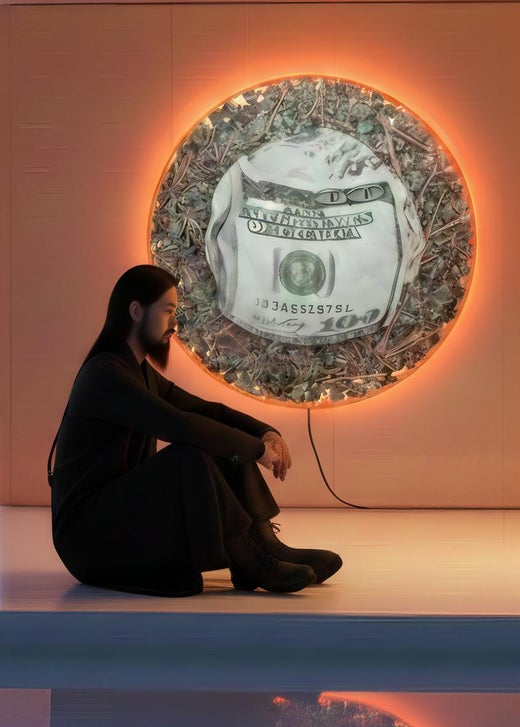
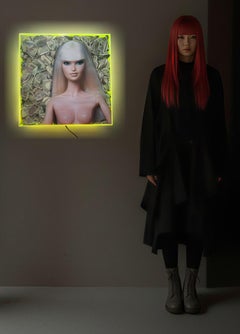
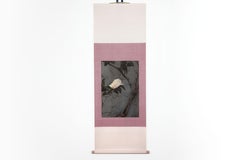
Ephemeral Elegance is an oil on canvas painting by Kumikaho Oshima from the series Naked Fortunes: Portraits of Barbie and Dollars, where the artist explores the delicate tension between bodily exposure and economic symbolism through the poised figure of a nude Barbie positioned against a layered backdrop of currency. The composition presents the doll standing upright on a surface of enlarged dollar imagery, suggesting both elevation and vulnerability, as if the figure’s balance depends on the unstable terrain of financial value. This visual arrangement invites viewers to reflect on how ideals of beauty and success are often intertwined with systems of measurement beyond personal control.
Oshima’s painterly technique reveals meticulous attention to tonal transitions and reflective surfaces, rendering the synthetic skin of the Barbie with a softness that contrasts sharply with the crisp detailing of the monetary background. Subtle highlights along the figure’s contours enhance the illusion of three-dimensionality, while the surrounding green hues of the dollar motif create an atmosphere that feels simultaneously grounded and elusive. The interaction between color and texture reinforces the idea that material wealth can both support and destabilize personal identity.
In Ephemeral Elegance, posture becomes a key expressive element. The figure’s upright stance suggests confidence and visibility, yet its nudity introduces a sense of fragility that complicates this perception. By placing the doll at the center of the composition, Oshima transforms it into a symbolic conduit through which societal expectations of perfection and prosperity are examined. The absence of clothing removes markers of status, directing attention instead toward the body as a universal site of projection and interpretation.
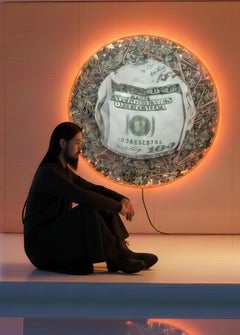
The dollar imagery, magnified and carefully painted, functions as a conceptual foundation that both supports and challenges the figure’s presence. Currency becomes a metaphor for the frameworks through which individuals are evaluated, reminding viewers that notions of worth often extend beyond financial contexts into the realm of personal validation. This juxtaposition highlights the transient nature of external recognition and the emotional complexity that accompanies the pursuit of achievement.
As a major member of the studio CrazyNoodles, Oshima engages with a broader Neo-Pop dialogue that examines the influence of global imagery on Japanese visual culture. In this work, Western symbols are reinterpreted through a distinctly Japanese sensibility, emphasizing hybridity and cross-cultural exchange. The Barbie figure serves as a lens through which questions of individuality, conformity, and aspiration are explored within a rapidly evolving social landscape.
The conceptual influence fostered within the collective by Hiro Ando is evident in Oshima’s ability to merge visual allure with intellectual inquiry. Ephemeral Elegance demonstrates this balance by drawing viewers in through aesthetic refinement while encouraging contemplation of deeper themes related to value, identity, and vulnerability. Each brushstroke contributes to a narrative that transcends surface beauty, revealing the layered dynamics underlying contemporary self-perception.
Through its poised composition, refined technique, and symbolic depth, Ephemeral Elegance stands as a compelling work within the Naked Fortunes series. The painting captures attention through its interplay of softness and structure, demonstrating Oshima’s capacity to transform familiar cultural icons into reflective spaces of inquiry. By its balanced composition, meticulous execution, and quiet emotional resonance, Ephemeral Elegance emerges as a highly collectible artwork. A piece particularly suited for collectors of contemporary Japanese art, Neo-Pop, and figurative paintings that explore the intersections of vulnerability, value, and the evolving narratives of identity.
LITERATURE ABOUT THE SERIE "Naked Fortunes : Portraits of Barbie and Dollars"
Within the series Naked Fortunes: Portraits of Barbie and Dollars, Kumikaho Oshima constructs a body of paintings that fully engages the language of Nippon Neo-Pop while introducing a distinctly introspective dimension. Across these oil-on-canvas works, the artist orchestrates a visual confrontation between the idealized nudity of Barbie figures and the rigid iconography of the American dollar, transforming the pictorial surface into a site where private vulnerability meets collective systems of value. Rather than opposing these symbols, Oshima reveals the subtle zones of friction where contemporary fantasies of desire, success, and identity are formed.
The dollar, omnipresent throughout the series, transcends its economic function to become a visual matrix that frames the body itself. In Oshima’s compositions, currency operates as a silent language of measurement, reminding viewers that personal worth is often evaluated through external standards. Rendered with near-documentary precision, the banknotes establish a normative backdrop against which the nude figure appears both exposed and resilient. This juxtaposition invites reflection on how individuals internalize comparison and performance within societies structured by visibility and achievement.
The Barbie figure functions as a universal projection of constructed femininity. By presenting the doll without clothing, Oshima strips the icon of its commercial attributes, revealing its psychological resonance. The Barbie becomes a metaphor for contemporary subjectivity: outwardly perfect yet internally shaped by tension between autonomy and conformity. This duality resonates strongly in the Japanese context, where young women navigate the intersection of personal ambition, social harmony, and image consciousness within a media-saturated environment.
From a sociological perspective, the series reflects the pressures influencing female identity formation in contemporary Japan. Between inherited cultural values and globalized aspirations, young Japanese women inhabit a space where independence, professional success, and public image can coexist in complex and sometimes conflicting ways. Oshima’s figures, isolated yet illuminated, embody this quiet tension, suggesting an acute awareness of the social mechanisms that influence self-perception and emotional resilience.
Psychologically, Oshima approaches nudity not as provocation but as a tool for introspection. Her figures appear suspended in moments of contemplation, neither entirely vulnerable nor fully protected, reflecting a sensitivity to the emotional nuances of modern existence. Rather than overtly criticizing consumer culture, the artist reveals its affective architecture, showing how memory, aspiration, and desire intertwine in shaping identity. This layered approach allows viewers to recognize their own projections within the work.
As a major member of the studio CrazyNoodles, Oshima participates in a broader movement that has redefined Japanese Neo-Pop, particularly under the conceptual influence of Hiro Ando. Yet her voice remains distinct for its introspective tone, where pop culture imagery becomes an analytical instrument rather than mere visual spectacle. The symbols she employs are never static; they evolve into reflective surfaces through which viewers examine their own relationships with value, beauty, and aspiration.
Ultimately, the paintings within Naked Fortunes: Portraits of Barbie and Dollars operate as cultural mirrors, revealing the intricate processes that shape individual desires within a world governed by comparison and representation. By combining refined painterly execution with conceptual depth, Kumikaho Oshima offers a lucid exploration of contemporary psychology. Her iconic figures become spaces for meditation on vulnerability, projection, and the quiet construction of identity, inviting audiences to question not only what they see, but how those images influence the narratives they live by.