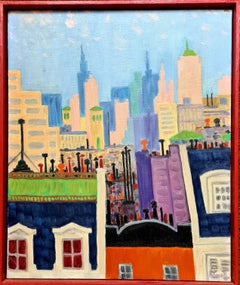
Want more images or videos?
Request additional images or videos from the seller
1 of 9

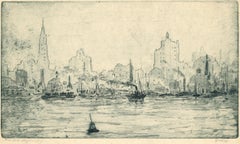
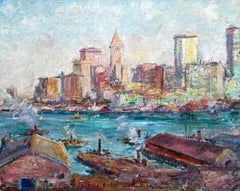
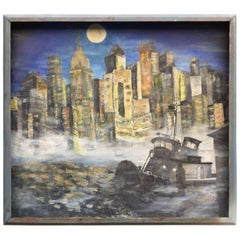
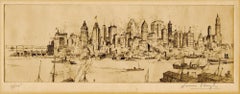
Bela de Tirefort
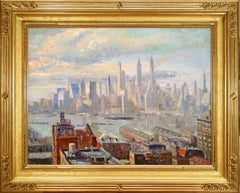
"New York Harbor from the East River, 1951, " American Cityscape of NYC Skyline

1951

$6,500List Price

You May Also Like

New York Skyline from Brooklyn Heights, Oil on Board, Mid-20th Century

New York Skyline from Brooklyn Heights, Oil on Board, Mid-20th Century

By Francis Vandeveer Kughler

Located in New York, NY

FRANCIS VANDEVEER KUGHLER "New York Skyline C. 1940" - oil on Masonite, 30"x40" Unframed, Signed lower center Born in New York City in 1901, Francis Vandeveer Kughler attended Co...

Category

Mid-20th Century American Modern Landscape Paintings

Materials

Oil, Board

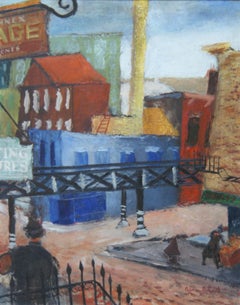
New York Skyline the West Side with Hudson River - Vintage New York

New York Skyline the West Side with Hudson River - Vintage New York

By Frank S. Hermann

Located in Miami, FL

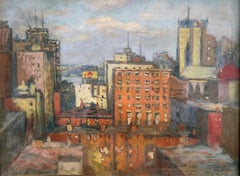
Rooftop view of the upper West Side Manhattan as it looked in the 1930s. There is a rough indication of a billboard and a glimpse of the Hudson River. The cluster of buildings depic...

Category

1930s American Impressionist Landscape Paintings

Materials

Oil, Gouache, Board

"View from the Docks on the East River, New York" Bela de Tirefort, Cityscape

"View from the Docks on the East River, New York" Bela de Tirefort, Cityscape

By Bela de Tirefort

Located in New York, NY

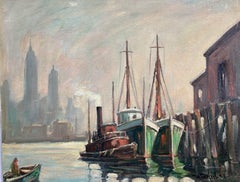
Bela de Tirefort View from the Docks on the East River, New York, 1958 Signed and dated lower right Oil on canvas 16 x 20 inches Bela de Tirefort was born in Eastern Europe, painted...

Category

1950s Modern Landscape Paintings

Materials

Canvas, Oil

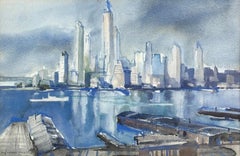
"New York City Skyline View from the East River, " Lionel Reiss, Jewish Artist

"New York City Skyline View from the East River, " Lionel Reiss, Jewish Artist

By Lionel Reiss

Located in New York, NY

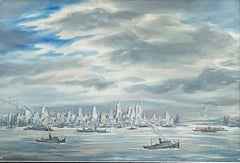
Lionel S. Reiss (1894 - 1988) New York City Skyline View from the East River Watercolor on paper 13 x 19 inches Signed lower left In describing his own style, Lionel Reiss wrote, “By nature, inclination, and training, I have long since recognized the fact that...I belong to the category of those who can only gladly affirm the reality of the world I live in.” Reiss’s subject matter was wide-ranging, including gritty New York scenes, landscapes of bucolic Bucks County, Pennsylvania, and seascapes around Gloucester, Massachusetts. However, it was as a painter of Jewish life—both in Israel and in Europe before World War II—that Reiss excelled. I.B. Singer, the Nobel Prize winner for Literature, noted that Reiss was “essentially an artist of the nineteenth century, and because of this he had the power and the courage to tell visually the story of a people.” Although Reiss was born in Jaroslaw, Poland, his family immigrated to the United States in 1898 when he was four years old. Reiss's family settled on New York City’s Lower East Side and he lived in the city for most of his life. Reiss attended the Art Students League and then worked as a commercial artist for newspapers and publishers. As art director for Metro-Goldwyn-Mayer, he supposedly created the studio’s famous lion logo. After World War I, Reiss became fascinated with Jewish life in the ‘Old World.’ In 1921 he left his advertising work and spent the next ten years traveling in Europe, the Middle East, and North Africa. Like noted Jewish photographers Alter Kacyzne and Roman Vishniac, Reiss depicted Jewish life in Poland prior to World War II. He later wrote, “My trip encompassed three main objectives: to make ethnic studies of Jewish types wherever I traveled; to paint and draw Jewish life, as I saw it and felt it, in all aspects; and to round out my work in Israel.” In Europe, Reiss recorded quotidian scenes in a variety of media and different settings such as Paris, Amsterdam, the Venice ghetto, the Jewish cemetery in Prague, and an array of shops, synagogues, streets, and marketplaces in the Jewish quarters of Warsaw, Lodz, Krakow, Lublin, Vilna, Ternopil, and Kovno. He paid great attention to details of dress, hair, and facial features, and his work became noted for its descriptive quality. A selection of Reiss’s portraits appeared in 1938 in his book My Models Were Jews. In this book, published on the eve of the Holocaust, Reiss argued that there was “no such thing as a ‘Jewish race’.” Instead, he claimed that the Jewish people were a cultural group with a great deal of diversity within and between Jewish communities around the world. Franz Boas...

Category

1940s American Modern Landscape Drawings and Watercolors

Materials

Paper, Watercolor

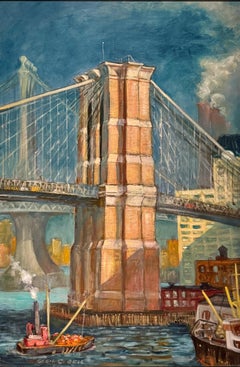
John Haymson "Brooklyn Bridge" Oil Painting of New York Skyline, circa 1955

John Haymson "Brooklyn Bridge" Oil Painting of New York Skyline, circa 1955

By John Haymson

Located in Miami, FL

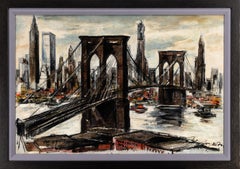
JOHN HAYMSON – "BROOKLYN BRIDGE" ⚜ Oil on Canvas ⚜ Hand Signed ⚜ Conservation Frame NEW YORK ICON IN VIVID DETAIL This atmospheric oil painting by John Haymson captures the enduring...

Category

1950s Modern Landscape Paintings

Materials

Canvas, Oil

New York Skyline, NY; East River

New York Skyline, NY; East River

By Leon Dolice

Located in Middletown, NY

Etching on medium stock, cream wove paper, 5 15/16 x 10 3/16 inches (151 x 259 mm), full margins. Signed and titled in pencil, lower margin. A fine and detailed impression in dark bl...

Category

1930s American Modern Landscape Prints

Materials

Archival Paper, Etching

“View of Lower New York from Brooklyn”

“View of Lower New York from Brooklyn”

By Max Kuehne

Located in Southampton, NY

Original oil on linen painting laid down to original fiberboard by the well know American artist, Max Kuehne. Signed in pencil verso upper left. Circa 1928. Condition is very good. ...

Category

1920s Abstract Impressionist Landscape Paintings

Materials

Canvas, Oil, Fiberboard

1960s NYC East River Cityscape Painting

1960s NYC East River Cityscape Painting

$2,240Sale Price|50% Off

H 49 in W 44 in D 0.5 in

1960s NYC East River Cityscape Painting

Located in New Windsor, NY

The oil on canvas is signed, L. Jesberger, lower right, has an amazing noir feel to it. The moored tugboat and Silhouette figure in the foreground are juxtaposed with the highly illu...

Category

Vintage 1960s American Mid-Century Modern Paintings

Materials

Canvas

New York Skyline

Louis H. RuylNew York Skyline, 1920

$450

H 9.18 in W 12.72 in

New York Skyline

By Louis H. Ruyl

Located in Middletown, NY

Etching with drypoint on cream wove paper with deckle edges, 4 3/8 x 12 3/4 inches (233 x 323 mm); sheet 9 1/2 x 15 3/4 inches (240 x 338 mm), full margins. Signed and numbered 4/75 ...

Category

Early 20th Century American Modern Landscape Prints

Materials

Handmade Paper, Etching, Drypoint

New York City Skyline, Mid Century Oil on Canvas by Nobel Laureate

New York City Skyline, Mid Century Oil on Canvas by Nobel Laureate

Located in Cotignac, FR

Mid century French oil on canvas view of the New York City skyline by André Lwoff a noted Nobel prize winning chemist and later artist. The painting is signed bottom right and presen...

Category

Mid-20th Century Modern Landscape Paintings

Materials

Canvas, Oil

More From This Seller

View All
NYC Cityscape American Scene WPA Modern Realism Mid 20th Century Architectural

NYC Cityscape American Scene WPA Modern Realism Mid 20th Century Architectural

By Ernest Fiene

Located in New York, NY

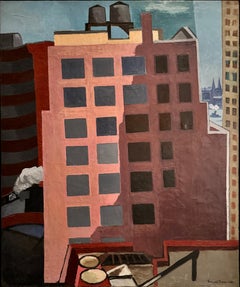
NYC Cityscape American Scene WPA Modern Realism Mid 20th Century Architectural Ernest Fiene (1894-1965) Cityscape 36 x 30 inches Oil on canvas Signed and dated 1930. lower right Provenance Estate of the artist. ACA Galleries, New York Exhibited New York, Frank Rehn Gallery, Changing Old New York, 1931. New York, ACA Galleries, Ernest Fiene: Art of the City, 1925-1955, May 2-23, 1981, n.p., no. 5. BIO Ernest Fiene was born in Elberfeld, Germany in 1894. As a teenager, Fiene immigrated to the United States in 1912. He studied art at the National Academy of Design in New York City from 1914 to 1918, taking day classes with Thomas Maynard and evening classes with Leon Kroll. Fiene continued his studies at the Beaux-Arts Institute of Design in New York from 1916 to 1918, adding classes in printmaking at the Art Students League in 1923. Fiene began his career as an artist in 1919 with his first exhibition of watercolors at the MacDowell Club arranged by his mentor Robert Henri. In 1923 the Whitney Studio Club mounted a large exhibition of his works. The following year he had an exhibition at the New Gallery in New York, which completely sold out all fifty-two works, including paintings, watercolors, drawings, and etchings. With the proceeds of sales from the New Gallery exhibition, Ernest Fiene and his younger brother Paul, a sculptor, built studios in Woodstock, New York in 1925. In the early Twenties Ernest Fiene painted mostly landscapes of Woodstock and both the Ramapo and Hudson River Valleys. The first monograph from the Younger Artists Series was published on Fiene in 1922. Published in Woodstock, the series went on to include Alexander Brook, Peggy Bacon, and Yasuo Kuniyoshi. The book reproduced 1 illustration in color and another 27 reproductions in black and white. Around 1925 Fiene became fascinated with the intensity, excitement, and opportunities for color harmonies New York City offered as a subject. His paintings shifted to urban and industrial themes with architecture, industry, and transportation becoming his subjects. By 1926 Fiene had attracted the dealer Frank K.M. Rehn, who gave him a one-man exhibition that year, which travelled to the Boston Arts Club. C.W. Kraushaar Galleries gave Fiene a one-man exhibition of urban, landscape, portrait, and still life paintings in 1927. Julianna Force, the director of the Whitney Studio Club and first director of the Whitney Museum of American Art, included two of Fiene’s paintings in a fall exhibition in 1928. The Whitney Studio Club showed Fiene’s paintings in a two-man exhibition with Glenn O. Coleman that year and acquired three of Fiene’s paintings. Also in 1928 Fiene became affiliated with Edith Halpert’s Downtown Gallery where he had an exhibition of 20 lithographs in the spring. Fiene sold his house in Woodstock in 1928 to spend more of his time in New York City. With so many successful exhibitions, Fiene returned to Paris in 1928-29 where he rented Jules Pascin's studio and studied at the Académie de la Grande Chaumière. In France, Fiene painted both landscape and urban subjects developed from ideas influenced by Cubist geometry and the use of flat areas of broad color. Upon returning to New York in 1930, Fiene used this new approach to continue to paint New York skyscraper and waterfront subjects, as well as to begin a series of paintings on changing old New York based on the excavations for Radio City Music Hall and the construction of the Empire State Building. Frank K.M. Rehn Galleries exhibited this series, titled “Changing Old New York,” in 1931. Fiene also has solo exhibitions at Rehn Galleries in 1930 and 1932. Fiene’s oil paintings are exhibited at the Chicago Arts Club in 1930 as well. Fiene was included in the Museum of Modern Art’s exhibition Painting and Sculpture by Living Americans in December of 1931. Visiting New York, Henri Matisse saw the exhibition and called Fiene’s Razing Buildings, West 49th Street the finest painting he had seen in New York. Fiene had two mural studies from his Mechanical Progress series exhibited at the Museum of Modern Art’s exhibition Murals by American Painters and Photographers in 1932. Fiene sent View from my Window which depicts Fiene working on a lithograph stone while looking out his window to the newly completed Empire State Building to the Carnegie International in 1931. In 1932 Fiene participated in the first Biennial of American Painting at the Whitney Museum and his prints were included in exhibitions at the Downtown Gallery and the Wehye Gallery. In the same year, Fiene was awarded a Guggenheim fellowship to further study mural painting in Florence, Italy. On his return from Italy in 1933 Fiene re-engaged himself in New York City life and won several public and private mural projects. Fiene resumed his active exhibition schedule, participating in two group exhibitions at the Whitney Museum and a one-man exhibition of recent paintings at the Downtown Gallery in January 1934. In 1933 he purchased a farm in Southbury, Connecticut, which added Connecticut scenes to his landscape subjects. This was also the year Fiene began to spend summers on Monhegan Island, Maine, where he painted seascapes, harbor scenes, and still lifes. Fiene’s landscape paintings attracted numerous commissions as part of the American Scene movement. Through the fall and winter of 1935-36, Fiene took an extended sketching trip through the urban, industrial, and farming areas of Pennsylvania and West Virginia. Most of the twenty-four Pennsylvania urban and rural paintings...

Category

1930s American Modern Landscape Paintings
Materials

Canvas, Oil

American Modernism WPA Mid 20th Century Realism NYC Street Scene Cityscape

American Modernism WPA Mid 20th Century Realism NYC Street Scene Cityscape

By Max Arthur Cohn

Located in New York, NY

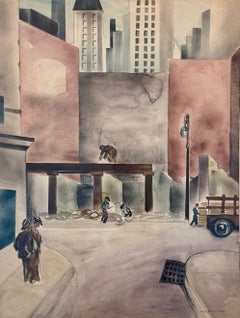
American Modernism WPA Mid 20th Century Realism NYC Street Scene Cityscape Max Arthur Cohn (1903 - 1998) "New York Street Scene" Watercolor on paper, c. 1930s Sight: 21 x 16 inches...

Category

1930s American Modern Figurative Paintings

Materials

Paper, Watercolor