Frederick Arthur Bridgman
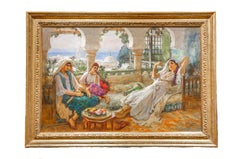
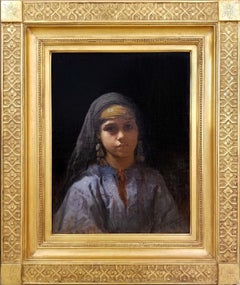
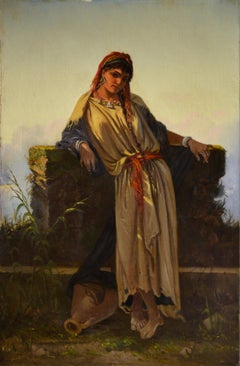
Frederick Arthur Bridgman (November 10, 1847 – January 13, 1928) was an American artist known for his paintings of "Orientalist" subjects. Born in Tuskegee, Alabama, Bridgman was the son of a physician. After his father died in 1850, his mother moved to New York City with her two sons. Bridgman began working as a draughtsman for the American Bank Note Company in 1864–65, and studied art in the same years at the Brooklyn Art Association and at the National Academy of Design. He exhibited his paintings at the Brooklyn Art Association, and encouraged by his success, he gave up his job in 1866 and moved to France with the sponsorship of a group of Brooklyn businessmen. Bridgman's first destination in France was Pont-Aven in the Brittany region, where he stayed with a group of American artists, among them Robert Wylie. In the autumn of 1866, he went to Paris and entered the studio of the noted academic painter Jean-Léon Gérôme (1824–1904), where he was deeply influenced by Gérôme's precise draftsmanship, smooth finishes, and concern for Middle-Eastern themes. While studying in the atelier of Gérôme, he became acquainted with his fellow students Harry Humphrey Moore and Thomas Eakins and also first came in contact with Orientalism. Bridgman's first exhibition in Paris took place at the Salon de Paris in 1870, and his painting A Provincial Circus was received very positively. It was then sent to New York and exhibited at the Brooklyn Art Association. Bridgman was forced to leave Paris in the early 1870s. He then made his first trips to North Africa between 1872 and 1874, dividing his time between Morocco, Tunisia, Algeria and Egypt. Arriving in Cairo in December 1873, they worked in the city producing numerous sketches of the Islamic monuments, but also the street life, which was Bridgman's main inspiration. They travelled along the Nile, reaching Abu Simbel in the south of Egypt. During his trips, Bridgman executed approximately three hundred sketches, which became the source material for several later oil paintings that attracted immediate attention. Bridgman became known as "the American Gérôme", although Bridgman would later adopt a more naturalistic aesthetic, emphasizing bright colors and painterly brushwork. His large and important composition, Funeral of a Mummy on the Nile (1876–77; Speed Art Museum, Louisville), exhibited at the Salon de Paris in 1877 and at the 1878 Paris Exposition, bought by James Gordon Bennett, Jr., established his success as an artist and brought him the Cross of the Legion of Honor. The painting was later purchased by the famous American collector Wendell Cherry who donated it to the Speed Art Museum in Louisville, Kentucky in 1990. In 1881, Bridgman exhibited over 300 of his works in a personal exhibition in New York. His work was highly praised for the variety of subjects and the fine quality of execution. Following this success, Bridgman was elected a member of the National Academy of Design, after already being an associate member since 1874.