Want more images or videos?
Request additional images or videos from the seller
1 of 5

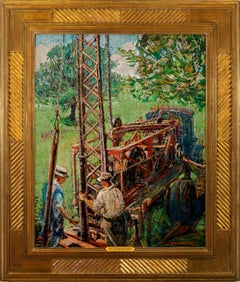
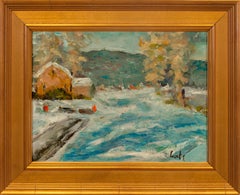
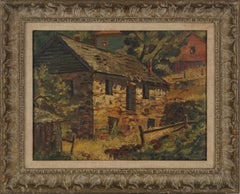
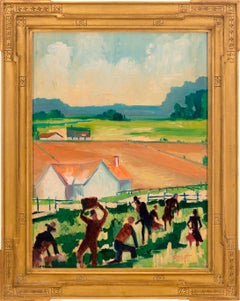
Harry Leith-Ross
"Concrete Construction"

Circa 1940

$24,375
£18,483.38
€21,594.75
CA$34,854.86
A$35,389.58
CHF 20,061.60
MX$431,119.21
NOK 237,275.04
SEK 237,344.01
DKK 161,417.05

About the Item

Jim’s of Lambertville is proud to offer this artwork. Signed lower left. Illustrated in "New Hope for American Art" Harry Leith-Ross (1886 - 1973) The son of an English father and a Dutch mother, Harry Leith-Ross was born in the British Colony of Mauritius, an island in the Indian Ocean a thousand miles off the southeast coast of Africa. His first formal art instruction began in England under Stanhope Forbes, followed by studies with Jean Paul Laurens at the Academie Julian in Paris. Leith-Ross came to the United States to enroll at the National Academy of Design in New York City in 1910, and then to Woodstock, in 1913. It was in Woodstock at the Art Students League, under the tutelage of Birge Harrison and John F. Carlson, that Leith-Ross would receive the training that most influenced his career as an artist. There he formed a lifelong friendship with fellow artist, John Folinsbee. The two artists shared a studio during this time and participated in several joint exhibitions exclusively featuring their work, including an exhibit at the Louis Katz Art Gallery in New York City in 1915. During the First World War, Leith-Ross served in the U.S. infantry, and upon his release, spent a summer painting in England. While there he participated in a solo exhibition at The Little Gallery in Worthing in 1919. It was said of Leith-Ross by an art critic in a local English newspaper: “An exquisite sense of color, perfect draftsmanship, a thorough grasp of composition, and a deep insight into nature, make of Harry Leith-Ross not only a brilliant painter but a poet”. Upon returning to the United States, Leith-Ross resided once again in Woodstock where he taught painting. Leith-Ross would often visit his close friend, John Folinsbee, who moved to New Hope in 1916 following his marriage to Ruth Baldwin Folinsbee. Leith-Ross was the best man in his wedding. Some years later, Leith-Ross met Emily, and the couple wed in 1925. They remained in Woodstock until purchasing a home in the Jericho Valley on the outskirts of New Hope in 1936, where Leith-Ross remained until the end of his life. Leith-Ross painted a wide array of subjects. His earlier works (1912-1930) are very finely painted impressionist landscapes consisting of small, tight brush strokes and a colorful refreshing palette. The early paintings usually depict Woodstock, New Hope and Gloucester. His later works often include figures and his application of paint is lighter. His skillful handling of shadows and light give the later works (1935-60) a striking resemblance to those of Edward Hopper. Many of these paintings depict the landscape surrounding his home in Jericho Valley and views of New England. Leith-Ross was also a gifted watercolorist. He made occasional trips to Europe and often summered in Rockport and Gloucester, where he held painting classes as well. Harry Leith-Ross exhibited widely and won more than forty awards. He participated in exhibitions at the National Academy of Design, the Salmagundi Club, the Pennsylvania Academy of the Fine Arts, the Society of Independent Artists, the Corcoran Gallery Biennials, the Carnegie Institute, the Art Institute of Chicago, the American Watercolor Society and the Metropolitan Museum of Art. Sources: -New Hope for American Art by James M. Alterman -Jim’s of Lambertville Archives- 2005 -The Gazette- Worthington, England - 1919 -The New Hope Gazette, 2/18/63 -Formative Years Leith-Ross, no date -Resume, 7/25/63
  • Creator:
    Harry Leith-Ross (1886-1973, American)
  • Creation Year:
    Circa 1940
  • Dimensions:
    Height: 14 in (35.56 cm)Width: 16 in (40.64 cm)Depth: 2 in (5.08 cm)
  • More Editions & Sizes:
    Frame Size 13.5 x 16" x 1.5"Price: $24,375
  • Medium:
  • Movement & Style:
  • Period:
  • Condition:
  • Gallery Location:
    Lambertville, NJ
  • Reference Number:
    Seller: LLL025124121stDibs: G14032237447

More From This Seller

View All
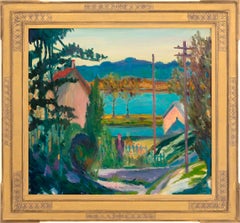
"None Such Days"

"None Such Days"

By Joseph Barrett

Located in Lambertville, NJ

Illustrated in "Joseph Barrett, The Prime Years 1970s - 1990s", pg. 14 #016 Jim’s of Lambertville is proud to offer this artwork by: Joseph Barrett (1936 – ) Joseph Barrett was born in Midland, North Carolina, in 1936 and studied at the Massachusetts College of Art in Boston and at the Tyler School of Art in Philadelphia. Barrett, now of Lahaska, Pennsylvania, has been painting his entire adult life. His favorite subjects include the landscape surrounding New Hope and many local landmarks often encompassing figures into his compositions. Barrett utilizes a heavy impasto and his palette bears similarities to that of Fern Coppedge and George Sotter. Barrett’s paintings are always found in unique and somewhat charming handmade frames designed by the artist and finished in metal leaf. A living contemporary of the no longer living “New Hope School” impressionist painters, Joseph Barrett resides outside of New Hope above his old-fashioned antique shop and studio. Entering Barrett’s shop is like taking a step back in time. Inside this cluttered and dusty haven of treasures from the past, is a studio spanning only four by eight feet. This little studio, containing cans of old brushes and hundreds of used paint tubes...

Category

Late 20th Century American Impressionist Landscape Paintings

Materials

Canvas, Oil

"Welldiggers from Titusville"

"Welldiggers from Titusville"

By Mary Elizabeth Price

Located in Lambertville, NJ

Jim’s of Lambertville is proud to offer this artwork. Signed lower right. Complemented by a hand carved and gilt frame. Illustrated in "New Hope for American Art" by James Alterman, and "Blue Chips" published by Jim's of Lambertville. M. Elizabeth Price (1877 - 1965) Mary Elizabeth Price was born in West Virginia and raised on a farm in Solebury, Pennsylvania, on the outskirts of New Hope. She studied at the Pennsylvania School of Industrial Arts and the Pennsylvania Academy of the Fine Arts under Hugh Breckenridge. Additionally, she studied in New Hope with William Lathrop. Following her art studies, Price went to New York. While there, she conducted the “Baby Art...

Category

1920s American Impressionist Landscape Paintings

Materials

Canvas, Oil

"New Hope Gothic"

"New Hope Gothic"

By Joseph Barrett

Located in Lambertville, NJ

Illustrated in "Joseph Barrett, The Prime Years 1970s - 1990s", pg. 62, plate #072. Jim’s of Lambertville is proud to offer this artwork by: Joseph Barrett (1936 – ) Joseph Barrett was born in Midland, North Carolina, in 1936 and studied at the Massachusetts College of Art in Boston and at the Tyler School of Art in Philadelphia. Barrett, now of Lahaska, Pennsylvania, has been painting his entire adult life. His favorite subjects include the landscape surrounding New Hope...

Category

Late 20th Century American Impressionist Landscape Paintings

Materials

Canvas, Oil

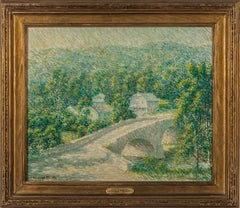
"Point Pleasant"

"Point Pleasant"

By S. George Phillips

Located in Lambertville, NJ

Jim’s of Lambertville is proud to offer this artwork. Signed lower left. Complemented by a period frame. Illustrated in "New Hope for American Art" by Jim Alterman and "The Philadelphia Impressionists" by Thomas C. Folk, pg, 102, plate 45 S. George Phillips (1890 - 1965) Regarded by some as “a poor man’s Garber” (“poor” needing to be redefined these days), S. George Phillips painted rich and colorful landscapes depicting views of the Delaware River and the environs surrounding New Hope. An extremely competent artist, Samuel George Phillips was born in Pennsylvania in 1890. He studied at the Pennsylvania Academy of the Fine Arts under William Merritt Chase, Cecilia Beaux, Hugh Breckenridge, and Daniel Garber. He then traveled to Europe to continue his studies. Phillips began his career as an illustrator and commercial artist. His work appeared in The Saturday Evening Post, The Ladies’ Home Journal, McCall’s, and The Liberty Magazine. His best known work as an illustrator was the Santa Claus logo he designed for the Whitman Candy Company. Around 1915, Phillips established a portrait studio in Philadelphia. Soon he was to become one of Philadelphia’s pre-eminent portraitists, painting many prominent socialites, politicians, and academicians. For fifty years, he commuted from his home in Atlantic City to his Philadelphia studio. Like many artists, painting was Phillips’s livelihood and although landscape painting was his passion, the bills were paid by money earned for commissioned portraits and illustration work. Phillips found portrait painting to be stressful and landscape painting to be relaxing, and as a result, he would frequently spend weekends in Bucks County, taking part-time residence at the Point Pleasant...

Category

1920s American Impressionist Landscape Paintings

Materials

Canvas, Oil

"Study for Lone House"

"Study for Lone House"

By John R. Grabach

Located in Lambertville, NJ

Jim’s of Lambertville is proud to offer this artwork. Signed lower center. Complemented by hand carved frame. John R. Grabach (1886 - 1981) John Grabach was a high...

Category

20th Century American Impressionist Landscape Paintings

Materials

Oil, Board

"Upper Black Eddy Lock"

"Upper Black Eddy Lock"

By Evelyn Faherty

Located in Lambertville, NJ

Jim’s of Lambertville is proud to offer this artwork by: Evelyn Faherty (1919 – 2015) Exhibitions James A. Michener Art Museum New Jersey State Museum Trenton Museum Phillps Mill Annual Art Exhibition Bianco Gallery Coryell Gallery Upstairs Gallery Gallery 21 Hilton Leach Gallery The Visual Arts Gallery Career & Colleagues Studied with John Folinsbee and Harry Leith-Ross Ben Badura...

Category

Late 20th Century American Impressionist Landscape Paintings

Materials

Oil, Board

You May Also Like

Blueprints into Reality - Building Construction Rebar Concrete Forms

Blueprints into Reality - Building Construction Rebar Concrete Forms

By Stanley Meltzoff

Located in Miami, FL

Blueprints into Reality - Full-page ad for United Engineers that ran in Fortune Magazine, March 1958, and other business magazines. As Fred Taraba stated, this image is symbolic of optimism and potential. Work includes the original issue of Fortune Magazine with the ad in which United Engineers mentions Stanley Meltzoff. "Here Stanley Meltzoff dramatizes with tools and massive concrete forms...

Category

1950s Abstract Geometric Landscape Paintings

Materials

Canvas, Oil

The Construction of the Key Bridge,  Washington DC

The Construction of the Key Bridge, Washington DC

Located in Saratoga Springs, NY

Signed lower left & dated 1920 The Francis Scott Key Bridge, also known as the Key Bridge, is a concrete arch bridge traffic across the Potomac River be...

Category

1920s American Realist Landscape Paintings

Materials

Oil, Board

Early 20th Century California Industrial Scene Landscape

Early 20th Century California Industrial Scene Landscape

By Erle Loran

Located in Soquel, CA

Vibrant California modernist industrial landscape by Erle Loran (American, 1905-1999). Signed and dated lower left "Erle Loran '37." Presented in a gilt wood frame, with faux suede liner, giltwood fillet and off white archival mat. Image, 15”H x 19”L. Erle Loran was born in Minneapolis, Minnesota. He studied at the Minneapolis School of Art under the direction of Cameron Booth...

Category

1930s American Modern Landscape Paintings

Materials

Watercolor, Gouache, Archival Paper

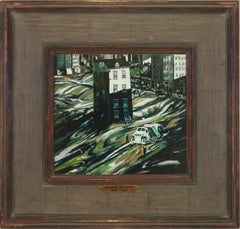
20th Century Industrial Cityscape Oil painting, Cleveland School Artist

20th Century Industrial Cityscape Oil painting, Cleveland School Artist

By Joseph O'Sickey

Located in Beachwood, OH

Work sold to benefit the CLEVELAND INSTITUTE OF ART Joseph B. O’Sickey (American, 1918–2013) Industrial Cityscape Oil on paper Signed lower left 13.75 x 16.5 inches Joseph O'Sicke...

Category

Late 20th Century Post-Impressionist Landscape Paintings

Materials

Oil

Thick Outside

Thick Outside

By Tod Lindenmuth

Located in Milford, NH

A fine Cape Cod scene with fisherman heading out on the dock in heavy fog by American artist Tod Lindenmuth (1885-1976). Lindenmuth was born in Allentown, Pennsylvania, and later worked in Provincetown and Rockport, Massachusetts, with a home in St. Augustine. A founder of the Provincetown Art Association and one of the original Provincetown Printers, Lindenmuth was a semi-abstract painter and graphic artist who did much to promote modernist styles and was well known for his modernist, semi-abstract and marine subject paintings. Lindenmuth studied with Robert Henri and was a member of the Salmagundi Club and the Rockport Art Association. He was also active in Provincetown until 1941, and then retired to Florida in the 1960s, having spent his winters there since the 1930s. Oil on canvas, signed lower right, title inscribed on verso Provincetown Art Association Regular Jury 1938 label “Thick Outside...

Category

1930s American Impressionist Landscape Paintings

Materials

Canvas, Oil