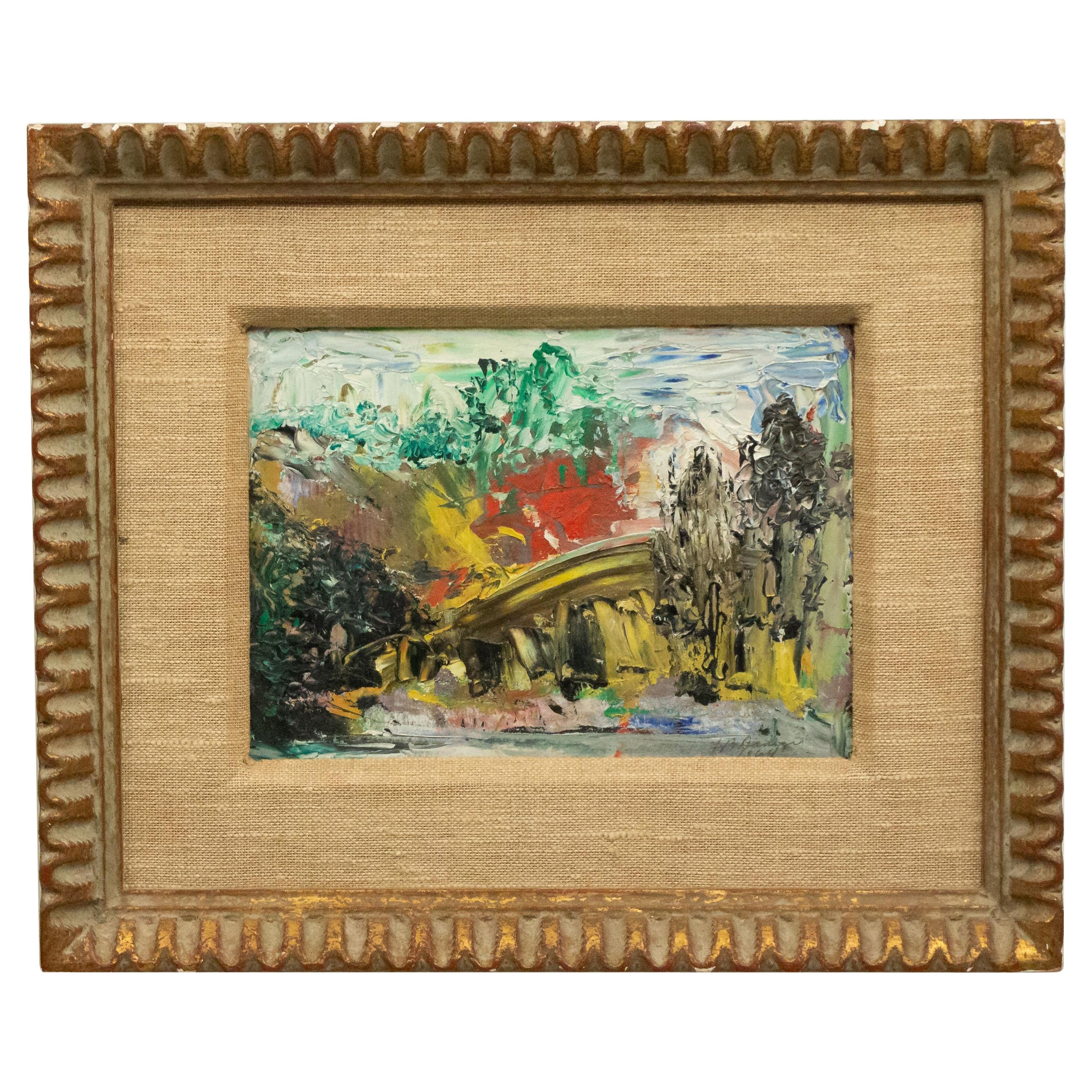
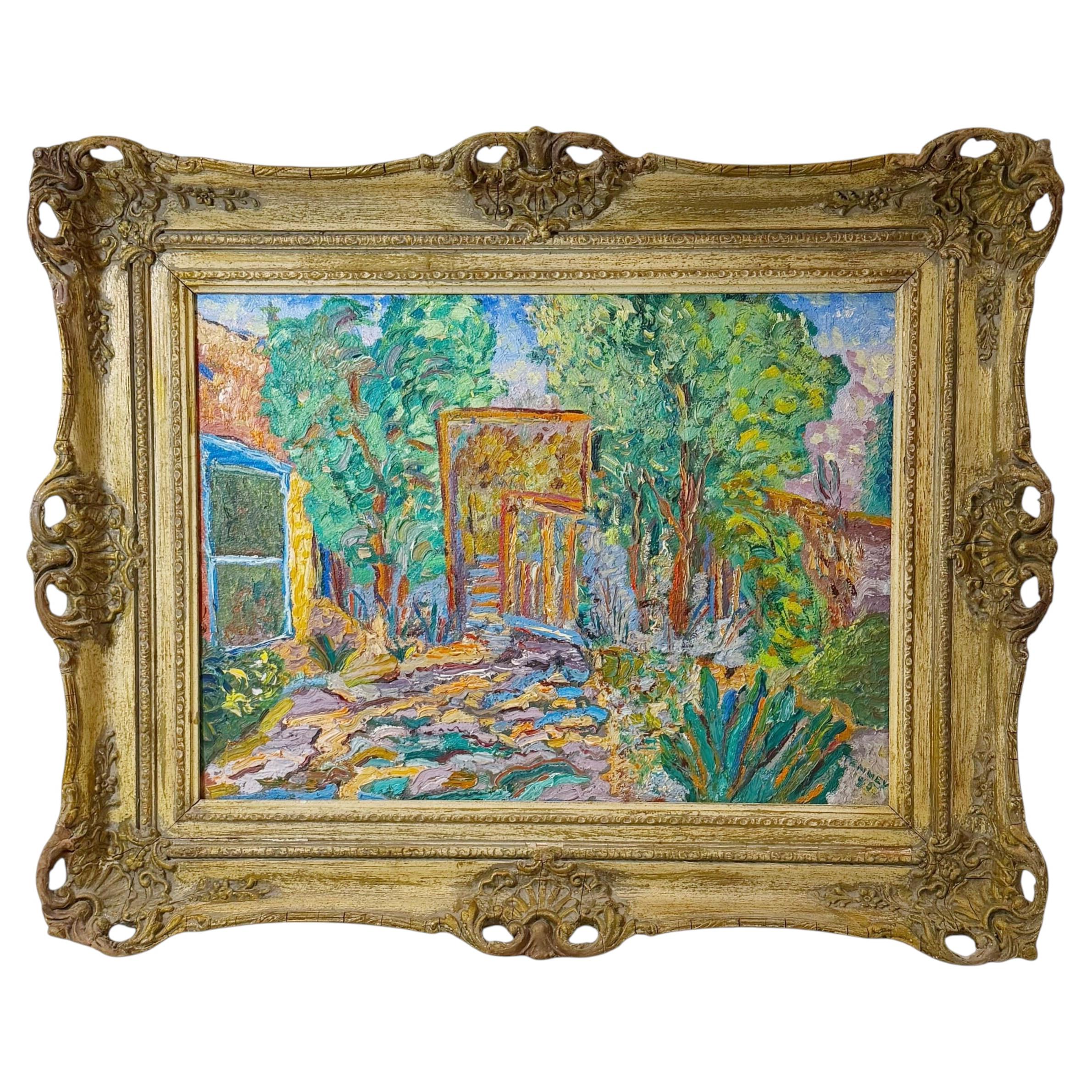
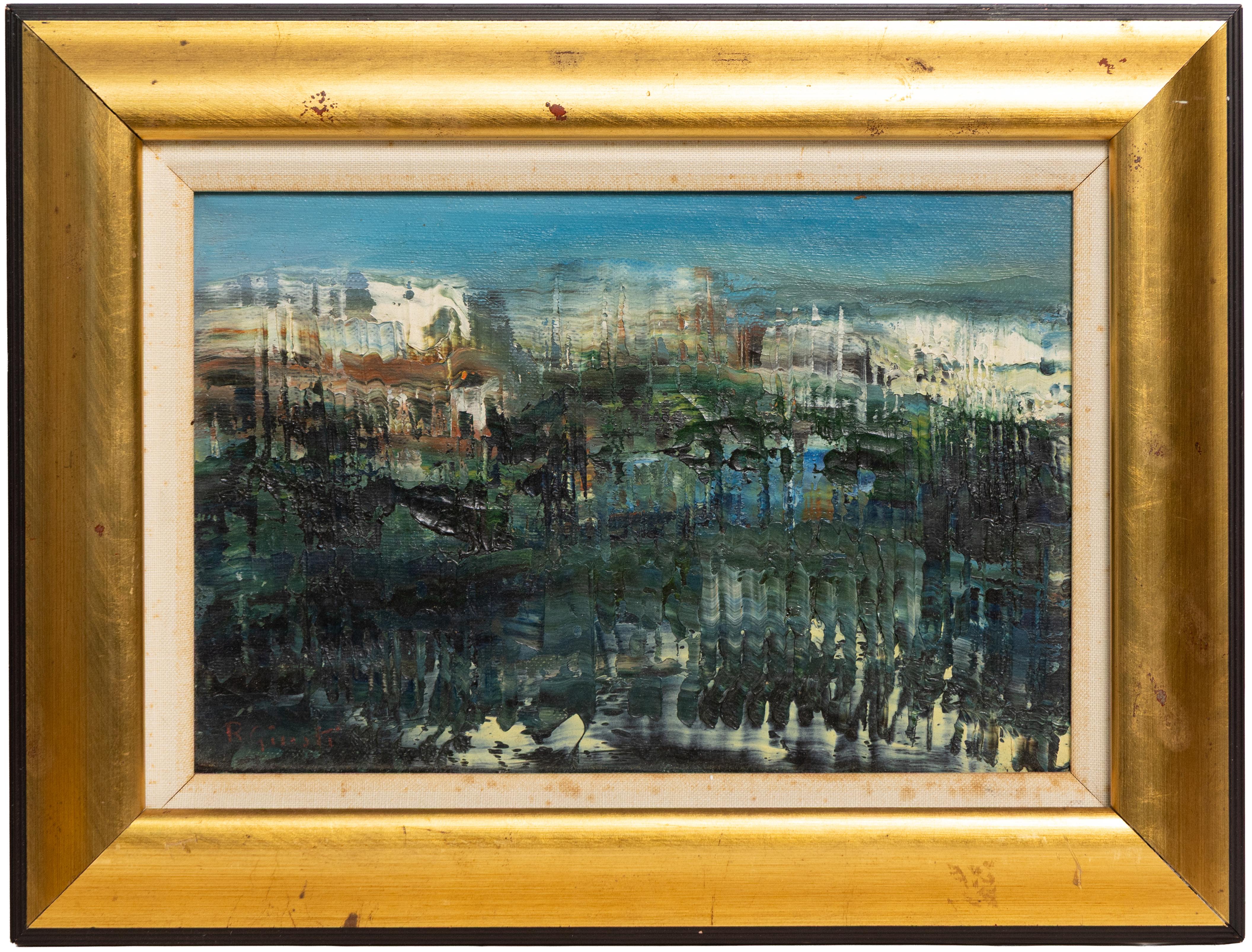
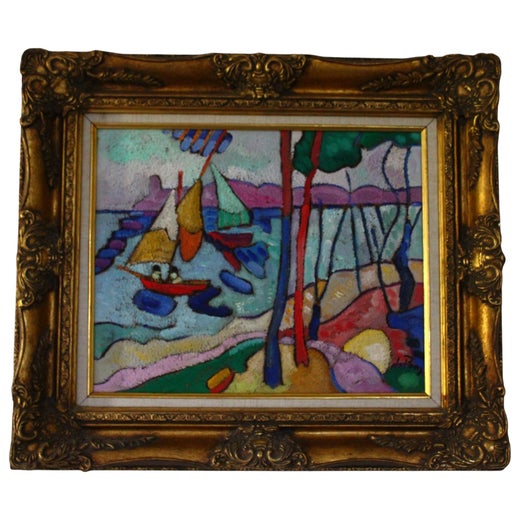
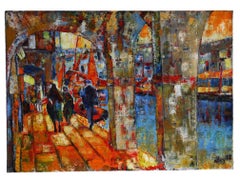
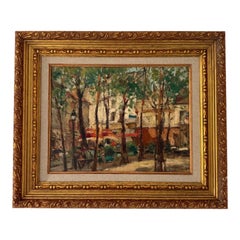
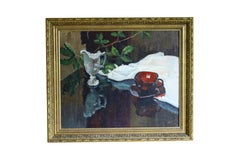
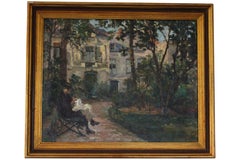
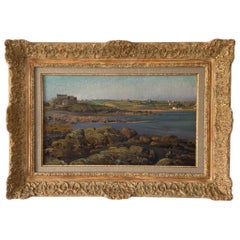
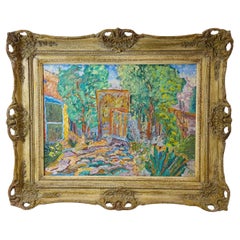
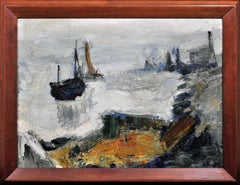
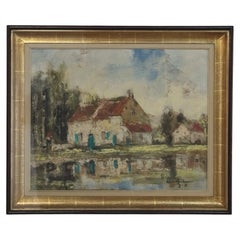
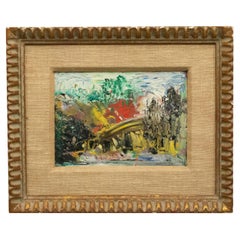
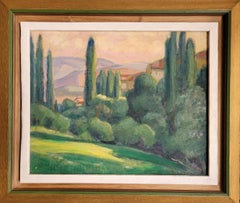
An exceptional mid-century modern abstract composition by French artist Jean Pons, signed in the lower right. This painting features a dynamic interplay of geometric forms, stylized figures, and vibrant color blocks, ranging from soft pastels to bold primary accents, all bound by strong, expressive outlines and a richly textured, impasto surface, a jewel of a painting.
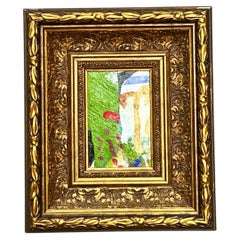
It is beautifully presented in an ornate, heavily carved gilt wood frame with a linen liner, offering a striking, sophisticated contrast between classical framing and avant-garde mid-century painting.
This piece perfectly bridges the gap between classic European elegance and modern abstraction. The juxtaposition of Jean Pon’s vibrant, graphic modernism against the ornate baroque-style gilt frame makes it an ideal statement piece for high-end modern interiors, eclectic galleries, or sophisticated residential spaces.
MORE ABOUT THIS PAINTING:
Medium: Oil Painting on Canvas
Size with frame: 23ins x 19.5ins or 58cms x 49.5cms
Date: 1960's
Condition: Very good vintage condition. The oil painting on canvas is well-preserved with vibrant coloration and intact, heavily textured impasto. The substantial gilt frame shows minor, age-appropriate wear and light patina, enhancing its authentic period charm.
Signed: Jean Pons (1913–2005), a highly influential French modernist painter, lithographer, and sculptor whose career spanned several major movements of the 20th-century École de Paris (School of Paris).
Born in Paris in 1913, Jean Pons grew up in the capital and received his formal art training at the prestigious École Estienne, where he studied the graphic arts and printmaking techniques that would later define a major pillar of his career.
In 1938, Pons founded a lithography studio in Paris. His exceptional skill as a master printer quickly turned the workshop into a vital crossroads for avant-garde artists. Throughout the 1940s and 1950s, his studio became a collaborative hub for key figures of the Nouvelle École de Paris. He printed works for and formed close personal friendships with legendary modernists, including: Nicolas de Staël, Serge Poliakoff,
Wassily Kandinsky, André Lanskoy and Sonia Delaunay
While running his successful workshop, Pons continuously developed a profound personal oeuvre as a painter. His artistic trajectory is characterized by striking stylistic shifts, earning him a reputation as a "peintre de ruptures" (a painter of breakthroughs).
His early works focused on still lifes, landscapes, and portraits rendered with intense, vivid colors and energetic brushwork, drawing inspiration from masters like Henri Matisse and Vincent van Gogh.
Driven by a "taste for risk," Pons transitioned into pure abstraction in the late 1940s. His abstract style was often highly structured, utilizing sharp lines, geometric angles, heavy impasto textures, mixed media, and collage elements.
In the late 1950s and 1960s, influenced by the Nouvelle Figuration movement, stylized human figures and graphic objects began reappearing in his work, heavily outlined and presented in bold, sometimes violent color blocks. This distinctive iconography evolved over the decades into highly personal series, such as his sponge- and spray-painted "Mitraillomachie" and his "Sonomachie" musical-themed works of the 1970s and 1980s.
In 1973, Pons passed the management of his Paris printing studio to his daughter, Babette, allowing him to move permanently to Eygalières in the South of France, where he dedicated himself entirely to painting until his death in 2005.
Over his long career, Jean Pons exhibited extensively across Europe and the United States, including major retrospectives at the Musée d'Art Moderne de la Ville de Paris (1984) and the Musée de l'Hospice Saint-Roch. Today, his work is highly regarded by collectors of mid-century European modernism for its bold graphic energy, rich surface textures, and fearless approach to color.