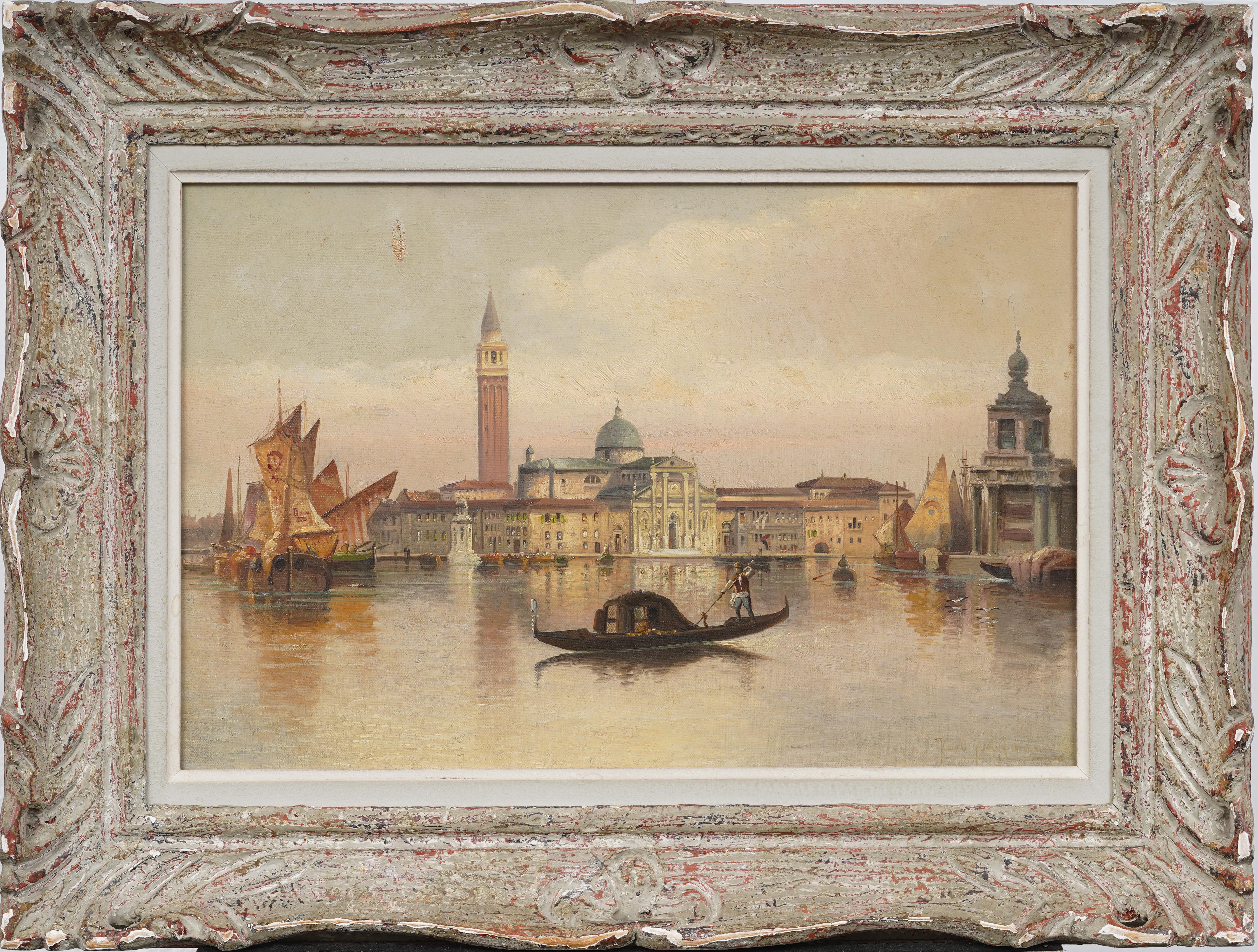
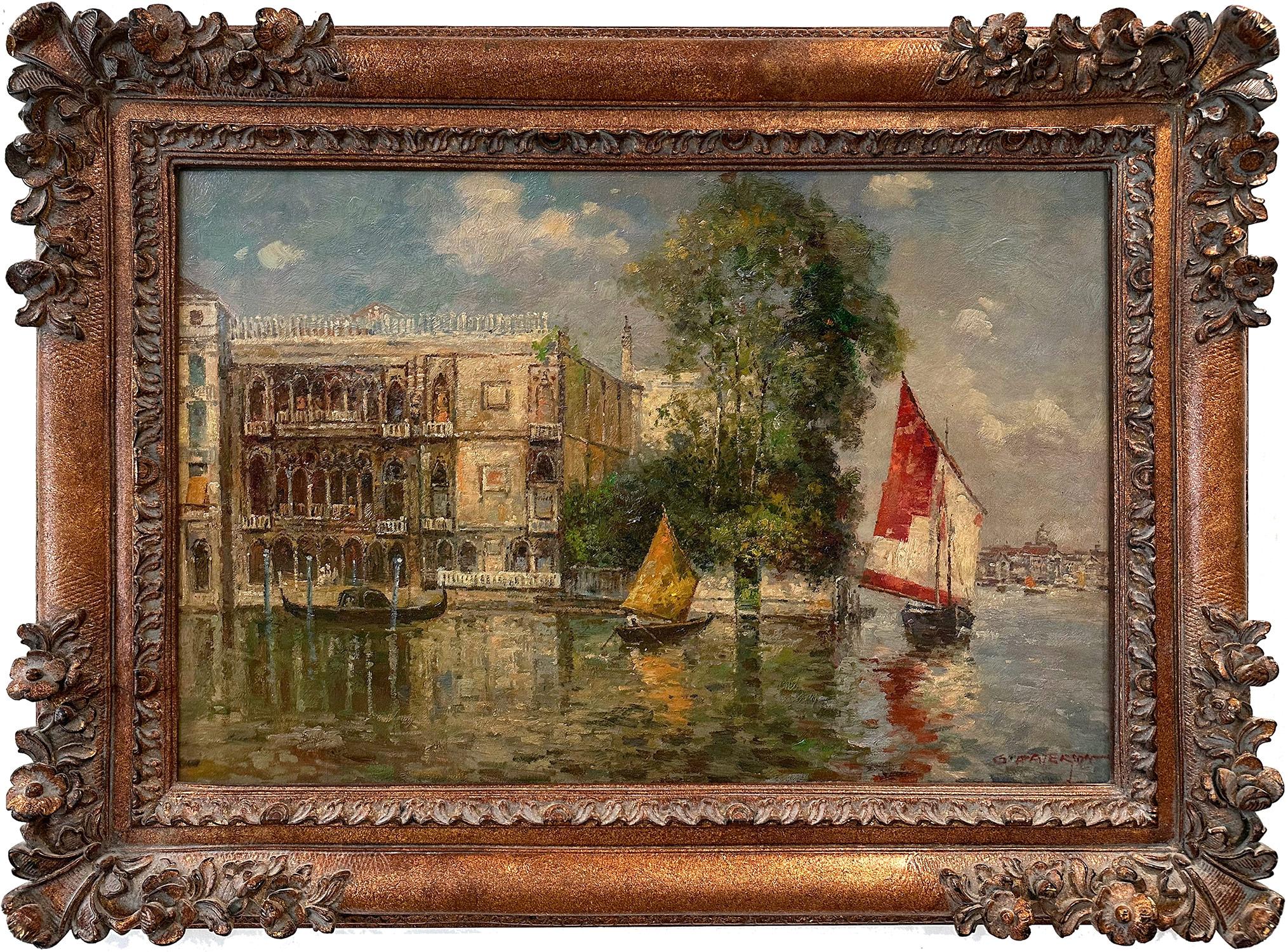
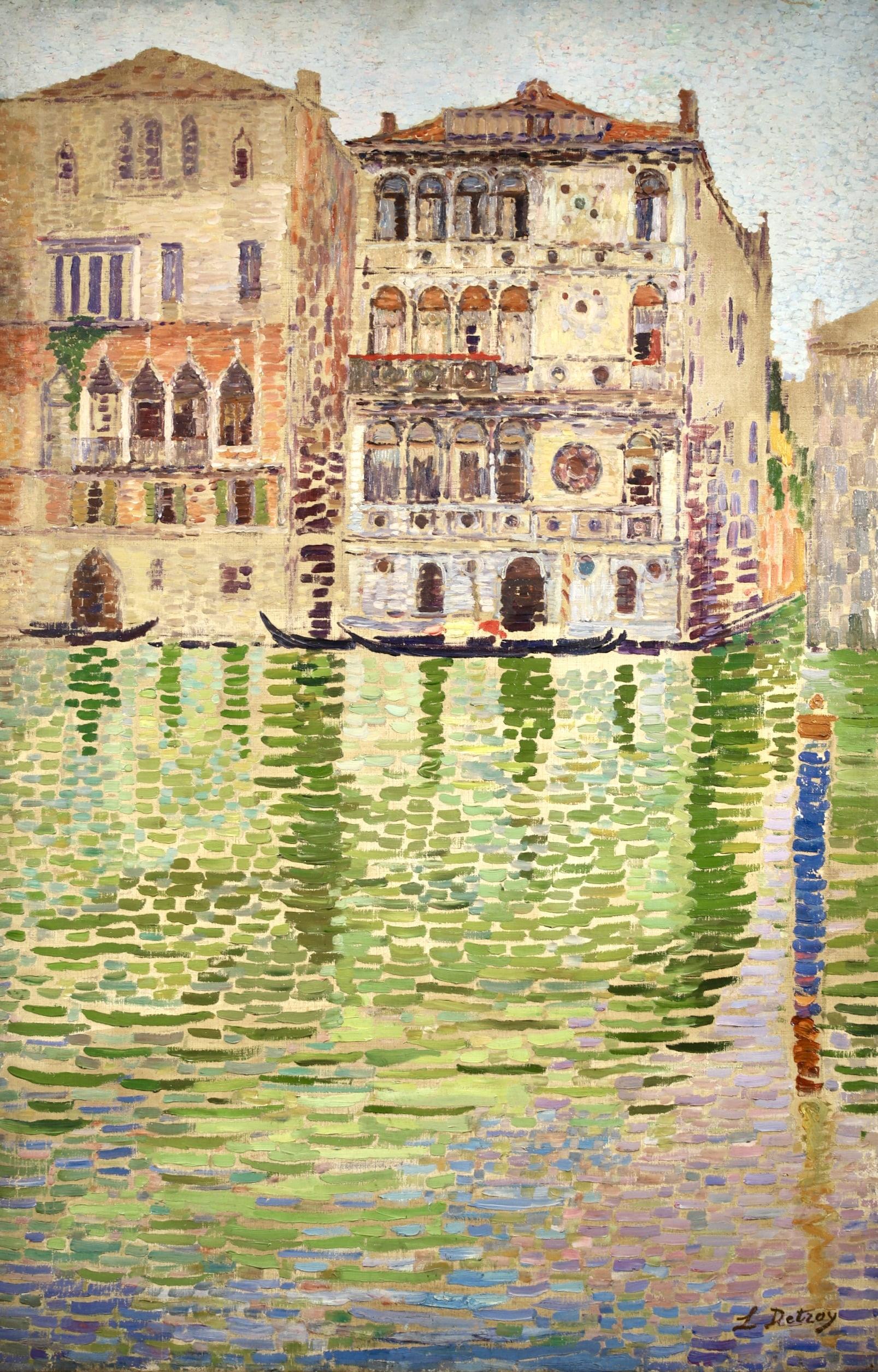
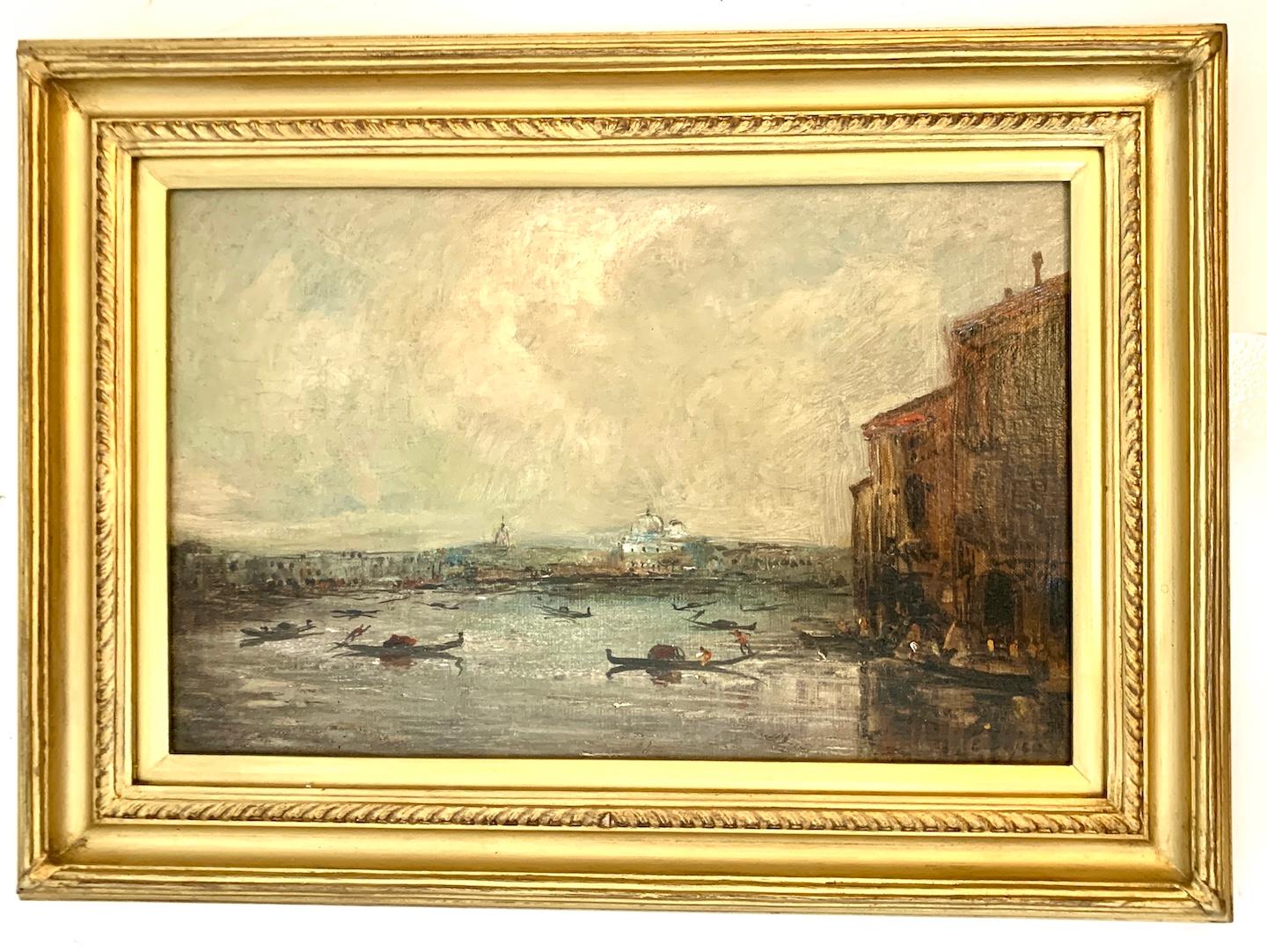
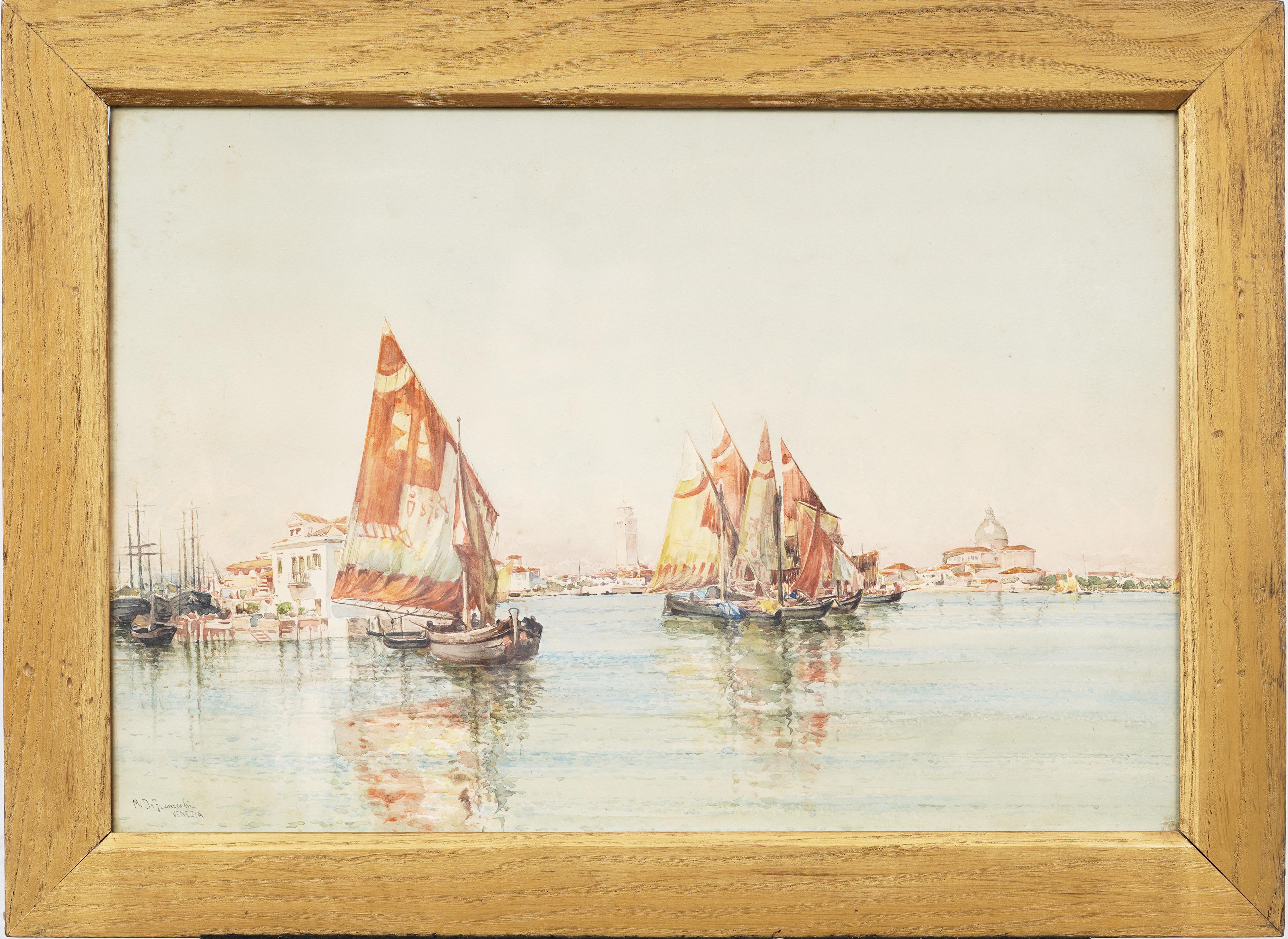
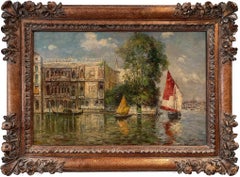
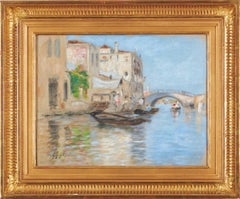
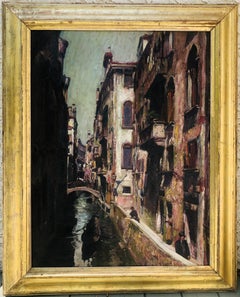
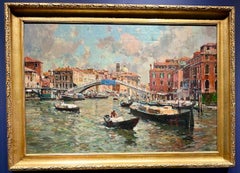
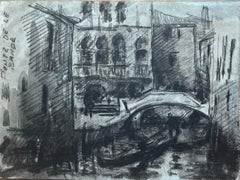
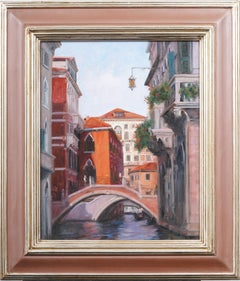
“Venice, 1889” by Louis Ritter (American, 1854-1892).
A fantastic example of Ritter’s renowned European watercolors. This beautifully poised composition captures the sun-washed façades, shuttered windows, and moored boats of the Venice canals. Ritter makes the scene feel alive through small human interactions. A figure leans from a window, another stands at the waterside, and a boatman in blue bends to his work at right. These small touches prevent the architecture from hardening into topography.
Ritter uses a serene palette of pale creams, grays, soft blues, and touches of warm brick red. The water carries the whole picture, breaking the stillness of the masonry into a fluttering surface of color and movement.
This work is watercolor on paper and is signed and dated in the lower left. It is beautifully framed behind glass and retains a label from Jensen Fine Arts on the verso.
Size:
10.25 inches tall by 13.75 inches wide (painting)
18 inches tall by 21.5 inches wide by 1.5 inches deep (frame)
Provenance:
Jensen Fine Arts, MA;
Private collection, CT;
Acquired from the above
About the artist:
Louis Ritter’s landscape paintings of scenes in Europe and on the New England coast demonstrate the influence of new trends in European art that were just beginning to infiltrate American painting in the 1870s and 1880s. Born in Cincinnati, he studied at the McMicken School of Design in 1873–74. In 1878 he went to Munich, Germany, like many of his fellow compatriots, to enroll in the prestigious Royal Academy of Munich, where he won a silver medal in drawing. Ritter studied with influential American painter and teacher Frank Duveneck, a native of the Cincinnati area. As a member of the “Duveneck Boys,” actually a mixed group of American art students, Ritter visited Florence, Italy, along with Theodore Wendel. Returning to Cincinnati around 1881, he organized an exhibition of artwork he and fellow students had completed abroad. Discouraged by the show’s poor reception by local critics, in 1883 Ritter moved to Boston, where he shared a studio with Wendel.
Ritter began teaching in Boston and at nearby Wellesley College. He became friends with John Leslie Breck and may also have met Willard L. Metcalf before traveling to France in 1886. The following year he showed a portrait in the prestigious Paris Salon exhibition. That summer, in the company of Metcalf, Wendel, Breck, and others, Ritter spent several months in Giverny, a rural village some ninety kilometers from Paris that soon would become an important artists’ colony. He shared a house in Giverny with Breck and Breck’s mother and brother for the summer. Ritter may have returned to France again in 1891, the year he was represented in the progressive Champs de Mars exhibition in Paris. He also exhibited in New York, Philadelphia, and his native Cincinnati, as well as in Boston. Ritter died of liver cancer in 1892 at the age of thirty-seven. The catalogue for the extensive memorial exhibition at Boston’s St. Botolph Club held shortly after his death indicates that he worked in watercolor and in pastel as well as oils, and that he made still lifes and portraits as well as landscapes.
Condition: Excellent overall condition. Typical minor surface wear commensurate with age and handling. Frame with wear and minor touch up commensurate with handling. It is ready to be displayed and enjoyed!