Want more images or videos?
Request additional images or videos from the seller
1 of 11

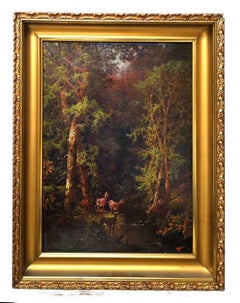
Maxfield Parrish
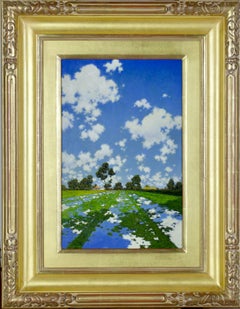
Cascades (Quiet Solitude)

1959

$1,650,000
£1,248,284.47
€1,458,847.96
CA$2,361,501.45
A$2,399,486.76
CHF 1,359,365.83
MX$29,195,842.50
NOK 15,939,861.30
SEK 16,026,704.10
DKK 10,913,026.41

About the Item

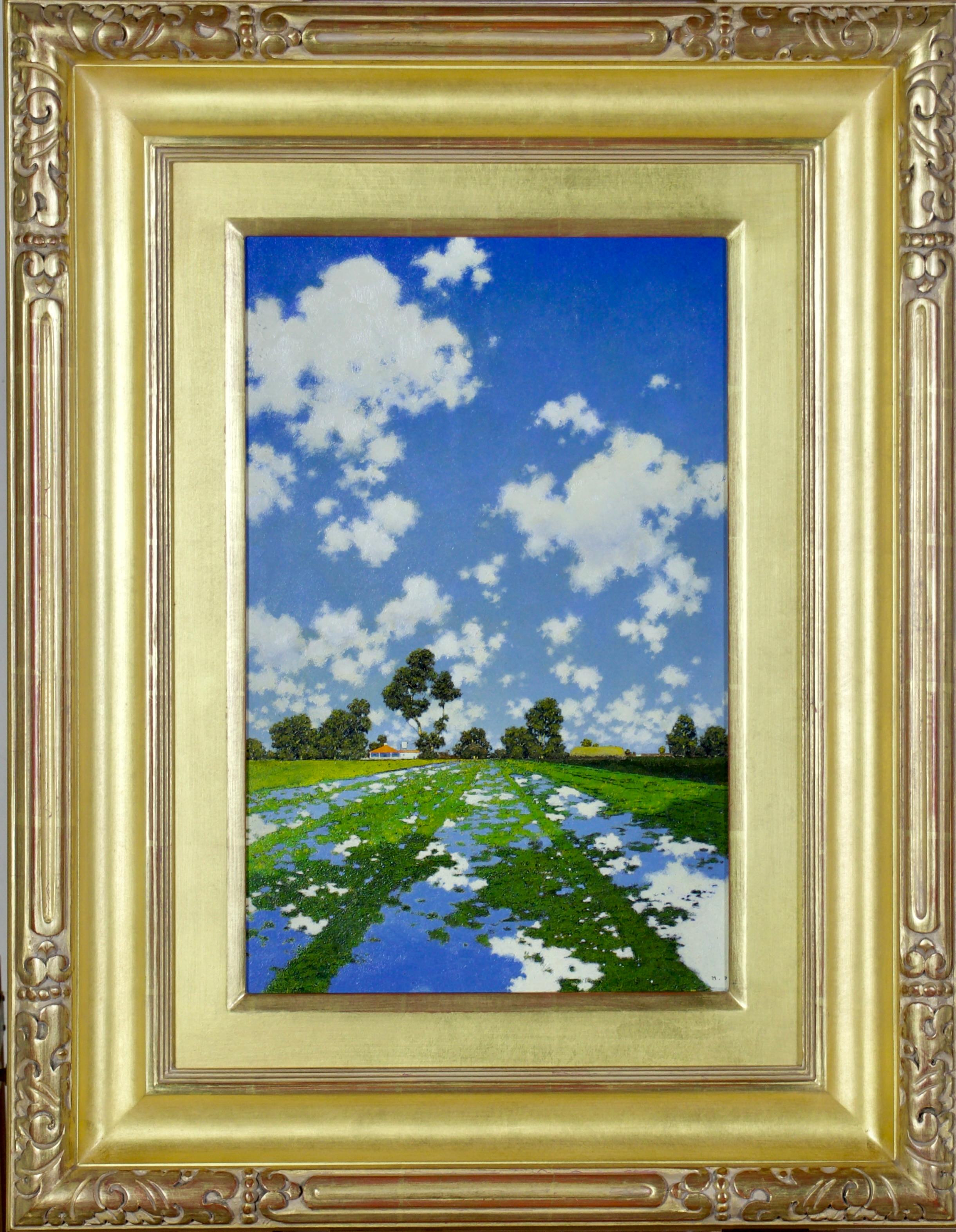
In 1930, Maxfield Parrish turned his attention to painting landscapes exclusively. Cascades is a fine example of the style that defined his late career. The composition features a fantastical rocky glen flanked by two massive trees with shimmering water in the foreground. It was published in 1962 by Brown and Bigelow, a calendar company based in Minnesota, under the title Quiet Solitude. Parrish had entered into his partnership with the company in 1936, following his final calendar project for General Electric, under the condition that he would be free to paint landscapes. The meticulously rendered scene demonstrates Parrish’s extraordinary gifts as a colorist. His signature technique of layering thin colored glazes over a white ground gives the surface its characteristic luminosity, creating the impression that light is shining through the pigment. Parrish captures the delicate balance of light and shadows through a rich palette of deep forest green and cobalt blue, punctuated by areas of orange and aquamarine, and anchored by the warm browns of the tree trunks and rocky crags. The result is a scene of quiet radiance. This command of color owed much to two formative trips: first to Arizona in 1901, where the dramatic light of the Southwest made a lasting impression, and then to Italy in 1903, where he carefully studied the subtler, earthier tones of the Mediterranean landscape. Parrish believed that a great landscape painting should transport its viewer completely: “those qualities which delight us in nature—the sense of freedom, pure air and light, the magic of distance, and the saturated beauty of color, must be convincingly stated and take the beholder to the very spot.” (Coy Ludwig, Maxfield Parrish, New York, 1973, p. 175.) Cascades also reflects Parrish’s deliberate move toward a smaller format in his later years. Having worked predominantly at 30 x 24 inches in the early 1930s, he settled into the 22 1/2 by 18 inch format, a scale that suited the jewel-like precision of his mature landscapes, lending their intricately detailed subjects more intimacy. EXHIBITED Chadds Ford, Pennsylvania, Brandywine River Museum, Maxfield Parrish:Master of Make-Believe, 1974,no. 61, p. 33 (titled Quiet Solitude) LITERATURE Coy Ludwig, Maxfield Parrish, New York, 1973, no. 847, p. 185, illustrated and p. 214 (titled Quiet Solitude and dated 1962) Year: 1959 Dimensions: 23" x 18.5" Medium: Oil on panel Signature: Signed ‘lower right’ and signed, titled and date on the reverse
  • Creator:
    Maxfield Parrish (1870-1966, American)
  • Creation Year:
    1959
  • Dimensions:
    Height: 23 in (58.42 cm)Width: 18.5 in (46.99 cm)Depth: 2 in (5.08 cm)
  • Medium:
  • Period:
  • Condition:
  • Gallery Location:
    Fort Washington, PA
  • Reference Number:
    Seller: 48721stDibs: LU384318087172

More From This Seller

View All
The Rawhide Part III

The Rawhide Part III

By Maxfield Parrish

Located in Fort Washington, PA

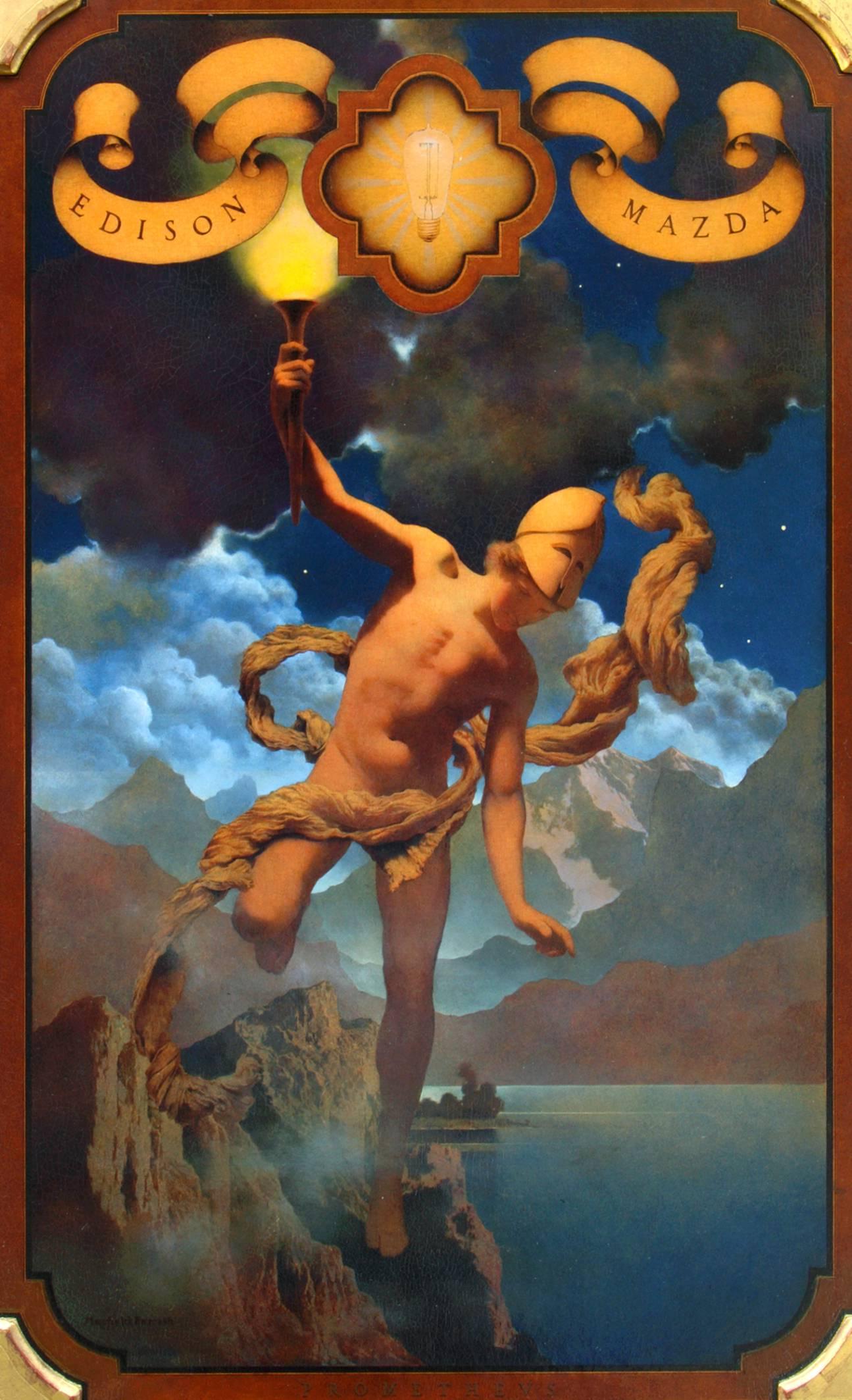
Artwork Dimensions: 16.00" x 12.125" Frame Dimensions: 22.5" x 18.75" Medium: Oil on Paper Mounted to Board Signature: Signed Lower Right, Signed Again and Dated August of 1904 on Reverse The Rawhide Part III, 'He swung himself into the saddle and rode away.' Signed with initials M·P...

Category

Early 1900s Landscape Paintings

Materials

Paper, Oil, Board

Prometheus

Prometheus

By Maxfield Parrish

Located in Fort Washington, PA

Medium: Oil on Panel Sight Size 31.00" x 21.25", Framed 36.00" x 22.00" Signature: Signed Lower Left Maxfield Parrish began his career at age 25 as an illustrator, painting magazin...

Category

1910s Figurative Paintings

Materials

Oil, Panel

The Oaks

The Oaks

By Maxfield Parrish

Located in Fort Washington, PA

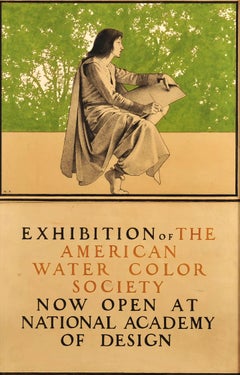
Medium: Mixed Media on Board Sight Size 21.50" x 14.50", Framed 26.00" x 19.00" Signature: Signed Lower Left Illustration for the "Exhibition of the American Water Color Society."

Category

1890s Mixed Media

Materials

Mixed Media, Board

Water Let in on a Field of Alfalfa

Water Let in on a Field of Alfalfa

By Maxfield Parrish

Located in Fort Washington, PA

Signed with initials M.P. (lower right); inscribed Article III. "Irrigation" water let in on a field of alfalfa (in the lower margin) Written on back "February of 1902. Hot Springs,...

Category

Early 1900s Figurative Paintings

Materials

Oil

Water Let in on a Field of Alfalfa

Water Let in on a Field of Alfalfa

By Maxfield Parrish

Located in Fort Washington, PA

Signed with initials M.P. (lower right); inscribed Article III. "Irrigation" water let in on a field of alfalfa (in the lower margin) Written on back "February of 1902. Hot Springs,...

Category

Early 1900s Figurative Paintings

Materials

Oil

A Dark Futurist

A Dark Futurist

By Maxfield Parrish

Located in Fort Washington, PA

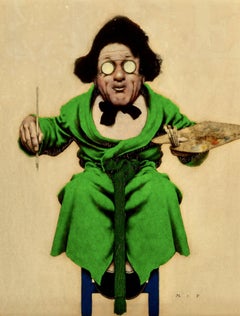
Medium: Oil on Paper Laid on Panel Signature: Signed Lower Right Initialed lower right: M.P. Signed on the reverse: Maxfield Parish Initialed and numbered by the artist's son on the reverse: M.P. Jr. / No. 68. When Maxfield Parrish painted the comical A Dark Futurist in 1923 for Life magazine, he had already established himself as America's leading book and magazine illustrator. His early artwork for children's classics like L. Frank Baum's Mother Goose in Prose (1897), Kenneth Grahame's Dream Days (1900), and Eugene Field's Poems of Childhood (1904) popularized his signature atmospheric settings, cobalt blue-and-gold palette, and dreamy figures inhabiting magical worlds. Likewise, his covers for Century, Collier's, Harper's Bazaar, Ladies' Home Journal, Life, and Scribner's Magazine were highly desirous and instantly recognizable, often more stylized than his book imagery; no other journal illustrator could match Parrish's winning combination of precise draftsmanship, strong graphic design, and amusing characters. According to David Apatoff, Art Critic, The Saturday Evening Post, "Parrish abandoned his customary heavy details and rainbow colors to present a bolder, more high-contrast design silhouetted against a stark white background - a treatment more suitable for a modern magazine cover vying for attention on a crowded newsstand. A Dark Futurist is silhouetted against a white field with no background or details to prop it up. The composition is carefully centered with only differences in the hands and the artist's necktie to break the symmetry. These are crucial to the success of the design. Just as important as Parrish's clean, high-contrast style in these pictures is the refreshing humor and sophistication in content, which is usually absent from Parrish's fairytale paintings. A Dark Futurist shows us a different kind of modernism. Parrish steps out of his timeless fairy tales to tweak one of the most incendiary artistic movements of his day. Futurism, with its militant manifesto and its outspoken artists, was all the rage in Europe. Parrish pokes them, showing a "dark" and anxious futurist with pursed lips and thick glasses, poised to paint but not exactly sure of, or optimistic about, what the 'future' will hold. This suggests that Parrish was alert to, and had opinions about, current events of the day - something one might never guess from his usual subject matter." In his early Collier's illustrations, Parrish also developed memorable themes that he would return to in his 1920s magazine work. One of his most popular characters was the "seer," or man with keen visual powers, most often depicted as an artist, but also appearing as a tourist, scientist, and philosopher. Parrish's seer was recognizable by particular physical attributes: round glasses, indicating his visual and analytical acuity, and an overcoat and/or hat signifying his role as observer of the outside world. A Man of Letters, sold last year at Heritage Auctions, was one of the first Life covers Parrish rolled out for Gibson, and he repeated the character of the artist-seer, emphasizing the comic spin, for two later editions: A Dark Futurist (Life, March 1, 1923) captures a Parrish-like artist in foggy round glasses and a long green coat...

Category

1920s Figurative Paintings

Materials

Paper, Oil, Panel

You May Also Like

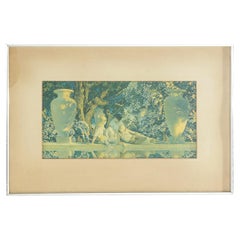
Art Deco Maxfield Parrish Print “Garden Of Allah” C1920

Art Deco Maxfield Parrish Print “Garden Of Allah” C1920

Located in Big Flats, NY

This is a vintage Art Deco print titled 'Garden Of Allah' by renowned American artist Maxfield Parrish, created around 1920. Known for his distinctive use of color and romanticized n...

Category

Early 20th Century Prints

Materials

Paper

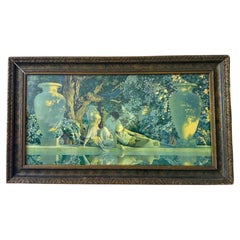
Maxfield Parrish “Garden of Allah” Crane Lithograph 1918

Maxfield Parrish “Garden of Allah” Crane Lithograph 1918

By Maxfield Parrish

Located in Van Nuys, CA

Original 1918 Maxfield Parrish "Garden of Allah" early lithograph published by C.A. Crane Co. in Cleveland. The print is presented in its original Mission-style hardwood frame. Signe...

Category

Vintage 1910s American Prints

Materials

Paper

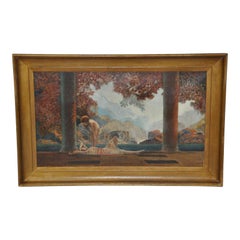
Modern Maxfield Parrish Framed Print "Daybreak"

Modern Maxfield Parrish Framed Print "Daybreak"

Located in Van Nuys, CA

Modern "Daybreak" artwork printed under glass, features a serene scene with a reclining woman and a standing girl set against rolling hills, a tranquil body of water, and classical a...

Category

Vintage 1980s American Decorative Art

Materials

Paper

Woodland Tranquility

Woodland Tranquility

Located in Saratoga Springs, NY

Henry Walcott Boss (American, 1820-1916) Woodland Tranquility Oil on canvas, signed “Boss” lower right & dated 1896 In Woodland Tranquility, Henry Walcott Boss offers a masterfully ...

Category

1890s Hudson River School Landscape Paintings

Materials

Canvas, Oil