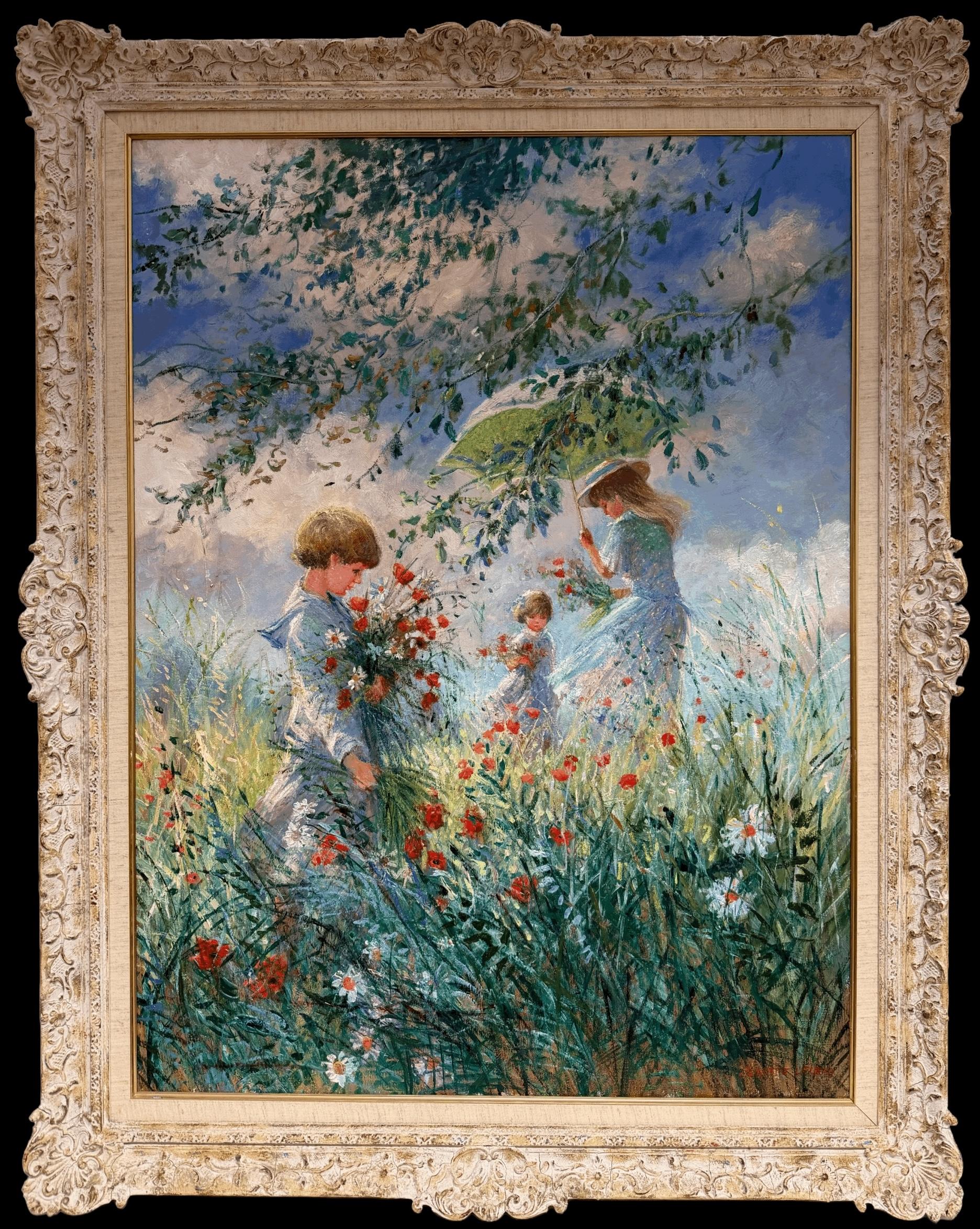
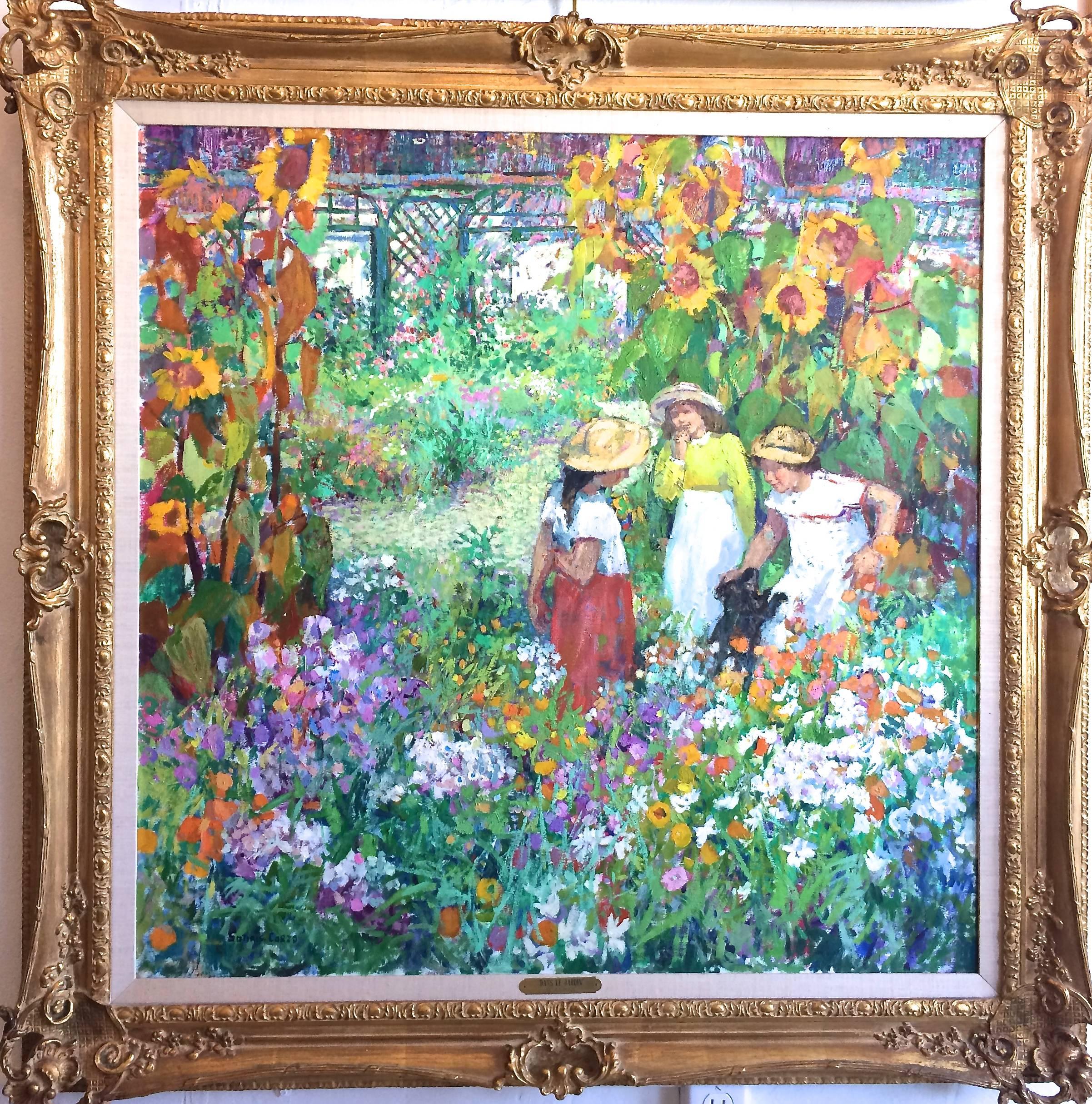
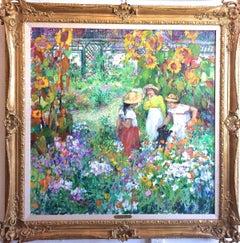
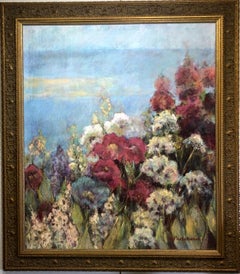
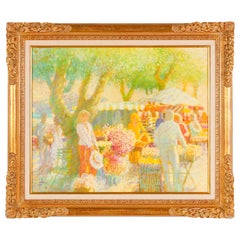
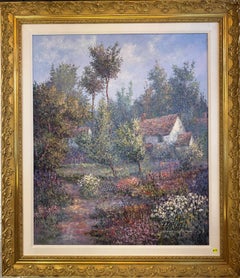
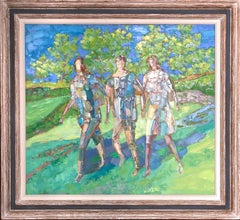
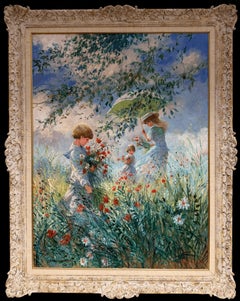
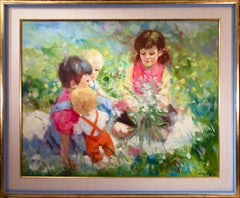
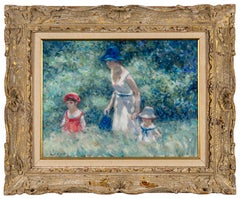
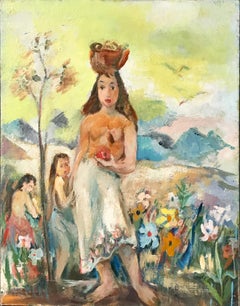
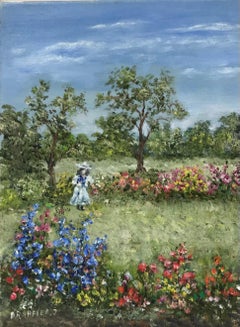
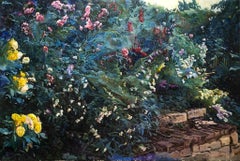
Flower garden with children.
Ramon Chirinos Venezuelan was born in 1950.
Painter and draftsman. He studied drawing and painting with Professor Andrés Guzmán. In the mid-seventies, he obtained the title of professor of physics at the Pedagogical Institute of Barquisimeto, a profession he held for a time until he decided to dedicate himself completely to art. In its beginnings, its pictorial theme shows a deep interest in landscaping and traditional scenes such as cockfights, processions of the Divina Pastora, and free markets. At the beginning of the eighties, he turned to an ecological type of painting in which he protested the contamination of natural places such as the Turbio Valley. His painting begins to become less narrative and more chromatic until it becomes eminently abstract and very bright colors in the nineties. It shows a figurative and abstract domain while making his work transmit a playful message, eminently plastic, symbolic, where the human reminiscences of his childhood have a just value. "In recent times, Chirinos has struggled to realize an art where the abstract, the violent, the stain, the machismo are amalgamated, with their own strength and the figurative, with the presence of the figurative, changed or invisible, but inescapable. The artist has achieved the vein that he has been searching for The searches and encounters are oriented towards the childhood, primal, primogenite, possibly experienced, lived by the artist, between Churuguara, Carora, Barquisimeto and other mundane sites. de Chirinos brings us closer to that world of dreams, of fantasies, of remembrances, from the informal pictorial material, from the violent stroke, from the college and the color, which in its case lends itself to place the message with force, with excellence, where it basically combines blues, whites, brick colors, strong purple, bermellas, yellows, certain points like looks or memories of images "(Aranguren, 1992). He has participated in collective exhibitions inside and outside of Venezuela such as the "Exhibition of Larenses painters" (UNA, Barquisimeto, 1973), "Second Larense painting festival, Homage to Rafael Monasterios" (Pro-Venezuela, Caracas, 1981), "Yacambú Dreams and water "(traveling exhibition in Caracas, Barquisimeto, Guanare and San Felipe, 1985), I Annual Salon of Novel Artists (Seguros Carabobo, Valencia, Edo. Carabobo, 1990)," Lawrence contemporary painting "(Venezuelan Center of Culture, Bogotá, 1991), XVIII Salón Aragua (Macma, 1993), "Three Visions, One Reality" (Paulina Riel Off Gallery, New York, 1994), "Latin American Art" (Los Toldos Gallery, Monterrey, Mexico, 1995), X Cementos Caribe Room (Museo de Arte de Coro, 1997), "Expressions of the millennium" (Ateneo de Barquisimeto, 2000) and "Three painters, three styles, three friends" (Sala de Arte Villalón, Fundasab, Barquisimeto, 2001).