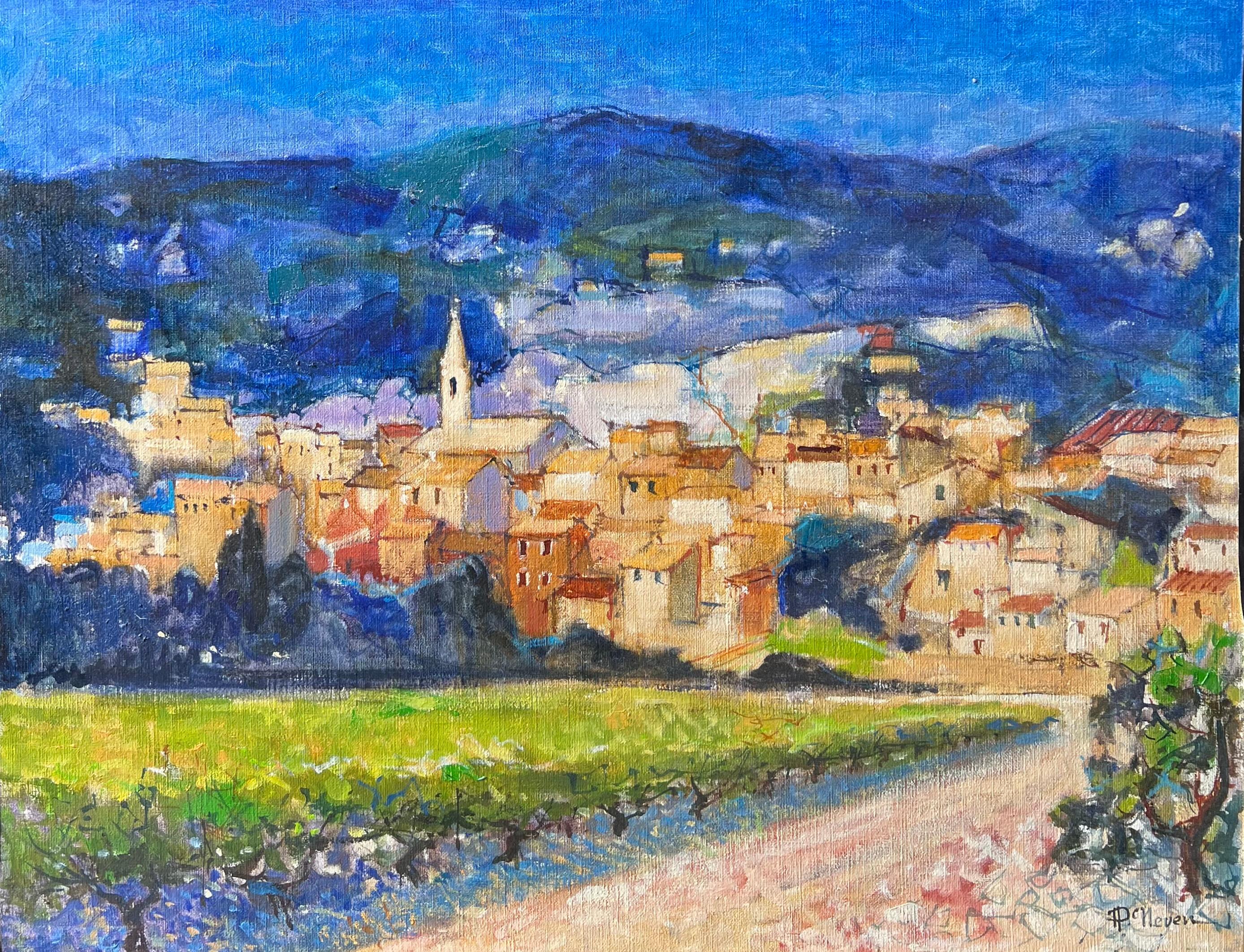
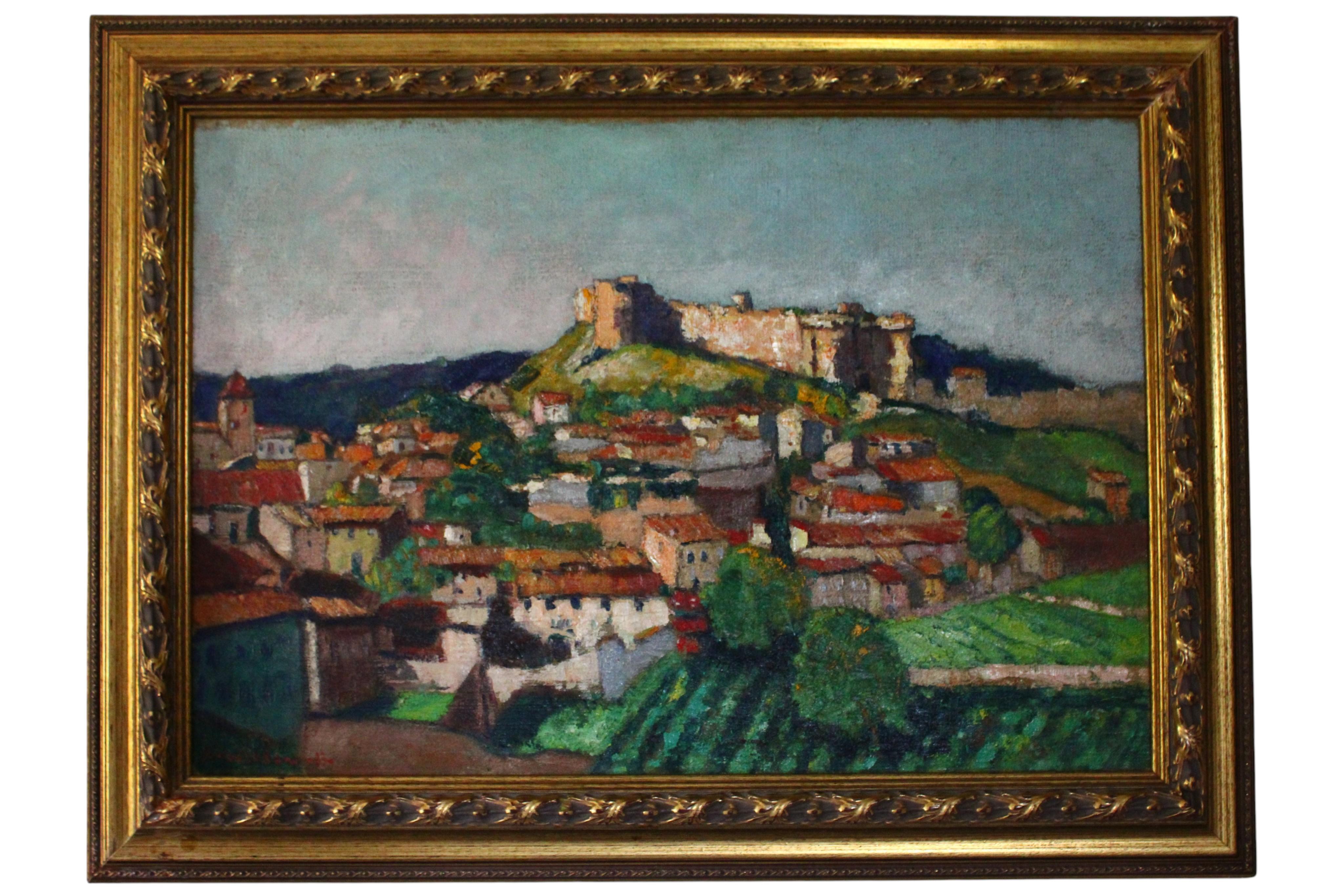
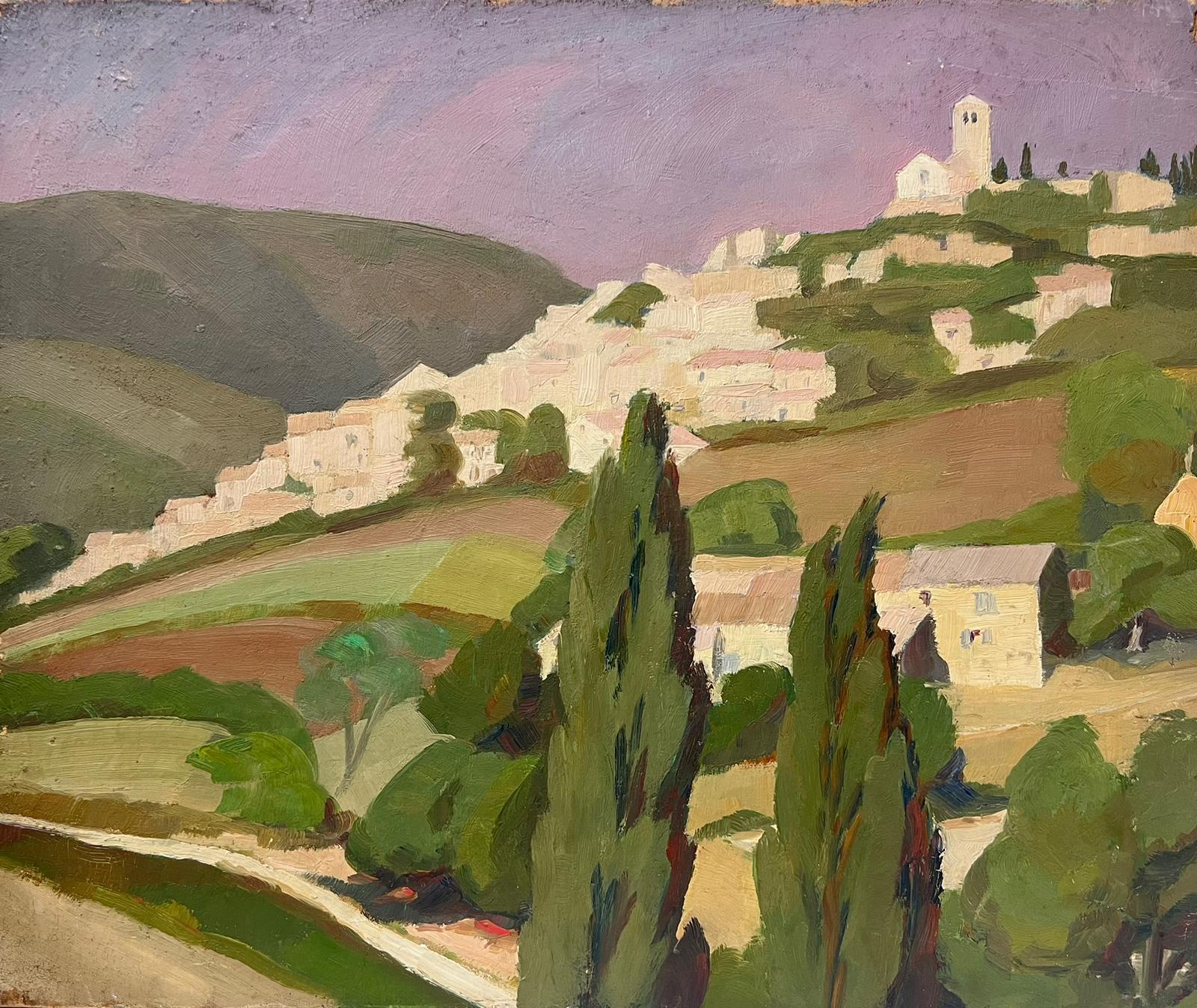
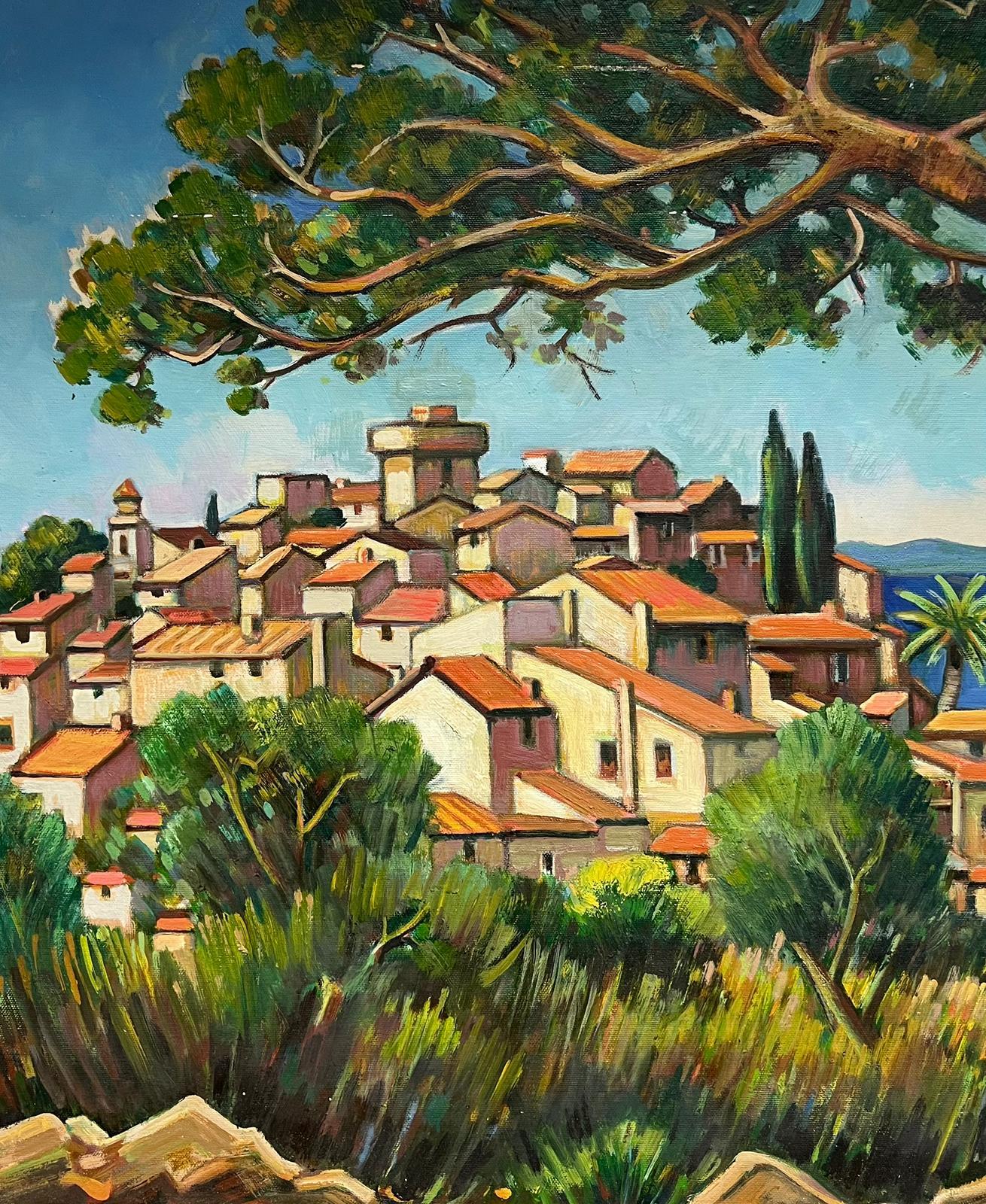
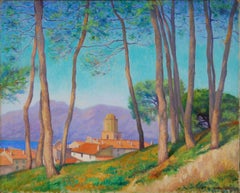
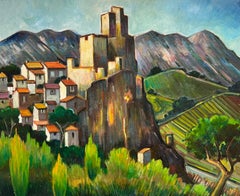
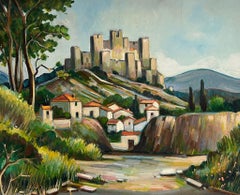
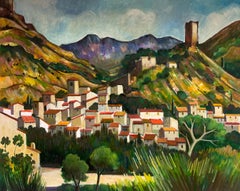
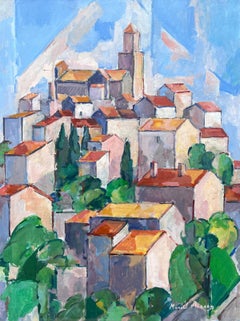
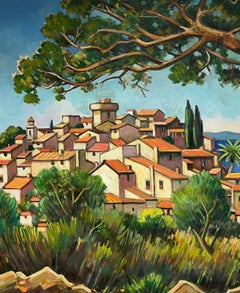
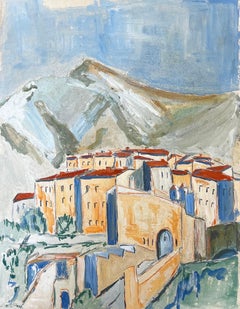
The town of Eze (French Riviera)
Oil on canvas, 1928
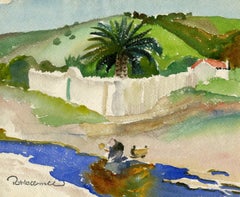
Signed and dated lower right (see photo)
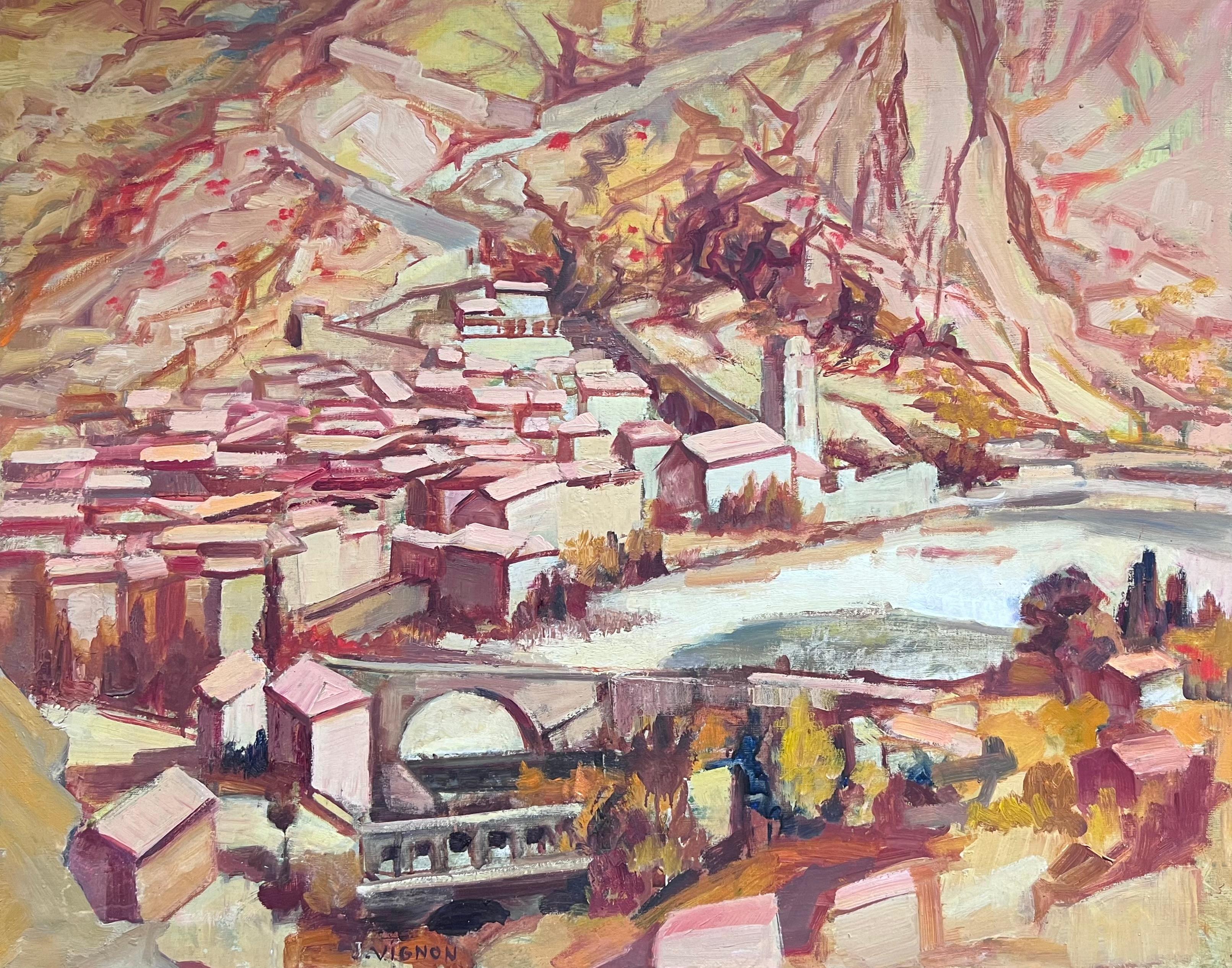
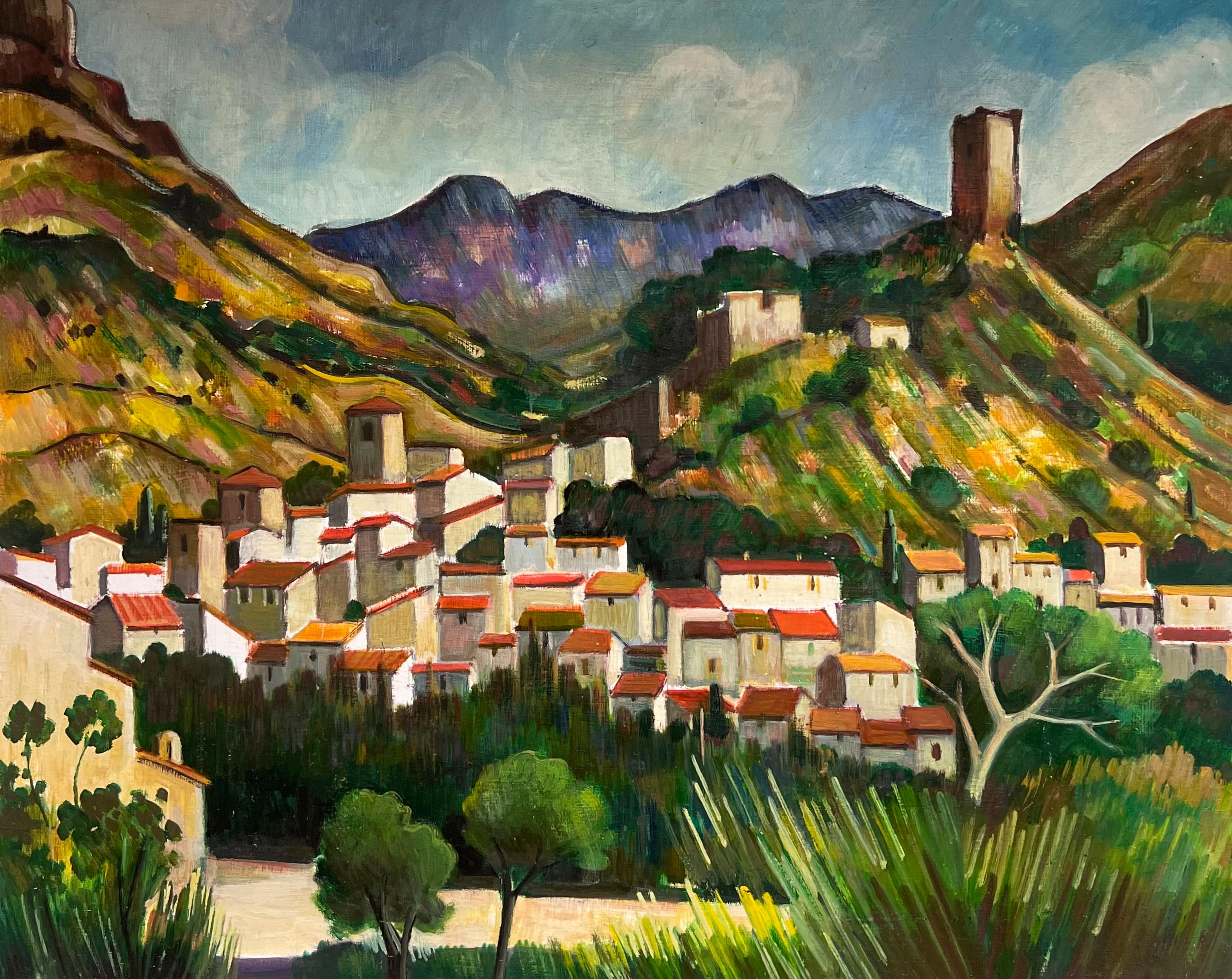
Depicts the Medieval village of Eze, located on the Riviera in the Alpes-Maritimes
Condition: Excellent
Canvas size: 21 x 29 inches
Does not come with a frame
Provenance: Estate of the Artist
Marbella Gallery Inc., NYC
Fred Thayler Cohen
The area surrounding Èze was first populated around 2000 BC as a commune situated near Mount Bastide. The earliest occurrence of the name "Èze" can be found in the maritime books of Antonin as a bay called the St. Laurent of Èze. A hoard of ancient Greek silver phialae dating from the 3rd century BC was found in Èze in the late nineteenth century and is now part of the British Museum's collection. The area was subsequently occupied by not only the Romans but also the Moors, who held the area for approximately 80 years until they were driven out by William of Provence in 973.
By 1388 Èze fell under the jurisdiction of the House of Savoy, who built up the town as a fortified stronghold because of its proximity to Nice. The history of Èze became turbulent several times in the next few centuries as French and Turkish troops seized the village under orders from Hayreddin Barbarossa in 1543, and Louis XIV destroyed the walls surrounding the city in 1706 in the war of the Spanish succession. Finally in April 1860, Èze was designated as part of France by unanimous decision by the people of Èze.
Èze has been described as an “eagle's nest” because of its location overlooking a high cliff 427 metres (1,401 ft) above sea level on the French Mediterranean. It is so high that the light ochre church within (Notre Dame de l’Assomption built in 1764) can be seen from afar. An Egyptian cross inside the church suggests the village's ancient roots, when the Phoenicians erected a temple there to honour the goddess Isis.
Traditionally, the territory of the Principality of Monaco was considered to begin in the Èze village (outskirts of Nice), running along the Mediterranean coast to Menton, on the present Italian border.
Courtesy Wikipedia
“There is in Mr. Hallowell’s work a grace that amounts to graciousness.”
Leo Stein (1872-1949)
Robert Hallowell (1886-1939) was highly regarded as an artist exhibiting at the finest galleries and museums in American and France in the 1920’s and 1930’s. His other professional life included graduating from Phillips Academy, Andover and Harvard University. While at Harvard he was president of the Harvard Lampoon (1909-1910) and was a founding member of the now famous New Republic Magazine with Walter Lippman and Herbert Croly. Robert worked there as business manager and publisher from 1914 to 1925, when he left to concentrate on his artistic creativity. Hallowell was an official for the Treasury Department during World War One. His final Government posting was as Assistant Director of the Federal Arts Project in 1935-36. How can someone of such cultural involvement have fallen to total obscurity today?
All the works came from Mildred Thaler Cohen (1921-2012), a noted New York collector and gallerist. Along with her first husband, they started collecting American paintings in the 1950’s when they were out of public favor. Upon the death of her husband, she opened the Marbella Gallery on 72nd Street in Manhattan establishing the reputation of being a connoisseur/dealer. The offerings were displayed in her gallery and home salon style.. When and how the Thaler’s acquired the works remain a mystery.
On my first viewing of Hallowell’s artwork, I was taken with his application of paint (oil and especially watercolor) and his color harmonies and delicate shading. The limited scholarship on the artist tells us he was self-taught. All the more impressive. Today, they stand the test of time and should be regarded for their beauty and for the historic acclaim they achieved in the 1920’s and 30’s.
Public Collections:
Phillips Collection, Washington, D.C.
Cleveland Museum of Art
Brooklyn Museum of Art
Baltimore Museum of Art
Harvard University, Adams Hall
McBride Collection
Lewishon Collection
Arthur B. Davies Collection
Metropolitan Museum of Art
Worcester Art Museum
Museum of the City of New York
Fogg Art Museum, Harvard
Museum of Fine Arts, Boston
Denver Museum
Newark Museum
Wilmington Museum
Selected Exhibitions
Bernheim-Jeune, Paris, 1924, 1925
Montrose Gallery, New York, 1924, 1927, 1929, 1932
Memorial Art Gallery, Rochester, NY 1925
Druet Gallery, Paris 1927
Feragil Gallery, New York 1930
Knoedler Gallery, Chicago 1930
McClaus Gallery, Philadelphia 1933
Macbeth Gallery, New York 1934
Paul Reinhardt Gallery, New York 1939
Babcock Gallery, New York 1949
Baltimore Museum of Art
Corcoran Gallery, Washington D.C.
Art Institute of Chicago 1925, 1926, 1927
Pennsylvania Academy of Fine Arts 1927, 1928, 1929
Brooklyn Museum, American Watercolors, Pastels, Collages, 1984
Excerpts from reviews of Hallowell’s exhibitions:
Royal Cortissoz (Art Critic New York Herald Tribune), 1924
“He is a firm and spirited workman, clever in the notation of his light, and very good in his color.”
Leo Stein (1872-1949) noted art critic and brother of Gertrude Stein, wrote in 1925
“There is in Mr. Hallowell’s work a grace that amounts to graciousness.”
New York Times Obituary Notice, Jan. 28, 1939
“…in 1926 a large showing of his watercolors and oils in the Montrose Gallery in New York established his American reputation.”
Elizabeth Luther Cary (1967-1936, the first art critic at the New York Times), 1935
“The paintings of Robert Hallowell speak in fewer words of greater things…Done expertly with a personal emotion…”
Ronald G. Pisano (1948-2000), noted American Art Historian and scholar on the works of William Merritt Chase wrote in the Marbella Gallery catalog of Robert Hallowell’s works:
“His art, like many of his contemporaries, reveals his interest in modernist tendencies introduced to American art in the early 20th century. It is only within recent years that artists such as Hallowell are being appreciated for their full value and whose historical significance is now emerging.”