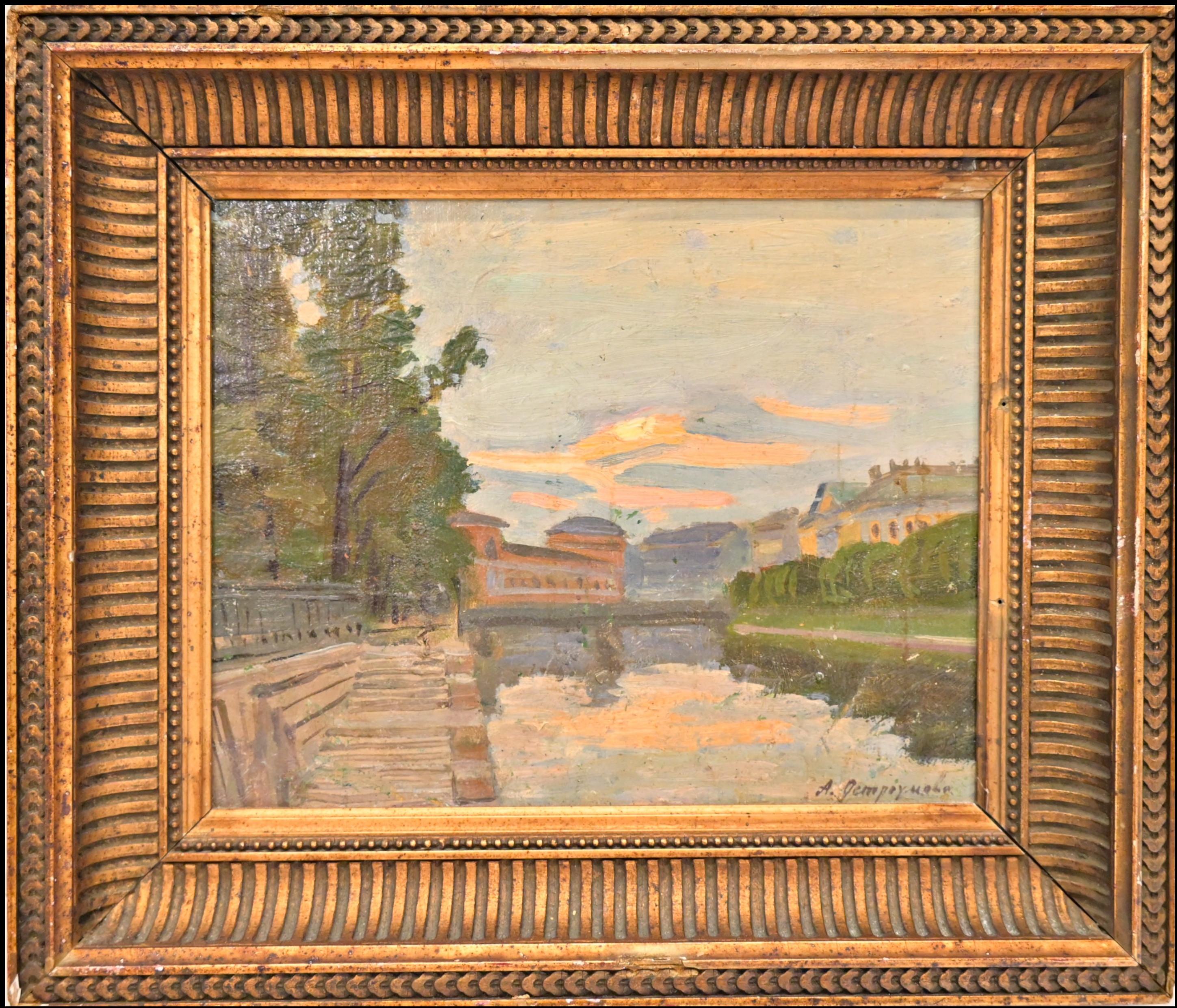
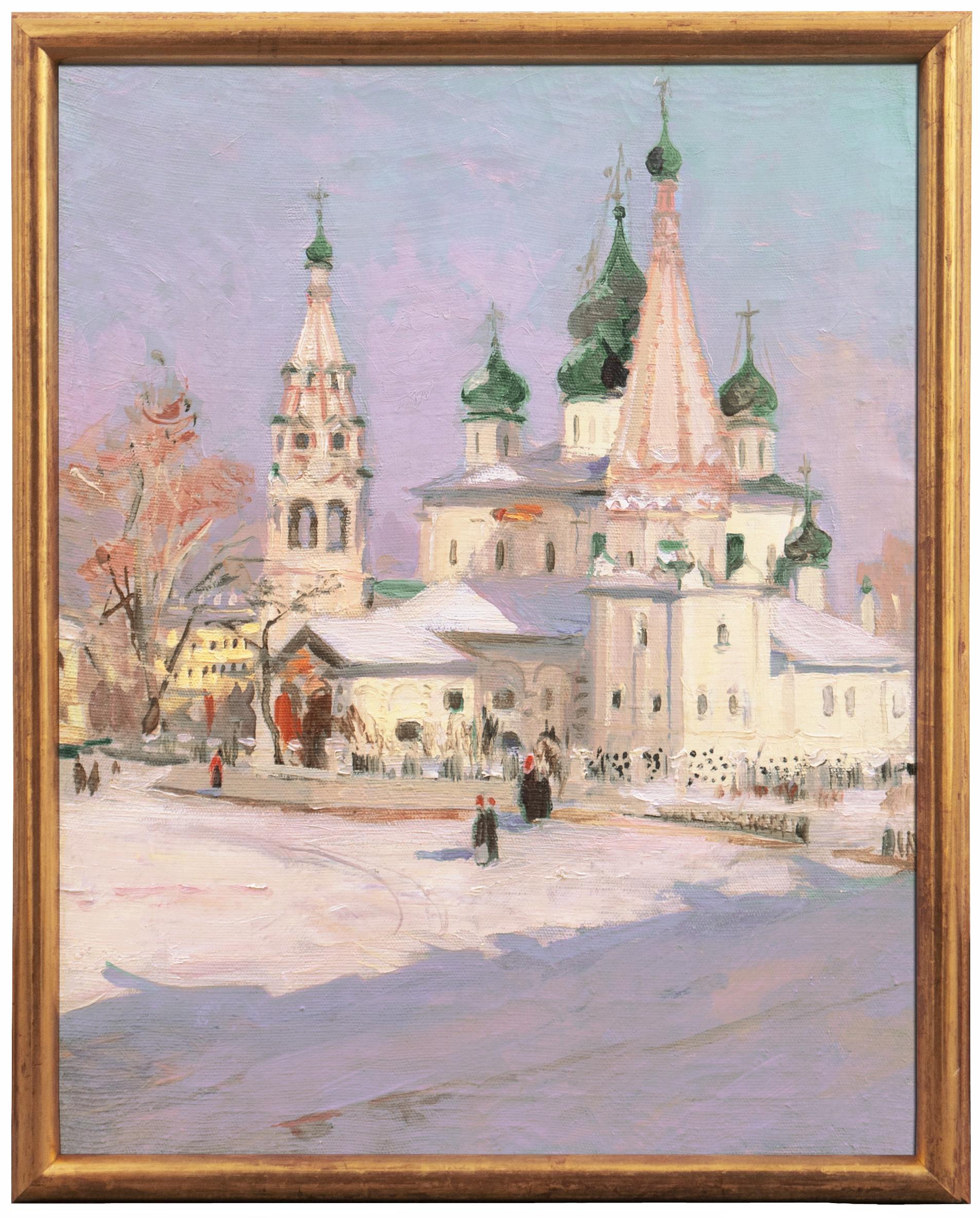
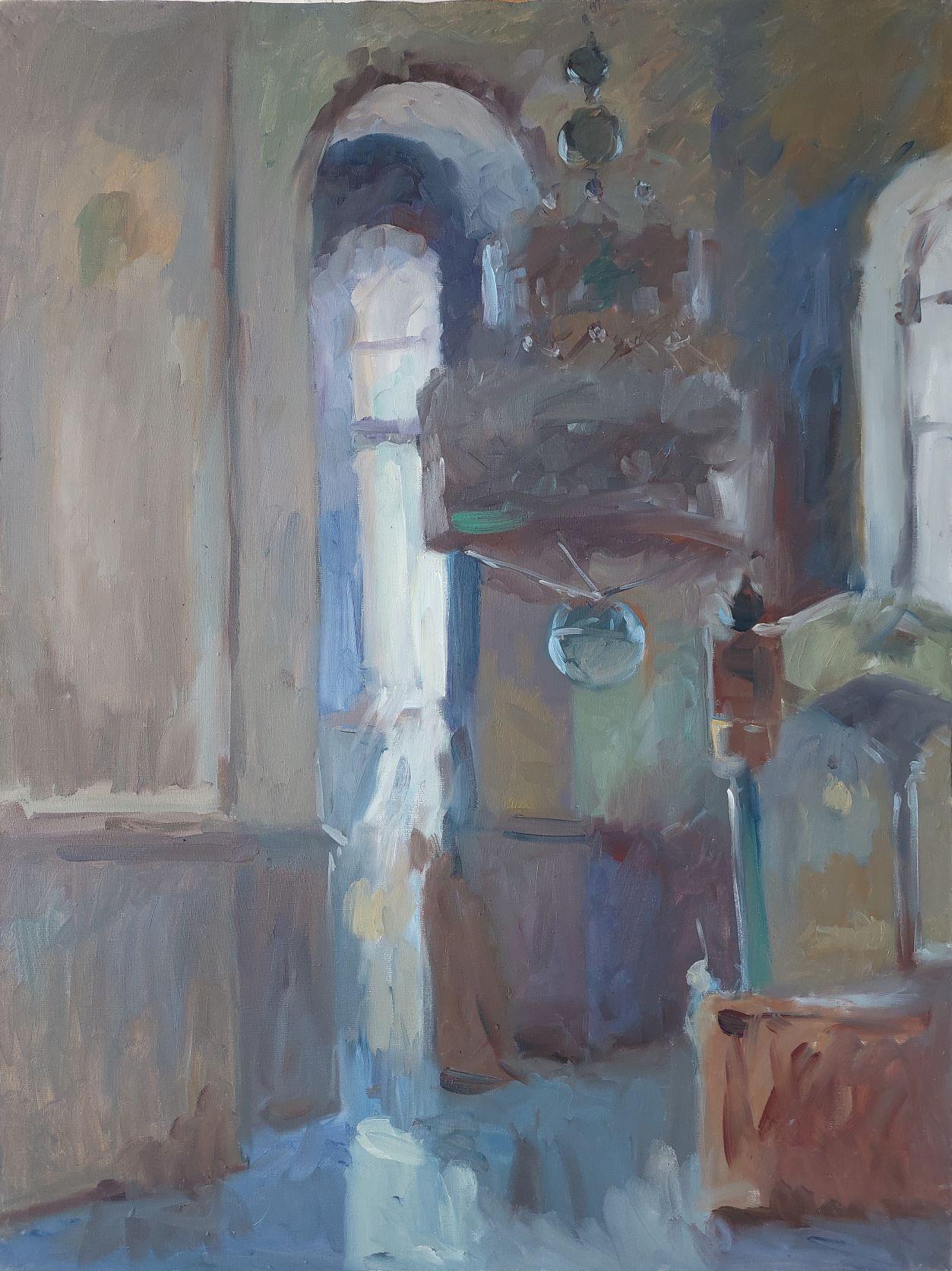
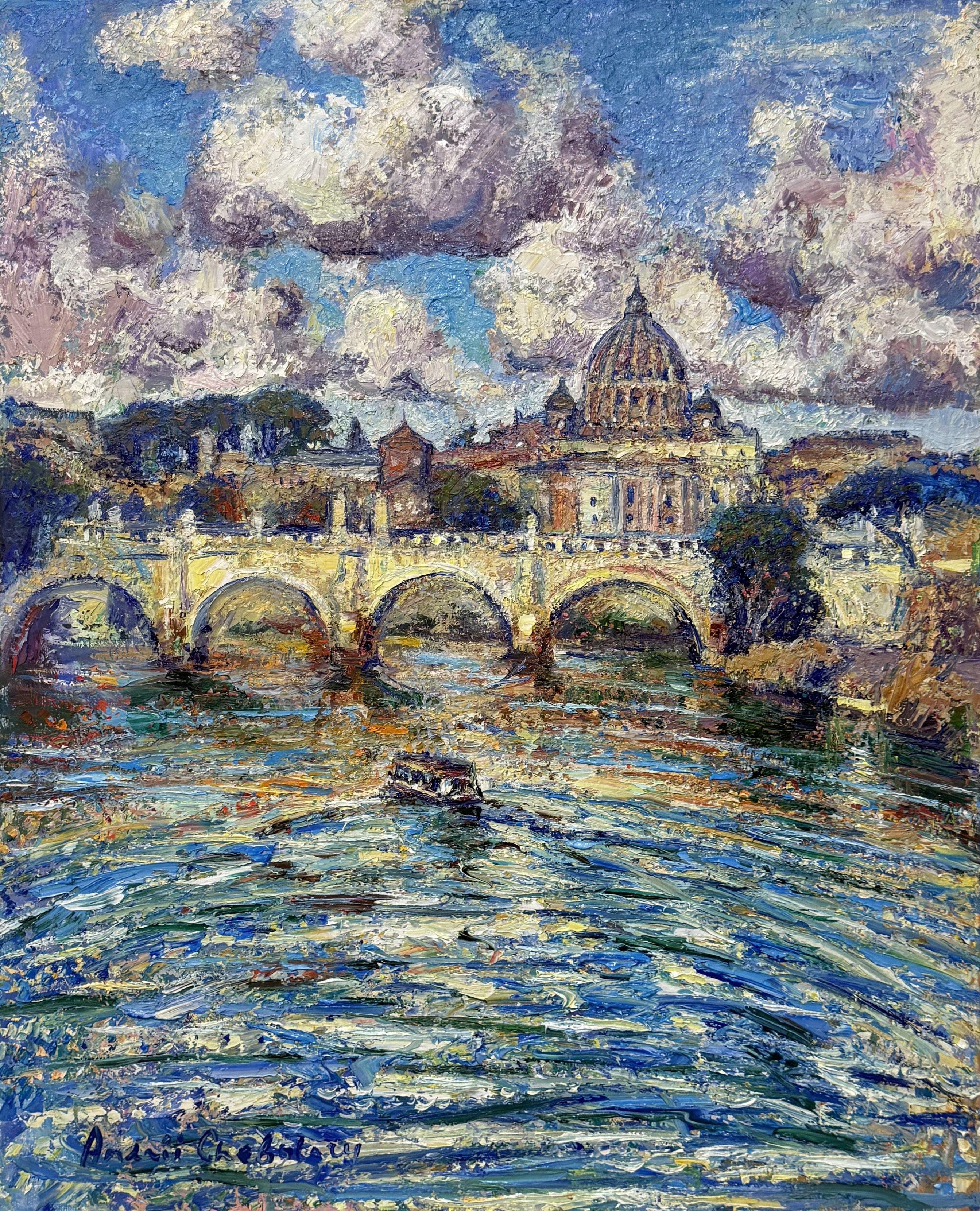
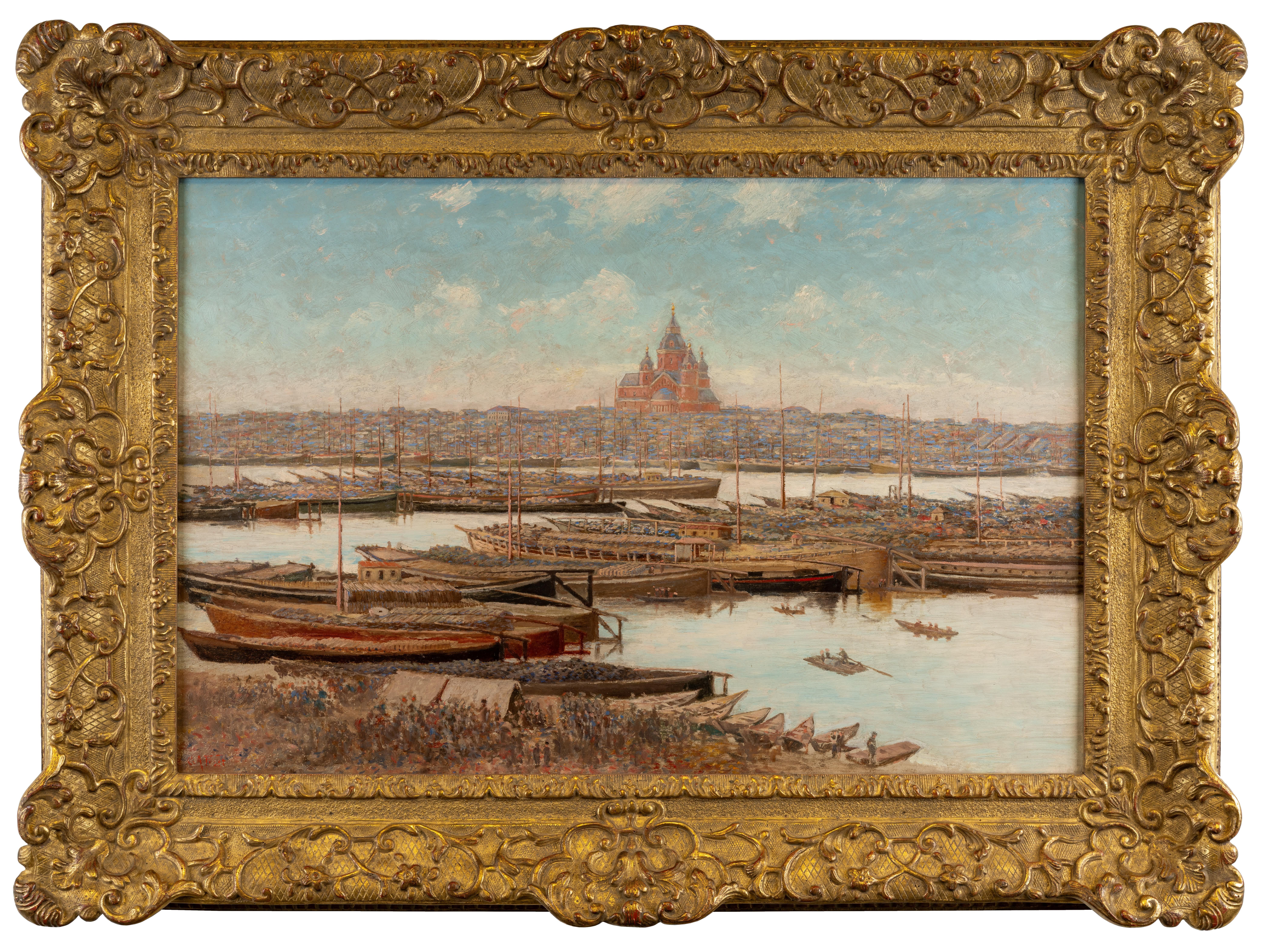
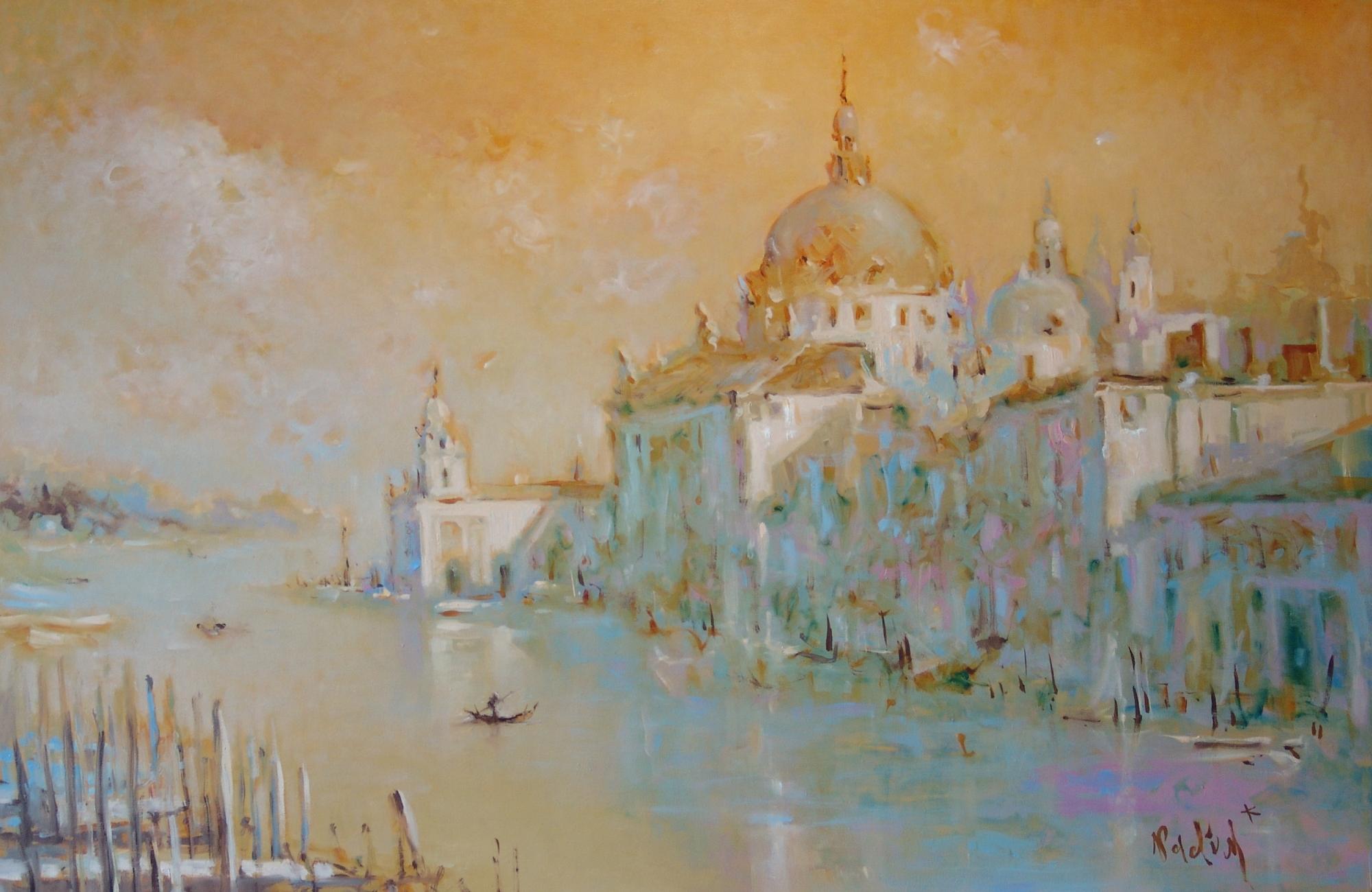
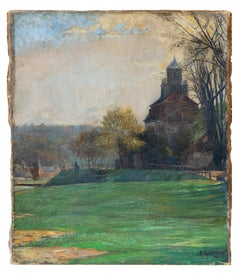
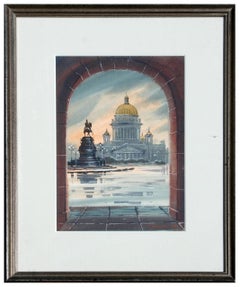
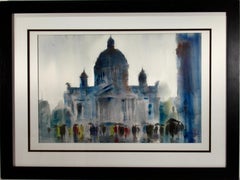
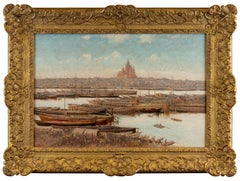
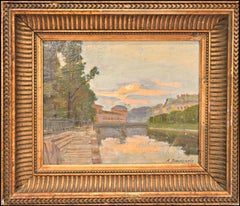
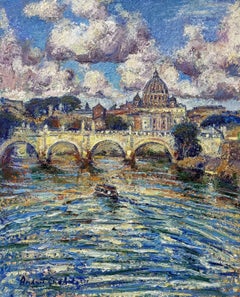
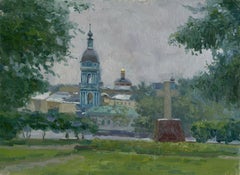
This painting presents a vivid and atmospheric view of Saint Isaac’s Cathedral, one of the defining monuments of Saint Petersburg, interpreted through the expressive lens of the Russian school in the early 1960s.
The scene unfolds at dusk or early evening, when the city is suspended between fading daylight and artificial illumination. At the center rises the monumental dome of Saint Isaac's Cathedral, its mass simplified into bold, luminous planes of ochre and gold. Rather than rendering architectural detail with precision, the artist captures the cathedral as an impression—its grandeur conveyed through color, light, and silhouette.
In the foreground, a small arched bridge crosses a canal, leading the viewer’s eye directly toward the cathedral. The bridge acts as both a compositional anchor and a symbolic passage, drawing the viewer from the intimate scale of the street into the monumental presence of the architecture beyond. The canal beneath reflects broken fragments of light—flecks of blue, yellow, and orange—suggesting movement and the instability of reflection rather than a literal mirror image.
Flanking the composition, buildings dissolve into loosely structured blocks of color. Their windows glow with warm yellows, contrasting against the deep, saturated blues of the sky. Streetlamps punctuate the scene, their light rendered as soft halos, reinforcing the sense of an urban environment transitioning into night. A few small figures appear along the right edge, reduced to silhouettes, emphasizing the scale of the setting and the quiet rhythm of city life.
The brushwork is direct and energetic, characteristic of mid-20th-century Russian painting influenced by both impressionism and post-impressionism. Forms are constructed through layered strokes rather than line, and perspective is subtly compressed, allowing the composition to feel both immediate and slightly abstracted. The palette is deliberately heightened: cool blues and violets dominate the sky and water, while warm oranges and golds animate the architecture and artificial light.
Dated to 1962, the painting reflects a period in which Soviet artists often balanced observational fidelity with expressive freedom. While the subject—a major architectural landmark—is unmistakable, the treatment prioritizes mood over documentation. The cathedral becomes less a fixed structure and more a luminous presence within the urban landscape.
Ultimately, the work operates as a study in atmosphere and perception. It captures not simply a place, but a moment: the quiet transformation of the city under evening light, where architecture, water, and sky merge into a unified field of colour and sensation.
Signed and dated on the front and back
Sizes 59 x 69 cm