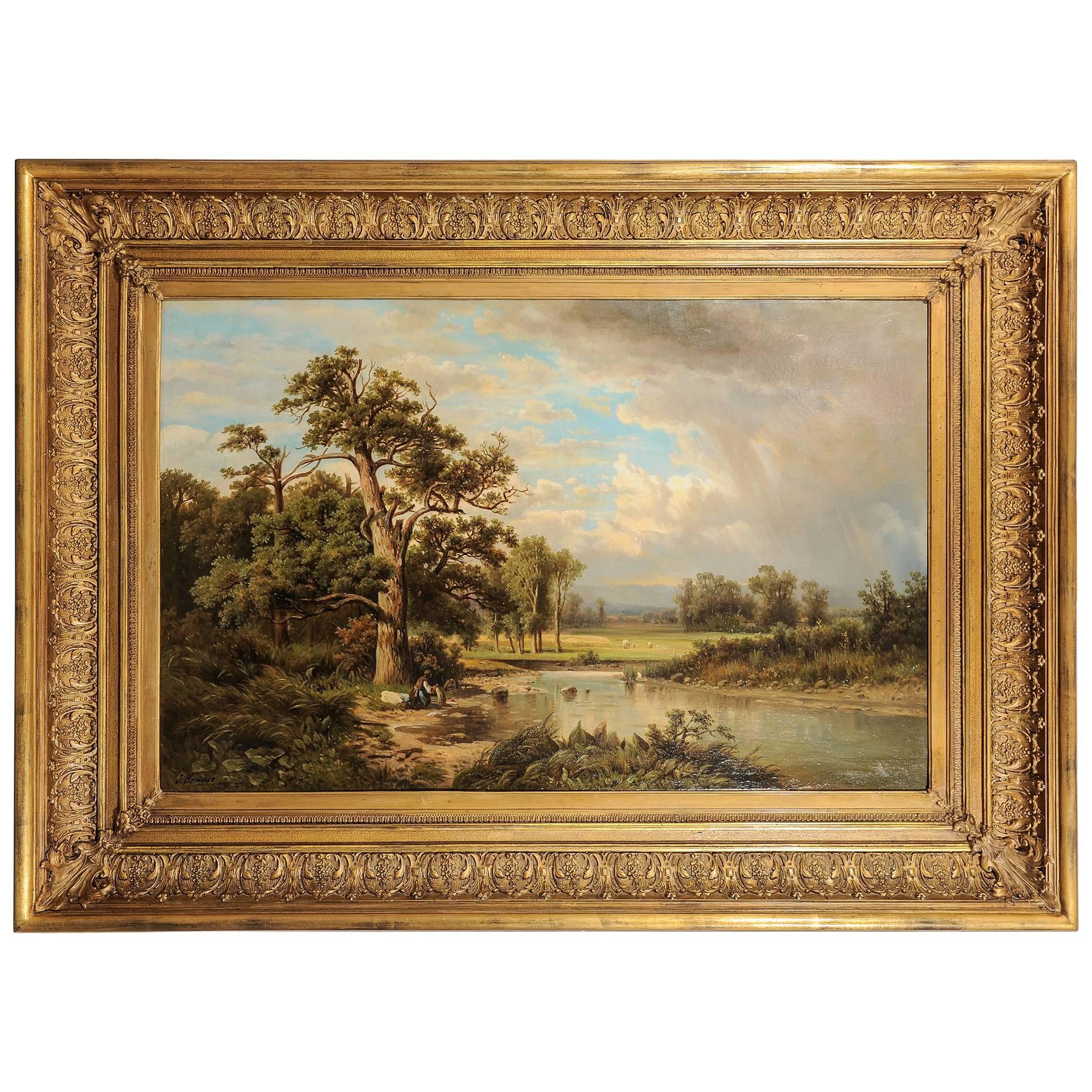
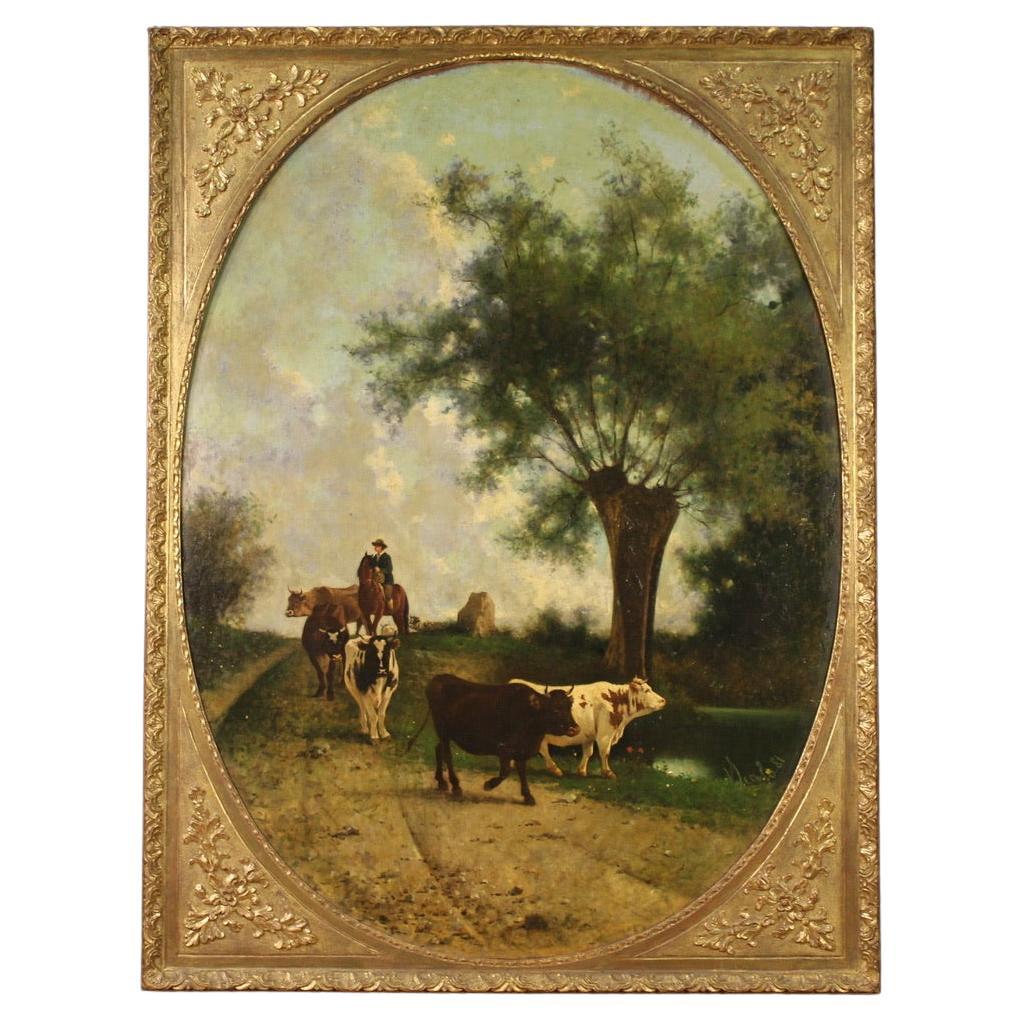
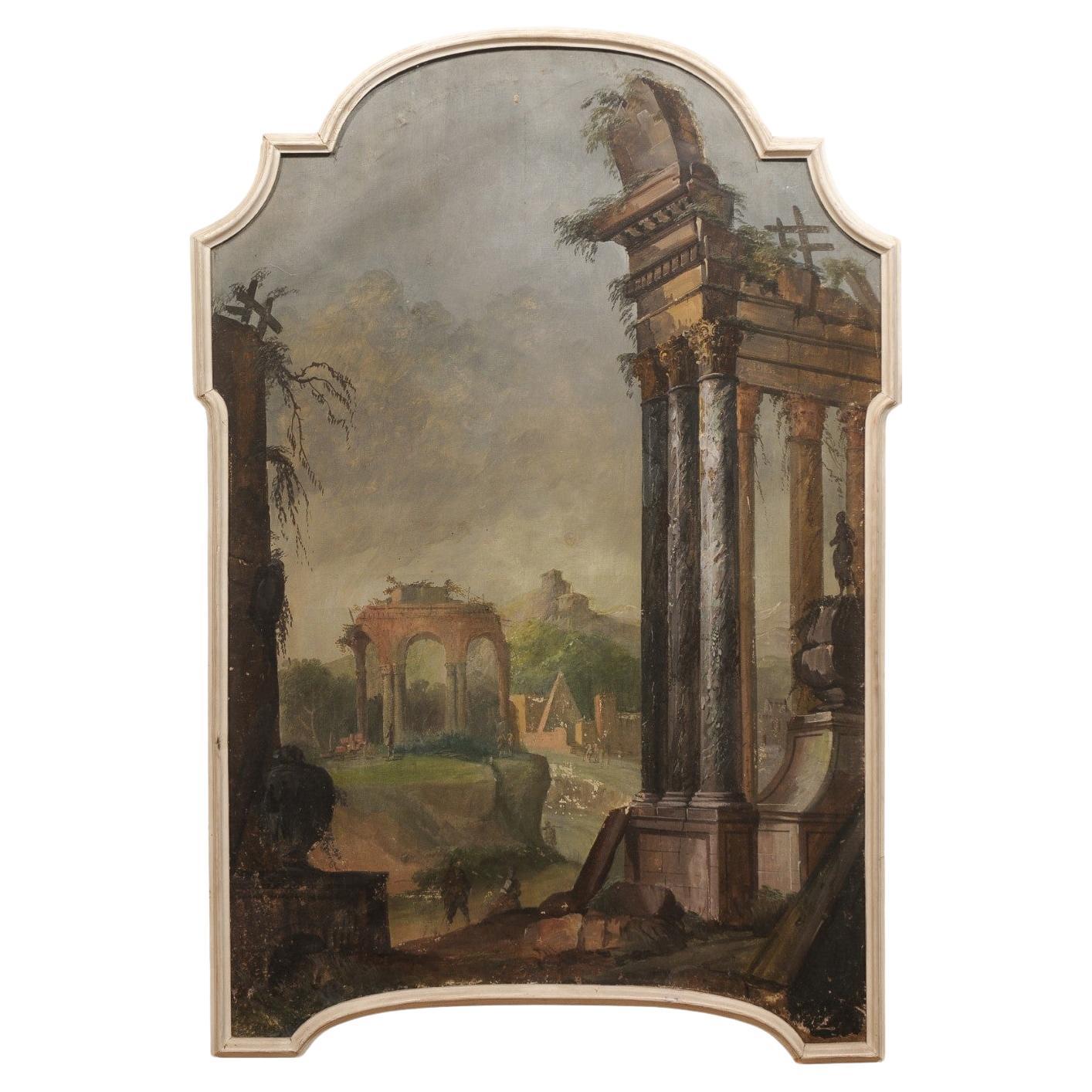
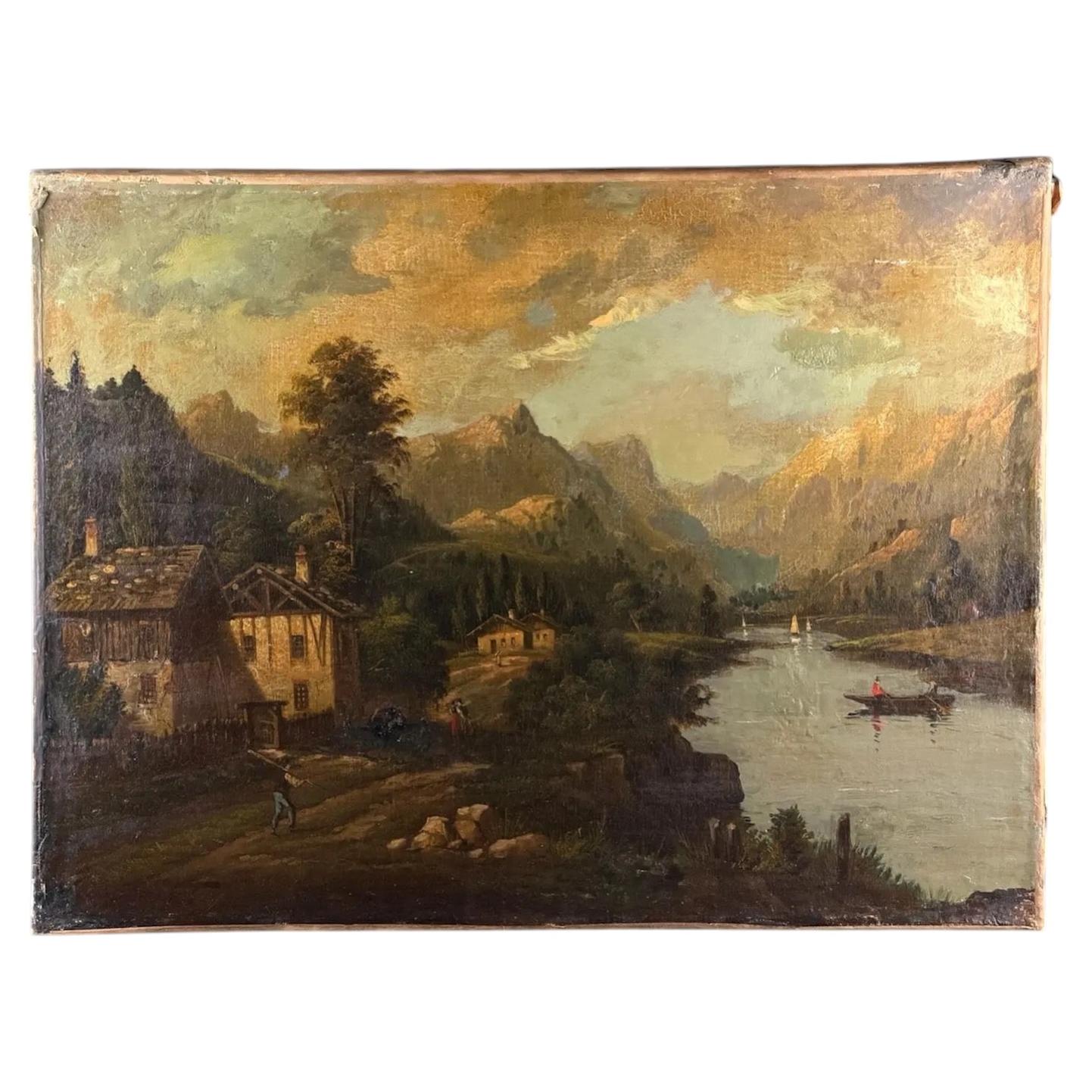
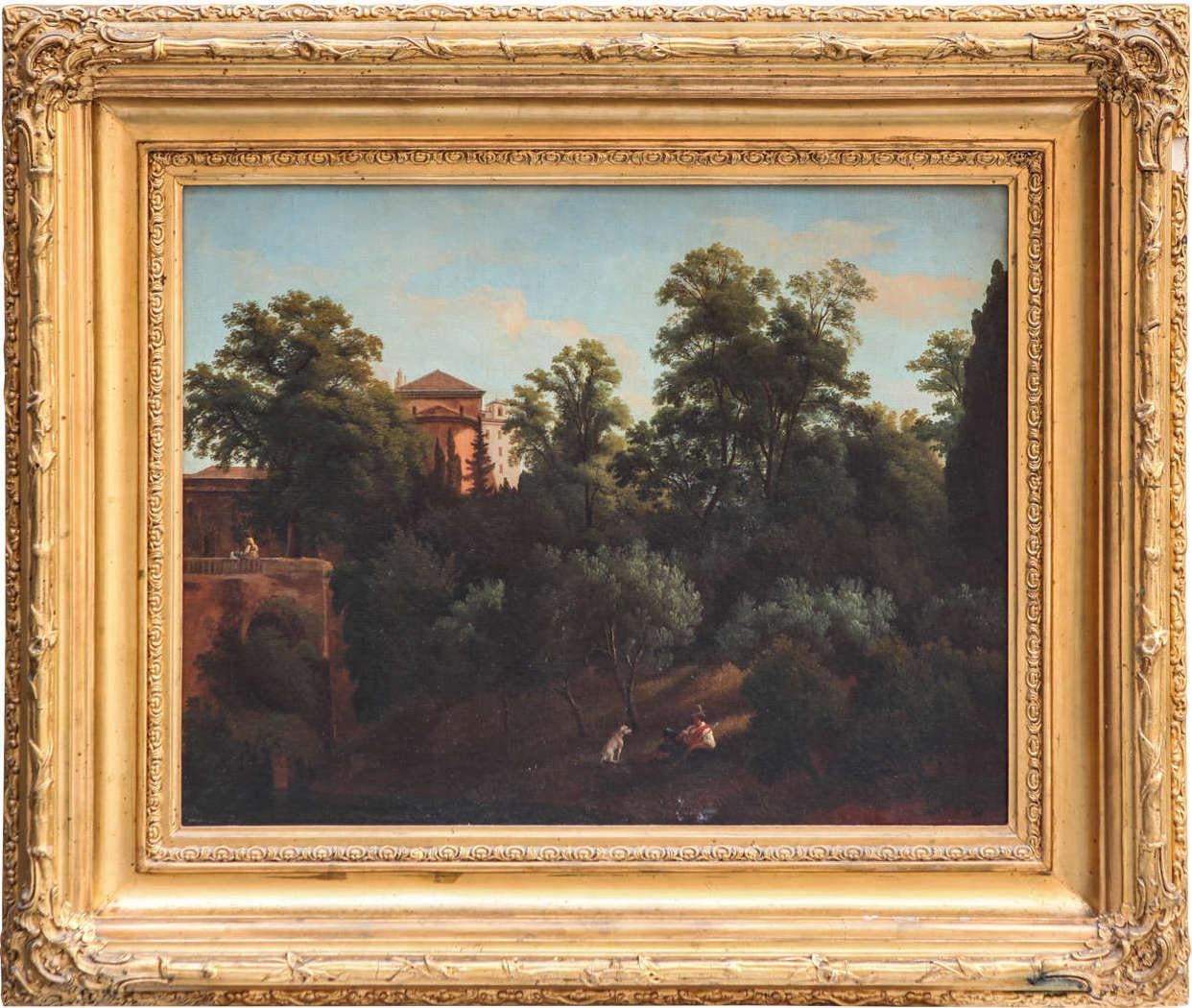
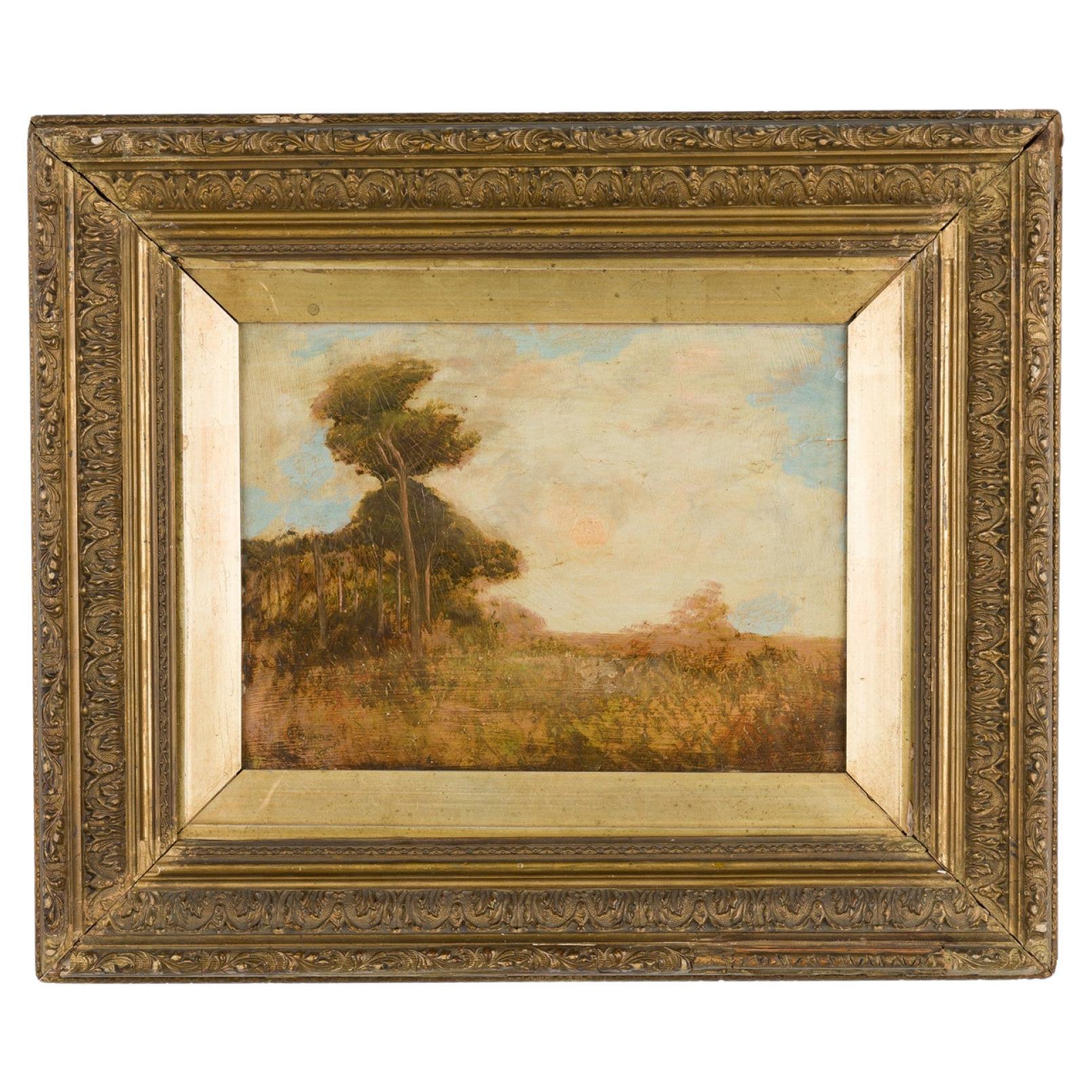
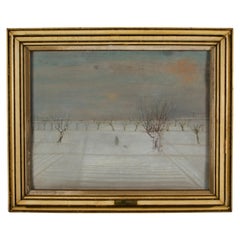
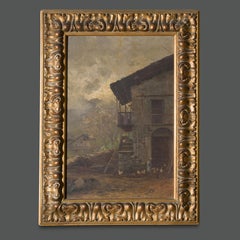
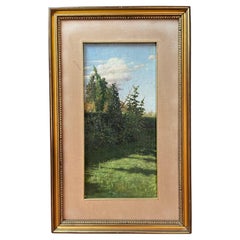
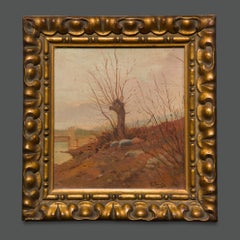
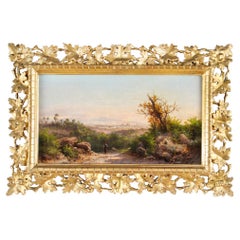
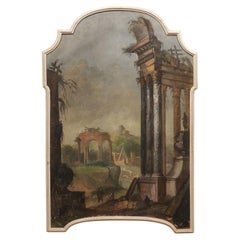
Beautiful painting of the Neapolitan school signed, dated and located. It has a metal plate on the front with the inscription ‘PAESAGGIO NAPOLETANO NUCCI Agosto 1893’.
Indeed, this painting of beauty and intensity represents the Posillipo School at its highest level.
Almost stopping time, it shows a bucolic landscape in the immediate vicinity of Naples; against a backdrop of mountainous heights, a peasant woman holding her child by the hand approaches.
Immersed in a natural luminosity, an orderly and peaceful village forms the backdrop to a classic sea pine typical of 19th century Neapolitan Vedutism. Signed and dated on the canvas at lower right, it also bears an inscription on the back ‘25 August 1893’ with the signature.
This painting, never before on the market, comes from a private collection and is beautified by an impressive antique frame in gilded wood, in almost perfect condition.
Sante Nucci
He was born on 22 April 1821 and trained at the Academy where he followed courses in Figure painting taught by Giovan Battista Frulli (1765-1837) and Napoleone Angiolini (1797-1871) and that of Painting by Clemente Albèri (1803-1864).
He received school prizes for Figure (1836 and 1837) and Nude (1843). As a figurist painter, he worked on many building sites in the city: in the 1840s in the Church of the Capuchins, together with Gaetano Belvederi and Girolamo Dal Pane (1821-1856);
in 1851 in the Church of Santa Maria della Carità (Santissimi Pietro e Paolo, on the sides of the high altar).
In 1852 he took part in the competition for the small Curlandese Painting Prize with Socrates in the act of drinking hemlock, but did not win (the aforementioned Girolamo Dal Pane won instead). In 1855 he exhibited a Portrait of a Woman: ‘[...] whose yellow dress was not to my liking, but who had beautiful hands’, and a half-figure of a Flower Girl: ‘in the act of decorating a large vase with flowers, which the decorative skill of the author discovers’, which, however, ‘[...] too brightened up the flesh, wanting it to be illuminated by the noontide, while to ordinary observers the hat appears admirable with its minute turns of straw, very transparent to the sun’ (Bellentani).
In 1867 he participated in the Second Exhibition of the Academies of Emilia with a Portrait, Adam and Eve and Marital Love.
In the meantime, in 1856, he worked in Rimini and, as Poppi (Bologna 1983b) writes: ‘From the 1860s onwards, he received numerous commissions from churches in Bologna and the province to paint altarpieces.
Nucci painted them without ever departing from the canons of the glorious local 17th century'.
In 1883, he participated in the Munich Exhibition with The Madonna and Child Dreaming of the Cross. In 1885, an advertisement in ‘Il Resto del Carlino’ warned of the three-day exhibition of one of his altarpieces in Santa Caterina di Saragozza.
As a portrait painter, between 1873 and 1874, he painted Aurelio Saffi, Giuseppe Mazzini and Maurizio Quadrio for the Republican club ‘L'Edera’, of which he was a founding member.
These portraits - together with the one of Federico Campanella now in the Museo Civico del Risorgimento in Bologna - betray ‘in the rigid posing, still an influence of Albèri the portrait painter’ (Poppi) and even more so a strong debt to photography, also due to the ‘chromatics based on greys and the flat surface’ and ‘perhaps, a poor attempt, to approach the stylistic instances of Antonio Puccinelli’ (Collina).
There is a late painting attributed to him in the Art and History Collections of the Fondazione Cassa di Risparmio in Bologna: Pius IX crowns the image of the Virgin of St. Luke and Personal Exhibition in the Capucci shop, dated 1890, from which emerges the painter's stylistic backwardness and ambition - reiterated in
Nucci's own Descrizione della vendita di un ricco studio di pittura, scultura etc. (Description of the sale of a rich studio for painting, sculpture etc.) by Sante Nucci, a figurine painter, ornamentist, plastic sculptor, architectural amateur and restorer - to be an all-round artist in accordance with an ancient tradition that is now outmoded, emerge. He died on 18 March 1896. He is buried at the Certosa di Bologna, Chiostro dell'Ossaia n 97.
Isabella Stancari
Under existing legislation, any artwork created over 70 years ago by an artist who has died can requires a license for export regardless of the work’s market price. The shipping may require additional handling days to require the license according to the destination of the artwork.
Dimensions are frame included