By Jan Van Haensbergen
Located in PARIS, FR
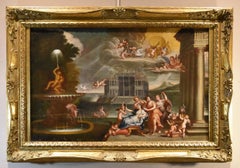
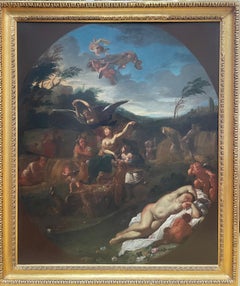
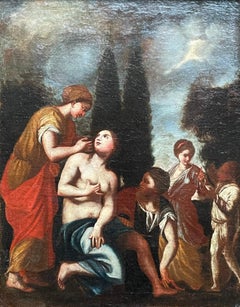
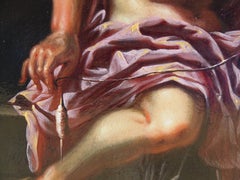
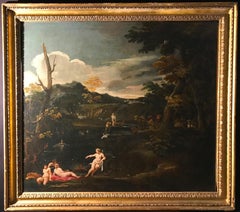
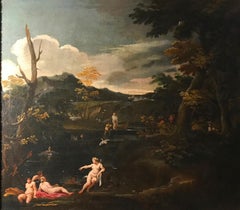
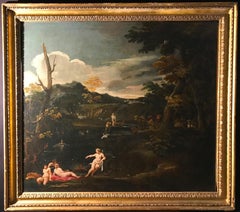
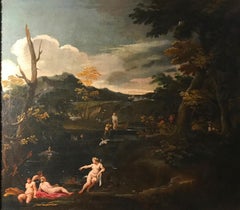
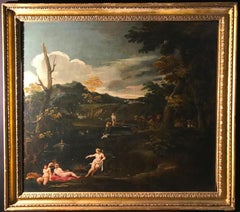
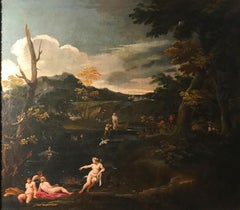
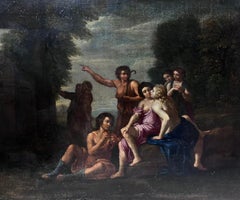
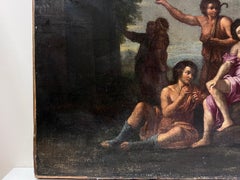
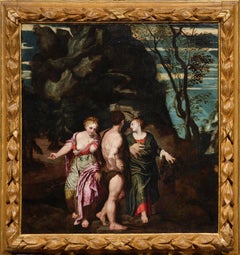
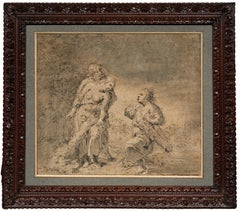
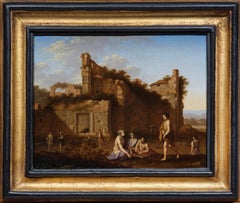
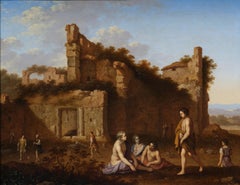
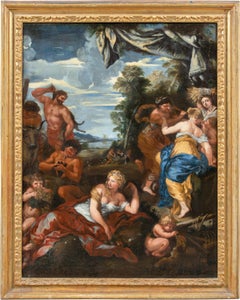
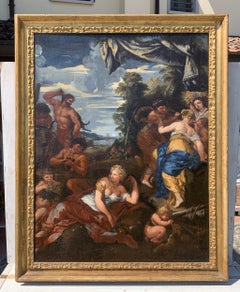
Jan van Haensbergen was a painter of the Dutch Golden Age and a pupil of Cornelius van Poelenburgh (Utrecht 1594 - 1667). The painting we are presenting is inspired by Poelenburgh’s landscapes from his Italian sojourn. The dreamlike atmosphere of this Gathering in antique ruins appealed to us. Against a backdrop of antique ruins, three draped characters (perhaps bathers) are sitting in a circle, greeting a fourth character walking towards them.
Their tranquility contrasts with the bustle of the other characters in the background. They constitute a vivid illustration of otium, this leisure time that allows us to realize our full potential. With this Arcadian landscape, Jan van Haensbergen invites us in turn to leave the hustle and bustle of everyday life behind, to take a break, to enjoy the present moment chatting with close friends…
1. Jan van Haensbergen, a landscape and portrait painter of the Dutch Golden Age
Jan van Haensbergen was born in 1642 in Gorinchem, a town in southern Holland to the east of Rotterdam. He was a pupil of Cornelius van Poelenburgh, and began by painting landscapes inspired by those of his master, in an Italianate style. Between 1668 and 1669, he was registered at the Guild of Saint Luke in Utrecht.
In 1669, he moved to The Hague, where he joined the Confrérie Pictura, an artist society founded in 1656. His portraits, which became his main activity as a painter after settling in The Hague, were strongly influenced by Caspar Netscher (Prague or Heidelberg 1639 - The Hague 1684), whom he met in The Hague and whose son Constantijn became his son-in-law by marrying his daughter Magdalena.
In addition to his work as an artist, Van Haensbergen was also an art dealer, probably helped by his appointment as Dean of the Confrérie Pictura, where he also teached.
2. Description of the artwork and related paintings
This painting seems to us to be a kind of allegory of otium, that quiet bliss promised by Epicurus. It might even evoke an Epicurean proverb: "It is better to lie on the naked ground and be at ease, than to have a golden carriage and a rich table and be worried" .
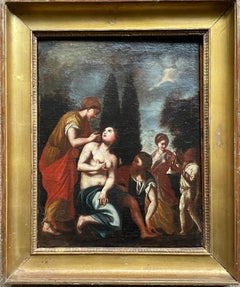
Three draped young people - two men and a woman in the background - are seated in a circle, greeting a fourth figure walking towards them, hair disheveled and body draped in a towel as if drying off after a bath, indicating the need for prior purification to fully enjoy this rest. Their nonchalance contrasts with the bustle of the various characters in the background.
The composition is punctuated by successive diagonals, and opens onto a landscape on the right, with a succession of mountainous planes. This painting is typical of the Italianate works produced by Van Haensbergen in the 1660s under the influence of Cornelis van Poelenburgh...
Category
Old Masters 18th Century and Earlier Nude Paintings