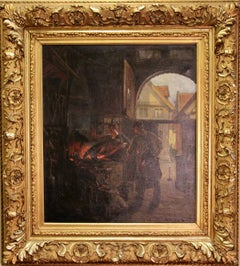
Henri DELUERMOZ
(Paris 1876 – Paris 1943)
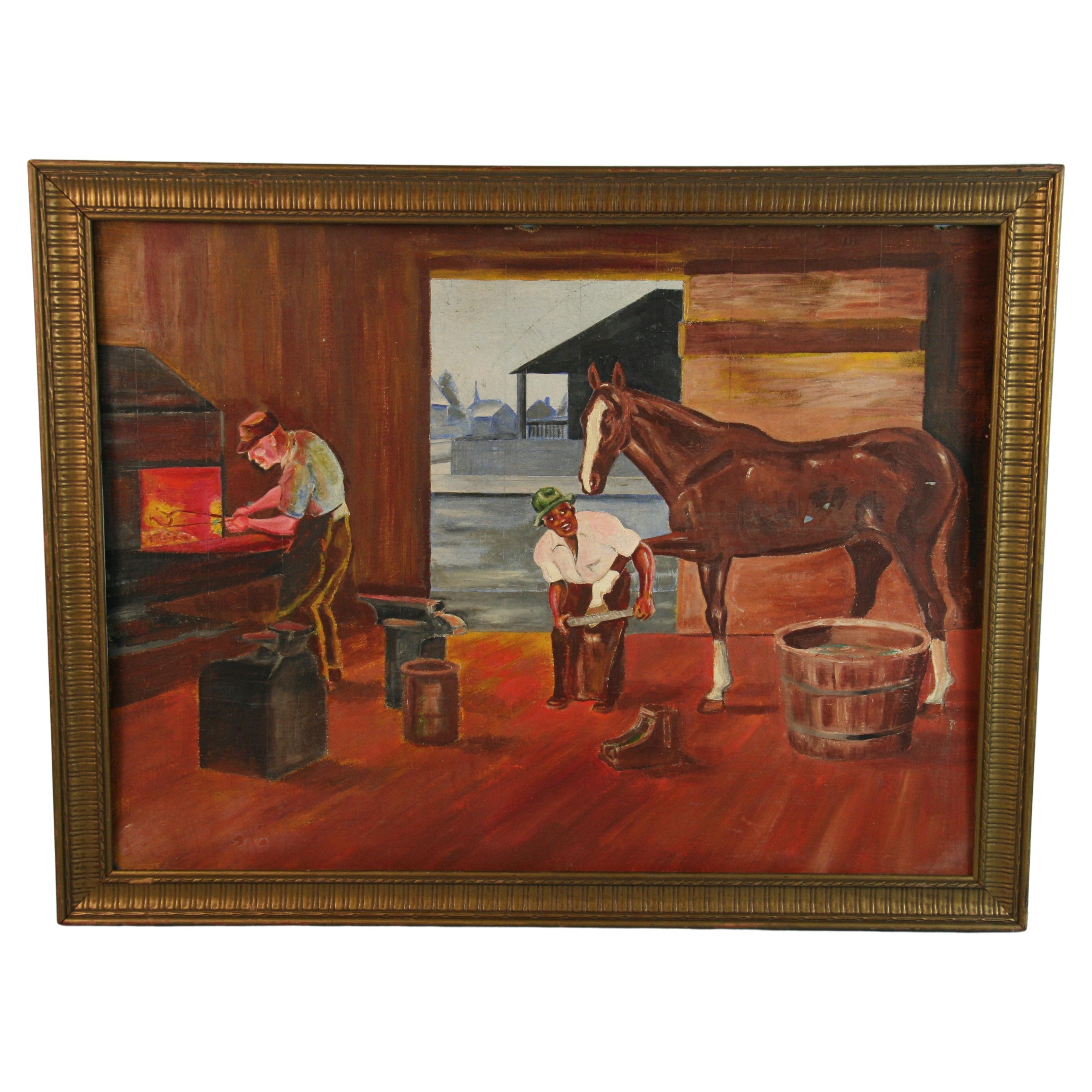
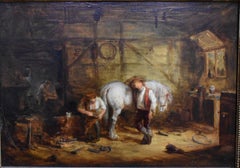
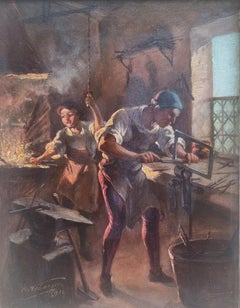
At the blacksmith's
Oil on metal. Two welded plates
H. 145 cm; W. 100.5 cm
Signed lower left
Trained under Alcide-Joseph Lorentz and Charles Gleyre, he established himself as a versatile realist artist: painter, draftsman, engraver, and lithographer.
Henri Deluermoz took his first steps as a painter in the studios of two leading masters of their time: Gustave Moreau, a figure of Symbolism, and Alexandre Roll, devoted to social realism and the great Parisian construction sites. At the same time, he began engraving, reproducing the works of other artists to support himself while pursuing his own research.
The First World War interrupted his work and his study of animals for four years. During this conflict, he produced a series devoted to massacres and victories. At the end of hostilities, he returned to the Jardin des Plantes and the Vincennes Zoo, where he carefully observed the morphology and character of the wild animals, which became his main source of inspiration.
His early drawings, watercolors, and paintings, still marked by the influence of his teachers, are distinguished by a careful and sensitive line. But it was only in the middle of his career that he truly established his style: a broad and energetic drawing, dominated by the exploration of animal movement.
His regular participation in the Société Nationale des Beaux-Arts, whose board of directors he joined, ensured his recognition and attracted French and foreign collectors.
Accustomed to engraving, he naturally turned to illustration. Like Jouve, he was captivated by the world of Kipling's The Jungle Book and illustrated the adventures of Mowgli, as well as Louis Pergaud's A Tale of Beasts and Montherlant's Bestiaries, where his talent as a draughtsman found favor.
Beyond the African forest that inspired him, Deluermoz was also interested in America. These lands fascinated early 20th-century artists, who sought traces of raw, primal expressions, sources of inspiration for creators such as Picasso and Braque.
Initially adept at a bright, tangy palette, Deluermoz evolved toward more subdued tones, closer to the earth and vegetation, in order to capture the very essence of nature. He did not hesitate to isolate a detail—an ear, a paw—transforming the animal into a pure graphic motif.
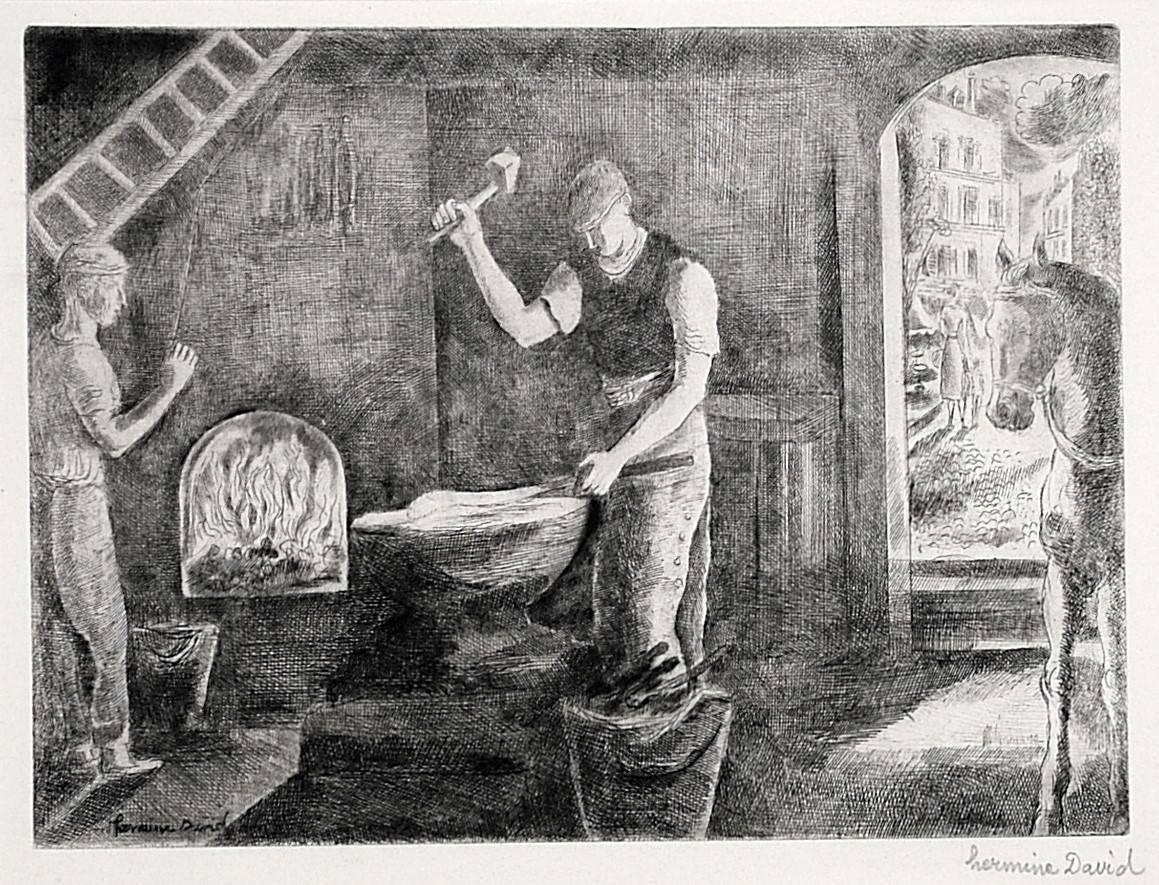
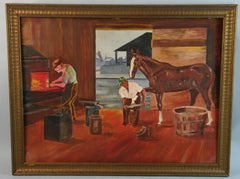
This large metal panel we are presenting raises questions about its use. Curved at the top, did it serve as a commercial sign for a blacksmith? The support might suggest so, but the finesse of the work makes us doubt.
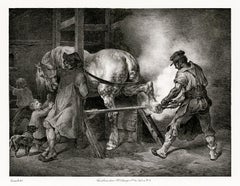
The rearing horse is omnipresent in Deluermoz's work, often with a gray or white coat, or even roan, as seen in our background. These horses are seen in all situations. Medieval tournament scenes, ridden by Apaches, by Marshal Lyautey, wild in the steppes, or again, as here, domesticated but reluctant to submit to our blacksmith (this time, a blacksmith), who is built like a wrestler.