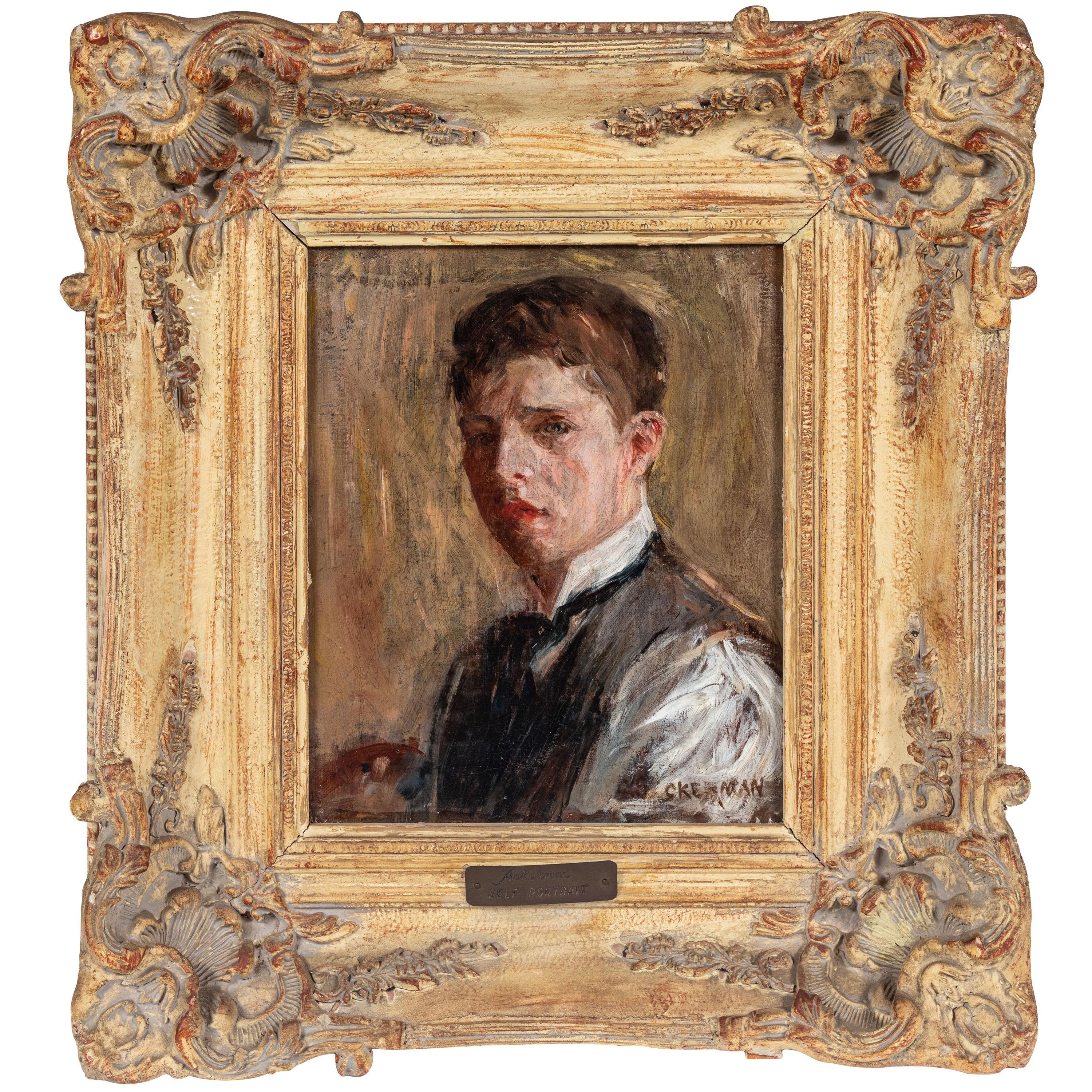
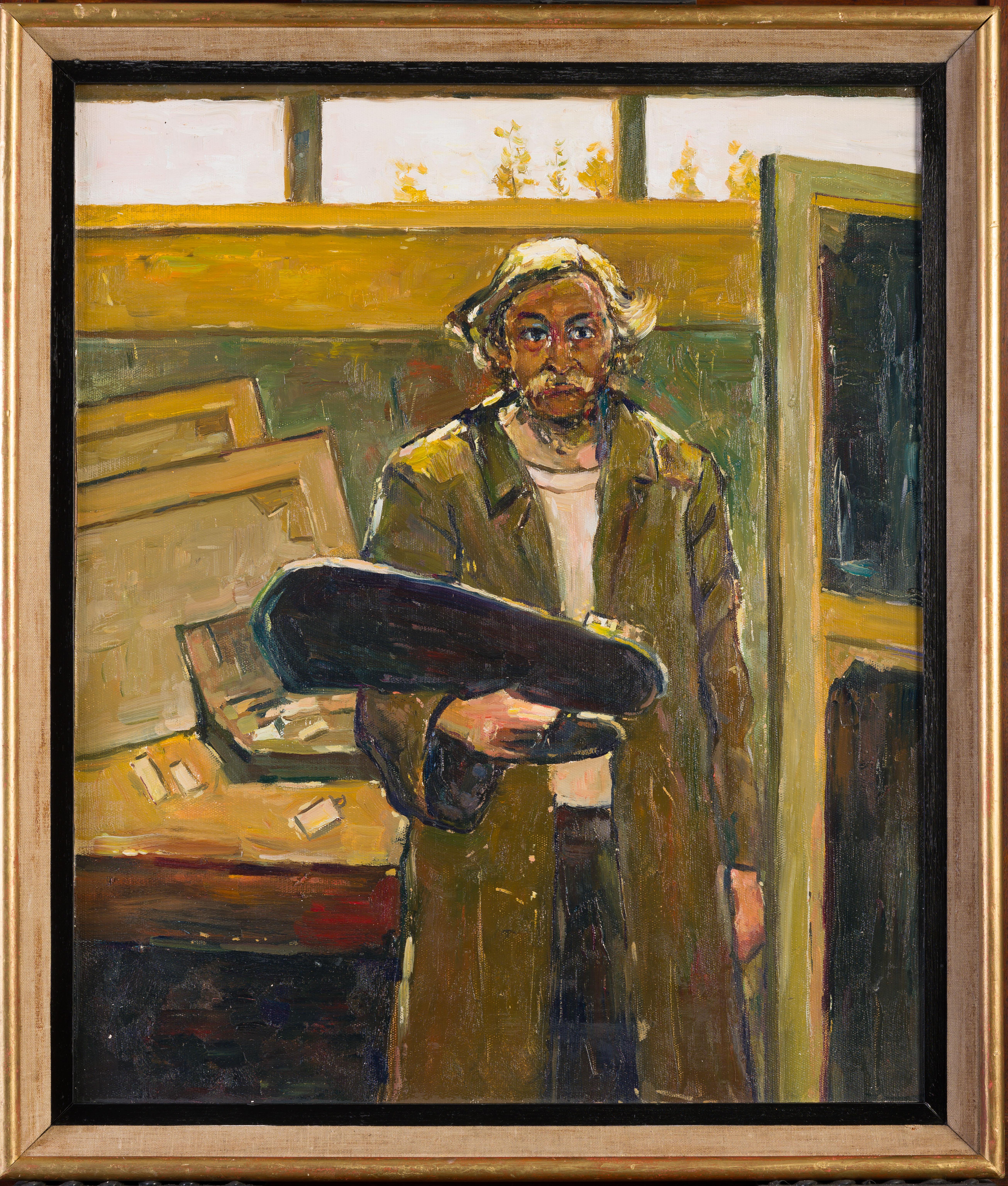
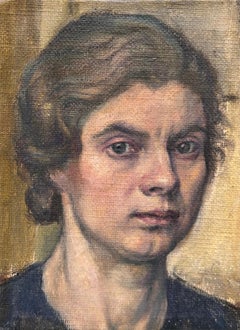
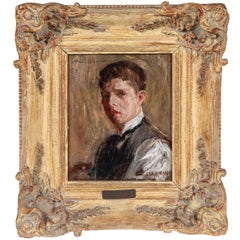
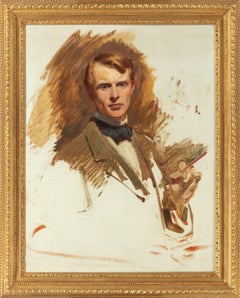
Robert Buhler R.A. 1916-1989, was a Swiss landscape and portrait painter born in England, lived in Chelsea and painted cityscapes and the portraits of a number famous painters, and joined the London Group of Artists. This self portrait we believe was painted in the 1940's probably during the war. A competent oil on canvas picture painted with a confidence and an unassuming manner. This painting is unsigned, and is retained in it's original condition without, in our opinion, the need of conservation.
I have included an alternative biography for your interest.
Robert Buhler RA (23 November 1916 – 20 June 1989) was an influential British-Swiss painter and educator celebrated for his atmospheric landscapes, intimate cityscapes, and striking portraits of mid-20th-century cultural figures. Best known for his restrained, muted color palettes and high-angle perspectives, Buhler was a prominent fixture of the post-war British art scene and a long-serving member of the Royal Academy of Arts. Buhler was born in London to Swiss parents; his father was a journalist and aircraft designer, and his mother managed a bookshop and café in Fitzrovia. His formal art education began in Switzerland, where he studied commercial art at the Kunstgewerbeschule in Zürich and later in Basel. Upon returning to London in 1933, Buhler fully committed to fine art. He attended the Saint Martin's School of Art from 1934 to 1936, studying under influential artists Leon Underwood and Vivian Pitchforth. In 1935, he secured a scholarship to the prestigious Royal College of Art (RCA). However, desiring immediate independence, he left after only a few weeks to establish his own professional studio in Camden Town. His mother’s café on Charlotte Street became a popular hub for the Euston Road School painters. While Buhler never formally joined their movement, their sparse arrangements and somber tonal ranges profoundly shaped his emerging style. Buhler's work split cleanly between two main passions: urban environments and the faces of his contemporaries. Buhler developed a unique visual signature by painting London's streets from elevated, upper-floor windows. This high viewpoint lent an atmospheric, almost photographic quality to post-war everyday life, as seen in his major works like Carlyle Square and Sloane Square. His landscapes, which frequently depicted the English countryside and the vineyards of Neuchâtel, Switzerland, featured thin, built-up layers of paint and structural geometry. Rather than conventional society figures, Buhler preferred painting close friends within London’s literary and artistic circles. He produced notable portraits of major figures like Francis Bacon, Stephen Spender, John Minton, and Sir Isaiah Berlin. Buhler quickly gained critical acclaim and integrated into the heart of the British art establishment. He began exhibiting at the Royal Academy Summer Exhibitions in 1945. He was elected an Associate (ARA) in 1947 and a full Royal Academician (RA) in 1956. He was an active member of both the New English Art Club (NEAC) and The London Group. Later in his career, his mastery was recognized with prestigious accolades, including the Wollaston Award in 1982 and the Hunting Art Prize in 1984. Alongside his studio work, Buhler was a dedicated educator, teaching at the Chelsea School of Art and working as a long-time staff member at the Royal College of Art from 1948 into the subsequent decades. Robert Buhler passed away on 20 June 1989 at the age of 72. Today, his quiet, contemplative interpretations of twentieth-century life are preserved in world-class institutional collections, including Tate Britain, the Royal Academy of Arts Collection, the Museum of London, and the Art UK Catalog.