Want more images or videos?
Request additional images or videos from the seller
1 of 15

Ursula Wood (att)
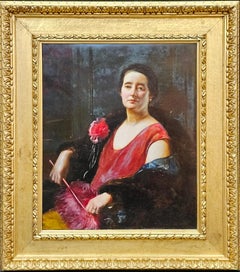
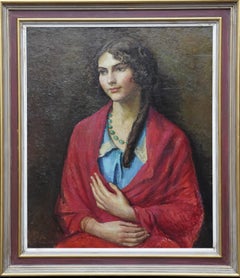
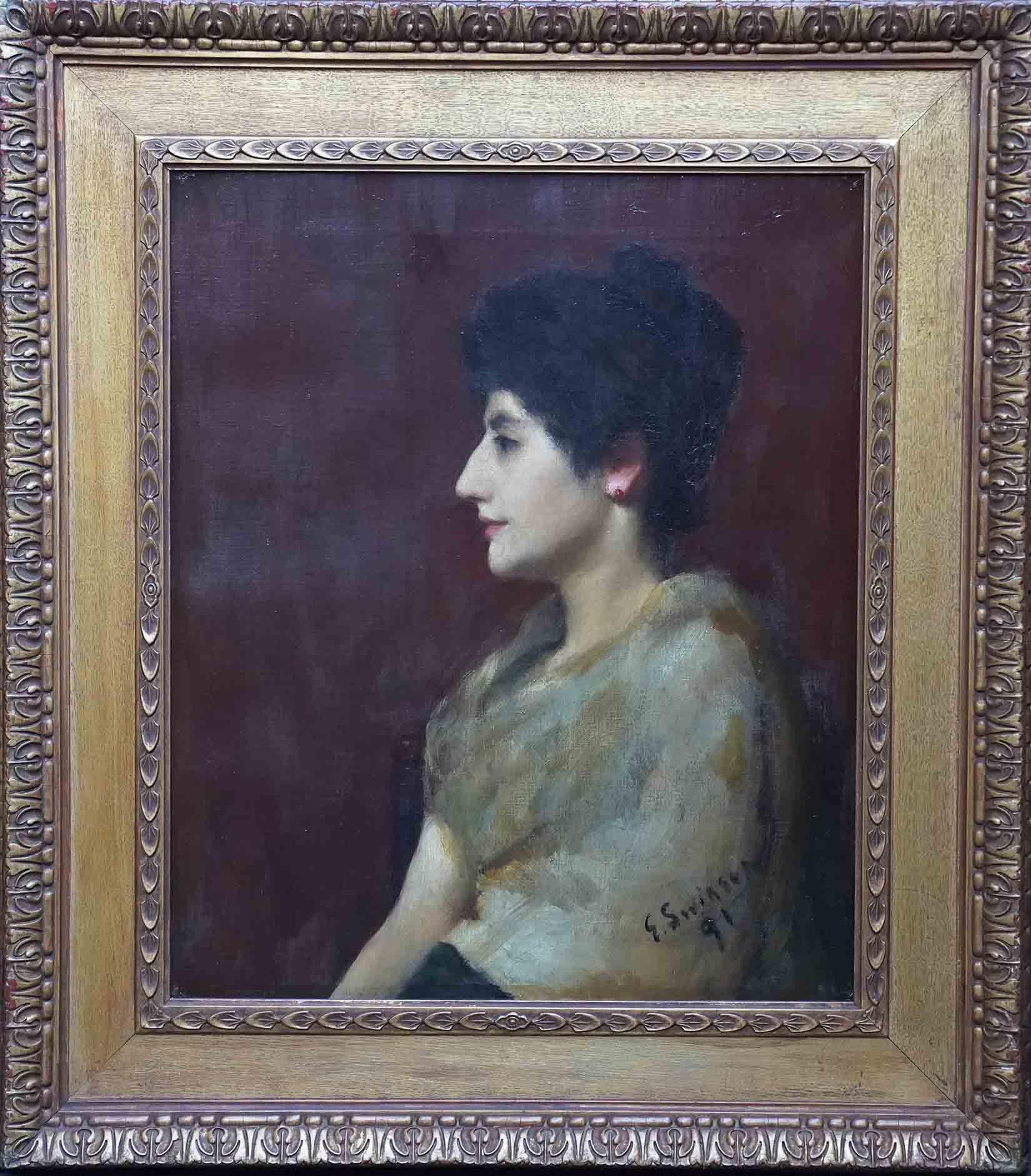
Portrait of a Lady in Orange Shawl - British Edwardian art portrait oil painting

Circa 1910

$4,139.99
$5,174.9820% Off
£3,000
£3,75020% Off
€3,561.93
€4,452.4120% Off
CA$5,710.12
CA$7,137.6520% Off
A$5,743.55
A$7,179.4320% Off
CHF 3,346.60
CHF 4,183.2520% Off
MX$69,976.71
MX$87,470.8820% Off
NOK 38,488.14
NOK 48,110.1820% Off
SEK 39,481.12
SEK 49,351.4020% Off
DKK 26,623.02
DKK 33,278.7820% Off

About the Item

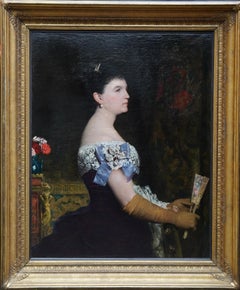
This lovely British Edwardian portrait oil painting is attributed to female artist Ursula Wood. Painted circa 1910 is is a half length portrait of a beautiful woman in an orange shawl and white blouse. The brush work and detail are stunning. A really lovely example of a British Edwardian portrait oil painting. Unsigned Provenance. Private collection. Condition. Oil on canvas, 24 inches by 20 inches and in good condition. Frame. Housed in a fine gilded Watts oak frame, 32 inches by 28 inches framed and in good condition. Ursula Wood (1868-1925), was a British artist and illustrator who had a long and distinguished career and is now best known for her depictions of the work of the Women's Land Army during World War One. Wood was educated at the St John's Wood Art School and at the Royal Academy schools where, in 1889, she won the Turner Gold medal and a £50 scholarship for one of her landscape paintings. Wood exhibited with the Society of Lady Artists in 1895 and received a favourable mention in The Times. As well as working in oils and with woodcuts, Wood also illustrated books, including at least one by E.Boyd Bayley, produced lithographs and decorated furniture. She engraved a series of views of Venice. She established a successful commercial studio in London with a Miss E Stewart Wood as a partner. At the start of the First World War, Wood closed down her business and volunteered to join the Women's Forestry Corps, one of the three divisions of the Women's Land Army. While working at a forestry camp in Wendover, Wood continued to paint and in January 1919 she contacted the Women's Work Committee of the Imperial War Museum. The Women's Work Committee had begun to collect artworks showing women's contribution to the war effort and so Wood offered them some of her sketches from Wendover. After much haggling over fees the Committee paid Wood 15 guineas for five sketches. Wood exhibited at the Royal Academy between 1890 and 1922, at the Society of Women Artists from 1892 to 1904 and at the Royal Scottish Academy in 1900 and at the Royal Glasgow Institute of the Fine Arts in 1921.
  • Creator:
    Ursula Wood (att) (1868 - 1925)
  • Creation Year:
    Circa 1910
  • Dimensions:
    Height: 32 in (81.28 cm)Width: 28 in (71.12 cm)Depth: 2 in (5.08 cm)
  • Medium:
  • Movement & Style:
  • Period:
  • Condition:
  • Gallery Location:
    Hagley, GB
  • Reference Number:
    1stDibs: LU853113398922

More From This Seller

View All
La Marquesa De Escombreras - French 19thC art female portrait oil painting

La Marquesa De Escombreras - French 19thC art female portrait oil painting

By Jules Elie Delaunay

Located in Hagley, England

This superb French Victorian portrait oil painting is by noted French society painter Jules-Elie Delaunay. Painted in 1883 it is a three-quarter length profile portrait of the Marquesa de Escombreras. Her full name was Trinidad Maria Piedad Fulgenico de Aguirre. She was born in 1824 in Cartagena, Spain, the seventh and last child of Jose de Aguirre, a retired naval officer. On October 22nd 1843 she married Frenchman Hilarion Roux (1819-1898) who was a banker from Marseille who settled in Cartegena in January 1843. After her marriage she was known as Trinidad Roux. Hilarion Roux had arrived in Cartagena first to trade silver. He quickly became one of the main lead industrialists in Catagena then in the Mediterranean area. The couple later lived in France again, in Marseille and later in Paris, where Trinidad died in 1905 aged 81. Interestingly there is no similar portrait of her husband. In this superb painting, the Marquesa, aged about 60 in reality, is wearing a black off the shoulder dress...

Category

19th Century Victorian Portrait Paintings

Materials

Oil

You May Also Like

LADY WITH BLUE SCARF-Neapolitan School  Italian Portrair Oil on canvas painting

LADY WITH BLUE SCARF-Neapolitan School Italian Portrair Oil on canvas painting

By Ciro De Rosa

Located in Napoli, IT

Lady with blue scarf - Ciro De Rosa Italia 2002 - Oil on canvas cm. 50x40 The painter Ciro De Rosa in this picture has painted a young woman caught in all her carelessness, to notice every detail, from the shawl resting on her shoulders, to the bracelets, earrings, make-up and hairstyle, emphasizing naturalness and sensuality. The De rosa is inspired by the painting of the master Vincenzo Irolli...

Category

Early 2000s Italian School Portrait Paintings

Materials

Canvas, Oil

Antique European Signed Impressionist Large Framed Woman Portrait Oil Painting

Antique European Signed Impressionist Large Framed Woman Portrait Oil Painting

Located in Buffalo, NY

Antique European impressionist oil painting. Oil on canvas. Signed. Framed. Provenance from a Sag Harbor, NY collection. Handsomely framed in period giltwood molding. Excellent cond...

Category

1890s Impressionist Portrait Paintings

Materials

Oil, Canvas

"Lady in yellow", 19th Century oil on panel by Rogelio de Egusquiza y Barrena

"Lady in yellow", 19th Century oil on panel by Rogelio de Egusquiza y Barrena

By Rogelio de Egusquiza y Barrena

Located in Madrid, ES

ROGELIO DE EGUSQUIZA Y BARRENA LADY IN YELLOW signed "R. Egusquiza" (lower right) oil on panel 28-5/8 X 20-3/4 inches (72.5 X 52.7 cm.) framed: 32-5/8 X 24-3/4 inches (82.5 X 62.5 cm.) Rogelio de Egusquiza y Barrena (1845 – 10 February 1915) was a Spanish painter, known for his friendship with the German composer Richard Wagner, whose works he helped make familiar in Spain He was born in El Astillero, into a well-to-do family. He studied in Madrid and with Léon Bonnat at the École des Beaux-Arts in Paris. In 1868, after travelling and participating several times in the National Exhibition of Fine Arts, he returned to Paris and settled there. At first, he painted historical scenes, but later turned to genre scenes and portraits in the Academic style. Following the death of Marià Fortuny, he moved to Rome at the invitation of the Madrazos, Raimundo and Ricardo, taking Fortuny's place at their studio through 1875 and attending classes at the Spanish Academy in Rome. He heard Wagner's music for the first time in 1876, after returning to Paris. Three years later, he travelled to Munich to hear a performance of The Ring of the Nibelungen. His enthusiasm for what he heard led him to go to Bayreuth, where he introduced himself to Wagner and became his friend. In the following years, he and Wagner got together again several times; in Venice (1880), Berlín (1881) and Bayreuth (1882); where he was a guest at the premiere of Parsifal. After his first meeting with Wagner, he decided to devote his career to doing works on Wagnerian themes; mostly portraits of the characters rather than specific scenes. During his visits to Germany, he also created portraits of Arthur Schopenhauer (posthumous) and King Ludwig II...

Category

1880s Realist Interior Paintings

Materials

Oil, Panel