JR : Silent Commute is a restrained and observant work by Ryoko Watanabe, examining daily urban movement as a silent ritual rather than a functional necessity.
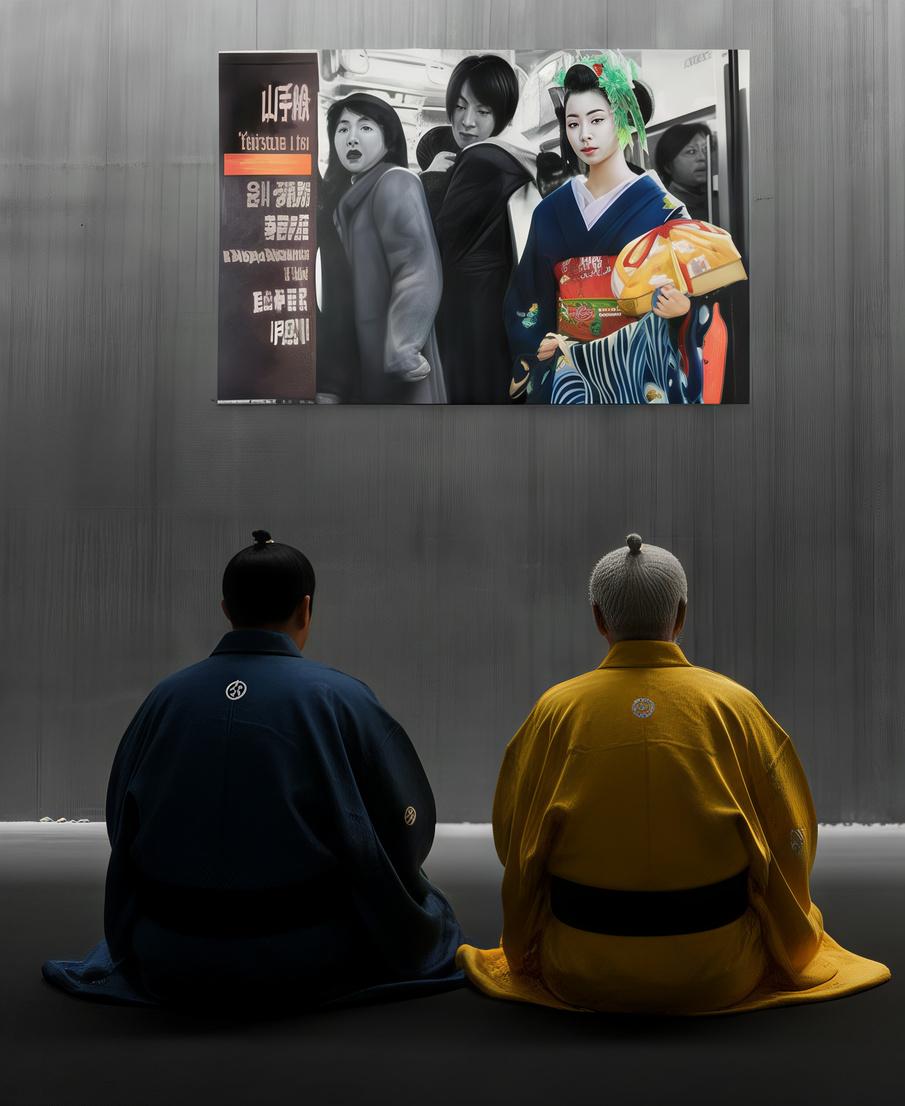
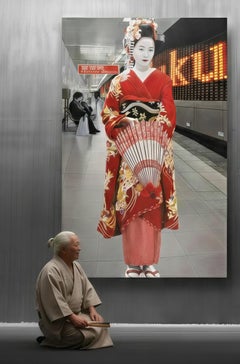
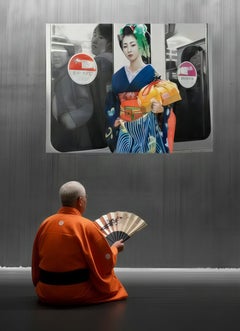
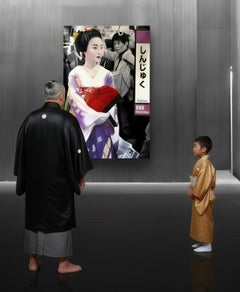
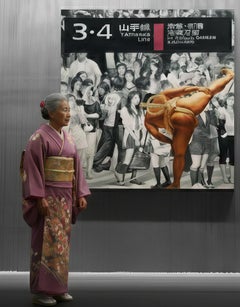
Created within the series Serenity Amidst Shadows : Geishas in the Monochromatic Urban Ensemble, the composition centers on a geisha dressed in vivid green, positioned inside one of Tokyo’s most emblematic transit spaces.
The presence of JR signage and Shinjuku Station anchors the scene in a precise, recognizable location, deeply embedded in contemporary Japanese life.
What is ordinarily perceived as routine becomes, under Watanabe’s gaze, a suspended psychological space.
The surrounding crowd, rendered in black and white, merges with the architecture, forming a collective body shaped by repetition and habit.
In contrast, the geisha stands as a temporal interruption, detached from the velocity of the commute.
Her colored kimono introduces memory and cultural continuity into an environment governed by efficiency and flow.
The figure’s upright posture suggests inward focus rather than outward engagement.
Movement is present, yet emotionally muted, absorbed by schedules and infrastructure.
The “silence” evoked in the title is internal, reflecting mental withdrawal amid constant circulation.
Watanabe captures the understated fatigue and quiet endurance of metropolitan existence.
The rigid geometry of escalators, signage, and walls structures the composition with architectural precision.
This strict framework heightens the contrast with the organic folds and gestures of traditional dress.
The work questions how ritual, identity, and heritage persist within standardized urban systems.
As a major member of the Japanese studio CrazyNoodles, founded by Hiro Ando, Watanabe brings a distinctly human perspective to the Nippon Neo-Pop movement.
Her practice is marked by an acute sensitivity to spaces of transition and their unspoken emotional weight.
JR : Silent Commute exemplifies her ability to reveal quiet poetry within ordinary gestures.
Through its precise urban anchoring and contemplative tone, JR : Silent Commute emerges as a compelling work within contemporary Japanese Neo-Pop.
A thoughtful acquisition for collectors drawn to artworks that transform everyday environments into introspective reflections on time, routine, and cultural persistence.
LITERATURE ABOUT THE SERIE " Serenity Amidst Shadows : Geishas in the Monochromatic Urban Ensemble "
The series Serenity Amidst Shadows : Geishas in the Monochromatic Urban Ensemble marks a significant chapter in the artistic trajectory of Ryoko Watanabe, where tradition and modernity intersect through a visual language both restrained and deeply contemporary.
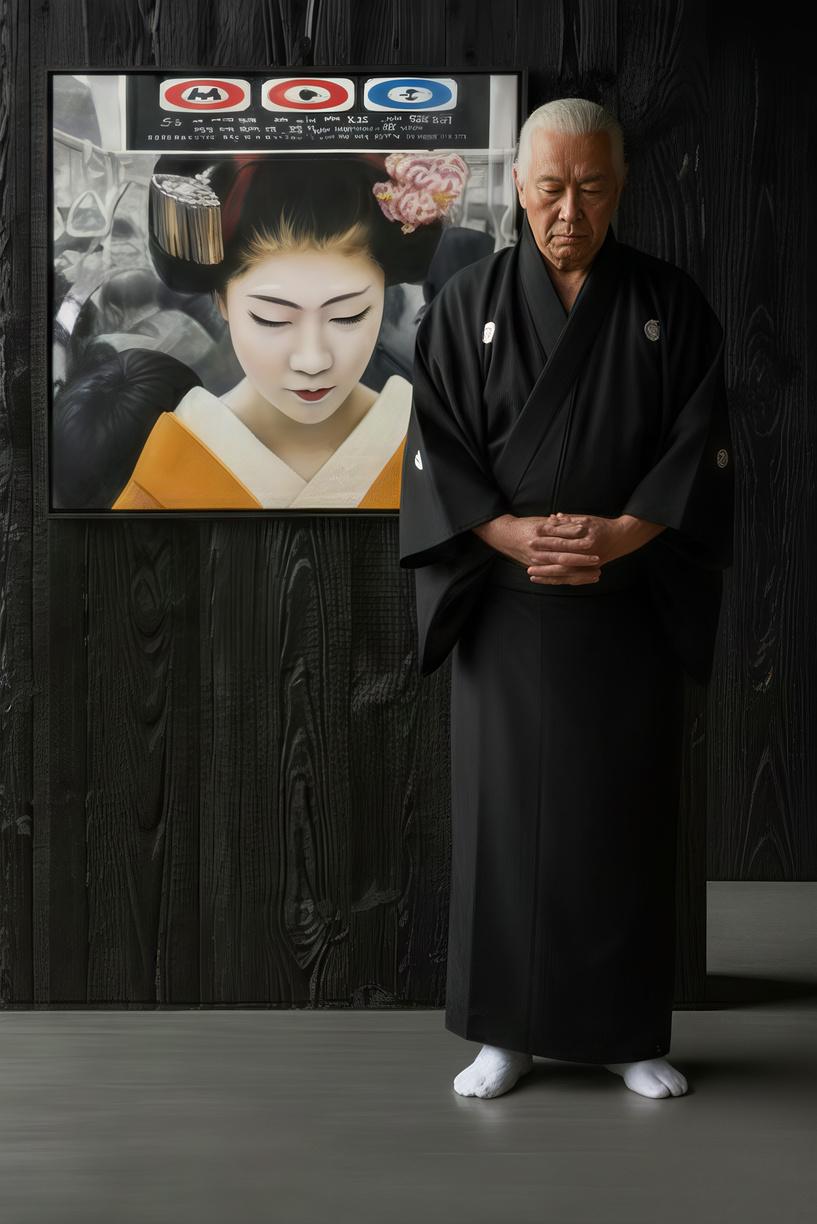
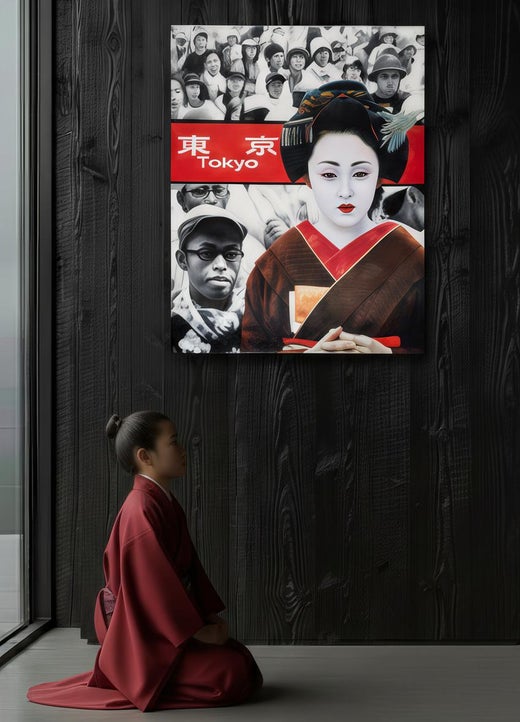
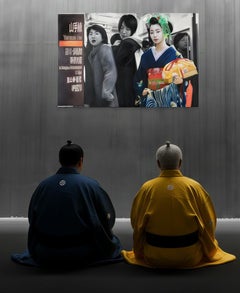
Across these works, Watanabe portrays geishas in vibrant traditional attire set against urban environments rendered in black and white.
This chromatic contrast operates as a metaphor for the coexistence of cultural heritage within a rapidly homogenizing society.
The geisha emerges as a figure of continuity, anchoring the composition amidst the fluidity of city life.
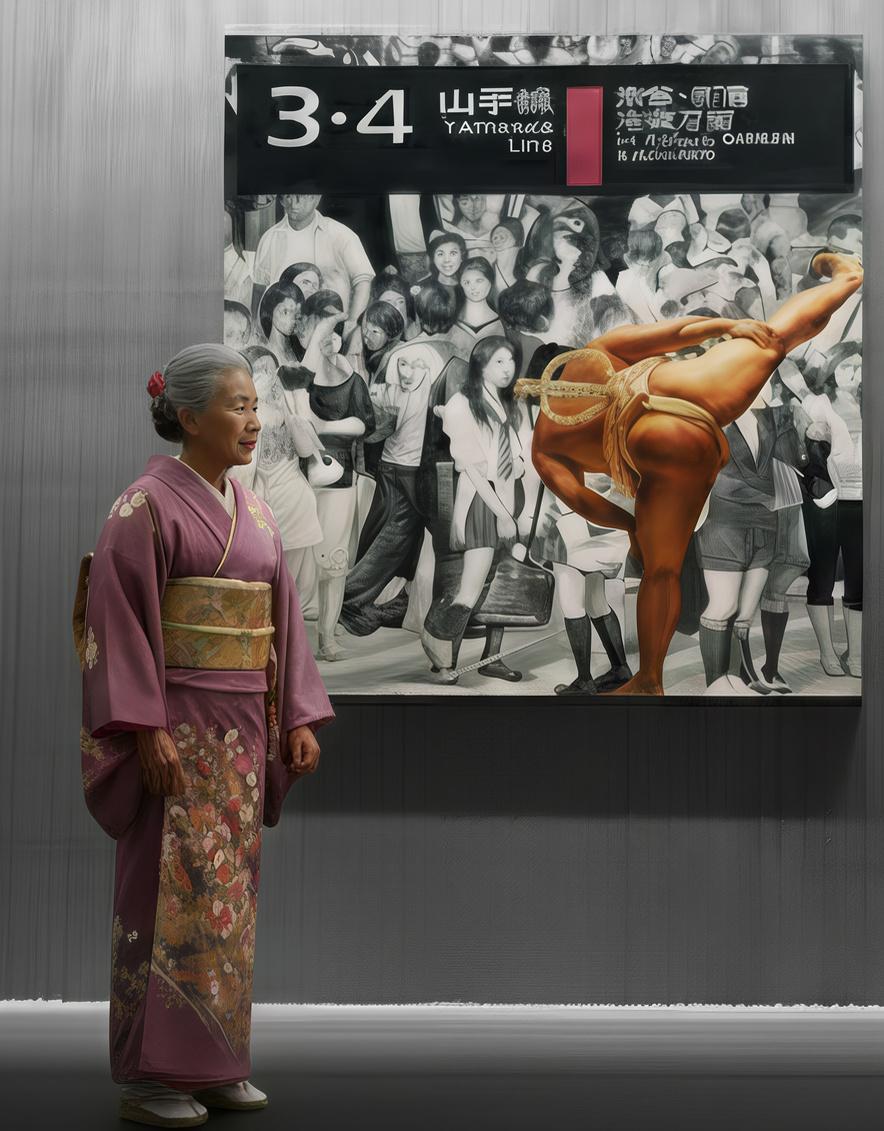
The surrounding crowds, often dense and anonymous, evoke the gradual dissolution of individuality within large metropolitan spaces.
Watanabe does not depict these crowds as antagonistic, but as reflections of a social order driven by efficiency and collective rhythm.
Urban transit signage plays a crucial compositional role, emphasizing direction, structure, and the repetition of daily routines.
These graphic elements underscore the mechanized tempo that defines contemporary urban existence.
Against this backdrop, the geisha embodies introspection, discipline, and an awareness of self that resists dissolution.
Her composed posture introduces a moment of visual pause within the flow of movement.
The series suggests that tradition can adapt without losing its essence.
The grayscale crowds function as psychological landscapes as much as physical settings.
They mirror the uniquely Japanese experience of shared proximity paired with emotional restraint.
Watanabe proposes that modernity does not erase cultural identity, but continuously reshapes it.
The geisha is never portrayed as nostalgic; she belongs fully to the present moment she inhabits.
This coexistence reveals a meditation on the balance between memory and adaptation.
Psychologically, the works reflect a keen awareness of the pressures exerted by collective environments on personal identity.
The artist appears drawn to moments where individuality persists within uniformity.
Transit spaces become zones of reflection rather than mere passage.
Each composition captures a suspended instant that invites the viewer to slow their gaze.
The geisha serves as a mirror for the inner tensions experienced by contemporary urban dwellers.
Watanabe explores the idea of discreet visibility, where presence does not demand spectacle.
Her approach aligns with the aesthetics of the Nippon Neo-Pop movement, blending traditional iconography with current social concerns.
Taken as a whole, the series offers a visual meditation on cultural resilience in the face of global standardization.
Through compositional precision, symbolic richness, and emotional subtlety, Serenity Amidst Shadows : Geishas in the Monochromatic Urban Ensemble stands as a compelling reflection on identity, memory, and the evolving place of the individual within contemporary Japanese society.