Want more images or videos?
Request additional images or videos from the seller
1 of 8

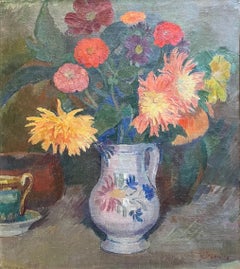
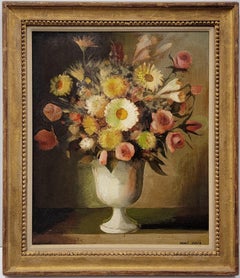
Nicolai Cikovsky
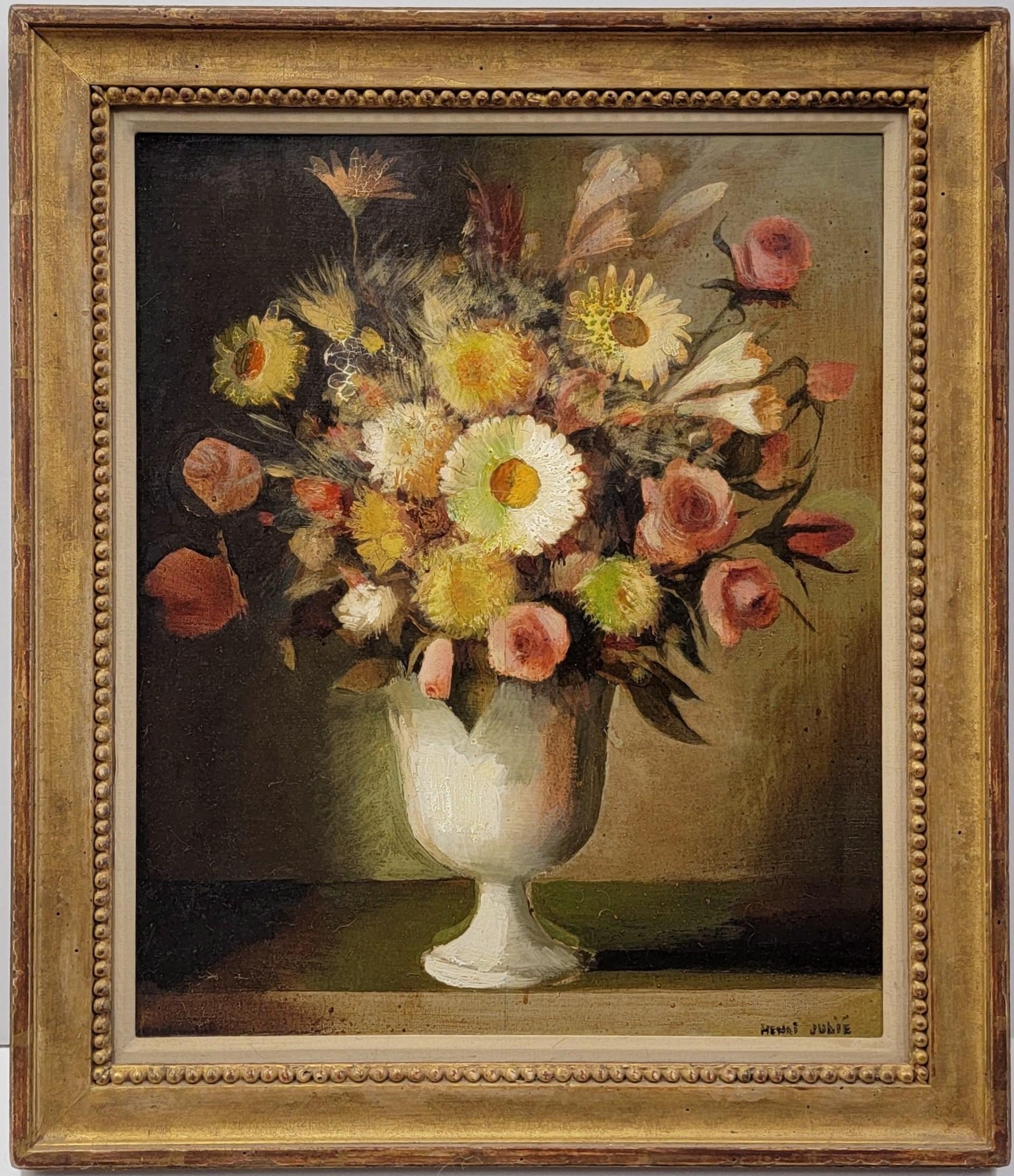
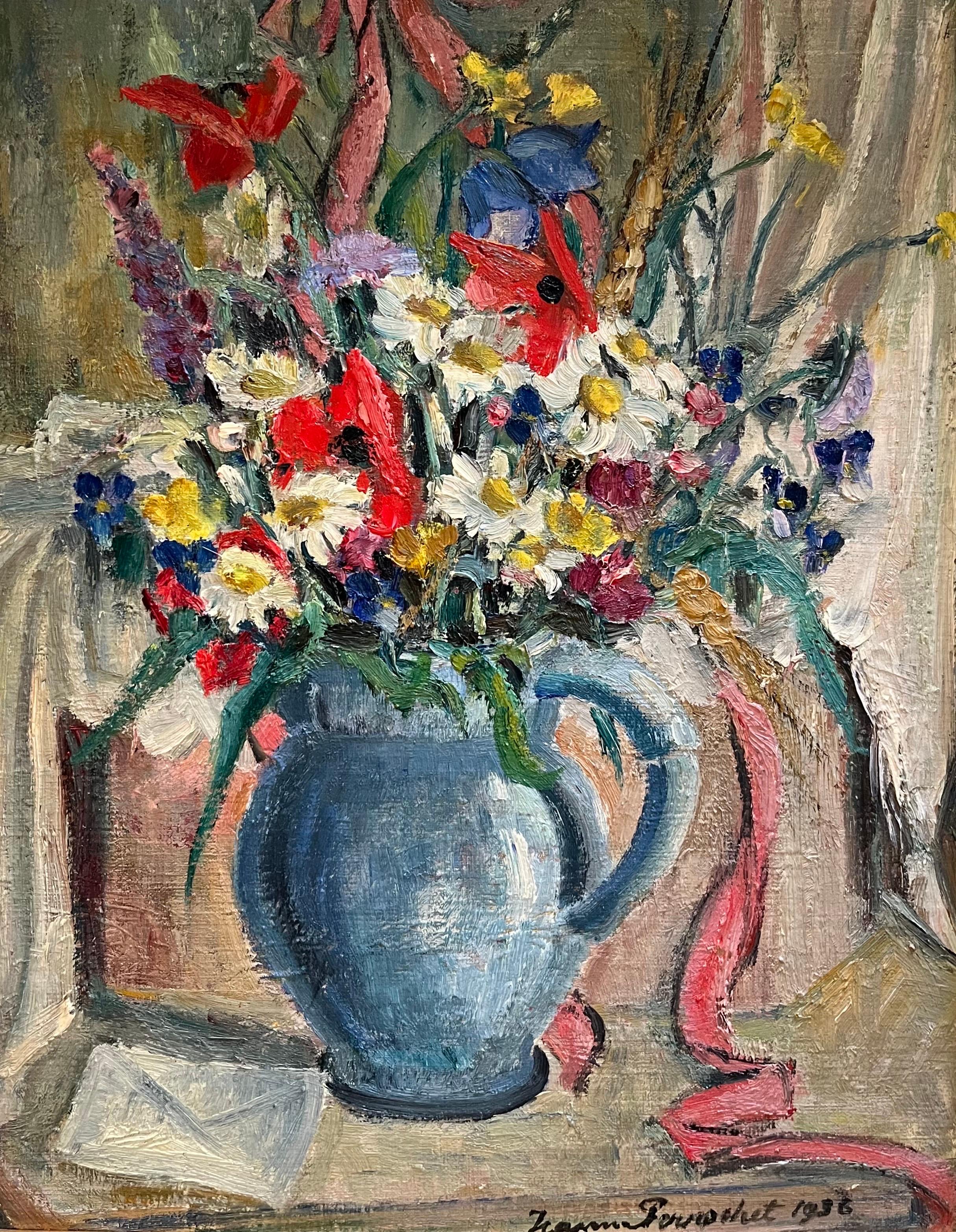
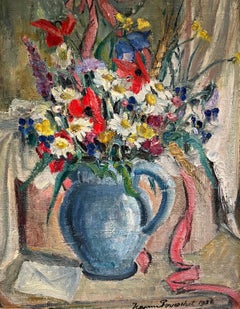
“Bouquet in Porcelain Pitcher”

Circa 1950

$1,875
$3,75050% Off
£1,417.56
£2,835.1250% Off
€1,654.84
€3,309.6850% Off
CA$2,668.03
CA$5,336.0750% Off
A$2,706.24
A$5,412.4850% Off
CHF 1,545.34
CHF 3,090.6850% Off
MX$32,773.46
MX$65,546.9250% Off
NOK 18,192.41
NOK 36,384.8250% Off
SEK 18,132.03
SEK 36,264.0650% Off
DKK 12,370.05
DKK 24,740.1050% Off

About the Item

Oil on artist board painting of a bouquet in porcelain pitcher by the American artist Nicholai Cikovsky. Signed lower right. In good condition. In contemporary gold leaf frame 27 by 23 inches. Nicolai Cikovsky, Russian/American (1894 - 1984) Nicolai Cikovsky painted figure subjects, landscapes, portraits and still lifes, working in a simplified Realist manner that reflects his earlier exposure to modern European art. During the 1930s and 1940s, he was linked with American Scene painting and Social Realism in New York, creating works of art that were acclaimed for their strength, vitality and individuality of expression. Later in his career, his paintings took on a more lyrical note as he responded to the light, color and scenic beauty of eastern Long Island. Cikovsky was born in Pinsk, Poland. The son of a fisherman and his wife, he was encouraged to paint and draw at an early age. He went on to receive his formal art training in Russia, studying at the Vilna Art School (1910-14), where Chaim Soutine was a fellow pupil, and at the Penza Royal Art School (1914-18), where he met the vanguard painter Vladimir Tatlin. Following this, Cikosvky attended classes under Favorsky and Mashkow at the Moscow Technical Institute of Art (1921-23), known for its promotion of progressive modes of painting. From 1919 until 1921 he was an instructor at the Ekaterinenburg Higher Technical Art Institute. During these years, Cikovsky’s painting style was influenced by avant-garde European art, ranging from the Post-Impressionism of Paul Cézanne and the Fauvism of Henri Matisse to styles such as Cubism, Futurism and Constructivism. Seeking greater opportunities to sell and exhibit his work, Cikovsky immigrated to the United States in 1923, settling in New York; unfortunately, he had to leave all his early paintings behind. He initially supported himself by working as a theatrical designer and a commercial muralist, while painting in his spare time. In 1926, he exhibited one of his Cubo-Futurist paintings at Kathryn Dreier’s International Exhibition of Modern Art, held at the Brooklyn Museum. In 1930, Cikovsky had his first one-man show at the Daniel Gallery in New York and soon found a market for his paintings. It was around this time that he met the painter Raphael Soyer, also a Russian émigré. Influenced by Soyer’s example, Cikovsky began to explore Social Realism, a thematic interest that reflected his growing belief that “the future of American art will be more closely identified with the working class.” This attitude was also sparked by his affiliation with the John Reed Club, the Artists Union Congress and the American Artists Congress. In addition to depicting aspects of daily life, especially in the vicinity of his East Fourteenth Street studio, Cikovsky also painted landscapes in Woodstock, New York and Massachusetts’s Cape Ann peninsula. During the 1940s, the artist spent five years in Washington, D.C., where he taught at the Corcoran School of Art. He also gave instruction at the Art Students League of New York, the St. Paul School of Art, the Cincinnati Art Academy, the College of Notre Dame in Maryland and the School of Art Institute of Chicago. Cikovsky worked in an advanced Realist manner, emphasizing flat color areas, rich, vibrant color and lush surfaces textures; as one commentator put it: “he seems enamored of the possibility of pigment, which in his hands has a lush richness of substance that is in itself a sensuous delight, yet he maintains a fine balance between the modern and the traditional.” In 1942, Cikovsky visited the North Sea area of Southampton, Long Island, at the invitation of the Russian-born painter David Burliuk. Attracted to the region, which had been a haven for artists since the late nineteenth century, he began spending his summers there, creating landscapes and beach scenes in oil, watercolor and tempera. He moved to Southampton permanently in the late 1970s, residing in a cottage on Wooley Pond. In his Long Island pictures, Cikovsky took a greater interest in color and light; as the aforementioned Soyer observed: “For me it was wonderful to watch Nick Cikovsky paint the white beaches, the ponds, the potato fields of Long Island. He loves moving clouds, shimmering sunlight on rippling water, and the multi-colored flowers in his own garden . . . If one could consider painting as poetry, then Nicolai Cikovsky may be called the poet of Long Island.” Not surprisingly, Cikovsky’s later work set an example for a number of Long Island painters, among them Jane Freilicher and Fairfield Porter. Cikovsky was the recipient of numerous awards and prizes, including the Harris Bronze Medal (1931) and the Logan Purchase Prize (1932) at the Art Institute of Chicago, three bronze medals at the Washington (D.C.) Society of Artists and purchase prizes at the Worcester Art Museum and the National Academy of Design among many others. In addition to his activity as a painter, he worked as a printmaker and as a muralist, executing decorations for the Department of Interior Building in Washington, D.C. and for post offices in Towson and Silver Spring, Maryland. Cikovsky died in Washington, D.C. Representative examples of his work can be found in important collections throughout the United States, including the Museum of Fine Arts, Boston; the Brooklyn Museum, Brooklyn, New York; the Art Institute of Chicago; Los Angeles County Museum of Art; the Metropolitan Museum of Art, New York; the Museum of Modern Art, New York; the Whitney Museum of American Art, New York; the Carnegie Museum of Art, Pittsburgh; and the Phillips Collection, Washington, D.C.
  • Creator:
    Nicolai Cikovsky (1894-1987, American, Russian)
  • Creation Year:
    Circa 1950
  • Dimensions:
    Height: 20 in (50.8 cm)Width: 16 in (40.64 cm)Depth: 1 in (2.54 cm)
  • Medium:
  • Movement & Style:
  • Period:
  • Condition:
  • Gallery Location:
    Southampton, NY
  • Reference Number:
    1stDibs: LU1412522031

More From This Seller

View All
“Bouquet in Porcelain Vase”

“Bouquet in Porcelain Vase”

Located in Southampton, NY

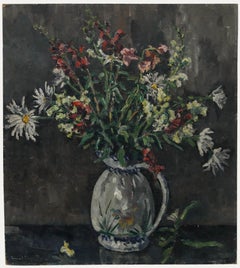
Here for your consideration is a very well done floral still life oil on canvas painting by the Yukoslavian/American artist, Marko Yukovic. Signed lower left. Circa 1960. Condition: Good. Overall measurements in original grey wash wood frame with faint gold highlights 18 by 22 inches. Biography Marko (Mark) Walker Vukovic From Yukoslavia, Marko Vukovic...

Category

1960s Post-Impressionist Still-life Paintings

Materials

Canvas, Oil

“Lasting Bouquet”

“Lasting Bouquet”

Located in Southampton, NY

Original oil pastel on archival paper of a beautiful bouquet of red and pink roses in an elegant vase. Signed lower right “Gini Toth”. Circa 1965. Titled verso. Artist name and addr...

Category

1960s Post-Impressionist Still-life Drawings and Watercolors

Materials

Oil Pastel, Archival Paper

“Flowers in Classical Urn”

“Flowers in Classical Urn”

By Edward Chalmers Leavitt

Located in Southampton, NY

Very fine example of the artistry of the master still life painter of his day, Edward Chalmers Leavitt. Signed lower left and dated 1875. Condition is very good. Provenance: Christie’s Auction, New York, December 2, 1992, lot 228. Overall in period replica gold leaf deep cove gallery frame 25.75 by 17.75 inches. Edward C. Leavitt (1842-1904) worked in Providence but is also associated with the Fall River School of still life painting through the influence of, and affinity of his style to, the work of Robert S. Dunning. Leavitt was a student of landscape painter James Morgan Lewin, a founder of Providence’s artistic “group of 1855.” Leavitt’s work is known for its realism, rich coloration, sharp focus and careful finish. His paintings of fruit and flowers incorporate ornate decorative pieces such as silver or bronze ewers, salvers, tankards, or plates on carved and polished tables. Leavitt was a prolific artist, exhibiting frequently at the National Academy of Design, the Boston Art Club, and the Pennsylvania Academy of Fine Arts. His work inspired other still life painters in Providence, resulting in that city’s own still life tradition, including artists such as John Clinton Spencer, Bryant Chapin...

Category

1870s Academic Still-life Paintings

Materials

Canvas, Oil

“Floral in Glass with Chinese Lantern”

“Floral in Glass with Chinese Lantern”

By Zhi Li

Located in Southampton, NY

Beautiful contemporary oil on canvas panel painting of an elaborate floral still life by the female Chinese artist Zhi Li. Signed by the artist lower left. Executed in 2026. Salmag...

Category

2010s Contemporary Still-life Paintings

Materials

Oil

“Spring Bouquet”

“Spring Bouquet”

Located in Southampton, NY

Original oil paint on heavy card stock of a lovely spring bouquet of pink flowers by the American impressionist artist, Bird Lefever. Signed lower left...

Category

1930s Post-Impressionist Still-life Paintings

Materials

Oil, Cardboard

“Still Life with Flowers and Fruit”

“Still Life with Flowers and Fruit”

By John Russell

Located in Southampton, NY

Beautifully painted oil on canvas still life with vase of flowers and a glass bowl of fruit. In the background is a painting of a young woman. Artist monogram lower right. The mon...

Category

1970s Post-Impressionist Still-life Paintings

Materials

Canvas, Oil

You May Also Like

Flowers in a Pitcher by Fernand Blondin - Oil on Canvas - 52x60 cm

Flowers in a Pitcher by Fernand Blondin - Oil on Canvas - 52x60 cm

By Fernand Blondin

Located in Geneva, CH

Fernand Blondin (1887-1967) was a Swiss painter and teacher, celebrated for his depictions of idyllic rural life, interiors, female nudes, portraits, still-lifes, religious subjects ...

Category

Mid-20th Century Modern Still-life Paintings

Materials

Canvas, Oil

Immanuel Meyer-Pyritz (1902-1974) - Oil, Flowers in a Ceramic Jug

Immanuel Meyer-Pyritz (1902-1974) - Oil, Flowers in a Ceramic Jug

Located in Corsham, GB

This intimate still life depicts a generous bouquet of wildflowers arranged in a beautiful ceramic jug. White daisies, pink and red blooms, and delicate yellow flowers stand out agai...

Category

Mid-20th Century Still-life Paintings

Materials

Oil

Bouquet in pitcher

Bouquet in pitcher

By Stéphanie Guerzoni

Located in Genève, GE

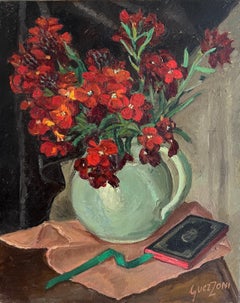
Work on canvas This work features an exquisite harmony of colors and textures that immediately captures attention. In the center, a smooth-finished, creamy white ceramic vase holds ...

Category

Mid-20th Century Still-life Paintings

Materials

Oil

Bright & Cheerful French Modernist Signed Oil Still Life Flowers in Vase

Bright & Cheerful French Modernist Signed Oil Still Life Flowers in Vase

By Huguette Ginet-Lasnier

Located in Cirencester, Gloucestershire

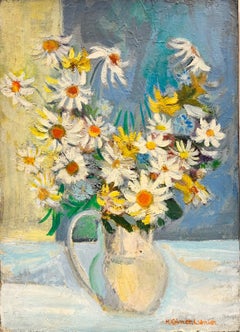
Flowers in Vase Huguette Ginet-Lasnier (French 1927-2020) signed inscribed verso oil painting on canvas 18 x 13 inches. All the paintings we have for sale by this artist have come fr...

Category

21st Century and Contemporary Modern Still-life Paintings

Materials

Canvas, Oil