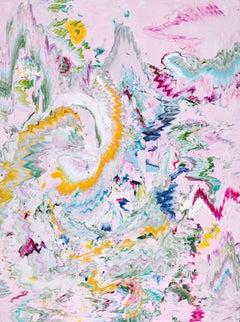
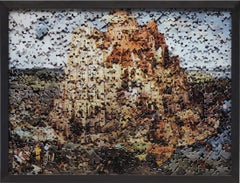
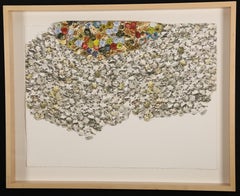
Haystack, After Monet #3 was created by Vik Muniz for his 'Pictures of Color' series. The art is 47.5 x 67 inches and the framed size is 52.25 x 72.5 inches. There is a label on the verso with the artist's signature and edition number AP 1/5. From the total edition of 15 of which there were 10 Arabics and 5 APs. Framed in the original artist's frame.
Literature:
Pedro Corrêa do Lago, Vik Muniz: Obra Completa 1987-2009, Rio de Janeiro, 2009, pg.456.
Vik Muniz — Haystack, After Monet #3 (from Pictures of Color)
Vik Muniz’s Pictures of Color series stands at a pivotal moment in the evolution of visual culture. Conceived for the Venice Biennale, the series responds to the year when digital cameras first outsold film cameras worldwide, a symbolic tipping point in how images are made, shared, and believed. While exploring Venice’s long tradition of mosaic art, Muniz recognized a striking parallel between ancient mosaics and the emerging digital pixel: both construct images from countless discrete units, inviting viewers to experience perception as an assembly of parts.
In Pictures of Color, Muniz replaces the pixel with a tactile, analog counterpart: Pantone color chips. Each work is composed of thousands of hand-placed squares, arranged with meticulous precision to form images that appear crisp and cohesive at a distance. As the viewer approaches, the illusion dissolves into grids of pure color. This oscillation between clarity and fragmentation, between image and code, lies at the heart of the series. Muniz reveals the mechanics behind seeing in the digital age, prompting the viewer to consider how images are built, translated, and trusted.
Within this broader project, Muniz created a subseries dedicated to reinterpreting Monet’s iconic haystacks. Monet’s original paintings were themselves explorations of perception: studies of how changing light and atmosphere transform a simple rural structure into a shifting field of color. Muniz extends this inquiry into the twenty-first century, reconstructing the familiar form through the visual logic of digital culture.
Haystack, After Monet #3 is a standout example. The work captures the warmth and luminosity of Monet’s palette—soft violets, ambers, and rose-gold tones—while reimagining the composition through thousands of colored squares. From afar, the image glows with Impressionist softness; up close, it breaks into a lyrical mosaic of Pantone chips, each a precisely chosen modern “pixel.” This dual experience embodies Muniz’s central theme: that every image, whether painted, printed, or digitally rendered, is a mosaic of choices and codes.
The result is a work that is both conceptually rigorous and visually captivating. It honors Monet’s legacy while speaking directly to the mechanisms of contemporary vision. Haystack, After Monet #3 bridges craft and technology, past and future, inviting viewers to reflect on how the world has come to be mediated through grids of color and light.
For collectors, the piece represents one of Muniz’s most resonant explorations of how images function—and how they evolve. It is a signature work from a series recognized for its innovation, its beauty, and its relevance in an era defined by digital perception.