Cy Twombly
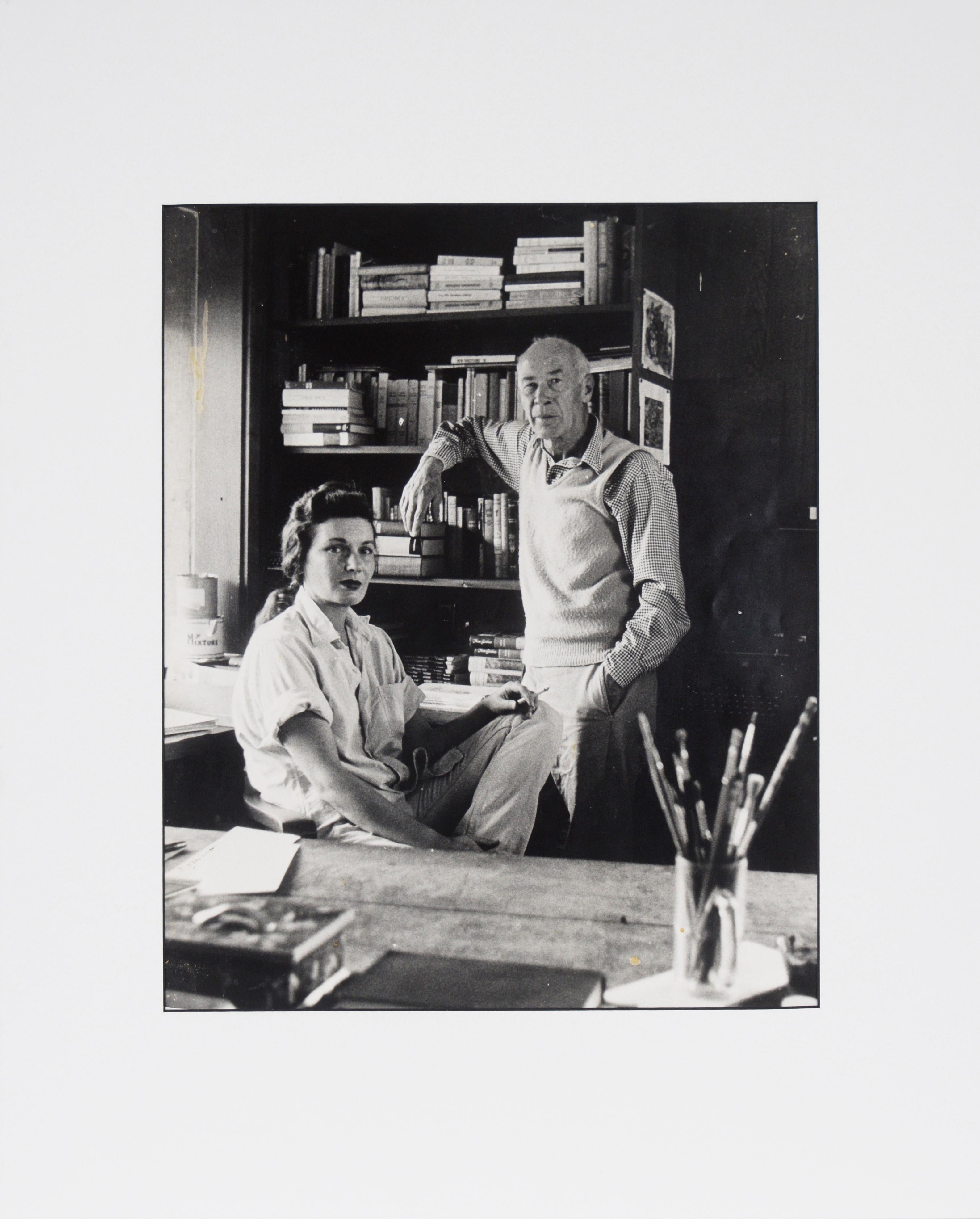
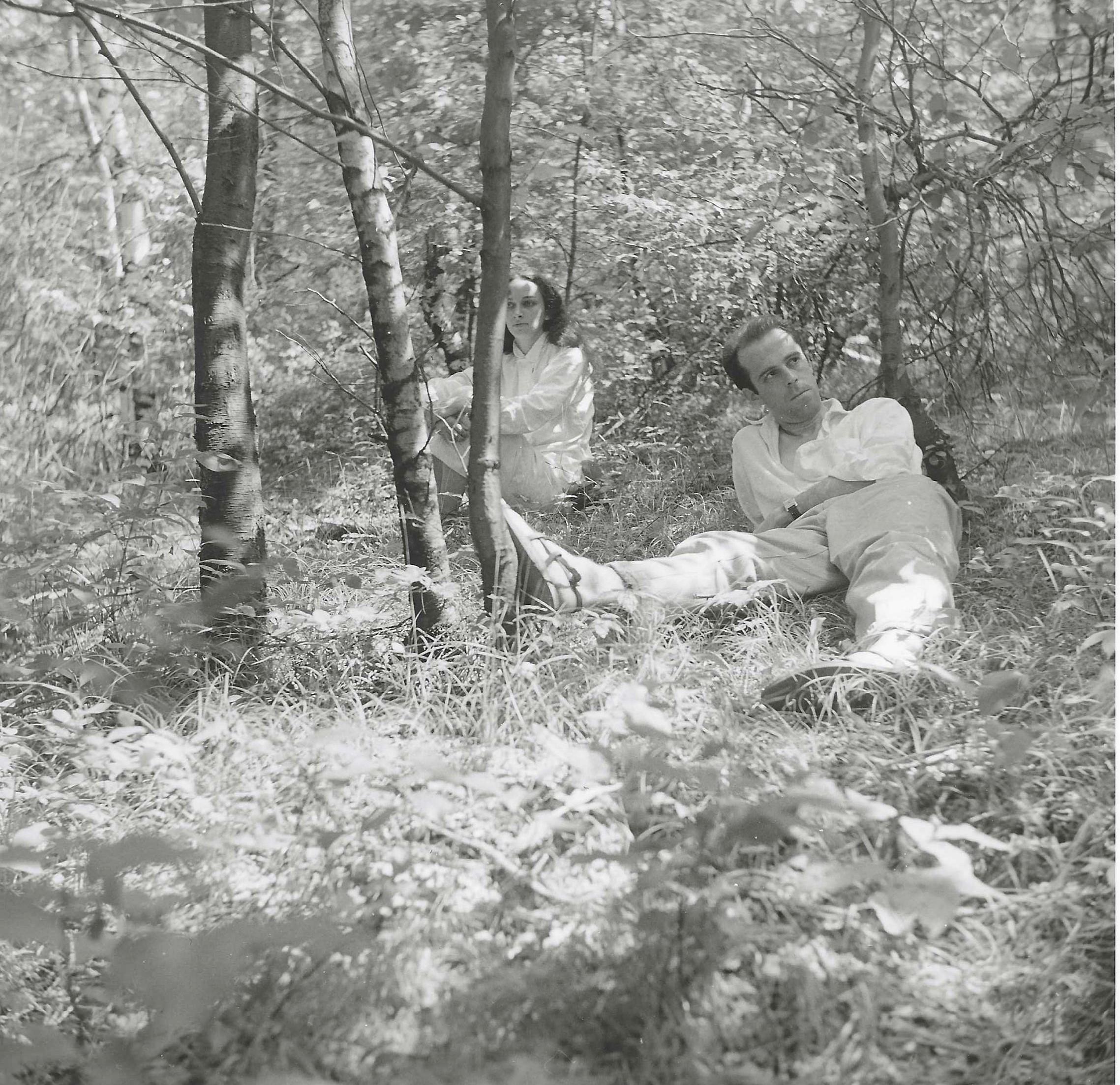
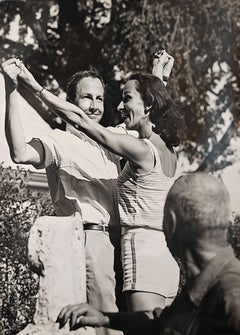
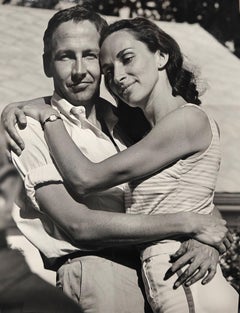
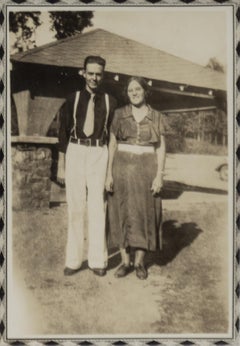
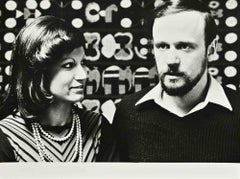
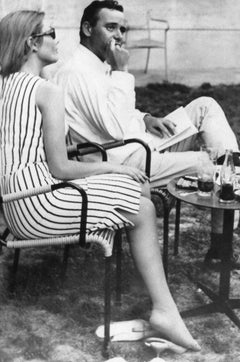
Earle and Carolyn Brown at the Stevenson's in Brewster, 1955
Identified and inscribed on the reverse by the sitter Carolyn Brown
Photograph on paper
8 x 8 inches
Provenance
Gift of the artist
Estate of Carolyn Brown, New York 2025.
Cy Twombly gained fame for his art that combined cultural, historical, and poetic elements—particularly those from classical antiquity—with abstract shapes and his distinctive script. Born Edwin Parker Twombly, Jr. on April 25, 1928, in Lexington, Virginia, he began his artistic journey under the guidance of Pierre Daura and Marion Junkin at Washington and Lee University. This initial training was complemented by his formative experiences at the Arts Students League of New York and Black Mountain College, where he established enduring friendships with influential figures like Robert Rauschenberg, John Cage, and Merce Cunningham.
A pivotal moment for Twombly was his 1952 trip to Italy and North Africa with Rauschenberg, funded by a grant from the Virginia Museum of Fine Arts. This journey allowed Twombly to engage deeply with the rich cultural history that would inform his future artistic endeavors, leading to the creation of significant early pieces.
Twombly made his way back to Italy in 1957 and 1958, during which he presented his first solo exhibition in Italy at Galleria La Tartaruga, owned by Plinio De Martiis. In 1959, he married Luisa Tatiana Franchetti, a photographer, painter, and collector of unique Indian and Middle Eastern textiles, in New York. They returned to Italy, where Twombly would spend part of every year for the remainder of his life.
The early 1960s marked a productive era for Twombly, known for his lengthy periods of reading and reflection before engaging in painting during intense, sporadic bursts. Throughout the 1970s, Twombly grew disillusioned with life in Rome; a shift that his longtime assistant and archivist, Nicola Del Roscio, linked to the suicide of their friend Nini Pirandello in 1971. As a result, Twombly spent increasing amounts of time in other regions of Italy, especially in Bassano in Teverina, where he renovated a palazzo alongside Giorgio Franchetti. It was in this setting that he embraced pastoral themes. Bassano in Teverina was also where Twombly created the initial of his major painting cycles, Fifty Days at Iliam (1978), which is now permanently exhibited at the Philadelphia Museum of Art.
The 1980s encompassed significant travels, notably to Luxor, Egypt, while the artist relocated within Italy to Gaeta, a seaside town introduced to him by Del Roscio. He spent a substantial part of the last twenty years of his life there, frequently returning to Lexington, where he kept a studio. In the 1990s, Twombly increasingly focused on monumental pieces. The last ten years of his career were characterized by an emphasis on Bacchic themes and large floral works inscribed with poetry. He passed away on July 5, 2011, in Rome.
Throughout his artistic journey, Twombly maintained a highly distinctive vision shaped by his extensive intellectual pursuits, steering clear of both the overarching machismo of Abstract Expressionism and the polished, industrial nonreferentiality of Minimalism. Instead, he resided within his own peculiar imagination, consistently existing at a unique angle relative to the New York art scene he departed from. The distinctiveness of his vision gained recognition later in his life, attracting numerous accolades.
Although notoriously private, Twombly fostered profound intellectual relationships throughout his life with individuals such as poet Patricia Waters and other artists like photographer Sally Mann. This circle also included both historical figures and fictional characters, due to his extensive book collection, which featured long-standing engagements with James Joyce, Rainer Maria Rilke, D. H. Lawrence, Alexander Pope, Homer, and Plato, among others. This fusion of present and historical intellectual interactions is evident throughout his work. With remarkable consistency, Twombly sought to establish the clear and singular vision articulated in his early fellowship application to the Virginia Museum of Fine Arts: “to establish is that Modern Art isn’t dislocated, but something with roots, tradition and continuity. ”