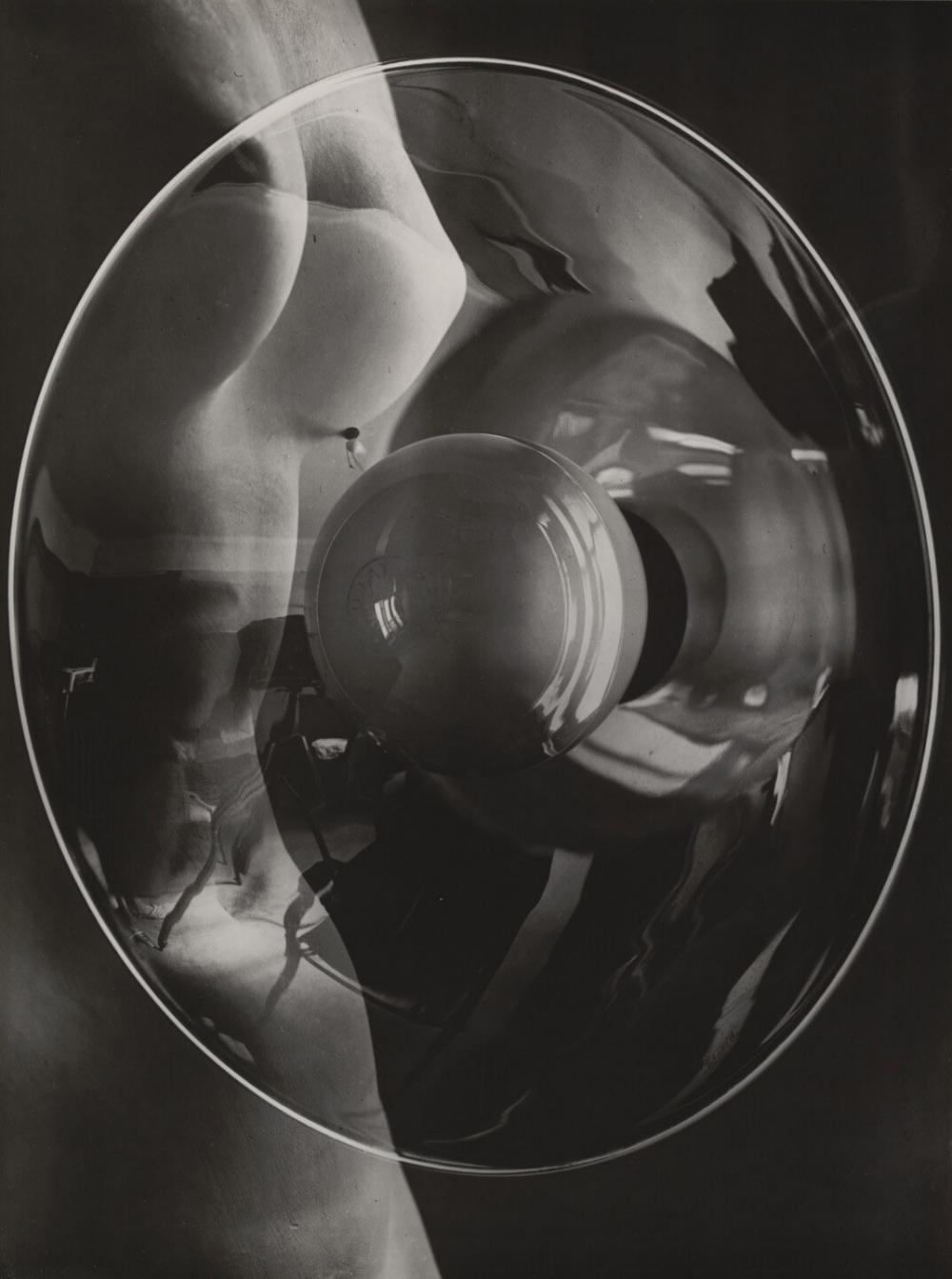
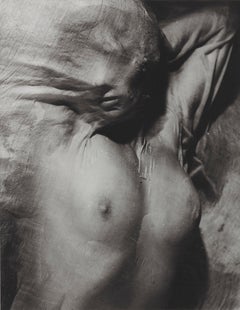
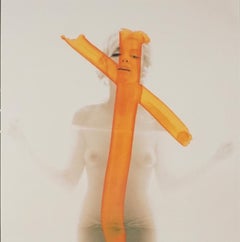
This exquisite heliogravure after Erwin Blumenfeld (1897–1969), titled The Devil's Cross, originates from the 1981 folio Erwin Blumenfeld, Electa Editrice Portfolios. Published by Gruppo Editoriale Electra S.P.A., Milano, and printed by Gruppo Editoriale Electra S.P.A., Milano, 1981. This haunting composition exemplifies Blumenfeld’s mastery of surrealist experimentation and photographic abstraction. Through the interplay of light, shadow, and form, The Devil's Cross reveals his fascination with psychological dualities—beauty and fear, elegance and distortion—transformed into visual poetry. Blumenfeld’s technique of manipulating negatives and tonal contrast imbues the image with an ethereal and unsettling quality, epitomizing his lifelong exploration of illusion and identity within the human figure.
Executed as a heliogravure on velin paper, this work measures 15.75 x 11.75 inches. Unsigned and unnumbered as issued. The edition exemplifies the refined craftsmanship of Gruppo Editoriale Electra, Milano.
Artwork Details:
Artist: After Erwin Blumenfeld (1897–1969)
Title: The Devil's Cross
Medium: Heliogravure on velin paper
Dimensions: 15.75 x 11.75 inches (40.01 x 29.84 cm)
Inscription: Unsigned and unnumbered as issued
Date: 1981
Publisher: Gruppo Editoriale Electra S.P.A., Milano
Printer: Gruppo Editoriale Electra S.P.A., Milano
Condition: Well preserved, consistent with age and medium
Provenance: From the folio Erwin Blumenfeld, Electa Editrice Portfolios, published and printed by Gruppo Editoriale Electra S.P.A., Milano, 1981
Notes:
Excerpted from the folio (translated from Italian), Editor, Daniela Palazzoli. Limited edition of M examples, drawn in heliogravure on special paper, designed specifically for the Portfolios Electa. Printed in Italy.
About the Publication:
The Erwin Blumenfeld, Electa Editrice Portfolio (1981) was published by Gruppo Editoriale Electra S.P.A., Milano, as part of the prestigious Electa Portfolios series honoring the great masters of 20th-century photography. Each edition in the series was printed using the artisanal heliogravure process on specially designed velin paper created exclusively for these portfolios. The Blumenfeld edition presents a selection of his most striking and experimental works—images that fused avant-garde surrealism with the precision and allure of high fashion. This folio celebrates Blumenfeld’s unique ability to merge abstraction and elegance, embodying the technical sophistication and visual daring that defined his career. The publication stands as both a scholarly and aesthetic tribute, preserving the tonal subtlety and depth of Blumenfeld’s original prints while exemplifying Italian mastery in fine art printing. Produced in collaboration with editor Daniela Palazzoli, the folio remains an essential collector’s reference for connoisseurs of modernist photography and 20th-century visual innovation.
About the Artist:
Erwin Blumenfeld (1897–1969) was a German-American photographer and one of the most daring and visionary innovators in 20th-century photography, whose groundbreaking work bridged the avant-garde and fashion worlds to redefine modern visual culture. Born in Berlin, he began his career as a painter and collage artist influenced by Dada and Surrealism before turning to photography in the 1920s, where he developed a radical style rooted in experimentation, abstraction, and psychological depth. Deeply inspired by photographic pioneers such as Gustave Le Gray, Joseph-Philibert Girault de Prangey, Alfred Stieglitz, Edward Steichen, Paul Strand, August Sander, Andre Kertesz, Henri Cartier-Bresson, Brassai, Bill Brandt, Edward Weston, and Man Ray, Blumenfeld absorbed their formal mastery and technical innovation while forging his own surreal and sensual visual language. His early experiments in solarization, reflection, and double exposure revealed the influence of Laszlo Moholy-Nagy and the Bauhaus, transforming the camera into a tool for psychological exploration rather than mere documentation. After moving to Paris in the 1930s, he became one of the era’s leading fashion photographers, creating iconic covers for Vogue and Harper’s Bazaar that fused surrealism, modernist design, and dreamlike color abstraction, positioning him alongside Edward Steichen as one of the architects of fashion photography’s golden age. His later work in New York during World War II introduced bold color techniques using Kodachrome and complex studio lighting, elevating him into the ranks of Irving Penn, Richard Avedon, and Helmut Newton as a master of elegance and visual innovation. Blumenfeld’s experimental manipulation of light, texture, and form—fragmenting, layering, and reimagining the human figure—transcended the boundaries between art and commerce and inspired generations of photographers and artists. His surreal approach and fascination with identity and illusion directly influenced Cindy Sherman’s performative photography, Jeff Wall’s cinematic tableaux, Richard Prince’s conceptual appropriations, and the provocative personas of Gilbert and George, while his compositional precision anticipated the monumental, architectural vision of Andreas Gursky, Thomas Ruff, Thomas Struth, and Wolfgang Tillmans. His ethereal sensuality and technical refinement also reverberate through the works of Robert Mapplethorpe, Irving Penn, and Helmut Newton, while the psychological and aesthetic depth of his images continues to resonate in the art of Gregory Crewdson, Vik Muniz, Philip-Lorca diCorcia, Nan Goldin, Daido Moriyama, Sebastiao Salgado, Peter Beard, William Eggleston, Lee Friedlander, Garry Winogrand, Stephen Shore, and Hiroshi Sugimoto. Like Robert Frank, he viewed photography as a tool for philosophical inquiry; like Edward Weston, he pursued perfection of form; and like Man Ray, he embraced the surreal tension between beauty and mystery. Blumenfeld’s photographs are held in major institutions including the Museum of Modern Art in New York, the Victoria and Albert Museum in London, the Centre Pompidou in Paris, and the J. Paul Getty Museum in Los Angeles, and his visionary legacy endures as a cornerstone of modern photography. Bridging the classical refinement of Alfred Stieglitz and Edward Steichen with the conceptual sophistication of Cindy Sherman, Jeff Wall, and Andreas Gursky, Blumenfeld remains a singular figure whose influence spans nearly every facet of visual art. His highest auction record was achieved by his photograph Nude (1937), which sold for 360,000 USD at Sotheby’s, New York, on April 5, 2011, affirming his place among the most innovative, influential, and collectible photographers in the history of modern art.
Erwin Blumenfeld The Devil's Cross, Electa heliogravure 1981, Gruppo Editoriale Electra Milan, Erwin Blumenfeld collectible print.