Want more images or videos?
Request additional images or videos from the seller
1 of 13

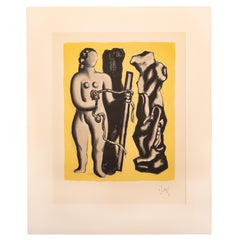
(after) Fernand Léger
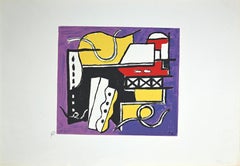
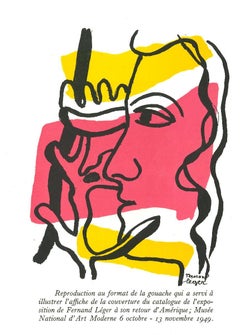
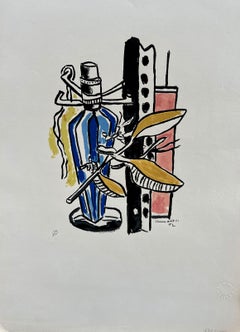
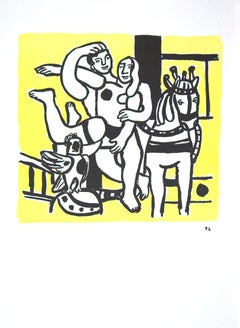
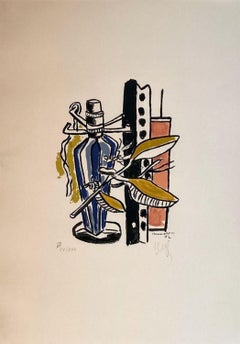
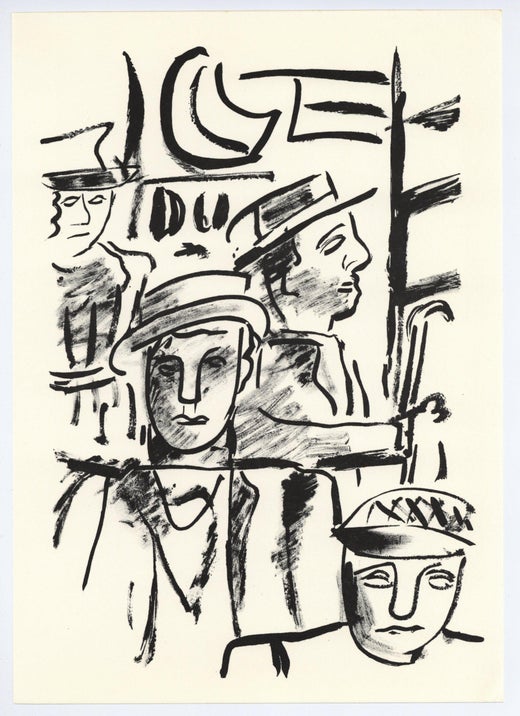
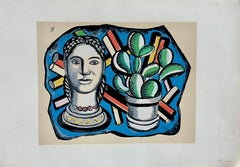
Fernand Leger Colorful Modernist Drawing Limited Edition Serigraph Lithograph

c.1950's

$750List Price

You May Also Like

Colorful lithograph part of a collection of 6 serigraphie. Original and signed .

Colorful lithograph part of a collection of 6 serigraphie. Original and signed .

By Fernand Léger

Located in Belgrade, MT

This print is part of my private collection. They were published in a numbered unsigned edition of 1000, and a signed edition of 200, printed by Serifraphie Fernand Leger, Paris and ...

Category

Mid-20th Century Abstract Expressionist Abstract Prints

Materials

Lithograph

Composition - Lithograph after Fernand Leger - Mid-20th Century

Composition - Lithograph after Fernand Leger - Mid-20th Century

By Fernand Léger

Located in Roma, IT

Composition is a screen print realized after Fernand Léger in the mid-20th Century. Monogrammed in plate and hand numbered in pencil lower right. The composition is part of a colle...

Category

Mid-20th Century Cubist Figurative Prints

Materials

Lithograph

Composition a la Bouteille Bleue Print, Unsigned, 1954/55, 11x7.5 in

Composition a la Bouteille Bleue Print, Unsigned, 1954/55, 11x7.5 in

By (after) Fernand Léger

Located in Belgrade, MT

This print is part of my private collection. They were published in a numbered unsigned edition of 1000, and a signed edition of 200, printed by Serifraphie Fernand Leger, Paris and ...

Category

Mid-20th Century Cubist Abstract Prints

Materials

Lithograph

Le Jeu Lithograph by Fernand Léger, Modern 20th Century Art

Le Jeu Lithograph by Fernand Léger, Modern 20th Century Art

By Fernand Léger

Located in Brooklyn, NY

This reproduction lithograph, titled Le Jeu by Fernand Léger, is a beautifully crafted piece printed on high-quality ARCHES paper. Originally created in 1948, this lithograph capture...

Category

20th Century Modern Prints and Multiples

Materials

Lithograph

Album de 10 sérigraphies

Album de 10 sérigraphies

By Fernand Léger

Located in Paris, FR

Lithograph, 1951 Edition : 57/200 Publisher : Guilde internationale de la Gravure (Genève) Printer : Jean Bruller (Paris) Catalog : Sapphire E7 56.00 cm. x 38.00 cm. 22.05 in. x 14....

Category

1950s Abstract Abstract Prints

Materials

Lithograph

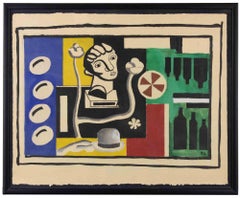
Nature Morte au Buste - Lithograph after Fernand Léger - 1959

Nature Morte au Buste - Lithograph after Fernand Léger - 1959

By Fernand Léger

Located in Roma, IT

Lithograph realized after Fernand Léger in 1959, on Moulin Richard de Bas paper. Monogrammed in the plate. It belongs to the suite "Contrastes", printed by Daniel Jacomet and publi...

Category

1950s Cubist Figurative Prints

Materials

Lithograph

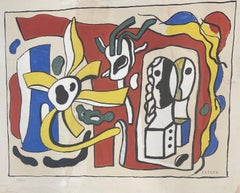
French Modern Art by Fernand Léger - Untitled

French Modern Art by Fernand Léger - Untitled

By Fernand Léger

Located in Paris, IDF

Lithography on paper printed in 40's, numbered 42/300, 54,5 x 75,5 x 0,1 cm - 21,4 x 29,7 x 0,04 in, printed by Moulot Editions Editions with the stamp Fernand Léger on Musee Biot pa...

Category

1940s Cubist Abstract Prints

Materials

Paper, Lithograph

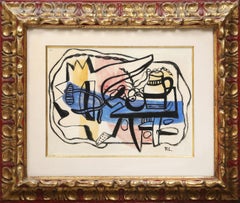
Composition, Original Modern Still Life Gouache Painting by Fernand Leger

Composition, Original Modern Still Life Gouache Painting by Fernand Leger

By Fernand Léger

Located in Long Island City, NY

Fernand Leger's depiction of a still life with a pitcher and bowl of fruit starts in simplistic and tangible reality on the right side of the composition before quickly devolving int...

Category

1950s Modern Still-life Drawings and Watercolors

Materials

Paper, Gouache

Original French MCM Modernist Signed Abstract Lithograph Fernand Leger 1952

Original French MCM Modernist Signed Abstract Lithograph Fernand Leger 1952

By Fernand Léger

Located in Portland, OR

Fernand Léger (1881-1955) Femme sur fond jaune (Woman Against Yellow Background), 1952 Created in 1952, this original color lithograph is hand signed in ink by Fernand Léger (1881 - 1955) in the lower right margin. Printed by Fernand Mourlot, Paris out of the total edition of 150 unnumbered proofs on Arches wove paper. We at Bloomsbury Fine Art & Antiques can...

Category

1950s Modern Figurative Prints

Materials

Paper

More From This Seller

View All
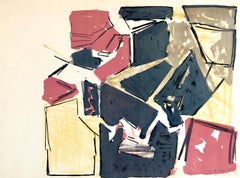
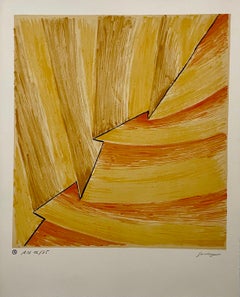
Israeli Josef Zaritsky Abstract Modernist Lithograph Print "Composition"

Israeli Josef Zaritsky Abstract Modernist Lithograph Print "Composition"

Located in Surfside, FL

Abstract Composition, 1959 Lithograph This was from a portfolio which included works by Yosl Bergner, Menashe Kadishman, Yosef Zaritsky, Aharon Kahana, Moshe Tamir and Michael Gross. Joseph (Yossef) Zaritsky (Hebrew: יוסף זריצקי‎; September 1, 1891 – November 30, 1985) was one of Israel's greatest artists and one of the early promoters of modern art in the Land of Israel both during the period of the Yishuv (Palestine, the body of Jewish residents in the Land of Israel before the establishment of the State of Israel) and after the establishment of the State. In 1948 Zaritsky was one of the founders of the "Ofakim Hadashim" group. In his works he created a uniquely Israeli style of abstract art, which he sought to promote by means of the group. For this work he was awarded the Israel Prize for painting in 1959. Joseph Zaritsky...

Category

1950s Modern Abstract Prints

Materials

Lithograph

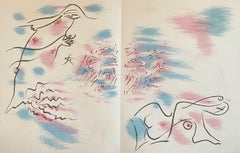
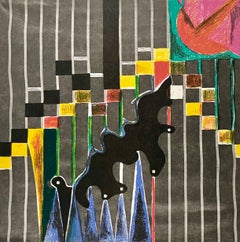
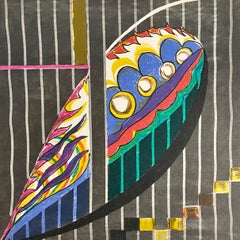
Feminist Surrealist French Abstract Colorful Lithograph Print Myriam Bat Yosef

Feminist Surrealist French Abstract Colorful Lithograph Print Myriam Bat Yosef

By Myriam Bat Yosef

Located in Surfside, FL

Myriam Bat-Yosef Surrealist abstract lithograph print in colorful abstract shapes and shades Hand signed and dated 1971. sheet measures 9.25 X 9.25 inches The envelope and the Peter Buch poster is just for provenance and is not included in this sale. Myriam Bat-Yosef, whose real name is Marion Hellerman, born on January 31, 1931 in Berlin, Germany to a Jewish family from Lithuania, she is an Israeli-Icelandic artist who paints on papers, paintings, fabrics, objects and human beings for performances. Myriam Bat-Yosef currently lives and works in Paris. In 1933, her family fleeing the Nazi Holocaust, Miriam Bat-Yosef emigrates to Palestine and settles in Jaffa. In 1936, she suffers a family tragedy, her father, militant Zionist, is called to fight, still recovering from an operation of appendicitis. The incision will become infected, antibiotics did not exist yet, and her father will die in the hospital after 9 months of suffering. Myriam and her mother leave Palestine to live in Paris for three years. French is Myriam's first school language. In 1939, still fleeing Nazism, she returned to Palestine, leaving France by the last boat from Marseille. She moved to Tel Aviv with her mother, aunt and maternal grandmother. In 1940, she began attending the Academy of Fine Arts in Tel Aviv and took her name as an artist, Bat-Yosef, which means Joseph's daughter in Hebrew, as a tribute to her father. In 1946, Myriam graduated as a kindergarten teacher but wanted to be an artist. Her mother enrolled her in an evening school to prepare a diploma of art teacher. At 19, she performs two years of military service in Israel. In 1952, with a pension of $50 a month that her mother allocated, she went to study at the Beaux-Arts in Paris. To survive, she has several activities while studying. In 1955, she had her first solo exhibition, at the Israeli Club on Wagram Avenue in Paris. Many artists, such as Yaacov Agam, Yehuda Neiman Avigdor Arikha, Raffi Kaiser, Dani Karavan and sculptors Achiam and Shlomo Selinger attended the opening . In 1956, she enrolled at the School of Fine Arts in Florence. This is where she meets the painter Errô. They share an icy studio in winter. Myriam moves to Milan with friends. She organizes a joint exhibition with Erro, one room each, at the Montenapoleone gallery. Her works are admired by the sculptor Marino Marini and the painters Renato Birolli and Enrico Prampolini. Myriam and Erro exhibit in Rome, Milan, Florence and meet many personalities: Alain Jouffroy and his wife, the painter Manina, Roberto Matta and his wife Malitte, textile artist who was one of the founders of the Pompidou Center. Back in Paris, Myriam and Erro get married, which allows Myriam to avoid being called into the Israeli army during the Suez Canal War. In 1957, Myriam and her husband went to Iceland. Myriam works in a chocolate factory. Having enough money, she starts producing art again. She exhibited in Reykjavik's first art gallery. She meets the artist Sigridur Bjornsdottir, married to the Swiss painter Dieter Roth . In 1958, Myriam and her husband leave for Israel. They exhibit in Germany, then in Israel. Back in Paris, the couple became friends with artists of the surrealist movement, such as Victor Brauner, Hans Bellmer, the sculptor Philippe Hiquily, Liliane Lijn, future wife of Takis and photographer Nathalie Waag. Erro and Myriam have a daughter on March 15, 1960, named Tura, after the painter Cosmè Tura, but also close to the Icelandic Thora or the Hebrew Torah. Bat-Yosef’s complex trajectory throughout the 20th century is linked as much to the transnational history of what was for a time called the School of Paris as it is to a certain legacy of Surrealism. Her work features the same idea of resolving antinomies that also defined the spirit of surrealism, and is enhanced with her readings of the Kabbalah and her spiritual grounding in Taoism. However, while there are reasons for her approach to be associated with the process of the ready-made, it is important to consider the immediate intrication of these works with her practice of performance, during which the body itself is also painted – a feminist response to Yves Klein’s Anthropometries (1960) and an echo of the happenings which Jean-Jacques Lebel organised at the time in Paris. In 1963, Erró told Myriam that if she wants to be a painter, she can not be his wife. Myriam chose to be a painter and the couple divorced in 1964. Since that time, Myriam Bat-Yosef has exhibited in many countries: Europe, United States, Japan, etc. Although long in the shadows, the work of Myriam Bat-Yosef has been greeted by many artists and personalities: Anaïs Nin, Nancy Huston, André Pieyre of Mandiargues, José Pierre, René de Solier , Jacques Lacarrière, Alain Bosquet, Pierre Restany, Sarane Alexandrian and Surrealist André Breton who, after a visit to her studio, confided to having been intrigued by its phantasmagorical dimension. She was included in the book Pop Art and Beyond: Gender, Race, and Class in the Global Sixties by Mona Hadler and Kalliopi Minioudaki. Extract "World Citizen, Artist of the Pop Era Sarah Wilson; Why do we know so little of Myriam Bat-Yosef, the most important female Israeli artist of the Pop era? Issues of identity and sexuality feature constantly in her work. She exhibited internationally from Reykjavik to Tokyo; she had two shows at Arturo Schwarz’s famous Dada/surrealist gallery in Milan; she participated in feminist art events in Los Angeles. Above all, in 1971, she conceived Total Art, a Pop Gesamtkunstwerk inside and outside the Israel Museum, Jerusalem. Painter, performer, and installation artist, she was also a lover, wife, and mother. Of Lithuanian-Jewish descent, she was close to the family of philosopher Emmanuel Levinas. An émigré in Paris she would repudiate a national passport, participating in Garry Davis’s short-lived “World Citizens” movement. She continues the lineage of women surrealist artists: Valentine Hugo, Leonor Fini, Dorothea Tanning, Leonora Carrington, Unica Zürn, Jane Graverol...

Category

1970s Surrealist Abstract Prints
Materials

Lithograph

Feminist Surrealist French Abstract Colorful Lithograph Print Myriam Bat Yosef

Feminist Surrealist French Abstract Colorful Lithograph Print Myriam Bat Yosef

By Myriam Bat Yosef

Located in Surfside, FL

Myriam Bat-Yosef Surrealist abstract lithograph print in colorful abstract shapes and shades Hand signed and dated 1971. sheet measures 9.25 X 9.25 inches The envelope and the Peter Buch poster is just for provenance and is not included in this sale. Myriam Bat-Yosef, whose real name is Marion Hellerman, born on January 31, 1931 in Berlin, Germany to a Jewish family from Lithuania, she is an Israeli-Icelandic artist who paints on papers, paintings, fabrics, objects and human beings for performances. Myriam Bat-Yosef currently lives and works in Paris. In 1933, her family fleeing the Nazi Holocaust, Miriam Bat-Yosef emigrates to Palestine and settles in Jaffa. In 1936, she suffers a family tragedy, her father, militant Zionist, is called to fight, still recovering from an operation of appendicitis. The incision will become infected, antibiotics did not exist yet, and her father will die in the hospital after 9 months of suffering. Myriam and her mother leave Palestine to live in Paris for three years. French is Myriam's first school language. In 1939, still fleeing Nazism, she returned to Palestine, leaving France by the last boat from Marseille. She moved to Tel Aviv with her mother, aunt and maternal grandmother. In 1940, she began attending the Academy of Fine Arts in Tel Aviv and took her name as an artist, Bat-Yosef, which means Joseph's daughter in Hebrew, as a tribute to her father. In 1946, Myriam graduated as a kindergarten teacher but wanted to be an artist. Her mother enrolled her in an evening school to prepare a diploma of art teacher. At 19, she performs two years of military service in Israel. In 1952, with a pension of $50 a month that her mother allocated, she went to study at the Beaux-Arts in Paris. To survive, she has several activities while studying. In 1955, she had her first solo exhibition, at the Israeli Club on Wagram Avenue in Paris. Many artists, such as Yaacov Agam, Yehuda Neiman Avigdor Arikha, Raffi Kaiser, Dani Karavan and sculptors Achiam and Shlomo Selinger attended the opening . In 1956, she enrolled at the School of Fine Arts in Florence. This is where she meets the painter Errô. They share an icy studio in winter. Myriam moves to Milan with friends. She organizes a joint exhibition with Erro, one room each, at the Montenapoleone gallery. Her works are admired by the sculptor Marino Marini and the painters Renato Birolli and Enrico Prampolini. Myriam and Erro exhibit in Rome, Milan, Florence and meet many personalities: Alain Jouffroy and his wife, the painter Manina, Roberto Matta and his wife Malitte, textile artist who was one of the founders of the Pompidou Center. Back in Paris, Myriam and Erro get married, which allows Myriam to avoid being called into the Israeli army during the Suez Canal War. In 1957, Myriam and her husband went to Iceland. Myriam works in a chocolate factory. Having enough money, she starts producing art again. She exhibited in Reykjavik's first art gallery. She meets the artist Sigridur Bjornsdottir, married to the Swiss painter Dieter Roth . In 1958, Myriam and her husband leave for Israel. They exhibit in Germany, then in Israel. Back in Paris, the couple became friends with artists of the surrealist movement, such as Victor Brauner, Hans Bellmer, the sculptor Philippe Hiquily, Liliane Lijn, future wife of Takis and photographer Nathalie Waag. Erro and Myriam have a daughter on March 15, 1960, named Tura, after the painter Cosmè Tura, but also close to the Icelandic Thora or the Hebrew Torah. Bat-Yosef’s complex trajectory throughout the 20th century is linked as much to the transnational history of what was for a time called the School of Paris as it is to a certain legacy of Surrealism. Her work features the same idea of resolving antinomies that also defined the spirit of surrealism, and is enhanced with her readings of the Kabbalah and her spiritual grounding in Taoism. However, while there are reasons for her approach to be associated with the process of the ready-made, it is important to consider the immediate intrication of these works with her practice of performance, during which the body itself is also painted – a feminist response to Yves Klein’s Anthropometries (1960) and an echo of the happenings which Jean-Jacques Lebel organised at the time in Paris. In 1963, Erró told Myriam that if she wants to be a painter, she can not be his wife. Myriam chose to be a painter and the couple divorced in 1964. Since that time, Myriam Bat-Yosef has exhibited in many countries: Europe, United States, Japan, etc. Although long in the shadows, the work of Myriam Bat-Yosef has been greeted by many artists and personalities: Anaïs Nin, Nancy Huston, André Pieyre of Mandiargues, José Pierre, René de Solier , Jacques Lacarrière, Alain Bosquet, Pierre Restany, Sarane Alexandrian and Surrealist André Breton who, after a visit to her studio, confided to having been intrigued by its phantasmagorical dimension. She was included in the book Pop Art and Beyond: Gender, Race, and Class in the Global Sixties by Mona Hadler and Kalliopi Minioudaki. Extract "World Citizen, Artist of the Pop Era Sarah Wilson; Why do we know so little of Myriam Bat-Yosef, the most important female Israeli artist of the Pop era? Issues of identity and sexuality feature constantly in her work. She exhibited internationally from Reykjavik to Tokyo; she had two shows at Arturo Schwarz’s famous Dada/surrealist gallery in Milan; she participated in feminist art events in Los Angeles. Above all, in 1971, she conceived Total Art, a Pop Gesamtkunstwerk inside and outside the Israel Museum, Jerusalem. Painter, performer, and installation artist, she was also a lover, wife, and mother. Of Lithuanian-Jewish descent, she was close to the family of philosopher Emmanuel Levinas. An émigré in Paris she would repudiate a national passport, participating in Garry Davis’s short-lived “World Citizens” movement. She continues the lineage of women surrealist artists: Valentine Hugo, Leonor Fini, Dorothea Tanning, Leonora Carrington, Unica Zürn, Jane Graverol...

Category

1970s Surrealist Abstract Prints
Materials

Lithograph