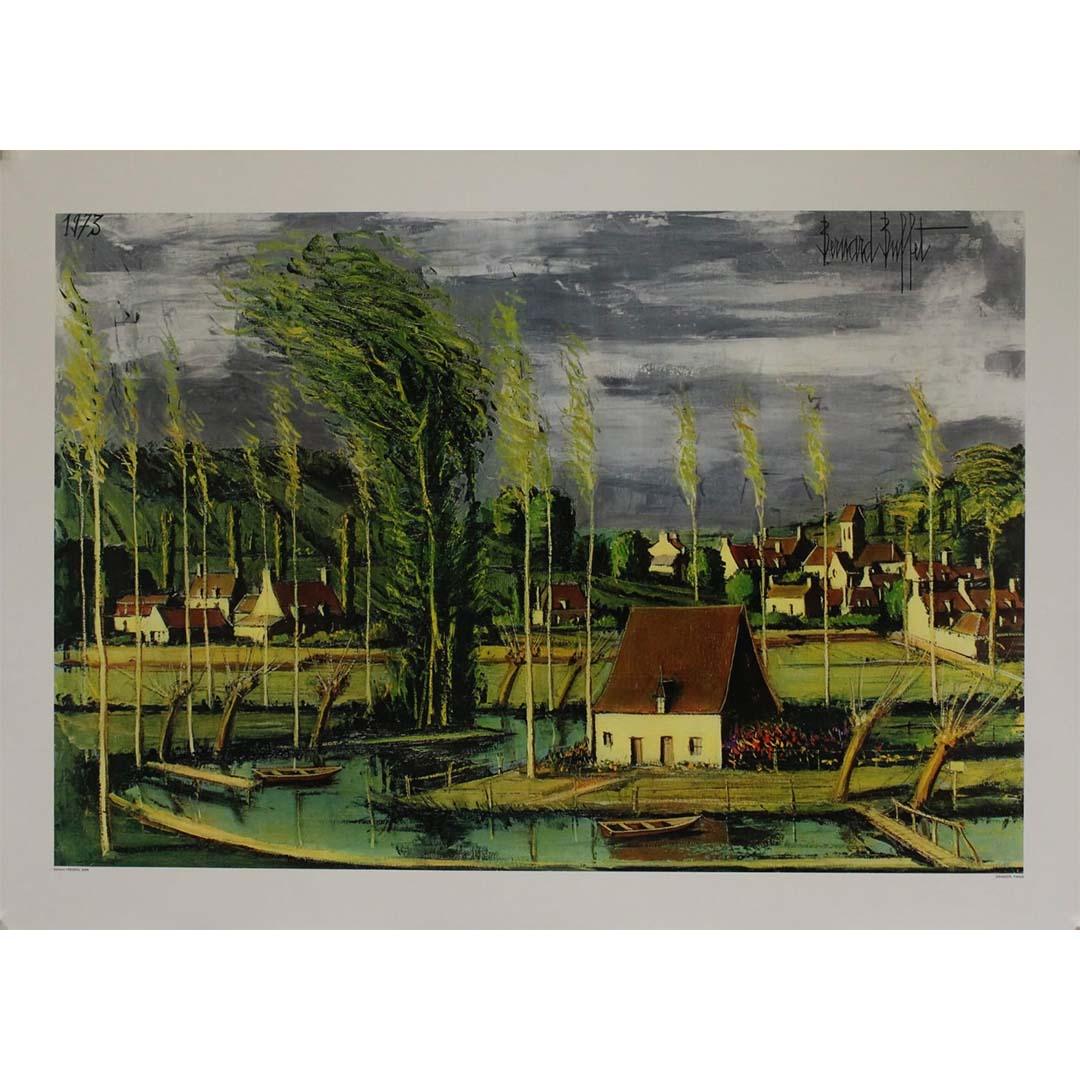
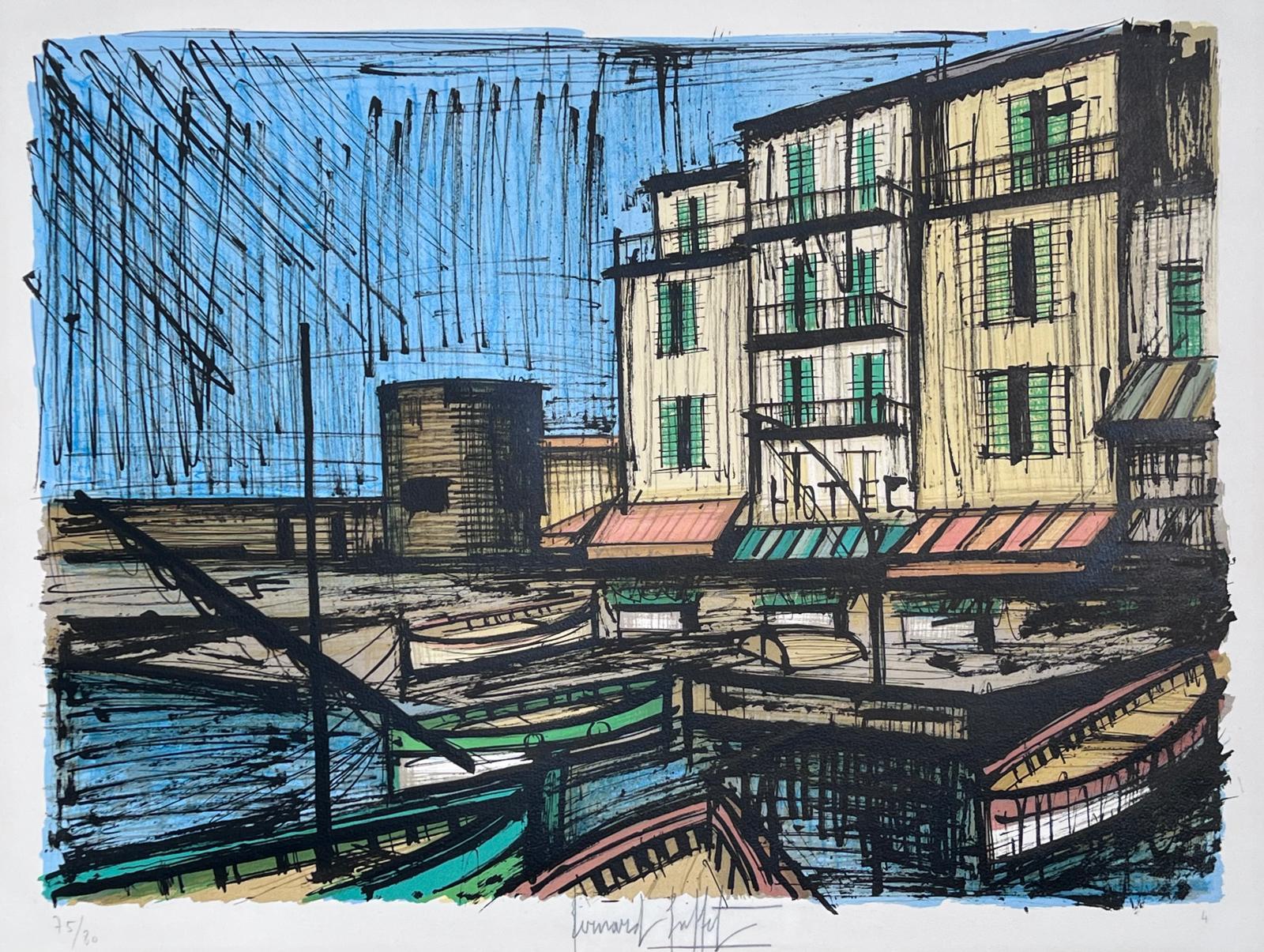
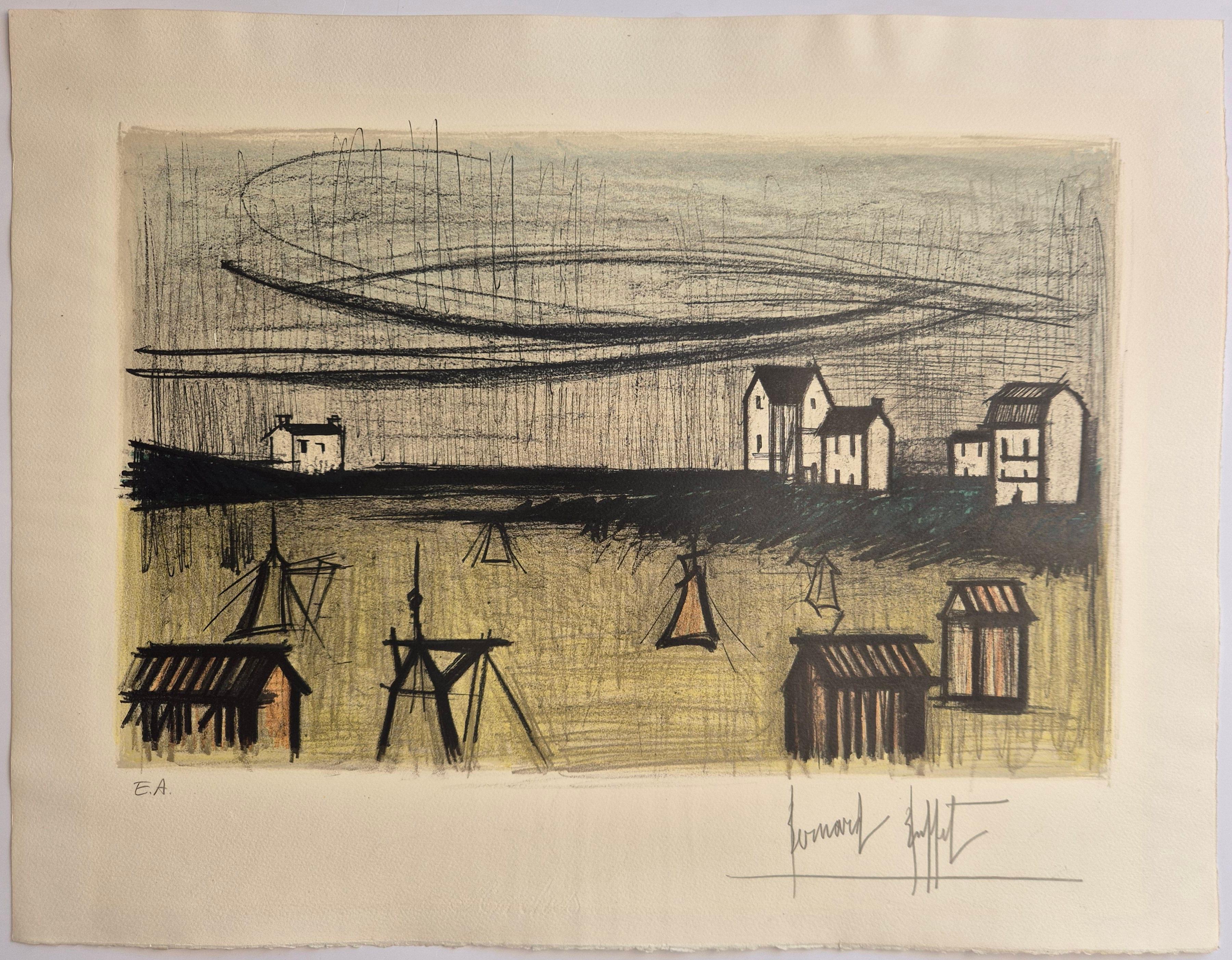
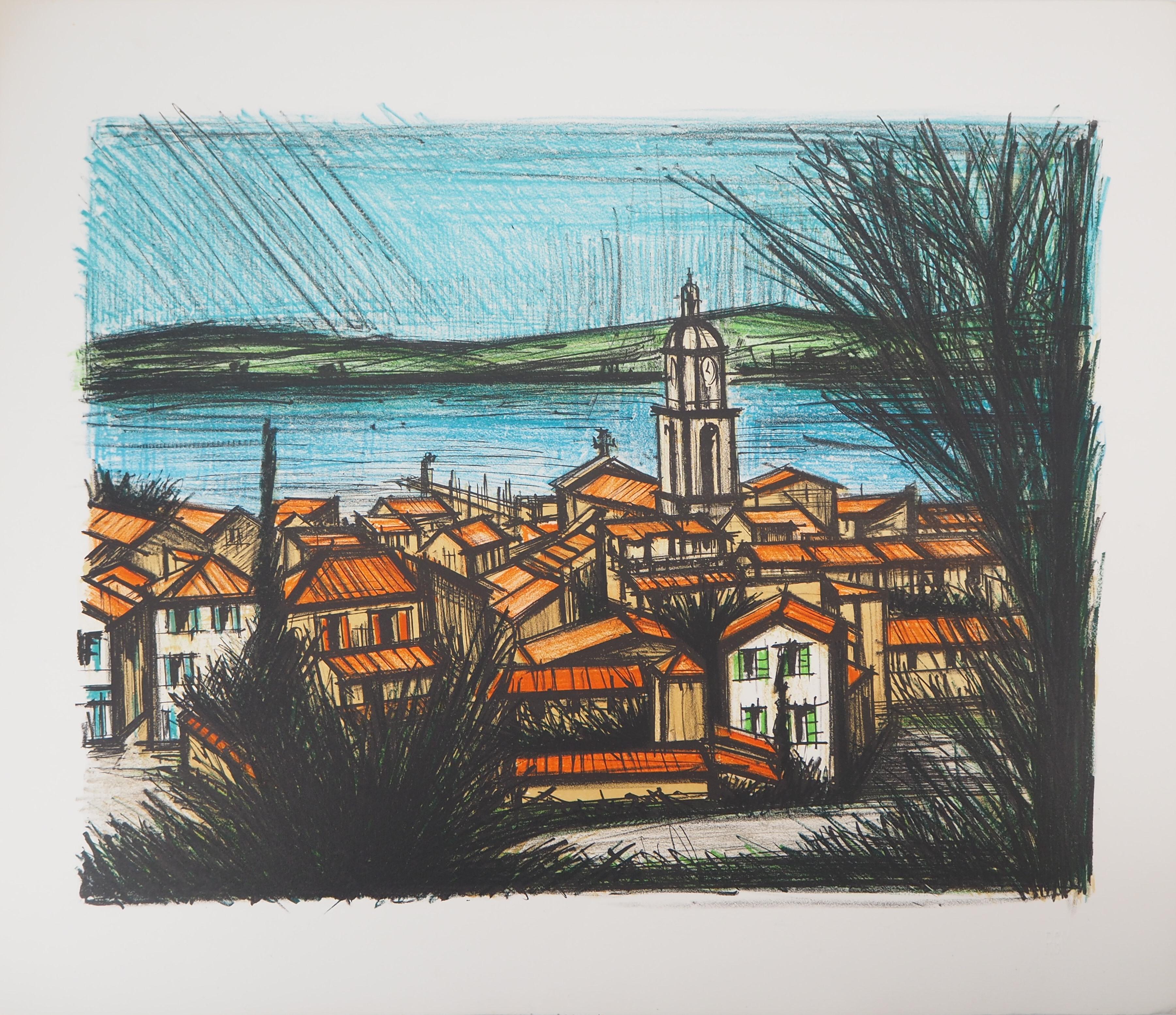
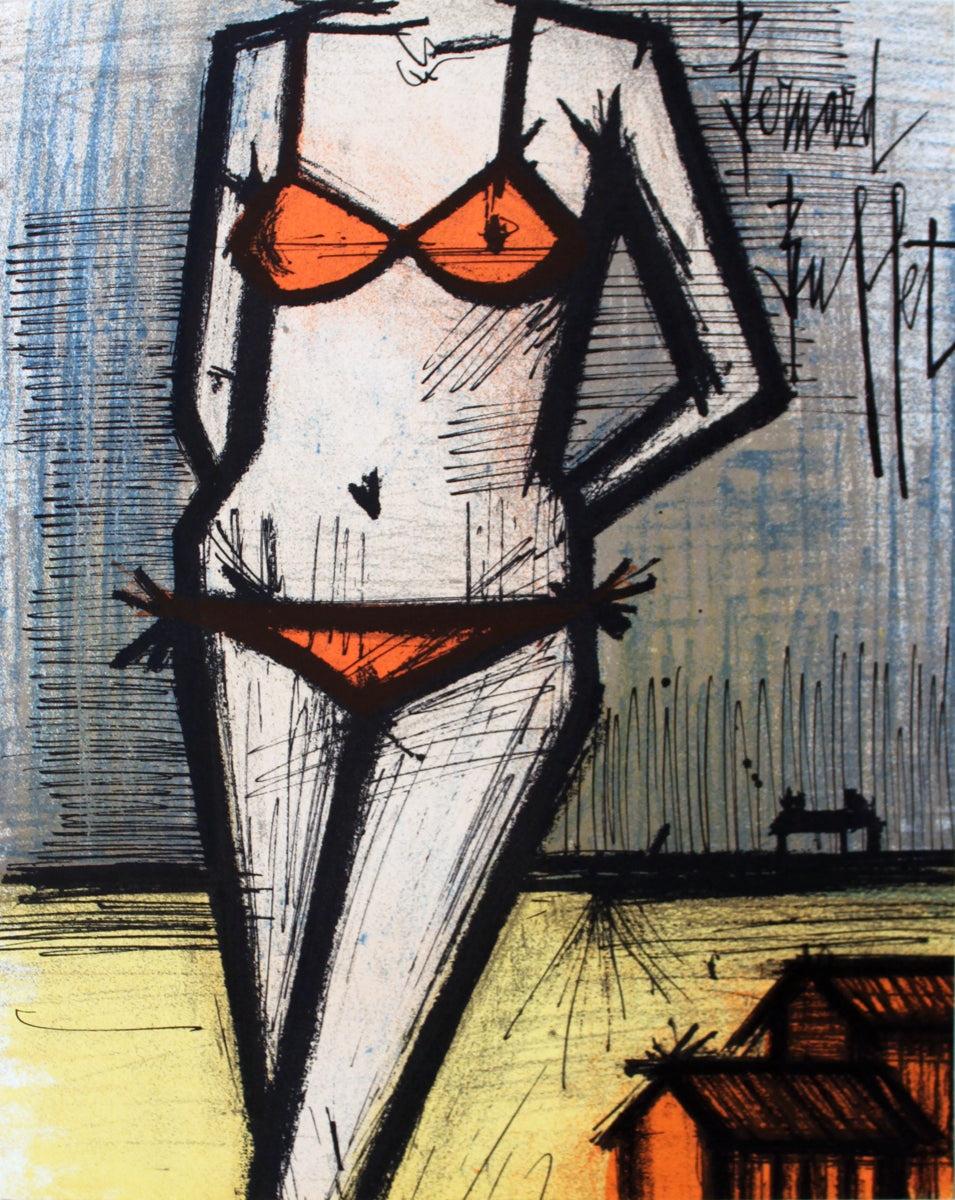
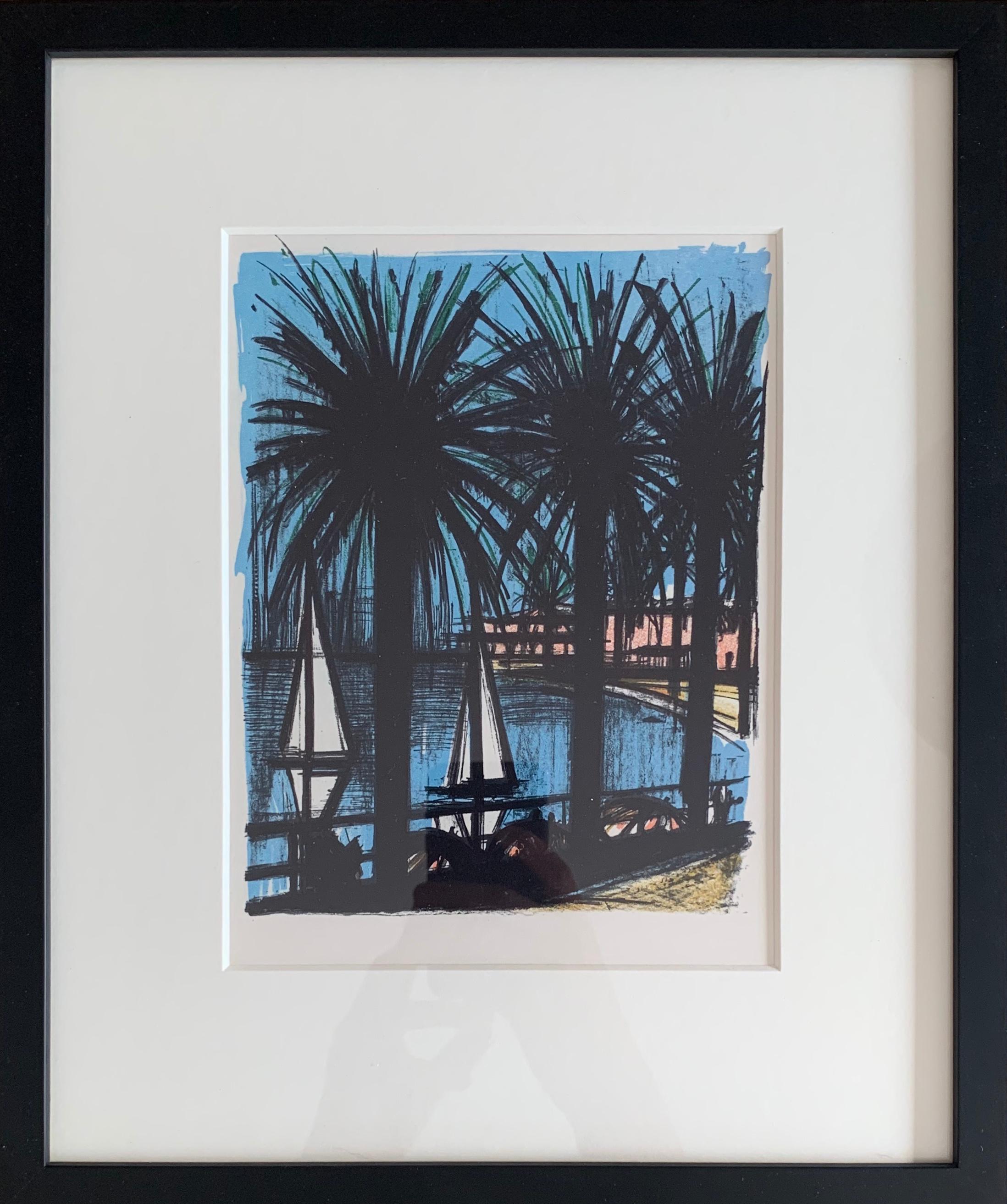
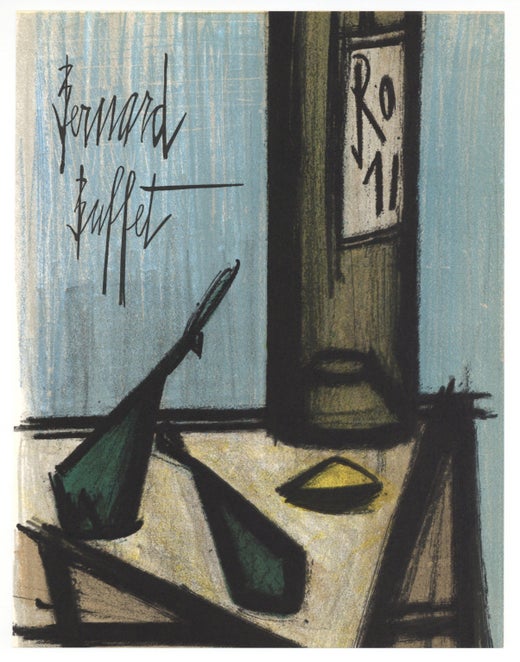
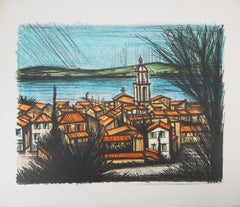
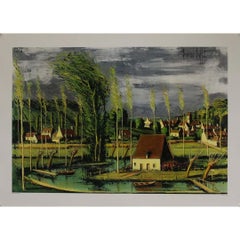
This exquisite lithograph by Bernard Buffet (1928–1999), titled Saint-Tropez (Saint-Tropez), originates from the 1979 album Bernard Buffet, Lithographe I (Bernard Buffet, Lithographer I), published by Editions Michele Trinckvel, Paris, and Draeger, Paris, and printed by maitre imprimeur Draeger, Paris, October 1979. The composition exemplifies Buffet’s austere linear precision and restrained palette, translating a celebrated Mediterranean setting into a stark, architectonic vision marked by tension, clarity, and emotional restraint.
Executed as a lithograph on velin paper, this work measures 12.5 x 9.25 inches (31.75 x 23.5 cm). Unsigned and unnumbered as issued. Printed by Draeger, Paris, one of the most respected Parisian fine art printing houses of the twentieth century.
Artwork Details:
Artist: Bernard Buffet (1928–1999)
Title: Saint-Tropez (Saint-Tropez), from Bernard Buffet, Lithographe I (Bernard Buffet, Lithographer I), 1979
Medium: Lithograph on velin paper
Dimensions: 12.5 x 9.25 inches (31.75 x 23.5 cm)
Inscription: Unsigned and unnumbered as issued
Date: 1979
Publisher: Editions Michele Trinckvel, Paris; Draeger, Paris
Printer: maitre imprimeur Draeger, Paris
Catalogue raisonne reference: Buffet, Bernard, and Charles Sorlier. Bernard Buffet: Lithographe I-II. M. Trinckvel, 1979-1987, illustration 299-301
Condition: Well preserved, consistent with age and medium
Provenance: From the 1979 album Bernard Buffet, Lithographe I (Bernard Buffet, Lithographer I), published by Editions Michele Trinckvel, Paris, and Draeger, Paris
Notes:
Excerpted from the album (translated from French), Finished printing in October 1979 on the presses of Draeger, maitre imprimeur in Paris.
About the Publication:
Bernard Buffet, Lithographe I, issued in 1979 under the direction of Editions Michele Trinckvel in collaboration with Draeger, Paris, represents one of the most authoritative printed surveys of Buffet’s graphic work. Conceived as a comprehensive presentation of his lithographic production, the album reflects the rigorous standards of Parisian printmaking at the close of the twentieth century, emphasizing fidelity to line, tonal clarity, and disciplined composition. Draeger’s technical expertise ensured exceptional consistency across impressions, preserving the stark intensity and architectural precision that define Buffet’s imagery. The album occupies a central place within Buffet’s printed oeuvre and remains a cornerstone reference for collectors and scholars of postwar figurative modernism.
About the Artist:
Bernard Buffet (1928–1999) was a French painter and printmaker whose unmistakable linear style, technical precision, and emotional intensity made him one of the most influential and prolific artists of the 20th century. Born in Paris, Buffet entered the Ecole Nationale Superieure des Beaux-Arts at fifteen and soon developed a visual language defined by taut black outlines, muted tones, and haunting stillness that reflected the existential climate of postwar Europe. Influenced by Pablo Picasso, Alexander Calder, Alberto Giacometti, Salvador Dali, Joan Miro, Wassily Kandinsky, Marcel Duchamp, and Man Ray, Buffet forged a path that blended classical rigor with modern expression. Emerging in the late 1940s as a prodigy of French modernism, he rose to fame after his work L’Homme accoude was acquired by the Musee National d’Art Moderne, and by his early twenties, he was being heralded as a successor to Picasso. His stark depictions of Parisian streets, still lifes, religious scenes, clowns, and self-portraits embodied the human struggle with isolation and resilience, capturing the postwar spirit with both intellect and empathy. Buffet’s disciplined draftsmanship, emotional gravity, and refusal to abandon figuration during the dominance of abstraction set him apart from his contemporaries and aligned him with the existentialism of Jean-Paul Sartre and Albert Camus. Throughout the 1950s and 1960s, he achieved international acclaim, exhibiting across Europe, America, and Asia, and in 1955 won the Prix de la Critique. His prolific output over thousands of works spanning painting, lithography, and illustration combined architectural order with psychological depth. A polarizing figure in his lifetime, Buffet was celebrated by collectors and the public for his expressive honesty, while critics debated his commercial success. In 1973, the Musee Bernard Buffet was founded in Surugadaira, Japan, housing thousands of his works and confirming his global legacy. His art remains in major museum collections including the Centre Pompidou, the Tate, and MoMA. His highest auction record was achieved by Le Cirque (1961), which sold for 13.6 million USD at Christie’s, Hong Kong, on May 26, 2022, reaffirming his status as one of the most distinctive and collectible painters of the modern era.
Bernard Buffet lithograph, Saint-Tropez, Buffet Lithographe I, Buffet Trinckvel, Buffet Draeger, Buffet 1979 lithograph, Buffet velin paper, Buffet collectible lithograph.